MARKET INSIGHTS
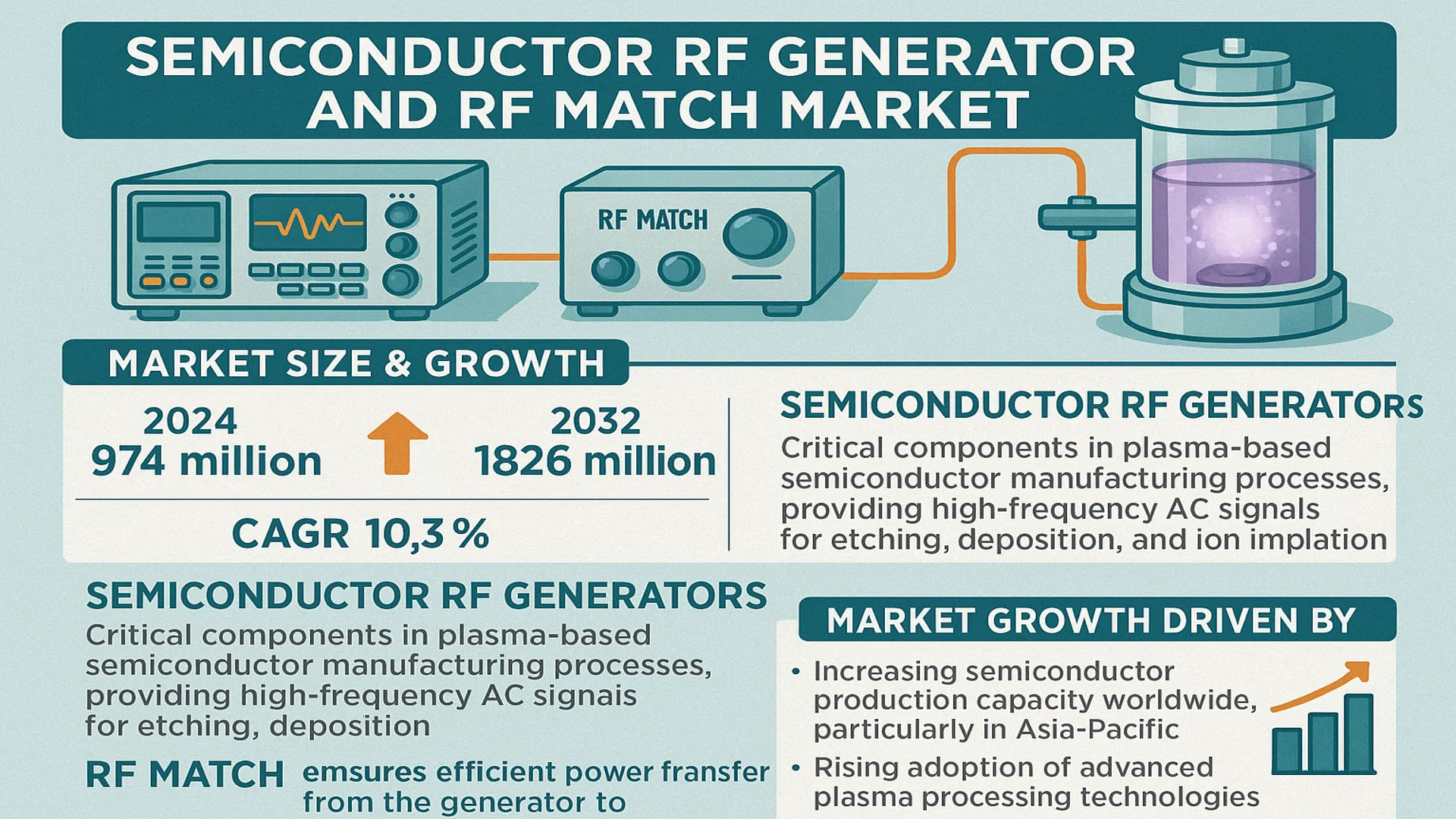
The global Semiconductor RF Generator and RF Match Market was valued at 974 million in 2024 and is projected to reach US$ 1826 million by 2032, at a CAGR of 10.3% during the forecast period.
Semiconductor RF Generators are critical components in plasma-based semiconductor manufacturing processes, providing high-frequency AC signals for etching, deposition, and ion implantation. An RF Match ensures efficient power transfer from the generator to the plasma chamber by minimizing impedance mismatches. These systems play a pivotal role in semiconductor fabrication, photovoltaic applications, and other advanced manufacturing processes.
The market growth is driven by increasing semiconductor production capacity worldwide, particularly in Asia-Pacific, and the rising adoption of advanced plasma processing technologies. While demand for RF generators remains strong in traditional semiconductor applications, emerging photovoltaic manufacturing presents new growth opportunities. Key players like Advanced Energy, MKS Instruments, and DAIHEN Corporation are investing in technological advancements to improve power efficiency and process control, further propelling market expansion.
MARKET DYNAMICS
MARKET DRIVERS
Expansion of Semiconductor Manufacturing Capacities Fuels RF Generator Demand
The global semiconductor industry continues to expand rapidly, requiring advanced fabrication tools to meet increasing production demands. RF generators and matching networks serve as critical components in plasma-based semiconductor processing equipment used for deposition, etching, and cleaning operations. With semiconductor foundries collectively investing over $120 billion annually in new fabrication facilities, the demand for reliable RF power sources has grown proportionally. Advanced node development below 7nm requires precise RF control, further driving adoption of high-performance generators with enhanced stability and tunability.
Transition to AI-Optimized Chip Architectures Accelerates Market Growth
Artificial intelligence and machine learning applications require specialized semiconductor designs that leverage three-dimensional structures and new materials. These architectures demand more sophisticated plasma processing techniques, where RF generators with wider frequency ranges and faster tuning capabilities become essential. The AI chip market is projected to maintain 35% annual growth through 2030, directly increasing requirements for RF power solutions that can handle complex thin film deposition on novel substrate materials. Manufacturers are responding with frequency-agile generators capable of operating across multiple bands with minimal reflected power.
Government Investments in Domestic Semiconductor Production Strengthen Market Position
National semiconductor self-sufficiency initiatives have created substantial momentum for equipment suppliers. The global semiconductor RF generator and match market benefits directly from policies like the U.S. CHIPS Act and Europe’s Chips Act which collectively allocate over $100 billion for domestic manufacturing expansion. These investments specifically target advanced packaging and compound semiconductor facilities, sectors that extensively utilize RF plasma processing. Equipment orders from new fabrication plants under construction have already increased 42% year-over-year, with RF subsystems representing approximately 15-20% of total tool costs.
MARKET RESTRAINTS
Technical Complexity in Advanced Node Processing Constrains Adoption
While semiconductor manufacturing progresses to 3nm nodes and beyond, RF power delivery systems face escalating technical challenges. Matching network designs must compensate for nonlinear plasma impedance characteristics that become more pronounced with smaller features. This requires highly specialized engineering expertise that remains scarce across the industry. The time required to develop and qualify these advanced RF solutions can delay production ramps by 6-12 months, creating bottlenecks for device manufacturers attempting to maintain technology leadership.
Supply Chain Vulnerabilities for Critical Components Limit Production Capacity
RF generator manufacturers depend on specialized components including high-power RF transistors and precision capacitors that face supply constraints. Several key materials originate from geographically concentrated suppliers, creating vulnerability to disruptions. The industry average lead time for these components has extended to 26-32 weeks, nearly doubling pre-pandemic levels. Manufacturers attempting to dual-source or redesign around constrained parts incur substantial qualification costs while facing 15-20% higher material expenses that negatively impact margins.
MARKET CHALLENGES
Meeting Stringent Fab Requirements Demands Continuous R&D Investment
Semiconductor fabs impose increasingly rigorous specifications for RF system stability, reliability, and mean time between failures (MTBF). Maintaining consistency across 10,000-hour operational cycles requires extensive qualification testing and refined manufacturing processes. Leading manufacturers allocate 12-15% of annual revenues to R&D to keep pace, a significant burden for smaller suppliers. The capital intensity of developing next-generation RF solutions creates barriers for new market entrants while pressuring incumbent profit margins.
MARKET OPPORTUNITIES
Emerging Compound Semiconductor Applications Open New Growth Avenues
Gallium nitride (GaN) and silicon carbide (SiC) device manufacturing presents a high-growth segment for RF power solutions. These materials require specialized plasma processing at higher frequencies (typically 13.56MHz to 60MHz) and power levels. The power electronics market for these devices is forecast to expand at 22% CAGR through 2030, creating parallel demand for compatible RF generators. Early movers developing purpose-built RF systems for these materials have captured premium pricing with gross margins exceeding 45%, compared to 30-35% for silicon-focused products.
Service and Refurbishment Market Offers Stable Revenue Streams
As installed base of RF systems grows beyond 100,000 units globally, aftermarket services become increasingly attractive. Refurbishment and upgrades of existing RF generators now represent 18-22% of total market revenue, with particularly strong demand in mature semiconductor manufacturing regions. This segment provides stability against cyclical equipment purchases, with service contracts typically delivering 60-65% gross margins. Leading suppliers are expanding predictive maintenance capabilities using IoT-enabled monitoring to further strengthen recurring revenue models.
SEMICONDUCTOR RF GENERATOR AND RF MATCH MARKET TRENDS
Advancements in Semiconductor Manufacturing Technologies to Drive Market Growth
The semiconductor industry is witnessing a surge in demand for advanced RF generators and matching networks due to the rapid adoption of cutting-edge fabrication techniques. As the global market for semiconductors expands, RF power solutions are becoming increasingly critical in processes such as plasma etching and thin-film deposition. The sector is expected to grow at a compound annual growth rate (CAGR) of 10.3%, reaching approximately $1.8 billion by 2032, driven by innovations in 5G technology, AI chip production, and the miniaturization of semiconductor components. Furthermore, semiconductor manufacturers are increasingly adopting high-power and high-frequency RF generators to enhance process precision and yield rates in advanced node production.
Other Trends
Expansion of Power Electronics and Photovoltaic Applications
The growth of power electronics and photovoltaic industries is accelerating the demand for RF generators and matching networks. Increased investment in renewable energy infrastructure, particularly in solar cell manufacturing, has necessitated highly efficient RF power solutions for deposition processes such as plasma-enhanced chemical vapor deposition (PECVD). Additionally, the rising adoption of gallium nitride (GaN) and silicon carbide (SiC) technologies in power devices is further fueling the need for high-performance RF generators capable of delivering stable power delivery at higher frequencies.
Growing Integration of Automation in RF Matching Networks
Industry players are increasingly incorporating automation and artificial intelligence into RF matching networks to optimize impedance tuning, reduce power reflections, and improve process repeatability. Automated impedance-matching solutions are becoming essential in high-volume semiconductor manufacturing, where slight deviations can result in costly inefficiencies. Leading manufacturers such as Advanced Energy and MKS Instruments are introducing smart matching networks with predictive maintenance capabilities, reducing downtime and enhancing productivity. This trend is reinforced by the growing complexity of fabrication processes, where tighter tolerances require more adaptive and intelligent RF power delivery.
COMPETITIVE LANDSCAPE
Key Industry Players
Leading Companies Drive Innovation in Semiconductor RF Power Solutions
The global semiconductor RF generator and RF match market exhibits a moderately consolidated landscape, dominated by established players with strong technological expertise and geographic reach. Advanced Energy and MKS Instruments currently lead the market, collectively accounting for a significant portion of 2024 revenue. Their dominance stems from decades of experience in plasma processing technologies and extensive R&D investments exceeding $100 million annually.
DAIHEN Corporation and COMET Group have emerged as formidable competitors, particularly in the Asian markets where semiconductor manufacturing is experiencing rapid growth. Both companies have demonstrated consistent 7-9% year-over-year revenue growth through strategic collaborations with foundries and equipment manufacturers.
The market also features several specialized players who compete through product differentiation. New Power Plasma has gained recognition for its high-efficiency matching networks, while YOUNGSIN-RF specializes in cost-effective solutions for emerging markets. These companies are actively expanding their manufacturing capabilities to meet the growing demand from photovoltaic and compound semiconductor applications.
Market leaders are accelerating innovation cycles to maintain competitive advantage, with recent developments including:
- Advanced Energy’s 2023 launch of the ‘Navigator’ series featuring AI-driven impedance matching
- MKS Instruments’ acquisition of a European plasma tech firm to bolster its RF match portfolio
- DAIHEN’s strategic partnership with a leading Chinese semiconductor equipment manufacturer
While the top players control significant market share, the competitive landscape remains dynamic due to:
- Increasing demand for specialized RF solutions in advanced packaging
- Emergence of new materials requiring unique plasma processing parameters
- Growing emphasis on energy-efficient RF power delivery systems
This environment creates opportunities for both established firms and innovative startups to gain market traction.
List of Key Semiconductor RF Generator and RF Match Companies
- Advanced Energy (U.S.)
- MKS Instruments (U.S.)
- DAIHEN Corporation (Japan)
- COMET Group (Switzerland)
- New Power Plasma (South Korea)
- YOUNGSIN-RF Co., Ltd (South Korea)
- XP Power (UK/Singapore)
- TruPlasma (Germany)
- ULVAC (Japan)
- Adtec Plasma Technology (Japan)
- KYOSAN Electric Manufacturing Co., Ltd (Japan)
- RF Power Tech (U.S.)
Segment Analysis:
By Type
RF Generator Segment Dominates Due to Critical Role in Plasma Processing and Semiconductor Fabrication
The market is segmented based on type into:
- RF Generator
- Subtypes: Solid-State RF Generators, Tube-Based RF Generators, and others
- RF Match
By Application
Semiconductor Segment Holds Major Share Owing to Extensive Use in Chip Manufacturing Processes
The market is segmented based on application into:
- Semiconductor
- Photovoltaic
- Others
By Frequency Range
Medium Frequency (13.56 MHz) Segment Leads Due to Widespread Industrial Adoption
The market is segmented based on frequency range into:
- Low Frequency (Below 1 MHz)
- Medium Frequency (1-50 MHz)
- Subtypes: 13.56 MHz, 27.12 MHz, and others
- High Frequency (Above 50 MHz)
By Technology
Automatic Matching Segment Gains Traction Due to Demand for Process Stability
The market is segmented based on technology into:
- Manual Matching
- Automatic Matching
- Semi-Automatic Matching
Regional Analysis: Semiconductor RF Generator and RF Match Market
Asia-Pacific
The Asia-Pacific region dominates the global Semiconductor RF Generator and RF Match market, accounting for the largest revenue share due to rapid semiconductor manufacturing growth in China, South Korea, Taiwan, and Japan. China’s semiconductor industry, supported by substantial government investments in domestic production capabilities, drives demand for advanced RF solutions. Taiwan’s TSMC and South Korea’s Samsung remain key consumers of RF generators for cutting-edge wafer fabrication. While Japan retains technological leadership in precision components, cost competitiveness from Chinese suppliers is reshaping procurement strategies. The rise of 5G and IoT applications further accelerates adoption, though geopolitical tensions and export controls create supply chain uncertainties.
North America
Home to semiconductor equipment leaders like MKS Instruments and Advanced Energy, North America maintains strong innovation in high-power RF technologies for advanced nodes below 7nm. The region benefits from substantial R&D investments in AI and quantum computing applications. Recent U.S. CHIPS Act funding of $52 billion for domestic semiconductor production is expected to bolster equipment demand through 2030. However, strict export regulations on advanced RF systems to certain markets create both opportunities and challenges for manufacturers navigating compliance requirements.
Europe
Europe’s market growth stems from specialized semiconductor applications in automotive and industrial sectors, with Germany’s Infineon and Netherlands’ ASML driving demand for precision RF matching networks. The region shows increasing preference for energy-efficient RF solutions aligned with EU sustainability directives. While lacking large-scale foundries compared to Asia, Europe excels in niche applications like compound semiconductors for power electronics. Collaborative R&D initiatives between academia and companies like Comet Group foster innovation, though reliance on imports for some components persists.
South America
The semiconductor equipment market remains nascent across most South American countries. Brazil shows potential with sporadic investments in electronics manufacturing, primarily serving domestic consumer markets. Limited local semiconductor production capacity results in modest demand for RF generators, mainly for maintenance and small-scale research applications. Economic instability and import dependency hinder market expansion, though increasing foreign investment in Mexico’s automotive electronics sector offers promising opportunities for RF equipment suppliers.
Middle East & Africa
This emerging market sees gradual growth through technology transfer initiatives in countries like Israel and UAE. Israel’s strong tech ecosystem drives specialized demand for RF systems in semiconductor-based security and communications applications. While lacking semiconductor fabrication bases, the region increasingly adopts advanced manufacturing technologies through strategic partnerships. Infrastructure development programs across Gulf nations may stimulate downstream demand, though market expansion remains constrained by technical expertise gaps and limited local manufacturing capabilities.
Report Scope
This market research report provides a comprehensive analysis of the global Semiconductor RF Generator and RF Match market, covering the forecast period 2025–2032. It offers detailed insights into market dynamics, technological advancements, competitive landscape, and key trends shaping the industry.
Key focus areas of the report include:
- Market Size & Forecast: Historical data and future projections for revenue, unit shipments, and market value across major regions and segments. The global Semiconductor RF Generator and RF Match market was valued at USD 974 million in 2024 and is projected to reach USD 1,826 million by 2032, growing at a CAGR of 10.3%.
- Segmentation Analysis: Detailed breakdown by product type (RF Generator, RF Match), application (Semiconductor, Photovoltaic, Others), and end-user industry to identify high-growth segments and investment opportunities.
- Regional Outlook: Insights into market performance across North America, Europe, Asia-Pacific, Latin America, and the Middle East & Africa, including country-level analysis. The U.S. market is estimated at significant value in 2024, while China is projected for strong growth.
- Competitive Landscape: Profiles of leading market participants including Comet, KYOSAN, XP Power, ASE, Advanced Energy, MKS Instrument, DAIHEN Corporation, and others, covering their product offerings, R&D focus, and recent developments.
- Technology Trends & Innovation: Assessment of emerging RF technologies, integration with semiconductor manufacturing processes, and evolving industry standards for plasma processing applications.
- Market Drivers & Restraints: Evaluation of factors driving market growth along with challenges such as supply chain constraints, regulatory issues, and technological barriers in semiconductor fabrication.
- Stakeholder Analysis: Insights for component suppliers, semiconductor manufacturers, OEMs, investors, and policymakers regarding the evolving RF power systems ecosystem.
Primary and secondary research methods are employed, including interviews with industry experts, data from verified sources, and real-time market intelligence to ensure the accuracy and reliability of the insights presented.
FREQUENTLY ASKED QUESTIONS:
What is the current market size of Global Semiconductor RF Generator and RF Match Market?
-> Semiconductor RF Generator and RF Match Market was valued at 974 million in 2024 and is projected to reach US$ 1826 million by 2032, at a CAGR of 10.3% during the forecast period.
Which key companies operate in this market?
-> Key players include Comet, KYOSAN, XP Power, ASE, Advanced Energy, MKS Instrument, DAIHEN Corporation, Pearl Kogyo, and New Power Plasma, among others.
What are the key growth drivers?
-> Key growth drivers include increasing semiconductor manufacturing, demand for advanced RF power solutions, and expansion of photovoltaic applications.
Which region dominates the market?
-> Asia-Pacific is the fastest-growing region due to semiconductor industry expansion, while North America remains a technology leader.
What are the emerging trends?
-> Emerging trends include higher frequency RF generators, advanced matching network technologies, and integration with Industry 4.0 systems.

Get Sample Report PDF for Exclusive Insights
Report Sample Includes
- Table of Contents
- List of Tables & Figures
- Charts, Research Methodology, and more...