MARKET INSIGHTS
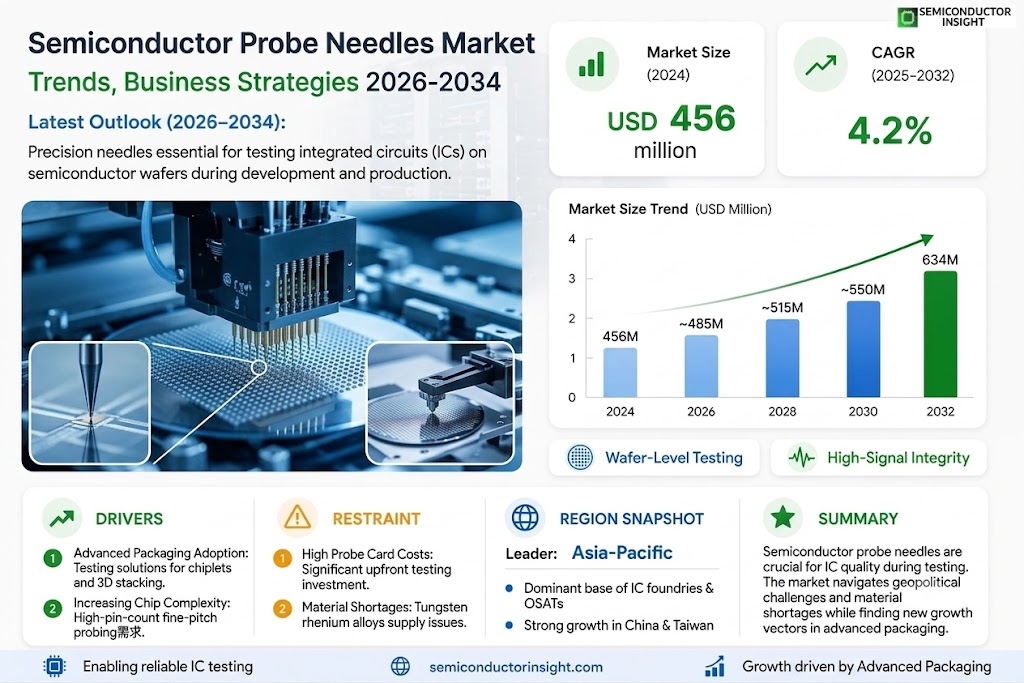
The global Semiconductor Probe Needles Market size was valued at US$ 456 million in 2024 and is projected to reach US$ 634 million by 2032, at a CAGR of 4.2% during the forecast period 2025-2032.
Semiconductor probe needles, also known as probe tips or needle probes, are precision components used for electrical testing of semiconductor devices. These needles come in various materials (tungsten, beryllium copper, and palladium alloys), lengths, and tip geometries to enable accurate contact with microscopic test points on wafers and ICs. They are critical for wafer sorting, final testing, and failure analysis in semiconductor manufacturing.
The market growth is driven by increasing semiconductor production, with the global semiconductor industry valued at USD 579 billion in 2022 and projected to reach USD 790 billion by 2029. While memory segments face volatility, analog ICs and sensors show robust 20.76% and 16.31% growth respectively, creating sustained demand for advanced probing solutions. The proliferation of IoT devices and automotive semiconductors further accelerates adoption, though material cost fluctuations present pricing challenges. Key players like Tecdia and Micromanipulator are expanding their portfolios with high-frequency and MEMS-compatible probe solutions to address evolving industry requirements.
MARKET DYNAMICS
MARKET DRIVERS
Expansion of Semiconductor Testing Infrastructure to Fuel Demand for Probe Needles
The semiconductor probe needles market is experiencing robust growth driven by the rapid expansion of global semiconductor testing infrastructure. As chip complexity increases with advanced nodes below 5nm, the need for precision testing solutions has never been greater. Leading foundries are investing heavily in new testing facilities, with global semiconductor equipment spending projected to exceed $100 billion annually by 2025. This expansion directly translates to higher demand for probe needles, which serve as critical components in wafer probe stations.
Growth of Automotive Electronics to Accelerate Market Expansion
The automotive sector’s increasing reliance on semiconductor content is creating significant opportunities for probe needle manufacturers. Modern vehicles now incorporate over 3,000 chips for applications ranging from ADAS systems to infotainment, with semiconductor content per vehicle expected to double by 2030. This surge requires rigorous testing at every production stage, particularly for safety-critical components. Probe needles must meet stringent automotive-grade reliability standards, driving innovation in materials and designs.
➤ The transition to 300mm wafer testing is creating new demand patterns, with probe card requirements expected to grow at 8-10% annually through 2030 to support advanced packaging technologies.
Furthermore, the proliferation of 5G infrastructure and IoT devices is generating additional testing requirements across RF and mixed-signal applications. These market segments demand specialized probe needles capable of handling high-frequency signals while maintaining precise contact resistance.
MARKET RESTRAINTS
Precision Requirements and Manufacturing Complexities to Constrain Market Growth
While demand grows, the semiconductor probe needles market faces significant technical constraints. The transition to advanced nodes below 7nm requires probe tips with diameters below 10µm and positioning accuracy measured in nanometers. Achieving such precision consistently across mass production represents a substantial technical challenge. Yield rates for ultra-fine pitch probe needles typically range between 60-75%, creating cost pressures across the supply chain.
Other Constraints
Material Limitations
The search for optimal materials balancing conductivity, durability and cost continues to pose challenges. While beryllium copper remains prevalent for many applications, its rising cost and environmental concerns are pushing manufacturers toward alternative alloys with differing performance characteristics.
Testing Throughput Demands
The need for faster test times conflicts with the physical limitations of probe needle technology. As wafer test times decrease to maintain profitability, the mechanical wear characteristics of probe materials become increasingly critical, with some advanced nodes requiring needle replacement after just 50,000 touchdowns.
MARKET CHALLENGES
Supply Chain Fragility and Geopolitical Factors to Challenge Market Stability
The semiconductor probe needle market faces mounting challenges from global supply chain disruptions. Specialized materials like tungsten rhenium alloys face periodic shortages, with lead times extending beyond six months during peak demand cycles. These disruptions create pricing volatility, with material costs fluctuating up to 30% year-over-year for critical components. Geopolitical tensions further complicate procurement strategies, particularly for manufacturers relying on single-source suppliers.
Other Challenges
Technological Obsolescence
The rapid pace of semiconductor innovation creates constant pressure to develop new probe solutions. R&D cycles that previously spanned years now compress to months, with probe needle designs sometimes becoming obsolete before achieving full production ramp.
Talent Shortages
The specialized nature of probe needle manufacturing has created acute skill gaps. With an estimated 35% of experienced technicians approaching retirement, the industry faces a critical knowledge transfer challenge that could impact quality consistency.
MARKET OPPORTUNITIES
Emerging Advanced Packaging Technologies to Create New Growth Vectors
The semiconductor probe needle market stands to benefit significantly from the rise of advanced packaging technologies. Heterogeneous integration approaches like chiplets and 3D stacking require innovative testing solutions, with the advanced packaging equipment market projected to grow at 15% CAGR through 2030. These technologies demand probe needles capable of handling ultra-fine pitch interconnects while accommodating thermal management challenges.
Meanwhile, the expansion of compound semiconductor testing for 5G and power electronics presents another substantial opportunity. GaN and SiC devices require specialized probe configurations to handle higher voltages and temperatures, creating demand for novel material formulations and tip geometries.
➤ Recent developments in MEMS probe technology demonstrate potential for 10x improvement in touchdown life compared to traditional needle designs, offering significant total cost of ownership advantages for high-volume test operations.
Furthermore, the integration of AI-driven predictive maintenance systems for probe card management is opening new service-based revenue streams. These solutions can extend needle life by 20-30% while reducing unplanned downtime, creating strong value propositions for test-intensive applications.
SEMICONDUCTOR PROBE NEEDLES MARKET TRENDS
Increasing Complexity in Semiconductor Testing to Drive Probe Needle Demand
The semiconductor industry’s rapid transition to advanced process nodes below 5nm is significantly increasing the demand for precision probe needles. As chip architectures become more complex with 3D stacking and multi-chiplet designs, test requirements have grown exponentially. Manufacturers are responding with ultra-fine probe needles featuring tip radii as small as 5-10 micrometers to accommodate shrinking pad pitches. The market for advanced probe needles is projected to grow at a CAGR of approximately 7% through 2032, outpacing broader semiconductor equipment growth. Novel materials like tungsten-rhenium alloys are gaining traction due to their enhanced durability under high-frequency testing conditions exceeding 10 GHz.
Other Trends
Automation in Wafer-Level Testing
The semiconductor industry’s push toward fully automated test cells is reshaping probe needle requirements. Modern automated test equipment (ATE) systems now integrate advanced probe cards with thousands of needles, driving demand for highly uniform needle arrays with positional accuracy within ±1 micron. This trend is particularly evident in memory testing applications where parallel testing of multiple devices requires perfect needle co-planarity. The global wafer probing equipment market, where probe needles play a critical role, is expected to reach $1.8 billion by 2027, reflecting increased automation adoption across foundries and IDMs.
Material Innovations Addressing Wear Challenges
With semiconductor test cycles becoming more rigorous, probe needle durability has emerged as a key industry challenge. Manufacturers are responding with innovative material solutions: nickel-palladium coatings now demonstrate 5-7 times longer lifespan than traditional nickel alloys in high-current applications. The development of composite materials combining tungsten carbide cores with specialized coatings has reduced contact resistance drift by 40-50% over conventional designs. These material advancements are critical as semiconductor testing moves toward higher pin counts and increased contact forces, with some advanced packaging applications requiring contact pressures exceeding 10 grams per needle.
COMPETITIVE LANDSCAPE
Key Industry Players
Leading Companies Invest in Precision Engineering to Capture Market Share
The Semiconductor Probe Needles Market is characterized by a mix of established manufacturers and emerging niche players, with competition intensifying due to rising demand for wafer testing and sorting applications. Tecdia Inc. emerges as a dominant player, leveraging its patented tungsten-carbide needle technology that offers superior durability and conductivity for high-frequency semiconductor testing. The company held approximately 18% revenue share in 2024, according to industry benchmarks.
Micromanipulator and SemiProbe follow closely, collectively accounting for nearly 25% of the global market. Their strength lies in customized probe solutions for advanced packaging applications, including 3D IC testing – a segment growing at 9.2% CAGR due to increasing heterogenous integration in chips.
Strategic moves are reshaping the competitive dynamics, with Heraeus recently acquiring a specialized probe needle manufacturer to strengthen its materials expertise in precious metal alloys. Meanwhile, Smiths Interconnect is expanding production capacity in Malaysia to serve the booming Southeast Asian semiconductor ecosystem, where probe needle demand grew 14% year-over-year in Q1 2024.
Smaller innovators like Micro to Nano are gaining traction through proprietary coating technologies that extend probe lifespan by 40-60% compared to conventional solutions. This is particularly crucial as foundries push for higher touchdown counts in mass production environments.
List of Key Semiconductor Probe Needle Manufacturers
- Tecdia Inc. (Japan)
- Micromanipulator Co., Inc. (U.S.)
- Micro to Nano (Netherlands)
- SemiProbe LLC (U.S.)
- Heraeus Electronics (Germany)
- McMaster-Carr Supply Co. (U.S.)
- Ted Pella, Inc. (U.S.)
- INGUN Prüfmittelbau GmbH (Germany)
- Organ Needle Co., Ltd. (Japan)
- Suzhou UIGreen Science and Technology (China)
- Smiths Interconnect (UK)
Segment Analysis:
By Type
Spherical Probe Needles Dominate Due to High Precision in Wafer Testing Applications
The market is segmented based on type into:
- Spherical Probe Needles
- Subtypes: Tungsten carbide, Beryllium copper, and others
- Straight Rod Probe Needles
- Subtypes: High-temperature alloys, Coated variants, and others
- Others
By Application
Wafer Testing Segment Leads Owing to Increasing Semiconductor Manufacturing Activities
The market is segmented based on application into:
- Wafer Sorting
- Wafer Testing
- Subtypes: Parametric testing, Functional testing, and others
- Packaging Testing
- Research and Development
- Others
By Material
Tungsten Carbide Gains Preference for Its Durability and Electrical Conductivity
The market is segmented based on material into:
- Tungsten Carbide
- Beryllium Copper
- Palladium Alloys
- Nickel Alloys
- Others
By End User
Semiconductor Foundries Lead Consumption Due to Mass Production Requirements
The market is segmented based on end user into:
- Semiconductor Foundries
- IDMs (Integrated Device Manufacturers)
- Testing Laboratories
- Research Institutions
- Others
Regional Analysis: Semiconductor Probe Needles Market
North America
North America, particularly the United States, dominates the Semiconductor Probe Needles Market due to its robust semiconductor manufacturing ecosystem and high demand for advanced testing solutions. The U.S. is home to leading semiconductor firms like Intel, NVIDIA, and AMD, which continuously drive innovation in wafer testing and sorting technologies. Recent investments, such as the CHIPS and Science Act allocating $52 billion for domestic semiconductor production, further reinforce the demand for precision probe needles. While R&D-intensive applications accelerate the need for high-performance probe tips, the market faces challenges like supply chain constraints for specialized materials such as tungsten and beryllium copper.
Europe
Europe’s market is growing steadily, anchored by automotive and industrial semiconductor applications. Germany, France, and the Netherlands are key contributors, leveraging strong R&D infrastructure and stringent quality standards. The EU’s focus on semiconductor sovereignty, including the Chips Act’s €43 billion investment plan, aims to reduce dependency on foreign supply chains. Local manufacturers are prioritizing durable probe needles capable of handling advanced packaging technologies like fan-out wafer-level packaging (FOWLP). However, market growth in Europe is tempered by slower adoption of cutting-edge nodes compared to Asia-Pacific, with many fabs still operating legacy equipment that uses traditional probing solutions.
Asia-Pacific
Asia-Pacific is the largest and fastest-growing region for Semiconductor Probe Needles, driven by Taiwan, South Korea, and China. Taiwan dominates wafer fabrication (TSMC alone accounts for over 50% of global foundry revenue), necessitating high-volume probe needle consumption for testing Logic, Memory, and Analog ICs. China’s aggressive semiconductor self-sufficiency push has led to new fabs, increasing demand for cost-effective probes. Meanwhile, vertical probe cards—critical for advanced memory testing—are gaining traction in South Korea due to Samsung and SK Hynix’s DRAM/NAND expansion. Price sensitivity remains a challenge, pushing suppliers to optimize manufacturing costs without compromising on performance.
South America
South America’s market is nascent but shows potential due to expanding electronics assembly and testing facilities in Brazil and Mexico. Local demand primarily stems from automotive electronics and consumer device manufacturing, though semiconductor production remains limited. The lack of domestic wafer fabs means most probe needles are imported, creating logistical and cost hurdles. Nevertheless, partnerships with global suppliers and gradual investments in semiconductor infrastructure could unlock long-term opportunities, particularly for mid-range probing solutions suited for legacy nodes.
Middle East & Africa
This region is in the early stages of semiconductor industry development, with the UAE and Israel emerging as focal points. Israel’s thriving fabless ecosystem and R&D hubs (e.g., Intel’s Haifa lab) drive niche demand for high-precision probe needles. In contrast, the UAE’s recent investments in AI and IoT startups could stimulate future testing needs. The broader region’s growth is constrained by limited local manufacturing and reliance on imported semiconductor components, though strategic initiatives like Saudi Arabia’s Vision 2030 may gradually reshape the landscape.
Report Scope
This market research report provides a comprehensive analysis of the Global Semiconductor Probe Needles Market, covering the forecast period 2025–2032. It offers detailed insights into market dynamics, technological advancements, competitive landscape, and key trends shaping the industry.
Key focus areas of the report include:
- Market Size & Forecast: Historical data and future projections for revenue, unit shipments, and market value across major regions and segments. The global Semiconductor Probe Needles market was valued at US$ 456 million in 2024 and is projected to reach US$ 634 million by 2032, growing at a CAGR of 4.2% during the forecast period.
- Segmentation Analysis: Detailed breakdown by product type (Spherical Probe Needles, Straight Rod Probe Needles), application (Wafer Sorting, Wafer Testing), and end-user industry to identify high-growth segments and investment opportunities.
- Regional Outlook: Insights into market performance across North America, Europe, Asia-Pacific, Latin America, and the Middle East & Africa, including country-level analysis where relevant. Asia-Pacific currently dominates the market due to semiconductor manufacturing concentration.
- Competitive Landscape: Profiles of leading market participants including Tecdia, Micromanipulator, Micro to Nano, SemiProbe, Heraeus, and Smiths Interconnect Group Limited, including their product offerings, R&D focus, and recent developments.
- Technology Trends & Innovation: Assessment of emerging probe needle technologies, integration with advanced semiconductor testing equipment, and evolving industry standards for precision measurement.
- Market Drivers & Restraints: Evaluation of factors driving market growth (increasing semiconductor demand, IoT expansion) along with challenges (supply chain constraints, material costs).
- Stakeholder Analysis: Insights for semiconductor manufacturers, testing equipment providers, investors, and policymakers regarding the evolving ecosystem and strategic opportunities.
Primary and secondary research methods are employed, including interviews with industry experts, data from verified sources, and real-time market intelligence to ensure the accuracy and reliability of the insights presented.
FREQUENTLY ASKED QUESTIONS:
What is the current market size of Global Semiconductor Probe Needles Market?
->Semiconductor Probe Needles Market size was valued at US$ 456 million in 2024 and is projected to reach US$ 634 million by 2032, at a CAGR of 4.2% during the forecast period 2025-2032.
Which key companies operate in Global Semiconductor Probe Needles Market?
-> Key players include Tecdia, Micromanipulator, Micro to Nano, SemiProbe, Heraeus, and Smiths Interconnect Group Limited, among others.
What are the key growth drivers?
-> Key growth drivers include increasing semiconductor production, demand for precision testing equipment, and growth in IoT and automotive electronics.
Which region dominates the market?
-> Asia-Pacific dominates the market due to high semiconductor manufacturing concentration, followed by North America and Europe.
What are the emerging trends?
-> Emerging trends include development of ultra-fine pitch probe needles, advanced materials for durability, and integration with automated testing systems.

Get Sample Report PDF for Exclusive Insights
Report Sample Includes
- Table of Contents
- List of Tables & Figures
- Charts, Research Methodology, and more...
 Download Sample Report PDF