
Semiconductor O-Rings Market Insights
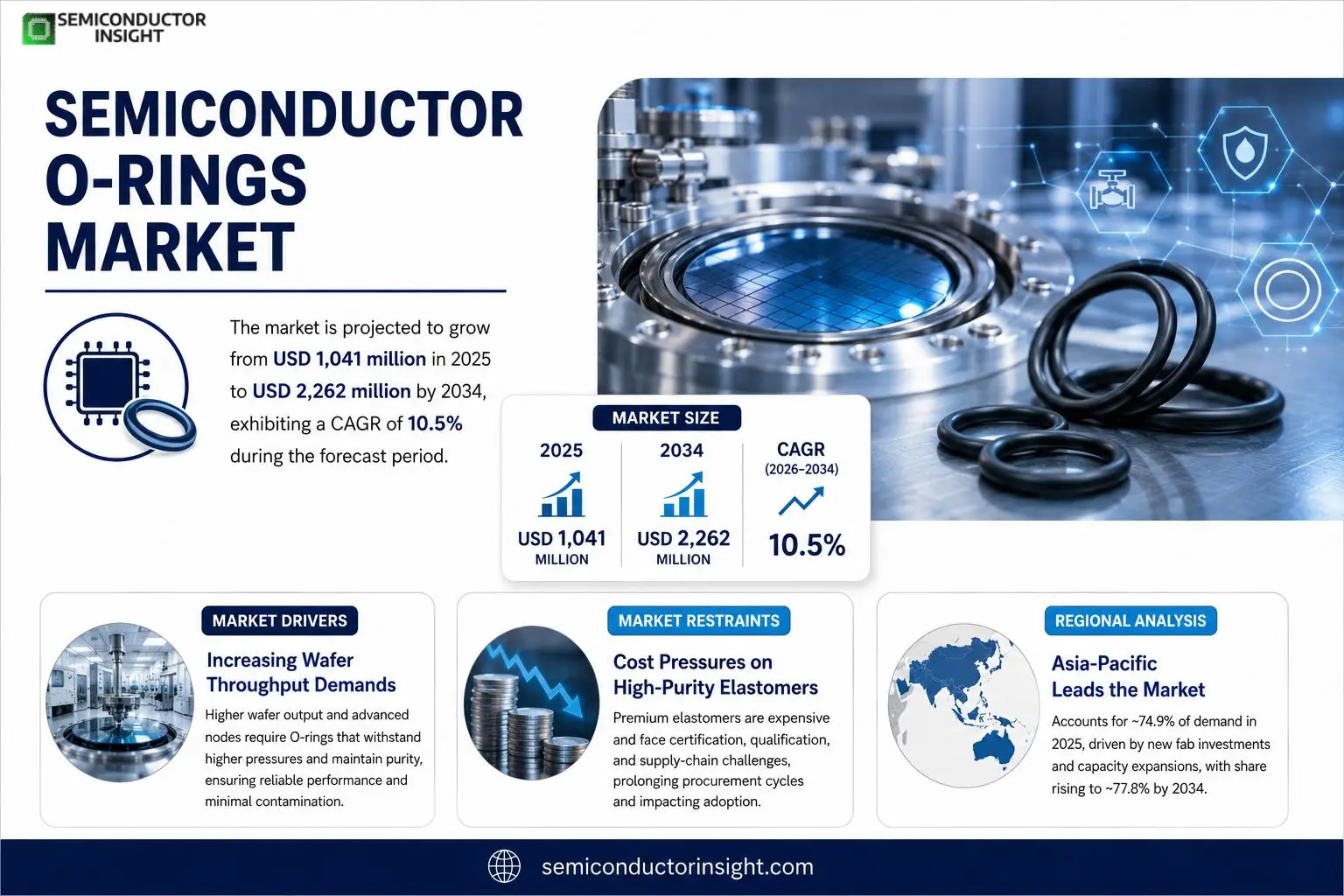
Semiconductor O-Rings market size was valued at USD 1,041 million in 2025 and is projected to reach USD 2,262 million by 2034, exhibiting a CAGR of 10.5% during the forecast period.
Semiconductor O‑rings are not generic rubber parts; they are critical functional materials embedded deep in wafer‑fab equipment architecture. In commercial terms, these seals sit at the intersection of contamination control, uptime management, preventive‑maintenance cadence, chamber reliability and process qualification. Their function extends far beyond leak prevention: they must deliver ultra‑high cleanliness, low particle generation, minimal trace‑metal contribution, resistance to aggressive wet chemistries, endurance in plasma environments, thermal stability and low compression set over long service windows. Because equipment makers and fabs base purchasing decisions on yield stability and total cost of ownership, performance specifications dominate pricing considerations.The market’s expansion is fueled by several forces. Intensifying semiconductor investmentSEMI forecasts front‑end fab equipment spending of USD 110 billion in 2025 rising to USD 130 billion in 2026creates steady demand for high‑purity sealing solutions. Supplier leadership rests on proprietary compound libraries, clean‑room manufacturing discipline and field failure analysis capabilities; first‑tier vendors such as Freudenberg, Daikin and Saint‑Gobain dominate while an “Others” segment still accounts for roughly 18 % of volume, indicating room for challengers. Regional demand remains heavily weighted toward Asia‑Pacific (≈ 75 % of units in 2025) because new fab starts and capacity upgrades are concentrated there, pushing the region’s share toward nearly 78 % by 2034.
MARKET DRIVERS
Increasing Wafer Throughput Demands
Semiconductor O-Rings Market benefits from the relentless push for higher wafer output in leading fabs. As manufacturers adopt 300 mm and larger substrates, sealing solutions must tolerate higher pressures without compromising fluid purity. This pressure creates a direct need for O‑rings that maintain integrity under tighter cycle times, prompting equipment makers to source higher‑performance elastomers.
Stringent Contamination Controls
Semiconductor processes now operate at sub‑particle‑per‑trillion levels, making any out‑gassing or particulate release from sealing components unacceptable. O‑rings formulated from low‑extractable silicone or fluorinated polymers address this concern, allowing fabs to meet ISO 14644‑1 class 1 standards while preserving equipment uptime.
➤ Operators who replace standard nitrile seals with qualified low‑extractable O‑rings report a 12 % reduction in defect‑related downtime, directly influencing overall fab yield.
Beyond defect mitigation, the shift toward advanced packagingsuch as fan‑out wafer‑level and 3D‑ICcreates new sealing interfaces where traditional metal gaskets cannot fit. The adaptability of O‑rings to complex geometries ensures they are a preferred choice for these emerging architectures.
MARKET CHALLENGES
Cost Pressures on High‑Purity Elastomers
While premium elastomers deliver the required purity, their price points remain considerably higher than conventional materials. Fab managers, operating under tight capital‑expenditure constraints, often weigh the incremental expense against the risk of contamination, leading to prolonged procurement cycles.
Other Challenges
Material Compatibility Issues
Certain chemistries used in etching and cleaning stages react with standard silicone O‑rings, shortening service life. Engineers must therefore engage in extensive validation testing, which adds time to product qualification and can delay line start‑ups.Supply‑chain volatility for specialty polymers further complicates planning. Shortages of fluorinated compounds during geopolitical disruptions have forced some manufacturers to revert to less optimal alternatives, temporarily affecting line reliability.
MARKET RESTRAINTS
Regulatory and Certification Hurdles
Every O‑ring destined for a clean‑room environment must satisfy stringent ISO and IEC certifications. The qualification process involves multiple batches, out‑gassing tests, and traceability audits, which lengthen time‑to‑market for new formulations.
Limited Supplier Concentration
Only a handful of vendors possess the facilities to produce ultra‑pure elastomers at scale. This concentration creates bargaining power imbalances and raises the risk of single‑source dependency, especially for fabs located in regions with nascent supplier ecosystems.Moreover, any regulatory changesuch as tighter limits on volatile organic compoundsnecessitates rapid reformulation. Companies that cannot pivot quickly may see their product lines sidelined, constraining overall market expansion.
MARKET OPPORTUNITIES
Custom Formulations for Extreme Environments
Emerging chip‑on‑wafer and high‑power applications expose seals to temperatures beyond 200 °C and aggressive plasma environments. Developing O‑rings that retain elasticity while resisting thermal degradation opens a lucrative niche for specialty manufacturers.
Geographic Expansion of New Fabrication Hubs
Investment in semiconductor fabs across Southeast Asia and Eastern Europe is accelerating. Early engagement with local equipment integrators provides a pathway to embed premium O‑rings in next‑generation lines, establishing market share before the ecosystems mature.Finally, the rise of MEMS and sensor packaging introduces micro‑scale sealing challenges where conventional gaskets cannot be miniaturized. Tailoring O‑rings to sub‑millimeter dimensions while preserving low‑extractable characteristics positions suppliers at the forefront of this fast‑growing segment.
Semiconductor O-Rings Market Trends
Premium Material Migration Accelerates
In 2025 the FFKM family captured roughly one‑third of total unit shipments yet contributed more than 70 % of revenue, underscoring a clear premiumisation of Semiconductor O-Rings Market. Buyers are increasingly demanding ultra‑pure, chemically inert compounds because even marginal particle counts can erode yield on 2 nm nodes. This shift forces manufacturers to expand formulation libraries and invest in clean‑room molding lines, activities that raise the cost of entry but also secure higher margins. As contamination tolerances tighten, the market premium moves from a niche specification to a baseline requirement across most high‑temperature and plasma chambers.
Other Trends
Regional Concentration Deepens in Asia‑Pacific
Asia‑Pacific supplied almost three‑quarters of demand in 2025, a share that is set to edge beyond 77 % by 2034. The surge mirrors aggressive fab construction programs and the region’s expanding domestic chip ecosystem. For suppliers, this geography‑centric demand pattern translates into a need for local engineering support, dual‑source logistics, and faster failure‑analysis cycles. Companies that can station application engineers within major semiconductor hubs will gain a decisive advantage in winning long‑term contracts.
Application Mix Tilts Toward Thermal Processes
Thermal processes now generate a disproportionate slice of revenue despite representing slightly less than one‑third of unit volume. The higher average selling price reflects the stringent endurance required in high‑temperature sealing positions, where thermal cycling and long‑life performance are critical. This revenue profile suggests that equipment makers are prioritising reliability upgrades on deposition and annealing tools, prompting O‑ring vendors to certify new grades that survive extended hot‑wall exposure without loss of compression set.
COMPETITIVE LANDSCAPE
Key Industry Players
Semiconductor O‑Rings: Competitive Dynamics and Qualification Barriers
Freudenberg remains the de‑facto platform leader, leveraging a deep library of perfluoro‑elastomer (FFKM) and fluoroketone (FKM) chemistries that satisfy the ultra‑clean, low‑particle requirements of front‑end wafer fab equipment. Its advantage stems not merely from material performance but from a ly coordinated engineering service that validates each seal across multiple OEM tool families. This service‑driven model creates a high entry barrier: customers prioritize long‑term yield stability and total cost of ownership, so they gravitate toward suppliers that can demonstrably certify an O‑Ring for plasma, thermal and wet‑chemical stations in a single qualification cycle. Consequently, Freudenberg commands a sizeable share of the premium segment, where average selling prices exceed US$150 per unit, reinforcing a market structure that is top‑heavy and highly dependent on qualification pedigree.Beyond the platform tier, a constellation of specialized manufacturers sustains market breadth. Daikin and Maxmold Polymer focus on niche plasma‑resistant grades, while GMORS and Air Water Mach excel in high‑temperature VMQ formulations for thermal processing bays. Regional challengers such as Precision Polymer Engineering (PPE) in the United States, Greene Tweed in Europe, and TRP Polymer Solutions in Japan provide localized engineering support that aligns with the increasingly regionalized fab footprint. Saint‑Gobain and Technetics (EnPro) contribute advanced composite‑seal designs for emerging 2 nm tools, and niche entrants like MFC Sealing Technology and Northern Engineering Sheffield leverage field‑failure analytics to carve out niche positions in specialty equipment lines. The “Others” cohort, still accounting for roughly 18 % of volume, illustrates that despite the dominance of a few platform players, credible niche expertise continues to attract fab spending, especially where dual‑sourcing and rapid spare‑part turnaround are contractual imperatives.
List of Key Semiconductor O‑Rings Companies Profiled
- Freudenberg
- Daikin
- Maxmold Polymer
- GMORS
- Air Water Mach
- Precision Polymer Engineering (PPE)
- Greene Tweed
- Saint‑Gobain
- Technetics (EnPro)
- TRP Polymer Solutions
- MFC Sealing Technology
- Northern Engineering Sheffield (NES)
- Ceetak
- Yoson Seals
- Vulcan Seals
Segment Analysis:
| Segment Category | Sub-Segments | Key Insights |
| By Type |
|
FFKM dominates the premium segment because it delivers ultra‑high chemical resistance and plasma durability.
|
| By Application |
|
Thermal Process is the leading application where temperature stability and low compression set are vital.
|
| By End User |
|
Semiconductor Fab Operators drive the most stringent specifications because their production yield hinges on seal integrity.
|
| By Material Purity |
|
Ultra‑High Purity is becoming the default requirement for critical chamber positions.
|
| By Process Environment |
|
Plasma‑Exposed environments prioritize materials that resist aggressive ion bombardment.
|
Regional Analysis: Semiconductor O-Rings Market
Asia‑Pacific
Foundries in Taiwan and Korea have vertically integrated sealing‑component lines, enabling batch‑size flexibility that mirrors chip output fluctuations. This scale advantage translates into tighter tolerances for O‑rings, reducing scrap rates and reinforcing supplier reliability for downstream assemblers.
Regional logistics hubs and port efficiencies mitigate disruptions that traditionally plagued the component supply chain. Multi‑modal transport options ensure that critical O‑ring inventories can be repositioned within days, preserving production schedules for high‑volume wafer fabs.
Universities in Japan and research consortia in Singapore are co‑developing fluorinated elastomers that sustain sealing performance beyond 250 °C. These collaborations shorten the time‑to‑market for premium O‑rings, giving early adopters a measurable reliability edge.
Targeted subsidies for high‑purity material handling and tax credits for eco‑friendly manufacturing have lowered entry barriers for niche suppliers, widening the competitive set and fostering a healthier ecosystem for the Semiconductor O‑Rings Market.
North America
In North America, the Semiconductor O‑Rings Market is anchored by a mature ecosystem of design houses and equipment manufacturers. The United States continues to prioritize reliability standards for aerospace and defense applications, prompting OEMs to source O‑rings that meet stringent outgassing and radiation‑hardness criteria. While overall volume lags behind Asia‑Pacific, the region compensates with premium‑price positioning for ultra‑clean, low‑leakage components used in data‑center cooling and quantum‑computing prototypes. Collaborative research initiatives between federal labs and private firms are also nurturing niche chemistries, which could eventually spill over into broader semiconductor packaging solutions.
Europe
European manufacturers draw strength from a legacy of precision engineering and a regulatory framework that emphasizes environmental compliance. While the continent’s semiconductor fab capacity is modest, the demand for high‑integrity sealing in automotive electronics and medical devices sustains a steady flow of orders for specialized O‑rings. EU subsidies for green manufacturing are nudging suppliers toward bio‑based elastomers, positioning Europe as a potential leader in sustainable sealing technologies. Moreover, cross‑border standards harmonization reduces variability, allowing European firms to serve multiple markets with a single product portfolio.
South America
South America remains a peripheral yet opportunistic market segment for semiconductor sealing components. Emerging investments in Brazil’s silicon‑on‑glass initiatives and Chile’s lithium‑ion battery factories create localized demand for O‑rings capable of withstanding harsh chemical environments. The region’s cost‑advantage labor pool enables low‑margin production, attracting multinational suppliers seeking to diversify manufacturing footprints. However, infrastructural gaps and import‑tariff volatility introduce risk, compelling firms to adopt flexible contract models that balance price competitiveness with supply certainty.
Middle East & Africa
The Middle East & Africa landscape is defined by a handful of high‑tech parks in the United Arab Emirates and Israel, where semiconductor packaging is gaining traction alongside renewable‑energy projects. Local utilities require O‑rings that can tolerate extreme temperature swings and saline exposure, prompting niche product development. While overall market size is limited, strategic partnerships with OEMs are establishing a foothold that could accelerate as regional digital‑infrastructure projects mature.
Report Scope
This market research report provides a comprehensive analysis of the Semiconductor O-Rings Market , covering the forecast period 2026–2034. It offers detailed insights into market dynamics, technological advancements, competitive landscape, and key trends shaping the industry.
Key focus areas of the report include:
- Market Overview: The report begins with an overview outlining its current market scenario, key growth indicators, and industry transformation drivers. It discusses macroeconomic factors, demand–supply balance, regulatory landscape, and the strategic role of semiconductors in powering advancements across industries such as automotive, telecommunications, consumer electronics, and industrial automation.
- Market Size & Forecast: Historical data and future projections for revenue, unit shipments, and market value across major regions and segments.
- Segmentation Analysis: Detailed breakdown by product type, technology, application, and end-user industry to identify high-growth segments and investment opportunities.
- Regional Insights: Insights into market performance across North America, Europe, Asia-Pacific, Latin America, and the Middle East & Africa, including country-level analysis where relevant.
- Competitive Landscape: Profiles of leading market participants, including their product offerings, R&D focus, manufacturing capacity, pricing strategies, and recent developments such as mergers, acquisitions, and partnerships.
- Technology Trends & Innovation: Assessment of emerging technologies, integration of AI/IoT, semiconductor design trends, fabrication techniques, and evolving industry standards.
- Market Drivers & Restraints: Evaluation of factors driving market growth along with challenges, supply chain constraints, regulatory issues, and market-entry barriers.
- Stakeholder Insights: Insights for component suppliers, OEMs, system integrators, investors, and policymakers regarding the evolving ecosystem and strategic opportunities.
Primary and secondary research methods are employed, including interviews with industry experts, data from verified sources, and real-time market intelligence to ensure the accuracy and reliability of the insights presented.
FREQUENTLY ASKED QUESTIONS:
What is the current market size of Semiconductor O-Rings Market?
-> Semiconductor O-Rings Market was valued at USD 1,041 million in 2025 and is expected to reach USD 2,262 million by 2034, at a CAGR of 10.5% during the forecast period.
Which key companies operate in Semiconductor O-Rings Market?
-> Key players include Freudenberg, Daikin, GMORS, Maxmold Polymer, Air Water Mach, Precision Polymer Engineering (PPE) (IDEX), Greene Tweed, Saint‑Gobain, among others.
What are the key growth drivers?
-> Key growth drivers include rapid expansion of front‑end fab equipment spending, increasing demand for ultra‑high‑purity sealing solutions, higher reliability requirements in plasma and thermal processes, and the shift toward advanced nodes such as 2 nm which intensify material specifications.
Which region dominates the market?
-> Asia‑Pacific dominates the Semiconductor O‑Rings market, accounting for about 74.9% of demand in 2025 and projected to rise to 77.8% by 2034 with the highest regional CAGR of 9.58% for 2026‑2034.
What are the emerging trends?
-> Emerging trends include greater adoption of premium FFKM materials for stringent contamination control, regionalization of supply chains with local engineering support and dual‑sourcing strategies, and increasing emphasis on service‑intensive models to ensure delivery resilience for advanced wafer‑fab equipment.
Get Sample Report PDF for Exclusive Insights
Report Sample Includes
- Table of Contents
- List of Tables & Figures
- Charts, Research Methodology, and more...
 Download Sample Report PDF