MARKET INSIGHTS
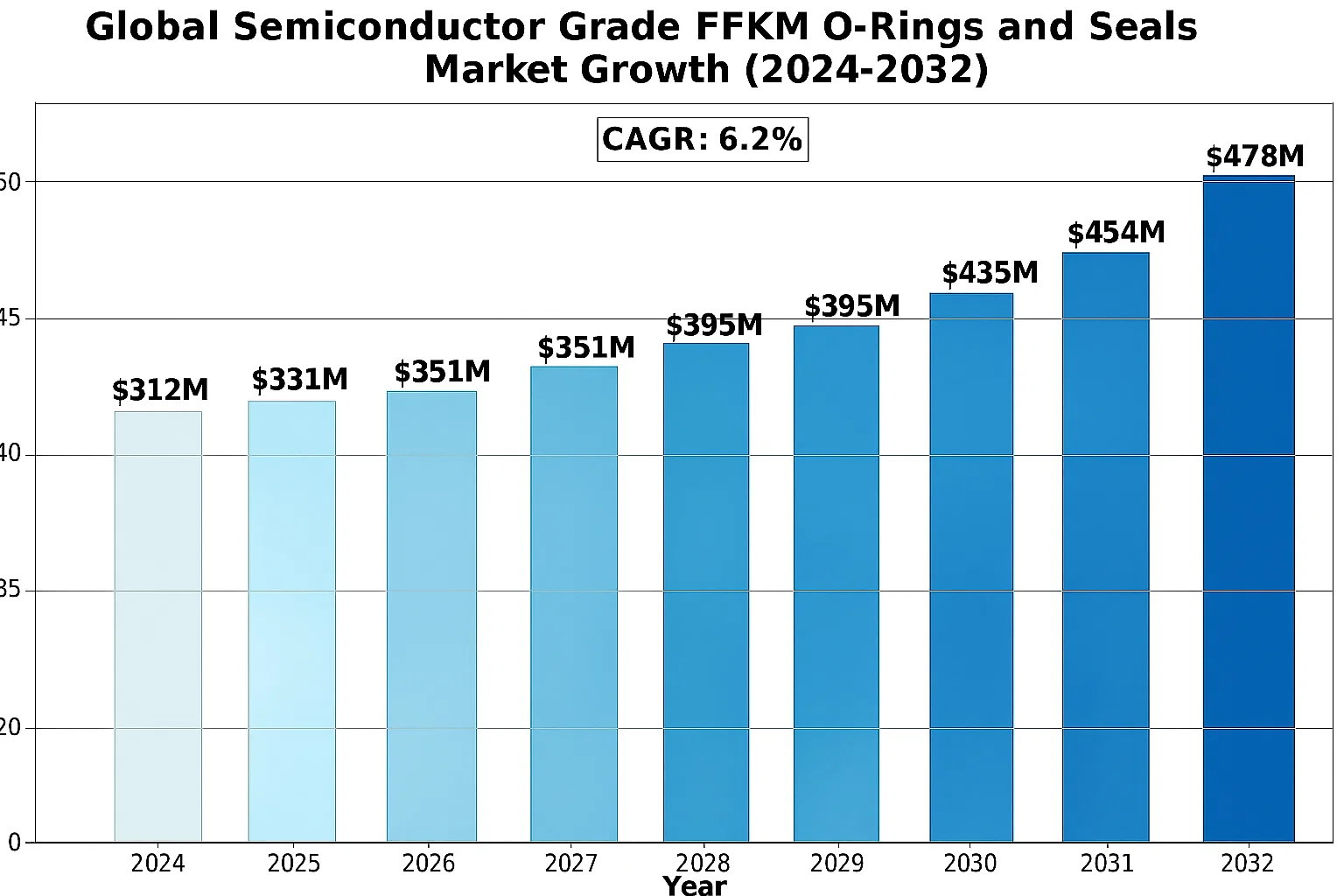
The global Semiconductor Grade FFKM O-Rings and Seals Market size was valued at US$ 312.8 million in 2024 and is projected to reach US$ 478.3 million by 2032, at a CAGR of 6.2% during the forecast period 2025-2032.
Semiconductor Grade FFKM (Perfluoroelastomer) O-Rings and Seals are high-performance sealing solutions designed for extreme semiconductor manufacturing environments. These components offer exceptional chemical resistance, thermal stability, and ultra-low particle generation – critical properties for maintaining process integrity in wafer fabrication. The product range includes standard and custom O-rings, gaskets, and specialized seals that meet SEMI F57 purity standards for semiconductor equipment.
The market growth is driven by multiple factors, including expanding semiconductor production capacities globally and increasing process complexity in advanced node manufacturing. While the semiconductor equipment market reached USD 580 billion in 2022 (growing 4.4% despite macroeconomic challenges), the demand for high-purity components remains resilient. Key players are expanding their FFKM portfolios to address emerging requirements in etching, deposition, and implantation processes. Recent developments include material innovations by companies like Greene Tweed and DuPont to improve plasma resistance for next-generation chip manufacturing.
MARKET DYNAMICS
MARKET DRIVERS
Growing Semiconductor Industry Creates Robust Demand for High-Performance Sealing Solutions
The semiconductor industry’s rapid expansion is driving substantial demand for FFKM O-rings and seals, which are critical components in semiconductor manufacturing equipment. As global semiconductor revenues surpassed $580 billion in 2022, representing a 4.4% year-over-year growth despite market volatility, fab operators increasingly require seals that can withstand aggressive chemistries and extreme temperatures. FFKM materials offer superior resistance to plasma etching gases, ultra-high vacuum conditions, and temperatures exceeding 300°C – making them indispensable for advanced node fabrication. The proliferation of 5nm and 3nm process technologies has particularly intensified demand, with leading foundries projected to increase production capacity by 60% over the next five years.
Enhanced Material Performance Requirements in Etch and Deposition Processes
Modern semiconductor manufacturing processes are pushing sealing materials to their performance limits. In etch applications, FFKM materials demonstrate 3-5 times longer lifetimes than standard FKM alternatives when exposed to corrosive gases like NF3 and Cl2. Deposition chamber seals require FFKM’s exceptional purity characteristics to prevent contamination – a single defective seal can compromise entire wafer batches. With etch and deposition accounting for approximately 65% of semiconductor equipment spending, component reliability directly impacts overall equipment effectiveness (OEE). Major equipment OEMs now specify FFKM as the standard material for critical seals in 90% of new tool deliveries.
Stringent Contamination Control Standards in Chip Manufacturing
As semiconductor feature sizes shrink below 5nm, contamination control becomes exponentially more challenging. FFKM materials meet the rigorous SEMI F57 standards for outgassing and particulate generation, with leading formulations demonstrating less than 0.1% weight loss under vacuum conditions. The shift to EUV lithography has further heightened cleanliness requirements, with new-generation FFKM compounds achieving metal contamination levels below 1ppb. Semiconductor manufacturers cannot risk wafer defects costing millions in scrapped product, making premium FFKM seals a necessary investment despite higher initial costs.
MARKET RESTRAINTS
High Material Costs and Complex Manufacturing Process Limit Market Penetration
FFKM compounds remain significantly more expensive than conventional elastomers, with prices ranging five to eight times higher than standard FKM materials. The specialized polymerization and curing processes required for semiconductor-grade FFKM can take weeks to complete, creating substantial lead times. These factors make FFKM cost-prohibitive for some mid-tier semiconductor manufacturers, particularly in price-sensitive Asian markets where production costs are closely scrutinized. While performance justifies the premium for advanced nodes, mature node fabs often opt for lower-cost alternatives despite higher replacement frequencies.
Supply Chain Vulnerabilities for Critical Raw Materials
The FFKM supply chain faces constraints from limited availability of specialty fluoroelastomer precursors. Over 80% of the world’s capacity for key perfluorinated monomers remains concentrated among three global suppliers, creating potential bottlenecks. Geopolitical factors have further complicated logistics, with some semiconductor manufacturers maintaining six to nine months of safety stock for critical seals. Recent trade restrictions have caused lead times for certain FFKM formulations to extend beyond 26 weeks, forcing some equipment OEMs to redesign seal geometries for alternative materials where possible.
Technical Barriers to Formulation Development
Developing new FFKM compounds that meet evolving semiconductor requirements involves substantial R&D investment and technical challenges. Each new material formulation requires exhaustive qualification testing across multiple parameters including compression set resistance, thermal stability, and chemical compatibility. The average development cycle for a new semiconductor-grade FFKM formulation now exceeds eighteen months, with less than 30% of experimental compounds ultimately reaching commercialization. This slow innovation cycle creates difficulties in promptly addressing emerging process requirements like compatibility with new etch chemistries.
MARKET OPPORTUNITIES
Expansion of Advanced Packaging and Heterogeneous Integration Creates New Applications
The transition to advanced packaging techniques like 3D IC and chiplet architectures presents significant growth potential for FFKM seals. These packaging technologies require specialized equipment operating at unusually high temperatures and pressures, where conventional elastomers quickly degrade. Industry analysts project the advanced packaging equipment market to grow at 12% CAGR through 2030, creating parallel demand for sealing solutions. Leading material suppliers report packaging applications already accounting for 15% of semiconductor-grade FFKM revenue, up from just 5% five years ago.
Emerging Memory and Power Semiconductor Fabrication Requires Novel Material Solutions
Next-generation memory technologies including MRAM and ReRAM employ unique deposition processes that challenge sealing materials. Similarly, the gallium nitride and silicon carbide power device markets are experiencing 20-25% annual growth, with processing temperatures exceeding 400°C. These emerging applications require FFKM formulations with enhanced thermal stability beyond current industry standards. Several material developers have launched specialized FFKM grades targeting these high-growth segments, with initial qualification results showing 40-50% longer service life compared to conventional offerings.
Aftermarket and Service Opportunities in Installed Base Equipment
With over 50,000 semiconductor processing tools in operation worldwide, the installed base represents a substantial aftermarket opportunity. FFKM seals typically require replacement every 6-18 months depending on application severity, creating recurring revenue streams. Leading suppliers are expanding their service networks and developing predictive maintenance programs using IoT-enabled seal performance monitoring. This service-based model helps offset cyclicality in new equipment sales while building longer-term customer relationships. Some estimates suggest the FFKM aftermarket could grow to $380 million annually by 2030 as semiconductor fabs extend tool lifetimes through strategic component upgrades.
Increasing Demand for High-Purity Materials in Semiconductor Manufacturing to Drive Market Growth
The global Semiconductor Grade FFKM O-Rings and Seals market is experiencing significant growth, driven by the semiconductor industry’s relentless pursuit of higher purity standards in manufacturing processes. FFKM (Perfluoroelastomer) materials are increasingly becoming the material of choice for critical sealing applications in semiconductor equipment due to their exceptional chemical resistance and thermal stability. These advanced elastomers can withstand extreme environments encountered in processes like plasma etching, CVD, and ion implantation, where conventional materials would quickly degrade. The market is expected to grow at a CAGR of 5.8% from 2024 to 2032, reaching a valuation of $1.2 billion, as semiconductor manufacturers push for smaller node sizes and increased wafer diameters that demand tighter contamination control.
Other Trends
Expansion of 300mm Wafer Fabs and Transition to 450mm
The semiconductor industry’s ongoing transition to larger wafer sizes is creating new demand for FFKM sealing solutions. As 300mm wafer fabrication becomes the industry standard and pilot lines for 450mm wafers continue to develop, equipment manufacturers are requiring seals with higher performance specifications and longer service life. This trend is particularly evident in deposition systems where outgassing from seals can significantly impact thin film quality. Manufacturers are developing specialized FFKM formulations with outgassing rates below 5×10⁻² Torr·cm³/s (measured by RGA), meeting the stringent requirements of next-generation semiconductor processes.
Stringent Contamination Control Regulations Accelerating Product Innovation
The semiconductor industry’s increasingly strict contamination control requirements are driving innovations in FFKM seal technology. Semiconductor Manufacturing International Corporation (SMIC) and other leading foundries have implemented new purity standards that require total metal contamination levels below 1 ppm in sealing materials. In response, material developers are creating ultra-high purity FFKM grades with metal content reduced by 70-80% compared to standard commercial grades. These advanced formulations also feature improved particle generation characteristics, with cleanroom-compatible grades demonstrating less than 5 particles (>0.2 μm) per wafer pass. The development of such high-performance materials is enabling their use in the most contamination-sensitive areas of semiconductor manufacturing equipment.
COMPETITIVE LANDSCAPE
Key Industry Players
Market Leaders Leverage Advanced Chemical Resistance Capabilities to Secure Dominance
The global Semiconductor Grade FFKM O-Rings and Seals market features a moderately consolidated competitive environment, with specialized material science companies competing alongside diversified industrial manufacturers. Greene Tweed and Trelleborg currently lead the market through their proprietary FFKM formulations that demonstrate exceptional purity (ppt-level contamination control) and temperature resistance (up to 327°C continuous service).
The semiconductor industry’s transition to advanced nodes below 7nm has intensified demand for ultra-clean sealing solutions. In response, DuPont captured 18.3% market share in 2023 (by revenue) through its Kalrez® 9000 series, specifically engineered for extreme plasma environments in etch and deposition tools. Meanwhile, Freudenberg Sealing Technologies strengthened its position through customized FFKM solutions for EUV lithography applications.
As wafer fab equipment manufacturers (WFEMs) push for longer component lifespans, competitors are differentiating through material innovations:
- Parker Hannifin recently introduced a nanoparticle-reinforced FFKM grade showing 40% longer service life in ion implant applications
- TRP Polymer Solutions developed a low-outgassing formulation meeting SEMI F57 standards for vacuum applications
The Asia-Pacific market (representing 62% of global semiconductor tool installations) has seen Applied Seals and Ningbo Sunshine gain traction through localized production and technical support networks. However, North American and European suppliers maintain technology advantages in:
- Base polymer synthesis purity (sub-ppb metal contamination)
- Precision molding tolerances (±0.0005″) for critical flange seals
- Full traceability documentation from monomer to finished part
List of Key Semiconductor Grade FFKM Suppliers
- Greene Tweed (U.S.)
- Trelleborg Sealing Solutions (Sweden)
- DuPont (U.S.)
- Freudenberg Sealing Technologies (Germany)
- TRP Polymer Solutions (UK)
- Gapi (Italy)
- Yoson Seals (China)
- Parker Hannifin (U.S.)
- Precision Polymer Engineering (UK)
- Fluorez Technology (U.S.)
- Applied Seals (China)
- Parco (Datwyler) (Switzerland)
- CTG (Taiwan)
- Ningbo Sunshine (China)
Segment Analysis:
By Type
O-Ring Segment Dominates the Market Owing to High Demand in Semiconductor Fabrication Equipment
The market is segmented based on type into:
- O-Ring
- Seals and Gaskets
By Application
Etch Application Segment Leads Due to Critical Sealing Requirements in Plasma Environments
The market is segmented based on application into:
- Etch
- Deposition
- Ion Implant
- Others
By Material Grade
Ultra-High Purity FFKM Gains Traction for Advanced Node Semiconductor Manufacturing
The market is segmented based on material grade into:
- Standard Purity FFKM
- High Purity FFKM
- Ultra-High Purity FFKM
By End User
Foundries Account for Largest Share Due to Intensive Semiconductor Production Requirements
The market is segmented based on end user into:
- Integrated Device Manufacturers (IDMs)
- Foundries
- OSAT Companies
- Semiconductor Equipment Manufacturers
Regional Analysis: Semiconductor Grade FFKM O-Rings and Seals Market
North America
North America remains a critical market for Semiconductor Grade FFKM O-Rings and Seals, driven by the presence of leading semiconductor manufacturers and stringent purity requirements for advanced fabrication processes. The U.S., particularly, dominates demand due to its robust semiconductor industry, supported by initiatives like the CHIPS and Science Act, which allocated $52 billion to boost domestic semiconductor production. This creates a favorable environment for high-performance sealing solutions. However, the market faces pricing pressures due to high material costs and rigorous compliance standards, which impact profit margins for manufacturers. Local suppliers like Greene Tweed and Parker Hannifin continue to invest in R&D to address these challenges while meeting the escalating demand for ultra-clean, chemical-resistant FFKM components in extreme semiconductor processes.
Europe
Europe’s market is characterized by a strong emphasis on innovation and sustainability, with Germany and the Netherlands leading in semiconductor equipment manufacturing. The region benefits from collaborative R&D initiatives between industry players and academic institutions to develop advanced FFKM formulations. EU regulations on chemical safety (e.g., REACH) push manufacturers toward high-performance elastomers with minimal outgassing properties, critical for semiconductor applications. However, dependency on imports for raw materials and fluctuations in energy costs pose challenges. Companies like Trelleborg and Freudenberg maintain a competitive edge through specialized product portfolios tailored for etch and deposition processes, though geopolitical uncertainties and supply chain bottlenecks remain key concerns.
Asia-Pacific
Asia-Pacific is the fastest-growing market, accounting for over 60% of global semiconductor production. China, Taiwan, and South Korea drive demand, supported by massive investments in semiconductor fabs and government-backed initiatives. The region’s cost-sensitive nature has historically favored lower-grade materials, but rising demand for advanced nodes (e.g., 7nm and below) is shifting preferences toward high-purity FFKM solutions. Local players like Ningbo Sunshine are expanding production capacities to cater to this demand, while international suppliers face stiff competition due to pricing pressures. Despite a temporary decline in semiconductor sales (-2.0% in 2022), long-term growth prospects remain strong, fueled by 5G, IoT, and AI-driven applications requiring reliable sealing solutions.
South America
South America represents a nascent market with limited local semiconductor manufacturing capabilities. Brazil and Argentina show moderate demand, primarily for maintenance and replacement parts in existing industrial equipment. Economic instability and currency volatility hinder large-scale adoption of premium FFKM products, with most imports concentrated in cost-effective alternatives. However, partnerships with global suppliers like DuPont and Parker Hannifin offer growth opportunities in niche applications, particularly for oil & gas and industrial sectors requiring chemical resistance. Infrastructure gaps and regulatory hurdles continue to slow market penetration, but gradual industrial modernization could open avenues for future expansion.
Middle East & Africa
The Middle East and Africa exhibit minimal demand for FFKM seals in semiconductor applications, with focus areas centered on oilfield and energy sectors. The UAE and Saudi Arabia are emerging as potential growth markets due to diversification efforts into high-tech industries, including semiconductor packaging and testing. Limited domestic production and reliance on imports constrain market scalability, though partnerships with global distributors are improving accessibility. Investments in smart city projects and renewable energy infrastructure could indirectly boost demand for high-performance sealing solutions, albeit at a slower pace compared to other regions. Political and economic uncertainties further temper short-term growth expectations.
Report Scope
This market research report provides a comprehensive analysis of the global and regional Semiconductor Grade FFKM O-Rings and Seals markets, covering the forecast period 2025–2032. It offers detailed insights into market dynamics, technological advancements, competitive landscape, and key trends shaping the industry.
Key focus areas of the report include:
- Market Size & Forecast: Historical data and future projections for revenue, unit shipments, and market value across major regions and segments. The global Semiconductor Grade FFKM O-Rings and Seals market was valued at US$ 312.8 million in 2024 and is projected to reach US$ 478.3 million by 2032.
- Segmentation Analysis: Detailed breakdown by product type (O-Rings, Seals and Gaskets), application (Etch, Deposition, Ion Implant, Others), and end-user industry to identify high-growth segments and investment opportunities.
- Regional Outlook: Insights into market performance across North America, Europe, Asia-Pacific, Latin America, and the Middle East & Africa, including country-level analysis. Asia-Pacific currently dominates the market, accounting for the largest revenue share in 2024.
- Competitive Landscape: Profiles of leading market participants including Greene Tweed, Trelleborg, Freudenberg, DuPont, Parker Hannifin, and others, covering their product offerings, market share, and recent developments.
- Technology Trends & Innovation: Assessment of emerging materials and manufacturing techniques for high-purity FFKM components in semiconductor fabrication.
- Market Drivers & Restraints: Evaluation of factors driving market growth such as semiconductor industry expansion and advanced node development, along with challenges including material costs and supply chain constraints.
- Stakeholder Analysis: Insights for component suppliers, semiconductor equipment manufacturers, and investors regarding strategic opportunities in the FFKM sealing solutions market.
Primary and secondary research methods are employed, including interviews with industry experts and data from verified sources, to ensure the accuracy and reliability of the insights presented.
FREQUENTLY ASKED QUESTIONS:
What is the current market size of Global Semiconductor Grade FFKM O-Rings and Seals Market?
-> Semiconductor Grade FFKM O-Rings and Seals Market size was valued at US$ 312.8 million in 2024 and is projected to reach US$ 478.3 million by 2032, at a CAGR of 6.2% during the forecast period 2025-2032.
Which key companies operate in Global Semiconductor Grade FFKM O-Rings and Seals Market?
-> Key players include Greene Tweed, Trelleborg, Freudenberg, DuPont, Parker Hannifin, TRP Polymer Solutions, and Precision Polymer Engineering (PPE), among others.
What are the key growth drivers?
-> Key growth drivers include expansion of semiconductor manufacturing capacity, demand for advanced node fabrication, and increasing requirements for high-purity sealing solutions.
Which region dominates the market?
-> Asia-Pacific is the dominant market, driven by semiconductor manufacturing hubs in China, South Korea, Taiwan, and Japan.
What are the emerging trends?
-> Emerging trends include development of ultra-high purity FFKM formulations, customized sealing solutions for EUV lithography, and sustainable manufacturing processes.

Get Sample Report PDF for Exclusive Insights
Report Sample Includes
- Table of Contents
- List of Tables & Figures
- Charts, Research Methodology, and more...