
MARKET INSIGHTS
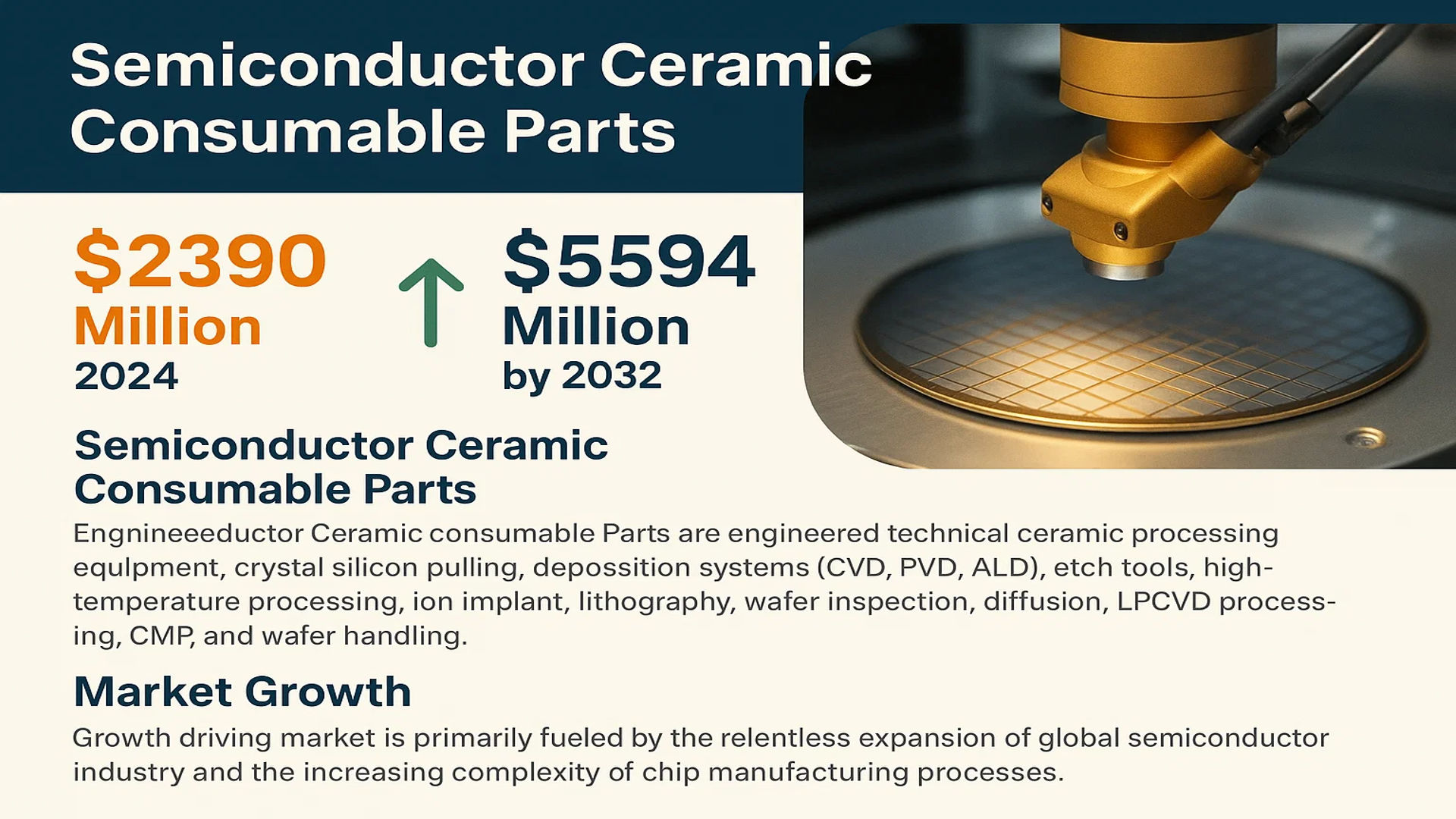
The global Semiconductor Ceramic Consumable Parts Market was valued at 2390 million in 2024 and is projected to reach US$ 3594 million by 2032, at a CAGR of 6.2% during the forecast period.
Semiconductor Ceramic Consumable Parts are engineered technical ceramic components critical for semiconductor wafer processing and fabrication. These parts are utilized across a wide range of equipment, including crystal silicon pulling, deposition systems (CVD, PVD, ALD), etch tools, high-temperature processing, ion implant, lithography, wafer inspection, diffusion, LPCVD processing, CMP, and wafer handling. Their adoption is driven by their exceptional mechanical stability, thermal conductivity, and resistance to highly corrosive environments.
The market’s growth is primarily fueled by the relentless expansion of the global semiconductor industry and the increasing complexity of chip manufacturing processes. Key material segments include Alumina Ceramics (Al2O3) and Aluminum Nitride (AlN), which held market shares of 43% and 37% respectively in 2022. The market is highly consolidated, with the top nine players, including NGK Insulators, Kyocera, and Coorstek, collectively holding over 88% of the global market share. Geographically, manufacturers from Japan dominate, accounting for approximately 68% of the market, followed by the United States with a 10.2% share.
MARKET DYNAMICS
MARKET DRIVERS
Accelerated Semiconductor Fabrication Advancements to Drive Demand for Ceramic Consumables
The global semiconductor industry is undergoing rapid technological evolution, with advanced nodes below 7nm becoming increasingly prevalent. This progression demands consumable parts capable of withstanding extreme thermal, chemical, and mechanical stresses during fabrication processes. Semiconductor ceramic consumables, particularly those made from aluminum nitride and alumina, provide exceptional thermal stability, corrosion resistance, and electrical insulation properties essential for modern chip manufacturing. The transition to more complex 3D NAND and logic architectures requires precision components that maintain dimensional stability under aggressive processing conditions. With semiconductor manufacturers investing over $150 billion annually in new fabrication facilities and equipment upgrades, the demand for high-performance ceramic consumables continues to grow substantially.
Expansion of IoT and 5G Infrastructure to Fuel Market Growth
The proliferation of Internet of Things devices and global 5G network deployment is creating unprecedented demand for semiconductor components, subsequently driving the need for ceramic consumable parts. These advanced communication technologies require specialized semiconductors with enhanced performance characteristics, necessitating sophisticated manufacturing processes that rely heavily on ceramic components. The thermal management requirements for 5G infrastructure components, particularly power amplifiers and RF devices, have increased the adoption of aluminum nitride ceramics known for their excellent thermal conductivity properties. The semiconductor industry’s production capacity expansion to meet IoT and 5G component demand has directly correlated with increased consumption of ceramic parts across deposition, etching, and wafer handling applications.
Furthermore, government initiatives worldwide supporting semiconductor independence and technological sovereignty are accelerating fab construction projects. Major economies are implementing policies and funding programs to strengthen domestic semiconductor capabilities, creating additional demand for ceramic consumables across new manufacturing facilities.
➤ For instance, recent legislation in multiple countries has allocated substantial funding for semiconductor research, development, and manufacturing infrastructure, directly impacting the consumption of advanced ceramic components in new fabrication facilities.
The increasing complexity of semiconductor manufacturing processes, particularly in advanced packaging and heterogeneous integration, requires more sophisticated ceramic components with enhanced properties. This technological evolution continues to drive innovation and adoption of advanced ceramic materials throughout the semiconductor supply chain.
MARKET RESTRAINTS
High Manufacturing Costs and Technical Complexities to Limit Market Expansion
The production of semiconductor-grade ceramic consumables involves sophisticated manufacturing processes requiring extreme precision and quality control. The raw material purification, forming, sintering, and finishing stages demand specialized equipment and controlled environments, resulting in significant capital investment and operational expenses. Advanced ceramics such as aluminum nitride require high-temperature sintering under controlled atmospheres, adding to the manufacturing complexity and cost structure. These elevated production costs are ultimately transferred to semiconductor manufacturers, creating pricing pressure throughout the supply chain. The stringent requirements for purity, dimensional accuracy, and surface finish further complicate manufacturing processes, limiting the number of qualified suppliers capable of meeting industry standards.
Additionally, the development of new ceramic formulations with enhanced properties requires substantial research and development investment. The time from material development to commercial implementation can extend beyond five years, creating significant barriers for new market entrants and limiting rapid innovation cycles.
The global concentration of manufacturing expertise in specific regions, particularly Japan, creates supply chain vulnerabilities and additional cost considerations for semiconductor manufacturers seeking diversified sourcing options.
MARKET CHALLENGES
Supply Chain Vulnerabilities and Geopolitical Factors to Challenge Market Stability
The semiconductor ceramic consumable parts market faces significant challenges related to supply chain concentration and geopolitical tensions. With approximately 68% of manufacturing capacity located in Japan, the market demonstrates high geographic concentration risk. This dependency creates vulnerability to regional disruptions, including natural disasters, trade restrictions, or political instability. The specialized nature of ceramic component manufacturing limits the ability to quickly establish alternative production facilities, as the required technical expertise and manufacturing know-how are developed over decades. Recent global events have highlighted the fragility of concentrated supply chains, prompting semiconductor manufacturers to seek diversification strategies that may impact existing supplier relationships.
Other Challenges
Technical Standardization Issues
The lack of universal technical standards across semiconductor equipment manufacturers creates compatibility challenges for ceramic component suppliers. Different equipment platforms require customized ceramic parts with unique specifications, limiting economies of scale and increasing development costs. This fragmentation necessitates maintaining extensive product portfolios and specialized manufacturing capabilities to serve diverse customer requirements.
Rapid Technological Obsolescence
The accelerated pace of semiconductor technology advancement creates challenges for ceramic component manufacturers. Products developed for current technology nodes may become obsolete within relatively short timeframes as new manufacturing processes emerge. This requires continuous investment in research and development to anticipate future requirements, creating financial pressure and technological uncertainty throughout the supply chain.
MARKET OPPORTUNITIES
Emerging Applications in Advanced Packaging to Create New Growth Avenues
The rapid evolution of semiconductor packaging technologies presents significant opportunities for ceramic consumable part manufacturers. Advanced packaging approaches including 2.5D and 3D integration, fan-out wafer-level packaging, and system-in-package designs require specialized ceramic components with enhanced thermal and mechanical properties. The increasing power density of advanced semiconductors necessitates improved thermal management solutions, driving demand for ceramics with superior thermal conductivity characteristics. The transition toward heterogeneous integration and chiplets creates additional requirements for precision ceramic components in assembly and testing equipment. These technological shifts are opening new application areas beyond traditional front-end processing, expanding the addressable market for ceramic consumable parts.
Additionally, the growing adoption of wide bandgap semiconductors based on silicon carbide and gallium nitride requires specialized ceramic components capable of operating at higher temperatures and power levels. These emerging semiconductor technologies demand ceramic materials with enhanced performance characteristics, creating opportunities for innovation and product differentiation.
The increasing focus on semiconductor equipment efficiency and productivity is driving demand for ceramic components with extended service life and improved performance characteristics. Manufacturers developing advanced ceramic formulations and surface treatments that enhance component durability and reduce particulate contamination are positioned to capture additional market share in this evolving landscape.
SEMICONDUCTOR CERAMIC CONSUMABLE PARTS MARKET TRENDS
Advanced Node Manufacturing and Miniaturization Drive Demand for High-Performance Ceramics
The relentless push towards smaller semiconductor nodes, particularly below 7nm and extending into the 3nm and 2nm realms, is a primary catalyst for the ceramic consumables market. These advanced fabrication processes involve increasingly aggressive chemistries, higher plasma densities, and extreme thermal cycles that demand ceramic components with superior purity, thermal stability, and corrosion resistance. For instance, in etch and deposition equipment, components like focus rings, showerheads, and susceptors manufactured from ultra-high purity alumina (Al2O3) and aluminum nitride (AlN) are essential to maintain process integrity and yield. The transition to more complex 3D NAND and FinFET architectures further amplifies this need, as these structures require longer process times and expose components to greater wear. This technological evolution directly correlates with the market’s projected growth from a valuation of 2390 million in 2024 to an anticipated 3594 million by 2032, reflecting the critical role these consumables play in enabling next-generation chip production.
Other Trends
Geopolitical Reshoring and Supply Chain Diversification
Intensifying geopolitical tensions and a strategic focus on supply chain security are prompting significant investments in domestic semiconductor manufacturing capacity across North America, Europe, and Asia-Pacific. Major initiatives, such as the CHIPS and Science Act in the United States, which allocates over 52 billion in funding and incentives, are accelerating the construction of new fabrication plants (fabs). This wave of fab construction inherently drives demand for the extensive array of ceramic consumable parts required to equip these facilities. While Japanese manufacturers currently hold a dominant 68% share of the ceramic parts supply, this expansion is fostering opportunities for regional suppliers and encouraging strategic partnerships and local production to mitigate over-reliance on a concentrated supply base. This trend not only supports market growth but also introduces a dynamic shift in the competitive landscape and global supply chain logistics.
Sustainability and Extended Component Lifespan Through Innovation
As semiconductor manufacturing is an energy and resource-intensive endeavor, there is a growing operational and economic imperative to enhance sustainability. A key trend within the ceramic consumables sector is the intense R&D focus on developing materials and coatings that significantly extend the operational lifespan of consumable parts. Innovations in surface treatment technologies, such as the application of specialized yttria-based coatings on alumina components, dramatically reduce particle generation and erosion rates in plasma-rich environments. This directly translates to fewer chamber cleans, reduced tool downtime, and lower consumption of process gases and energy, thereby improving the overall cost of ownership for chipmakers. Furthermore, manufacturers are increasingly adopting closed-loop recycling programs for spent ceramic components, recovering valuable materials and aligning with broader corporate environmental, social, and governance (ESG) goals. This focus on durability and recyclability is becoming a critical differentiator for ceramic part suppliers in a competitive market.
COMPETITIVE LANDSCAPE
Key Industry Players
Companies Strive to Strengthen their Product Portfolio to Sustain Competition
The competitive landscape of the global semiconductor ceramic consumable parts market is highly consolidated, dominated by a handful of established players from Japan, the United States, and South Korea. This consolidation is evidenced by the fact that the top nine companies collectively command over 88% of the global market share. The market’s structure is characterized by deep technical expertise, significant barriers to entry due to stringent material purity and performance requirements, and long-standing relationships with major semiconductor fabrication equipment (semicon fab) manufacturers.
NGK Insulators, Ltd. and Kyocera Corporation are the undisputed leaders in this space, leveraging their decades of experience in advanced ceramics engineering and their formidable presence in the Asia-Pacific region, which is the heart of global semiconductor manufacturing. Their dominance is further solidified by continuous investment in research and development for next-generation materials like high-purity aluminum nitride (AlN) and silicon carbide (SiC) that meet the evolving demands of sub-5nm process nodes. These companies benefit immensely from the proximity to key customers and a deep understanding of the rigorous quality standards required in cleanroom environments.
Following closely, Ferrotec Corporation, TOTO Advanced Ceramics (a division of TOTO LTD.), and Morgan Advanced Materials also hold significant market shares. Their growth is intrinsically linked to their specialized product portfolios that cater to specific applications such as chemical vapor deposition (CVD), etch, and wafer handling systems. These players compete not only on product performance and reliability but also on their ability to provide comprehensive technical support and rapid response times, which are critical for minimizing downtime in high-cost semiconductor fabrication plants.
Furthermore, these leading companies are actively strengthening their market positions through strategic expansions and acquisitions. For instance, recent capacity expansions in Southeast Asia by several Japanese players aim to secure supply chains and reduce logistical risks. Meanwhile, Coorstek, Inc. and 3M Company are leveraging their strong materials science heritage and global commercial networks to capture a larger share, particularly in the North American and European markets where onshoring of semiconductor production is incentivized.
The competitive dynamics are also influenced by regional strengths. Japanese manufacturers hold a dominant share of approximately 68%, a testament to their technological prowess and integration with the local semiconductor equipment ecosystem. While U.S.-based players like Coorstek and 3M hold a notable share, their strategy often involves focusing on high-value, complex components. The landscape also features important specialized players from South Korea, such as MiCo Ceramics Co., Ltd. and SK enpulse, who are growing their influence by supporting the domestic semiconductor giant, Samsung Electronics.
List of Key Semiconductor Ceramic Consumable Parts Companies Profiled
- NGK Insulators, Ltd. (Japan)
- Kyocera Corporation (Japan)
- Ferrotec Corporation (Japan)
- TOTO Advanced Ceramics (Japan)
- Morgan Advanced Materials plc (U.K.)
- Niterra Co., Ltd. (formerly NGK Spark Plug Co., Ltd.) (Japan)
- ASUZAC Fine Ceramics Co., Ltd. (Japan)
- Coorstek, Inc. (U.S.)
- 3M Company (U.S.)
- CeramTec GmbH (Germany)
- MiCo Ceramics Co., Ltd. (South Korea)
- SK enpulse (South Korea)
- Saint-Gobain S.A. (France)
- WONIK QnC (South Korea)
- ChaoZhou Three-circle (Group) Co., Ltd. (China)
Segment Analysis:
By Type
Alumina Ceramics Segment Dominates the Market Due to Superior Mechanical Stability and Cost-Effectiveness
The market is segmented based on type into:
- Aluminas (Al2O3)
- Aluminum Nitride (AlN)
- Silicon Carbide (SiC)
- Silicon Nitride (Si3N4)
- Others
By Application
Semiconductor Deposition Equipment Segment Leads Due to Critical Role in Thin Film Fabrication Processes
The market is segmented based on application into:
- Semiconductor Deposition Equipment
- Semiconductor Etch Equipment
- Lithography Machines
- Ion Implant Equipment
- Heat Treatment Equipment
- CMP Equipment
- Wafer Handling
- Assembly Equipment
- Others
By Material Property
High Thermal Conductivity Materials Lead the Market Due to Increasing Demand for Efficient Heat Dissipation
The market is segmented based on material property into:
- High Thermal Conductivity
- High Mechanical Strength
- Corrosion Resistance
- Electrical Insulation
- Others
By End-User
Foundries Segment Leads Due to High Volume Semiconductor Manufacturing Requirements
The market is segmented based on end-user into:
- Foundries
- IDMs (Integrated Device Manufacturers)
- OSATs (Outsourced Semiconductor Assembly and Test)
- Research and Development Facilities
- Others
Regional Analysis: Semiconductor Ceramic Consumable Parts Market
Asia-Pacific
Asia-Pacific is the undisputed global leader in the Semiconductor Ceramic Consumable Parts market, driven by its position as the world’s semiconductor manufacturing hub. The region accounts for the largest market share, with Japan alone holding an estimated 68% of global manufacturing. This dominance is fueled by the presence of industry titans like Kyocera, NGK Insulators, and TOTO Advanced Ceramics, whose deep-rooted expertise in advanced ceramics is critical for next-generation chip fabrication. While China and South Korea are massive consumers due to their expansive semiconductor fabrication facilities, they also host significant local players like ChaoZhou Three-circle and SK enpulse. The entire region benefits from relentless investment in new fabrication plants and the transition to more complex process nodes, which increases the consumption of high-performance ceramic components in etching, deposition, and wafer handling applications.
North America
North America represents a technologically advanced and innovation-driven market, characterized by high-value demand for precision ceramic parts. The region’s market is primarily propelled by leading-edge semiconductor R&D and the presence of major equipment manufacturers and fabless companies. Key U.S.-based players, such as Coorstek and 3M, hold a significant portion of the global market share, estimated at over 10%, by focusing on high-performance materials like Aluminum Nitride (AlN) and Silicon Carbide (SiC) for extreme applications. Recent U.S. government initiatives, including the CHIPS and Science Act, which allocates billions in funding for domestic semiconductor production, are expected to further stimulate local demand. The focus is squarely on components that offer superior thermal management, plasma resistance, and ultra-high purity for sub-7nm process technologies.
Europe
The European market is defined by a strong emphasis on research, specialized applications, and stringent quality standards. Holding approximately a 10.3% share of the global manufacturing landscape, the region is home to established technical ceramics giants like CeramTec and Morgan Advanced Materials. European innovation often targets niche, high-value segments within semiconductor manufacturing, such as components for lithography machines and advanced packaging. Furthermore, the region’s strong automotive and industrial sectors drive demand for semiconductors used in power electronics and sensors, which in turn requires robust ceramic consumables. Collaboration between research institutions and manufacturers ensures a continuous pipeline of advanced materials designed to meet the evolving needs of the global semiconductor industry.
South America
The Semiconductor Ceramic Consumable Parts market in South America is in a nascent stage of development. The region’s involvement is primarily on the consumption side, with limited local manufacturing capability for these highly specialized components. Demand is tied to the assembly and packaging segments of the electronics industry rather than front-end fabrication. Countries like Brazil and Argentina import most of their advanced ceramic parts from global suppliers to support their consumer electronics and automotive sectors. Economic volatility and a lack of significant government investment in semiconductor infrastructure currently hinder the development of a local production ecosystem, making the region largely dependent on international supply chains.
Middle East & Africa
The market in the Middle East & Africa is emerging but remains minor on the global scale. Activity is concentrated in a few nations, such as Israel and the UAE, which are making strategic investments to diversify their economies into technology and advanced manufacturing. Israel, with its strong tech startup ecosystem, shows potential for demand in specialized semiconductor applications. However, the region lacks the established semiconductor fabrication base and ceramic manufacturing expertise seen in other parts of the world. Growth is expected to be gradual, linked to broader economic diversification plans and foreign direct investment in technology parks, but it is not yet a significant driver of the global ceramic consumables market.
Report Scope
This market research report provides a comprehensive analysis of the global Semiconductor Ceramic Consumable Parts market, covering the forecast period 2025–2032. It offers detailed insights into market dynamics, technological advancements, competitive landscape, and key trends shaping the industry.
Key focus areas of the report include:
- Market Size & Forecast: Historical data and future projections for revenue, unit shipments, and market value across major regions and segments.
- Segmentation Analysis: Detailed breakdown by product type, technology, application, and end-user industry to identify high-growth segments and investment opportunities.
- Regional Outlook: Insights into market performance across North America, Europe, Asia-Pacific, Latin America, and the Middle East & Africa, including country-level analysis where relevant.
- Competitive Landscape: Profiles of leading market participants, including their product offerings, R&D focus, manufacturing capacity, pricing strategies, and recent developments such as mergers, acquisitions, and partnerships.
- Technology Trends & Innovation: Assessment of emerging technologies, integration of AI/IoT, semiconductor design trends, fabrication techniques, and evolving industry standards.
- Market Drivers & Restraints: Evaluation of factors driving market growth along with challenges, supply chain constraints, regulatory issues, and market-entry barriers.
- Stakeholder Analysis: Insights for component suppliers, OEMs, system integrators, investors, and policymakers regarding the evolving ecosystem and strategic opportunities.
Primary and secondary research methods are employed, including interviews with industry experts, data from verified sources, and real-time market intelligence to ensure the accuracy and reliability of the insights presented.
FREQUENTLY ASKED QUESTIONS:
What is the current market size of Global Semiconductor Ceramic Consumable Parts Market?
-> Semiconductor Ceramic Consumable Parts Market was valued at 2390 million in 2024 and is projected to reach US$ 3594 million by 2032, at a CAGR of 6.2% during the forecast period.
Which key companies operate in Global Semiconductor Ceramic Consumable Parts Market?
-> Key players include NGK Insulators, Kyocera, Ferrotec, TOTO Advanced Ceramics, Coorstek, Morgan Advanced Materials, Niterra Co., Ltd., ASUZAC Fine Ceramics, and 3M, among others. The top nine players hold a collective market share exceeding 88%.
What are the key growth drivers?
-> Key growth drivers include increasing semiconductor fabrication activities, demand for advanced node technologies, and the essential role of ceramics in providing mechanical stability, thermal conductivity, and corrosion resistance in harsh processing environments.
Which region dominates the market?
-> Asia-Pacific is the dominant region, with Japan alone accounting for approximately 68% of global manufacturing share, followed by significant contributions from the United States (10.2%) and Europe (10.3%).
What are the emerging trends?
-> Emerging trends include the development of ultra-high purity ceramics, integration of ceramic components in advanced lithography and etching systems, and the adoption of ceramics in next-generation packaging for enhanced thermal management and hermeticity.

Get Sample Report PDF for Exclusive Insights
Report Sample Includes
- Table of Contents
- List of Tables & Figures
- Charts, Research Methodology, and more...
 Download Sample Report PDF


