MARKET INSIGHTS
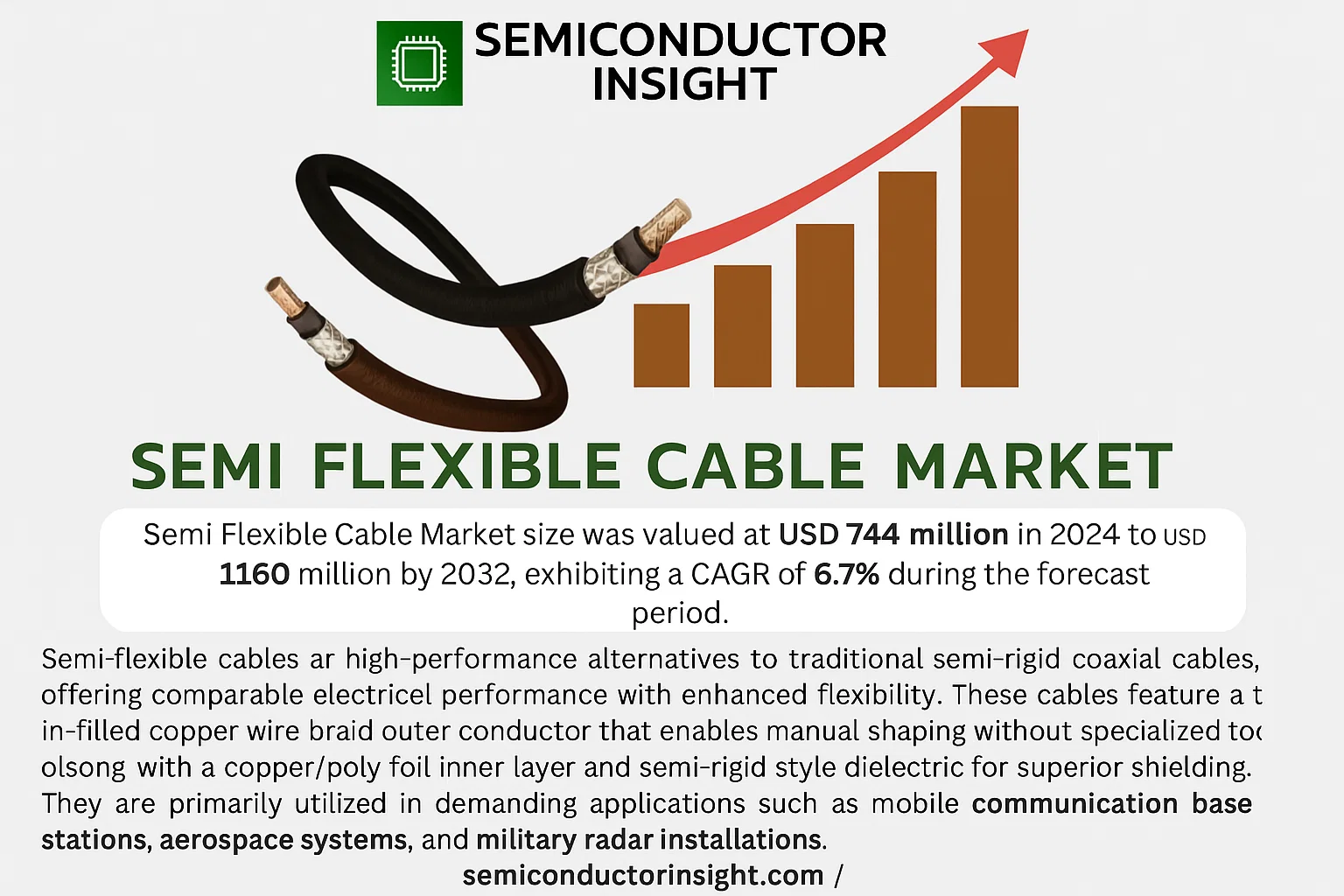
Global Semi Flexible Cable Market size was valued at USD 744 million in 2024 to USD 1160 million by 2032, exhibiting a CAGR of 6.7% during the forecast period.
Semi-flexible cables are high-performance alternatives to traditional semi-rigid coaxial cables, offering comparable electrical performance with enhanced flexibility. These cables feature a tin-filled copper wire braid outer conductor that enables manual shaping without specialized tools, along with a copper/poly foil inner layer and semi-rigid style dielectric for superior shielding. They are primarily utilized in demanding applications such as mobile communication base stations, aerospace systems, and military radar installations.
Market growth is being driven by increasing demand for reliable RF/microwave connectivity solutions across telecom and defense sectors. The expansion of 5G infrastructure and modernization of military communication systems are particularly significant contributors. Key players like Habia (18% market share), Huber-Suhner (16%), and Nexans (14%) dominate the competitive landscape, leveraging their technological expertise to meet evolving industry requirements for high-frequency signal transmission with minimal loss.
MARKET DRIVERS
Proliferation of 5G Infrastructure Deployment
The global rollout of 5G networks is a primary catalyst for the semi-flexible cable market. These cables are essential components in base station antennas, remote radio heads, and small cells due to their superior electrical performance and flexibility, which allows for easier installation in complex layouts. The demand for higher data rates and lower latency is accelerating the expansion of 5G infrastructure globally.
Growth in Aerospace and Defense Applications
The aerospace and defense sectors require highly reliable interconnection solutions that can withstand extreme environmental conditions, including vibration, temperature fluctuations, and limited space. Semi-flexible cables are increasingly adopted in avionics, radar systems, and military communications for their durability and stable signal integrity, driving significant market growth.
➤ The global market for 5G infrastructure is projected to surpass $45 billion by 2026, creating sustained demand for high-frequency coaxial cables.
Furthermore, advancements in automotive electronics, particularly in electric vehicles (EVs) and advanced driver-assistance systems (ADAS), are contributing to market expansion. Semi-flexible cables are used for sensors, infotainment, and control systems, benefiting from the trend toward vehicle electrification and connectivity.
MARKET CHALLENGES
High Material and Manufacturing Costs
Semi-flexible cables often utilize premium materials like PTFE (Teflon) and require precise manufacturing processes to maintain consistent electrical properties. These factors result in a higher cost per unit compared to standard coaxial or flexible cables, which can be a barrier for price-sensitive applications and emerging markets.
Other Challenges
Intense Competition from Alternative Solutions
The market faces competition from highly flexible cables and PCB-integrated solutions. In some cost-driven applications, designers may opt for these alternatives, despite potentially lower performance, which challenges the adoption of semi-flexible cables.
Supply Chain Vulnerabilities
The reliance on specific raw materials, such as specialized fluoropolymers, creates supply chain risks. Geopolitical tensions and trade restrictions can lead to price volatility and material shortages, impacting production timelines and cost structures for manufacturers.
MARKET RESTRAINTS
Limited Flexibility Compared to Fully Flexible Cables
While offering a balance between rigidity and flexibility, semi-flexible cables are not as pliable as fully flexible coaxial cables. This characteristic can be a restraint in applications requiring frequent bending or movement after installation, limiting their use in dynamic environments such as robotics or moving machinery.
Technical Complexity in Customization
Designing and manufacturing custom semi-flexible cables for specific impedance, frequency, and mechanical requirements involves significant engineering expertise. This complexity can lead to longer development cycles and higher costs, potentially deterring rapid prototyping and adoption in fast-moving industries.
MARKET OPPORTUNITIES
Expansion in Medical Electronics
The medical device industry presents a substantial growth opportunity, particularly for diagnostic imaging equipment like MRI and CT scanners, which require high-frequency, low-loss cables. The trend towards minimally invasive surgical tools and portable medical devices also drives the need for reliable, compact interconnect solutions.
Emerging Demand for High-Frequency Test and Measurement Equipment
As technology advances towards higher frequencies for applications in millimeter-wave and beyond-5G research, the demand for precise test and measurement equipment is rising. Semi-flexible cables are critical for ensuring accurate signal integrity in laboratory and field testing environments, opening new revenue streams.
Adoption in Satellite Communication Systems
The growth of low-earth orbit (LEO) satellite constellations for global broadband internet is creating demand for robust RF components. Semi-flexible cables are well-suited for ground station equipment and satellite payloads due to their phase stability and performance in harsh conditions, representing a significant future market.
Semi Flexible Cable Market Trends
Strong Market Growth Fueled by Communication Infrastructure
The global Semi Flexible Cable market is on a significant growth trajectory, valued at US$744 million in 2024 and projected to reach US$1160 million by 2032, reflecting a compound annual growth rate (CAGR) of 6.7%. This robust expansion is primarily driven by the continuous global deployment and upgrading of mobile communication base stations. The superior electrical performance and ease of installation of semi-flexible cables make them an ideal choice for the complex RF/microwave systems within this critical infrastructure, supporting the roll-out of 4G LTE and 5G networks.
Other Trends
Consolidated Market Leadership
The competitive landscape is characterized by a high degree of consolidation among a few key players. Habia, Huber-Suhner, and Nexans are the market leaders, capturing significant revenue shares. In 2024, Habia led the market with an 18% revenue share, followed closely by Huber-Suhner at 16% and Nexans at 14%. This concentration suggests that technological expertise, established supply chains, and strong customer relationships are critical barriers to entry and key factors for success in this specialized market.
Application Diversification and Technological Superiority
Beyond telecommunications, demand from the aerospace and military radar sectors provides stable growth avenues. The cables’ enhanced shielding, achieved through a copper/poly foil inner layer and semi-rigid style dielectric, along with their ability to be hand-formed without specialized tools, is crucial for applications requiring reliability in demanding environments. Their performance exceeds that of traditional conformable cables, making them a preferred solution where signal integrity is paramount.
Regional Market Dynamics and Segmentation
The market is segmented by type, with distinctions between Type I and Type II Semi Flexible Cables catering to different performance specifications. Geographically, Asia represents a dominant and high-growth region, fueled by massive investments in communication infrastructure in countries like China, India, and South Korea. North America and Europe remain significant markets, driven by defense expenditures and upgrades to existing network infrastructure. The regional analysis highlights varying development potentials and market spaces across the globe.
COMPETITIVE LANDSCAPE
Key Industry Players
Market Leadership Concentrated Among Established RF Cable Specialists
The global semi-flexible cable market is characterized by a high level of consolidation, with the top three players commanding a significant combined revenue share. Habia, a prominent manufacturer of high-performance cables for demanding applications, currently dominates the market with an 18% revenue share. Its leadership is attributed to a strong product portfolio and a long-standing reputation for quality in the aerospace, defense, and telecommunications sectors. Following closely is Huber-Suhner, a global supplier of electrical and optical connectivity solutions, which holds a 16% revenue share. The company’s expertise in RF technology and its extensive global distribution network contribute to its strong market position. Nexans secures the third position with a 14% share, leveraging its broad industrial cable manufacturing capabilities and significant scale to serve a diverse range of markets including mobile communication infrastructure.
Beyond the market leaders, a tier of specialized and regional manufacturers compete by focusing on specific application niches or geographical markets. Companies such as Kingsignal and Hengxin have established strong positions, particularly within the Asia-Pacific region, by catering to the robust demand from mobile communication base station deployments. Other significant players include Nissei, Hansen, and Trigiant, which offer specialized products for military, aerospace, and industrial applications. These companies compete on factors including product performance, customization capabilities, price competitiveness, and reliable supply chains to capture market share in their respective segments.
List of Key Semi Flexible Cable Companies Profiled
- Habia
- Huber-Suhner
- Nexans
- Nissei
- Kingsignal
- Hansen
- Hengxin
- Trigiant
- TGC
- Shenyu
- Axon’ Cable
- Carlisle Interconnect Technologies
- Gore
- Pasternack
- Micro-Coax
Segment Analysis:
| Segment Category | Sub-Segments | Key Insights |
| By Type |
|
Type I Semi Flexible Cable represents the foundational product category, characterized by its well-established design that balances performance with ease of installation. The primary strength of this segment lies in its broad compatibility and proven reliability across a wide range of standard applications, making it a default choice for many system integrators. In comparison, Type II cables are typically engineered for more advanced performance parameters, offering enhanced electrical characteristics or specialized construction features to meet the stringent demands of next-generation communication and radar systems, which drives their adoption in high-value segments. |
| By Application |
|
Mobile Communication Base Station is the dominant application segment due to the continuous global expansion and upgrading of telecommunications infrastructure, particularly with the rollout of 5G networks. The unique combination of superior electrical performance comparable to semi-rigid cables and the flexibility for easy installation makes semi-flexible cables indispensable for antenna feeder systems. The Aerospace and Military Radar segments are critical niches, driven by uncompromising requirements for signal integrity, durability, and reliability in extreme environments, where the ability to hand-form the cables without special tools is a significant operational advantage over fully rigid alternatives. |
| By End User |
|
Telecommunication Service Providers represent the most significant end-user segment, as they are the primary drivers behind the deployment and maintenance of mobile network infrastructure. They have a continuous demand for components that can deliver consistent performance while simplifying on-site installation and maintenance processes. |
| By Performance Specification |
|
High-Frequency/Low-Loss specifications are increasingly becoming the leading segment as modern RF and microwave systems demand minimal signal attenuation for optimal performance. This trend is tightly linked to advancements in mobile communication technologies and sophisticated radar systems. While Standard Performance cables serve cost-sensitive applications adequately, the market’s growth trajectory is heavily influenced by the adoption of premium, low-loss variants. The Extreme Environment Rated segment, designed to withstand wide temperature fluctuations, high humidity, and mechanical stress, is essential for aerospace and military applications, representing a high-value, specialized niche. |
| By Sales Channel |
|
Direct Sales (OEM) is the predominant channel for this market, particularly for large-volume contracts with major telecommunications equipment manufacturers, defense primes, and aerospace companies. This channel facilitates close technical collaboration, customization, and ensures supply chain integrity for critical applications. Distributors & System Integrators play a vital role in serving smaller OEMs and for aftermarket maintenance and repair operations, providing accessibility and local inventory. While Online Platforms are gaining traction for standardized products and smaller orders, the technical nature and customization requirements of semi-flexible cables mean traditional direct relationships remain the cornerstone of the industry’s sales strategy. |
Regional Analysis: Semi Flexible Cable Market
Asia-Pacific
The region’s unparalleled electronics manufacturing ecosystem provides a significant advantage. Dense clusters of component suppliers, cable assemblers, and OEMs create a highly efficient and cost-competitive environment for producing semi-flexible cables. This integrated supply chain allows for rapid prototyping and scaling of production to meet global demand for devices used in telecommunications, computing, and consumer electronics, ensuring a steady market for these specialized cables.
Rapid technological adoption, particularly in 5G infrastructure and the Internet of Things (IoT), is a key driver. There is strong demand for high-frequency semi-flexible cables in base stations and network equipment. The burgeoning consumer electronics market also demands thinner, more flexible cables for smartphones, wearables, and laptops, pushing local manufacturers to innovate in cable design and materials to maintain their competitive edge.
The strong industrial automation sector and the rapid transition to electric vehicles (EVs) in countries like China are creating substantial demand. Semi-flexible cables are essential for robotics, CNC machinery, and sensor systems due to their reliability and space-saving profiles. In the automotive industry, they are increasingly used in EV battery management systems and advanced infotainment, supported by strong government policies and local manufacturing capabilities.
Supportive government policies, such as “Made in China 2025” and investments in digital infrastructure across Southeast Asia, are propelling market growth. These initiatives prioritize advanced manufacturing and connectivity, directly benefiting the semi-flexible cable market. Funding for R&D in new materials and manufacturing processes helps local companies advance product performance, ensuring the region remains a leader in supplying high-quality cables for next-generation technologies.
North America
North America represents a mature yet innovation-driven market for semi-flexible cables, characterized by high demand from the aerospace, defense, and advanced telecommunications sectors. The region is a hub for research and development, with a strong focus on high-reliability applications in military communications, satellite systems, and medical devices. The rollout of 5G networks and ongoing upgrades to existing telecommunications infrastructure by major service providers create a consistent need for high-performance coaxial and RF cables. The presence of leading technology companies and a robust automotive industry, particularly in the development of electric and autonomous vehicles, further stimulates demand for specialized cabling solutions that offer durability and signal integrity in challenging environments.
Europe
The European market for semi-flexible cables is shaped by stringent regulatory standards and a strong industrial base, particularly in automotive, industrial automation, and renewable energy. The region’s automotive manufacturers, a key end-user segment, require high-quality cables for vehicle electronics, infotainment systems, and the growing electric vehicle segment. There is significant demand from the telecommunications sector for infrastructure upgrades and from the medical device industry for reliable, precision cabling. The push towards Industry 4.0 and smart manufacturing across European nations is driving the integration of advanced sensors and control systems, which rely on robust interconnect solutions like semi-flexible cables to ensure operational reliability and efficiency.
South America
The South American market for semi-flexible cables is emerging, with growth primarily fueled by gradual industrialization and infrastructure development, particularly in Brazil and Argentina. Demand is linked to the telecommunications sector, where mobile network expansions are occurring, and the industrial sector, including mining and energy. The market is price-sensitive, and adoption is often driven by the need for reliable components in harsh industrial environments. While the region does not yet have the same level of advanced manufacturing or R&D investment as other areas, increasing foreign investment and economic stabilization efforts are expected to create more opportunities for market growth over the coming years.
Middle East & Africa
The Middle East & Africa region shows diverse and growing potential for semi-flexible cables, driven by large-scale infrastructure projects, telecommunications expansion, and the energy sector. In the Middle East, investments in smart city initiatives, 5G deployment, and oil & gas infrastructure create demand for high-performance cabling. Africa’s growth is more fragmented but is supported by mobile network rollouts in Sub-Saharan Africa and infrastructure development projects. The market is characterized by a need for durable cables that can withstand extreme environmental conditions, with opportunities emerging in renewable energy projects and gradual industrial automation efforts.
Report Scope
This market research report provides a comprehensive analysis of the Semi Flexible Cable Market , covering the forecast period 2025–2032. It offers detailed insights into market dynamics, technological advancements, competitive landscape, and key trends shaping the industry.
Key focus areas of the report include:
- Market Overview: The report begins with an overview outlining its current market scenario, key growth indicators, and industry transformation drivers. It discusses macroeconomic factors, demand–supply balance, regulatory landscape, and the strategic role of semiconductors in powering advancements across industries such as automotive, telecommunications, consumer electronics, and industrial automation.
- Market Size & Forecast: Historical data and future projections for revenue, unit shipments, and market value across major regions and segments.
- Segmentation Analysis: Detailed breakdown by product type, technology, application, and end-user industry to identify high-growth segments and investment opportunities.
- Regional Insights: Insights into market performance across North America, Europe, Asia-Pacific, Latin America, and the Middle East & Africa, including country-level analysis where relevant.
- Competitive Landscape: Profiles of leading market participants, including their product offerings, R&D focus, manufacturing capacity, pricing strategies, and recent developments such as mergers, acquisitions, and partnerships.
- Technology Trends & Innovation: Assessment of emerging technologies, integration of AI/IoT, semiconductor design trends, fabrication techniques, and evolving industry standards.
- Market Drivers & Restraints: Evaluation of factors driving market growth along with challenges, supply chain constraints, regulatory issues, and market-entry barriers.
- Stakeholder Insights: Insights for component suppliers, OEMs, system integrators, investors, and policymakers regarding the evolving ecosystem and strategic opportunities.
Primary and secondary research methods are employed, including interviews with industry experts, data from verified sources, and real-time market intelligence to ensure the accuracy and reliability of the insights presented.
FREQUENTLY ASKED QUESTIONS:
What is the current market size of Semi Flexible Cable Market?
-> Global Semi Flexible Cable Market was valued at USD 744 million in 2024 and is projected to reach USD 1160 million by 2032.
Which key companies operate in Semi Flexible Cable Market?
-> Key players include Habia, Huber-Suhner, Nexans, Nissei, Kingsignal, Hansen, Hengxin, Trigiant, TGC, and Shenyu, among others.
What are the key growth drivers?
-> Key growth drivers include advancements in mobile communication base stations, expansion in aerospace and military radar applications, and demand for cables with enhanced shielding and superior performance compared to traditional conformable cables.
Which region dominates the market?
-> The report provides a detailed regional breakdown, covering market performance across North America, Europe, Asia, South America, and the Middle East & Africa.
What are the emerging trends?
-> Emerging trends include the adoption of Semi-Flex cables as a proven alternative to traditional Semi-Rigid Coaxial Cables, offering comparable electrical performance with simple hand-forming capability and enhanced shielding.

Get Sample Report PDF for Exclusive Insights
Report Sample Includes
- Table of Contents
- List of Tables & Figures
- Charts, Research Methodology, and more...
 Download Sample Report PDF