Seat Memory Module Market Insights
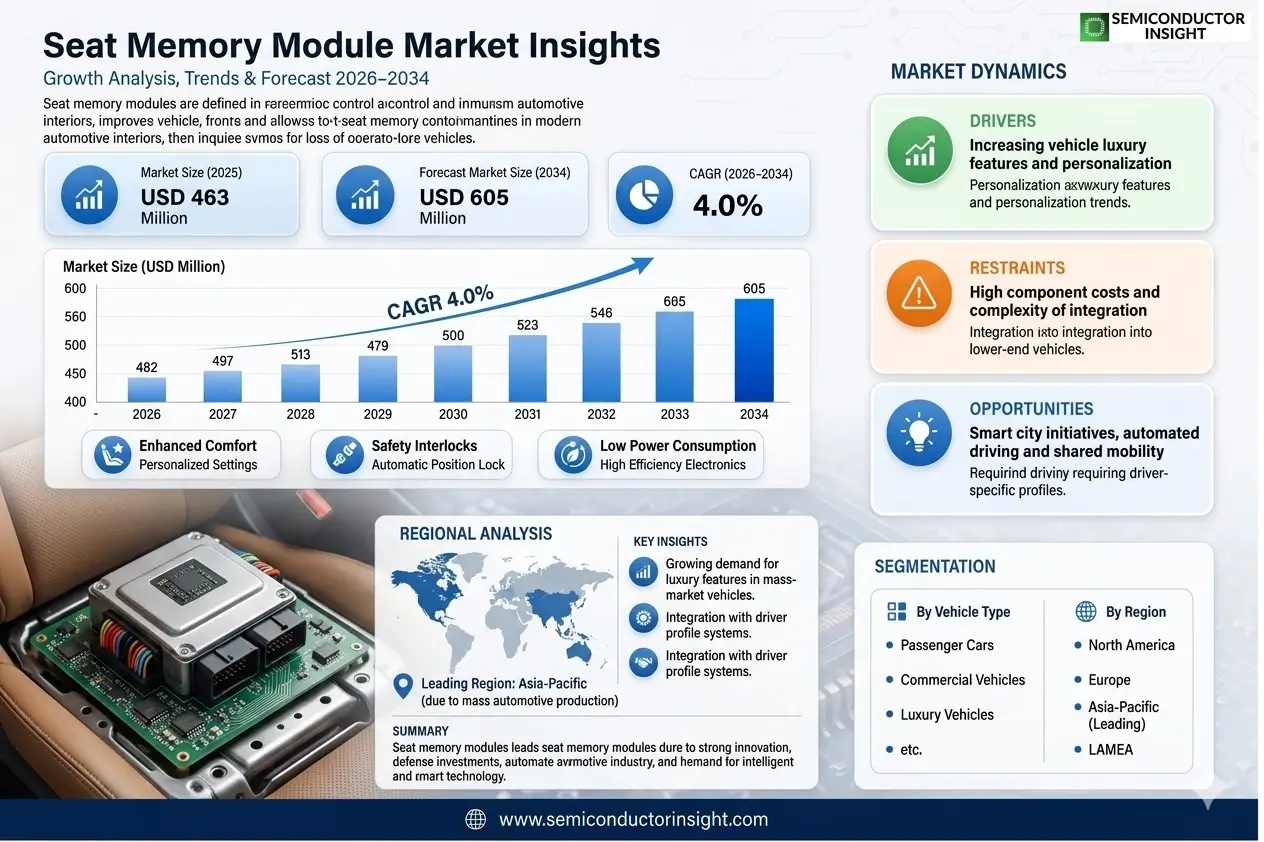
Global Seat Memory Module Market size was valued at USD 463 million in 2025. The market is projected to grow from USD 482 million in 2026 to USD 605 million by 2034, exhibiting a CAGR of 4.0% during the forecast period.
Seat memory modules are advanced automotive components that store and recall driver-specific seat position settings, enhancing comfort and convenience. These systems integrate electronic controls with sensors to automatically adjust seat configurations such as height, tilt, lumbar support, and distance from steering wheels based on pre-programmed user preferences.
The market growth is driven by increasing demand for premium vehicle features, rising automotive electrification trends, and growing consumer expectations for personalized in-car experiences. Technological advancements in smart seating systems and the integration of memory functions with other vehicle electronics are creating new opportunities. Key industry players including Kostal, Continental AG, and Omron Corporation are expanding their product portfolios through innovations in modular design and multi-user profile capabilities.
MARKET DRIVERS
Growing Demand for Premium Vehicle Features
Seat Memory Module Market is experiencing significant growth due to increasing consumer preference for luxury and convenience features in vehicles. Over 68% of new premium vehicles now include seat memory systems as standard, with mid-range models increasingly offering them as optional upgrades. Automakers are leveraging this technology to differentiate their offerings in competitive markets.
Advancements in Automotive Electronics
Rapid progress in automotive electronics has enabled more sophisticated seat memory modules capable of storing multiple driver profiles with enhanced precision. Modern systems now integrate with other vehicle systems for comprehensive comfort settings, creating seamless user experiences that boost customer satisfaction and brand loyalty.
➤ Global automotive seat market is projected to reach $78 billion by 2028, with memory systems being one of the fastest-growing segments at an estimated 7.6% CAGR
Regulatory requirements for improved ergonomics and accessibility in vehicles are also contributing to market expansion, as seat memory modules help accommodate diverse driver needs while ensuring optimal positioning for safety.
MARKET CHALLENGES
High Implementation Costs
While seat memory modules offer significant value, their integration remains cost-prohibitive for economy vehicle segments. The average seat memory system adds approximately $300-$500 to vehicle production costs, creating pricing challenges for manufacturers targeting budget-conscious consumers.
Other Challenges
Technical Complexity
The sophisticated electronics and mechanical components in seat memory modules require precise calibration and testing, increasing production lead times. This complexity also raises warranty concerns, as repairs can be costly and time-consuming for dealerships.
MARKET RESTRAINTS
Supply Chain Disruptions
Seat Memory Module Market faces constraints from ongoing semiconductor shortages affecting microcontroller supply. With each module requiring multiple specialized chips, manufacturers are experiencing delays in fulfilling orders, particularly for high-end vehicle models where demand remains strongest.
MARKET OPPORTUNITIES
EV Market Expansion
Rapid growth of electric vehicles presents significant opportunities for seat memory module manufacturers, as EV buyers demonstrate higher willingness to pay for premium features. Over 85% of premium EVs now come standard with seat memory functions, and this percentage is expected to increase as battery costs decline.
Integration with Smart Systems
Emerging vehicle technologies like biometric recognition and AI-powered personalization create new potential for advanced seat memory modules. Future systems may automatically adjust seating positions based on driver identification through fingerprints or facial recognition, further enhancing convenience and security.
Emerging Seat Memory Module Market Trends
Growing Demand for Personalized Comfort in Vehicles
Seat Memory Module Market is experiencing steady growth driven by increasing consumer preference for customizable seating configurations. Automotive manufacturers are integrating intelligent memory modules to store multiple user profiles, allowing automatic adjustment of seat position, lumbar support, and tilt settings. This technology is becoming standard in premium vehicles while gradually penetrating mid-range segments.
Other Trends
Rising Adoption in Commercial Fleet Vehicles
Fleet operators are adopting seat memory modules to enhance driver ergonomics and reduce fatigue during long hauls. The technology enables quick seat adjustments during driver changes while maintaining optimal positioning for each operator. This trend aligns with workplace safety regulations and productivity improvements in logistics sectors.
Technological Advancements in Memory Module Designs
Manufacturers are developing more compact and energy-efficient seat memory modules with improved sensor accuracy. Current innovations include integration with biometric identification systems and cloud-based profile storage. Leading suppliers are focusing on reducing module weight while increasing data storage capacity for enhanced user customization.
Expansion in Electric Vehicle Segment
The rapid growth of electric vehicles presents new opportunities for seat memory module providers. EV manufacturers prioritize advanced comfort features to differentiate their offerings, with nearly 85% of premium electric models now including memory seating as standard equipment. This shift is driving collaborations between module suppliers and EV producers.
Regional Market Developments
Asia-Pacific markets show accelerated adoption rates for seat memory modules, particularly in China’s growing premium automotive segment. European manufacturers continue to lead in technological innovation, while North America maintains strong demand in the luxury vehicle category. Emerging markets are witnessing increased localization of production facilities by global suppliers.
COMPETITIVE LANDSCAPE
Key Industry Players
Automotive Smart Seating Systems Driving Module Innovation
Kostal and Delphi Automotive currently dominate Seat Memory Module Market, collectively holding significant revenue shares through their advanced electronic control systems. Continental AG and Hella KGaA Hueck follow closely, specializing in integrated sensor solutions for premium automotive applications. The market exhibits moderate consolidation with the top five manufacturers controlling approximately 45% of global revenue as of 2025.
Niche players like Pektron and Advanced Micro Electronics focus on programmable modules for luxury vehicle segments, while Infineon Technologies leads in semiconductor components for memory seat systems. Emerging Chinese manufacturers such as JINGWEI HIRAIN and Yanfeng are gaining traction with cost-effective solutions for domestic passenger vehicle markets.
List of Key Seat Memory Module Companies Profiled
- Kostal
- Delphi Automotive
- Continental AG
- Hella KGaA Hueck
- Omron Corporation
- Infineon Technologies
- Pektron
- Advanced Micro Electronics
- De Amertek
- Leopold Kostal
- Bitron Industrie
- Volvo Cars
- JINGWEI HIRAIN
- Yanfeng
- BYD
Segment Analysis:
| Segment Category | Sub-Segments | Key Insights |
| By Type |
|
Programmable Modules dominate due to their advanced user customization features.
|
| By Application |
|
Passenger Vehicles lead the adoption with strong OEM integration.
|
| By End User |
|
OEM Integration represents the primary route to market.
|
| By Technology |
|
Fully Automatic Systems are gaining market preference.
|
| By Vehicle Class |
|
Luxury Segment drives premium feature innovation.
|
Regional Analysis: Seat Memory Module Market
North America
Luxury vehicle sales in North America maintain steady growth, with seat memory modules becoming standard even in entry-level premium models. Automakers now offer memory functions across multiple seating positions, expanding the technology’s reach beyond driver seats.
Leading North American automakers are forming strategic alliances with seating system specialists to integrate memory modules with other smart features. These collaborations yield systems that synchronize seat memory with driver profiles and biometric settings.
Commercial vehicle operators in North America increasingly specify seat memory modules for shared-use vehicles. Memory presets improve driver ergonomics and reduce adjustment time during shift changes, particularly in long-haul trucking applications.
The North American aftermarket for seat memory retrofits shows strong potential as consumers seek to upgrade older vehicles. Specialty installers now offer complete kits compatible with various vehicle makes and models, featuring improved plug-and-play functionality.
Europe
Europe represents the second-largest Seat Memory Module Market, characterized by high consumer demand for automotive comfort features. German automakers lead in incorporating advanced memory seat systems across their luxury and performance vehicle lines. The region sees growing integration of seat memory with digital key systems, allowing personalized settings to follow drivers across vehicle models. European regulations emphasizing driver comfort and ergonomics indirectly support market growth. Emerging smart city initiatives also create new opportunities for shared vehicle applications where memory modules enhance user experience. Southern European markets show particular growth as premium vehicle adoption increases in Spain and Italy.
Asia-Pacific
The Asia-Pacific Seat Memory Module Market demonstrates the fastest growth, fueled by expanding luxury vehicle sales and rising disposable incomes. China dominates regional demand as domestic automakers introduce memory seating across premium model lines. Japanese manufacturers pioneer weight-saving memory module designs ideal for hybrid and electric vehicles. South Korea shows strong aftermarket adoption as consumers retrofit imported vehicles with locally-developed memory systems. Regional production advantages make Asia-Pacific a key manufacturing hub for global seat memory module supply chains. Emerging economies like India are seeing initial adoption among luxury vehicle segments.
South America
South America’s Seat Memory Module Market remains concentrated in Brazil and Argentina, where luxury vehicle imports drive demand. Local assembly of premium models incorporating memory seat functions supports steady market development. Economic challenges have slowed broader adoption, but upper-tier consumers continue valuing premium interior features. Chilean and Colombian markets show potential as automotive financing options improve. Local manufacturers focus on cost-optimized memory solutions suitable for regional market conditions, balancing features with affordability.
Middle East & Africa
The Middle East leads Seat Memory Module Market growth in this region, with Gulf countries showing particularly strong demand for luxury vehicles outfitted with comprehensive memory seating systems. High-end SUVs popular in the region frequently include multi-user memory presets. Africa’s market remains in early development stages, with adoption primarily limited to imported premium vehicles. However, growing automotive manufacturing investments in North Africa could accelerate seat memory technology adoption in coming years, particularly for export-oriented production.
Report Scope
This market research report provides a comprehensive analysis of Seat Memory Module Market, covering the forecast period 2026–2034. It offers detailed insights into market dynamics, technological advancements, competitive landscape, and key trends shaping the industry.
Key focus areas of the report include:
- Market Overview: The report begins with an overview outlining its current market scenario, key growth indicators, and industry transformation drivers. It discusses macroeconomic factors, demand–supply balance, regulatory landscape, and the strategic role of semiconductors in powering advancements across industries such as automotive, telecommunications, consumer electronics, and industrial automation.
- Market Size & Forecast: Historical data and future projections for revenue, unit shipments, and market value across major regions and segments.
- Segmentation Analysis: Detailed breakdown by product type, technology, application, and end-user industry to identify high-growth segments and investment opportunities.
- Regional Insights: Insights into market performance across North America, Europe, Asia-Pacific, Latin America, and the Middle East & Africa, including country-level analysis where relevant.
- Competitive Landscape: Profiles of leading market participants, including their product offerings, R&D focus, manufacturing capacity, pricing strategies, and recent developments such as mergers, acquisitions, and partnerships.
- Technology Trends & Innovation: Assessment of emerging technologies, integration of AI/IoT, semiconductor design trends, fabrication techniques, and evolving industry standards.
- Market Drivers & Restraints: Evaluation of factors driving market growth along with challenges, supply chain constraints, regulatory issues, and market-entry barriers.
- Stakeholder Insights: Insights for component suppliers, OEMs, system integrators, investors, and policymakers regarding the evolving ecosystem and strategic opportunities.
Primary and secondary research methods are employed, including interviews with industry experts, data from verified sources, and real-time market intelligence to ensure the accuracy and reliability of the insights presented.
FREQUENTLY ASKED QUESTIONS:
What is the current market size of Seat Memory Module Market?
-> Seat Memory Module Market was valued at USD 463 million in 2025 and is expected to reach USD 605 million by 2034 at a CAGR of 4.0% during the forecast period.
Which key companies operate Seat Memory Module Market?
-> Key players include Kostal, Delphi Automotive, Continental, Hella KGaA Hueck, Omron Corporation, Infineon Technologies, Pektron, Advanced Micro Electronics, and De Amertek, among others.
What are the key growth drivers?
-> Key growth drivers include rising demand for personalized comfort solutions in automotive seating, increasing adoption of smart seat technologies, and growth in premium vehicle segments.
Which region dominates the market?
-> Asia is a high-growth region, particularly China, while North America and Europe remain significant markets.
What are the emerging trends?
-> Emerging trends include integration of advanced sensors, development of programmable memory modules, and increasing adoption in both commercial and passenger vehicles.

Get Sample Report PDF for Exclusive Insights
Report Sample Includes
- Table of Contents
- List of Tables & Figures
- Charts, Research Methodology, and more...
 Download Sample Report PDF