Seamless Splicing Display Market Insights
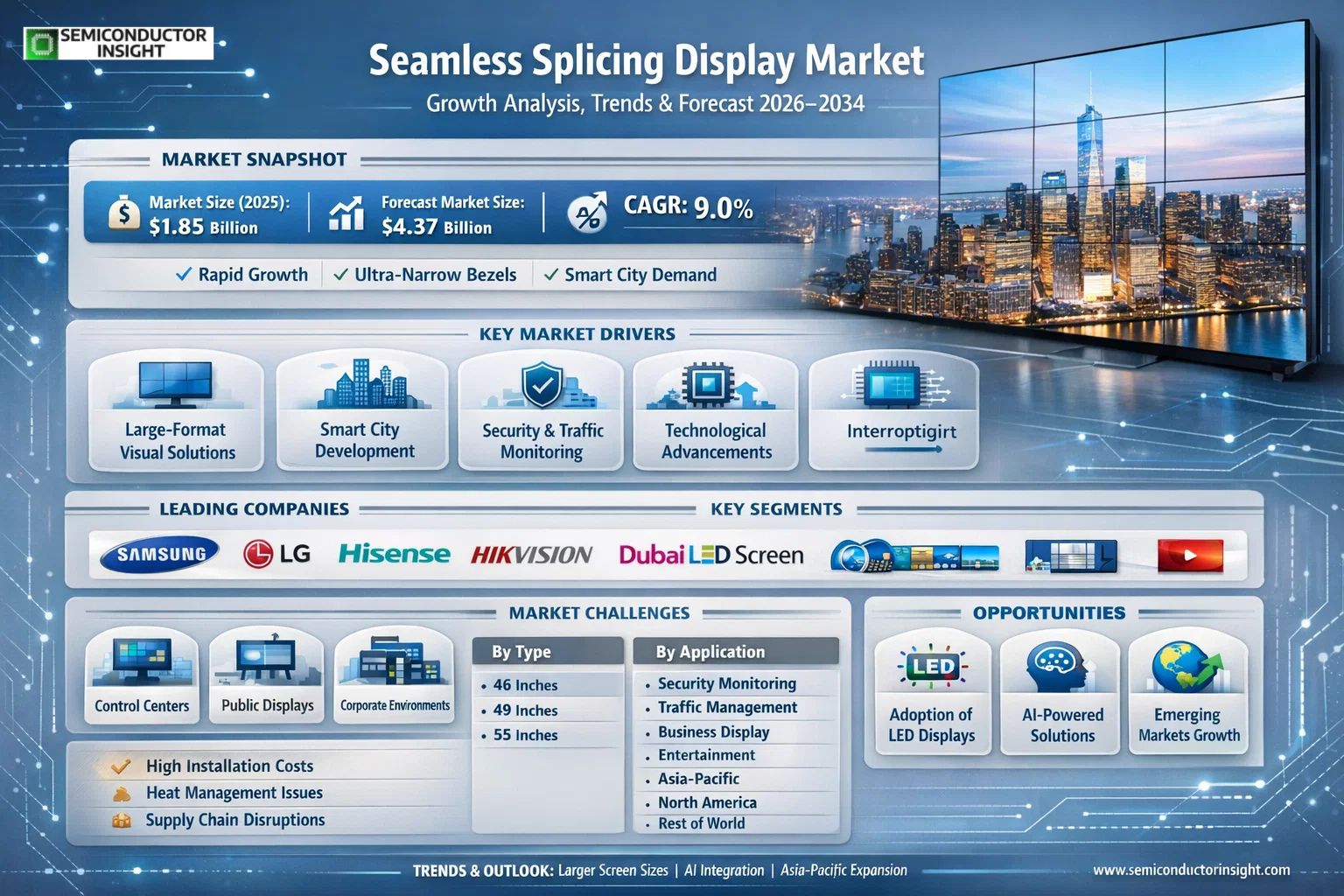
Global Seamless Splicing Display market size was valued at USD 1.85 billion in 2025. The market is projected to grow from USD 2.01 billion in 2026 to USD 4.37 billion by 2034, exhibiting a CAGR of 9.0% during the forecast period.
Seamless splicing display is a display system composed of multiple display modules or screens, engineered to reduce or eliminate visual gaps at splicing points , delivering a more coherent and visually immersive image experience. These display systems are widely deployed across public venues, corporate conference rooms, security and traffic control centers, outdoor billboards, and entertainment environments. Available in standard panel sizes including 46 inches, 49 inches, and 55 inches, seamless splicing displays leverage advanced LCD and LED backlight technologies to achieve ultra-narrow bezels, often as thin as 1.7 mm, enabling large-format video walls with minimal visual disruption.
The market is witnessing robust expansion driven by escalating demand for high-definition surveillance infrastructure, smart city development initiatives, and the rapid digitization of public and commercial spaces. Furthermore, growing investments in traffic management systems and command-and-control centers across emerging economies are significantly broadening the addressable market. Key global manufacturers shaping this competitive landscape include Samsung, LG, Hisense, Hikvision, Dahua Technology, and Zhejiang Uniview Technologies, among others, who continue to advance product innovation through tighter bezel engineering, 4K resolution integration, and AI-driven content management capabilities.
MARKET DRIVERS
Rising Demand for Large-Format Visual Solutions Across Commercial Sectors
seamless splicing display market is experiencing robust growth driven by the accelerating adoption of large-format, high-resolution visual systems across commercial, retail, and public infrastructure environments. Enterprises increasingly prioritize immersive visual communication to enhance customer engagement and brand visibility, positioning seamless display walls as a strategic asset. The ability to deliver uninterrupted, edge-to-edge imagery across multi-panel configurations has made seamless splicing displays the preferred choice over conventional display setups in control rooms, corporate lobbies, and experiential retail spaces. As organizations invest in modernizing their visual communication infrastructure, demand for seamless splicing display solutions continues to strengthen.
Expansion of Smart City Infrastructure and Public Safety Applications
Government investments in smart city projects and public safety monitoring systems represent a significant growth catalyst for seamless splicing display market. Command and control centers, traffic management authorities, and emergency response agencies are increasingly deploying multi-screen display walls to aggregate real-time data feeds, surveillance streams, and geographic information system outputs. The need for continuous, distortion-free visual monitoring across expansive display surfaces directly elevates the utility of seamless splicing technologies. Urban development programs across Asia-Pacific, the Middle East, and North America are incorporating seamless video wall systems as fundamental components of intelligent infrastructure planning.
➤ The integration of seamless splicing display systems within mission-critical environments such as utility management centers and national security command hubs underscores the technology’s reliability and scalability advantages over conventional display architectures.
Technological advancements in display panel manufacturing, particularly the commercialization of ultra-narrow bezel LCD and direct-view LED technologies, have substantially lowered the visible gap between adjacent panels. This engineering progress has made seamless splicing displays more visually convincing and functionally superior, reinforcing their adoption across broadcast studios, simulation environments, and high-end hospitality venues. Continued innovation in display uniformity calibration and multi-source signal processing further strengthens the market’s growth trajectory.
MARKET CHALLENGES
High Installation Complexity and Total Cost of Ownership Constraints
Despite strong demand signals, seamless splicing display market faces meaningful challenges related to the technical complexity and financial commitment associated with large-format installations. Deploying multi-panel seamless display systems requires specialized structural mounting frameworks, precision calibration equipment, and skilled integration personnel, all of which contribute to elevated project costs and extended deployment timelines. For mid-sized enterprises and budget-constrained public sector entities, the total cost of ownership , encompassing hardware procurement, professional installation, ongoing maintenance, and periodic panel replacement , can represent a significant barrier to adoption. This dynamic tends to concentrate demand among large enterprise and government customers, limiting broader market penetration.
Other Challenges
Heat Management and Long-Term Panel Uniformity
Seamless splicing display walls operating continuously in mission-critical or high-ambient-temperature environments are susceptible to thermal stress, which can accelerate panel degradation and compromise color uniformity over time. Maintaining consistent brightness, color temperature, and white balance across multiple display units requires sophisticated calibration software and periodic manual adjustment, adding to operational complexity and maintenance expenditure for end users.
Supply Chain Vulnerability for Specialty Display Components
seamless splicing display market remains exposed to supply chain disruptions affecting specialty components such as ultra-narrow bezel panels, high-density LED modules, and proprietary signal processing chips. Geopolitical factors, raw material constraints, and semiconductor availability fluctuations can create procurement delays and cost volatility, challenging manufacturers’ ability to meet project delivery schedules and maintain stable pricing for system integrators and end customers.
MARKET RESTRAINTS
Intense Price Competition and Margin Compression Among Display Manufacturers
The increasing participation of low-cost regional manufacturers, particularly from China and Southeast Asia, has intensified price competition within seamless splicing display market, placing downward pressure on average selling prices and compressing profit margins for established vendors. While competitive pricing benefits cost-sensitive buyers, it simultaneously creates challenges for manufacturers investing in research and development, premium materials, and advanced quality assurance processes. Vendors unable to differentiate through technology innovation or service excellence risk commoditization, which could inhibit long-term investment in next-generation seamless display technologies.
Interoperability Limitations and Proprietary Ecosystem Lock-In
A persistent structural restraint in seamless splicing display market involves the fragmented interoperability landscape, where proprietary signal processing platforms, content management software, and hardware control systems from different vendors frequently lack cross-compatibility. End users investing in a specific manufacturer’s seamless display ecosystem may encounter significant switching costs and integration friction when attempting to incorporate third-party content sources, control systems, or expansion panels. This ecosystem lock-in dynamic can delay purchasing decisions, particularly among enterprise buyers conducting multi-vendor technology evaluations, and may slow overall market expansion in segments where standardization is absent.
MARKET OPPORTUNITIES
Accelerating Adoption of Direct-View LED Technology in Premium Display Segments
The rapid maturation of fine-pitch and micro-pitch direct-view LED technology presents a compelling growth opportunity for seamless splicing display market, particularly in premium commercial and entertainment applications. Direct-view LED panels inherently eliminate the bezel gap challenge that constrains LCD-based seamless walls, enabling truly continuous image surfaces at large scales. As manufacturing efficiencies drive down per-unit costs for fine-pitch LED modules, adoption is expanding beyond broadcast and flagship retail into corporate campuses, higher education institutions, and luxury hospitality environments. Vendors positioned to offer competitive LED-based seamless display systems stand to capture significant incremental revenue as this technology transition accelerates.
Integration with AI-Driven Content Management and Real-Time Data Visualization Platforms
The convergence of seamless splicing display systems with artificial intelligence-powered content orchestration and real-time data visualization platforms represents a high-value opportunity for market participants. Intelligent display management solutions capable of dynamically routing, scaling, and contextualizing content across multi-panel configurations are increasingly demanded by control room operators, financial trading floors, and smart retail environments. Vendors developing software ecosystems that enhance the functional intelligence of seamless display hardware , including predictive maintenance diagnostics, automated brightness calibration, and audience analytics integration , are well-positioned to command premium pricing and build defensible competitive advantages in the evolving seamless splicing display market.
Emerging Market Expansion Driven by Infrastructure Modernization Initiatives
Significant untapped demand exists across emerging economies in Southeast Asia, Latin America, and Sub-Saharan Africa, where accelerating urbanization, expanding airport and transit infrastructure, and growing retail modernization investments are creating new deployment opportunities for seamless splicing display solutions. As regional governments and private sector developers upgrade public spaces, transportation hubs, and commercial facilities, demand for large-format display systems is expected to intensify. Manufacturers and system integrators that establish localized distribution networks, flexible financing structures, and region-specific service capabilities are positioned to capture early-mover advantages in these high-growth geographies.
Trends
Rising Demand Across Control Centers and Public Infrastructure Drives seamless splicing display market
seamless splicing display market is witnessing sustained growth driven by expanding adoption across security monitoring, traffic management, and control center applications. Seamless splicing display systems, which combine multiple display modules to eliminate visible gaps at junctions, are increasingly preferred in environments where visual continuity is critical. Industries such as public safety, smart transportation, and enterprise operations are accelerating deployments of these systems to support real-time data visualization and command-and-control operations. The growing complexity of urban infrastructure and the need for high-resolution, uninterrupted visual feeds are among the most prominent structural drivers shaping current market dynamics.
Other Trends
Shift Toward Larger Screen Formats and Standardized Sizes
Within seamless splicing display market, the 55-inch segment has gained considerable traction due to its balance between resolution density and installation flexibility, making it a preferred choice for large-scale deployments in conference rooms and business display environments. Meanwhile, the 46-inch and 49-inch variants continue to hold relevance in cost-sensitive deployments and space-constrained installations. Manufacturers including Samsung, LG, Hisense, and Hikvision are actively developing product lines across these standardized sizes to cater to diverse end-user requirements, with competitive differentiation increasingly focused on bezel width reduction, brightness uniformity, and long-term reliability.
Asia-Pacific Emerging as a High-Growth Regional Market
The Asia-Pacific region, led by China, is emerging as a dominant force in seamless splicing display market, supported by large-scale government investments in smart city infrastructure, surveillance networks, and transportation management systems. Domestic manufacturers such as Hikvision, Dahua Technology, Zhejiang Uniview Technologies, and Mankun Technology are strengthening their regional foothold through competitive pricing strategies and localized product development. Southeast Asia and India are also registering rising demand as public sector digitization programs gain momentum, further broadening the regional opportunity landscape for seamless display technologies.
Entertainment and Business Display Applications Expanding the Market Scope
Beyond traditional command-and-control use cases, seamless splicing display market is experiencing growing penetration in entertainment venues, retail environments, and corporate settings. High-impact visual experiences enabled by seamless display walls are increasingly sought after for brand activations, digital signage installations, and immersive presentation environments. This diversification of application segments is broadening the addressable market for global players and encouraging investment in advanced display technologies, including ultra-narrow bezel panels and enhanced color calibration systems. As competition intensifies among key manufacturers, innovation in installation efficiency and total cost of ownership reduction is expected to remain a central strategic priority across seamless splicing display market.
COMPETITIVE LANDSCAPE
Key Industry Players
Seamless Splicing Display Market , Competitive Dynamics, Strategic Positioning, and Leading Manufacturer Profiles
Global Seamless Splicing Display market is characterized by intense competition among a mix of established multinational electronics giants and specialized display technology manufacturers. Samsung and LG continue to dominate the upper tier of the competitive hierarchy, leveraging their advanced panel manufacturing capabilities, extensive R&D investment, and global distribution networks to maintain commanding revenue shares. These industry leaders set the benchmark for image quality, bezel minimization, and system integration, particularly across premium deployments in control centers, traffic management infrastructure, and large-scale business display environments. Hikvision and Dahua Technology have also emerged as formidable competitors, capitalizing on their deep-rooted expertise in security and surveillance ecosystems to position seamless splicing display solutions as integral components of intelligent monitoring and smart city projects. Hisense further strengthens the competitive field with its cost-competitive product portfolio and growing global footprint, targeting both mid-market enterprise clients and regional system integrators seeking scalable display solutions.
Beyond the top-tier players, a robust cohort of specialized and regional manufacturers continues to intensify competitive pressure across niche verticals and emerging markets. Companies such as Noark Group, Glozeal, Createview International, Mankun Technology, Kingfung, Vican, KINGLY LED, Shenzhen Nainuo, and Zhejiang Uniview Technologies have carved out meaningful market positions by offering highly customizable display configurations, competitive pricing structures, and localized after-sales support , particularly across Asia-Pacific markets where demand for seamless splicing displays in security monitoring, entertainment, and public signage applications is accelerating. Spiriyo and Dubai LED Screen address geographically distinct demand clusters in the Middle East and select international markets, contributing to the market’s increasingly fragmented and regionalized competitive landscape. As the industry progresses toward higher-resolution panels, narrower bezels, and AI-integrated display management systems, competitive differentiation will increasingly hinge on technological innovation, supply chain resilience, and the ability to deliver end-to-end turnkey solutions across diverse application segments.
List of Key Seamless Splicing Display Companies Profiled
- Samsung
- LG
- Hisense
- Hikvision
- Dubai LED Screen
- Spiriyo
- Noark Group
- Glozeal
- Createview International
- Mankun Technology
- Kingfung
- Vican
- KINGLY LED
- Shenzhen Nainuo
- Zhejiang Uniview Technologies Co., Ltd.
- Dahua Technology
Segment Analysis:
| Segment Category | Sub-Segments | Key Insights |
| By Type |
|
55 Inches is the leading segment in seamless splicing display market by screen size, driven by its optimal balance between visual impact and spatial efficiency across a wide range of deployment environments.
|
| By Application |
|
Security Monitoring represents the dominant application segment for Seamless Splicing Displays, underpinned by escalating global demand for comprehensive surveillance infrastructure across urban, industrial, and institutional settings.
|
| By End User |
|
Government & Public Safety is the leading end-user segment, reflecting robust procurement activity from municipal authorities, defense agencies, and public security departments investing in advanced visual infrastructure.
|
| By Technology |
|
LCD Seamless Splicing Display currently holds the leading position within the technology segment, owing to its mature manufacturing ecosystem, cost-effective production scalability, and proven performance across diverse indoor deployment scenarios.
|
| By Installation Type |
|
Fixed Installation dominates the installation type segment, as the vast majority of seamless splicing display deployments are purpose-built for permanent infrastructure in command centers, corporate lobbies, retail flagship stores, and public venues.
|
Regional Analysis: Seamless Splicing Display Market
Asia-Pacific
China commands a pivotal role in seamless splicing display market as both the world’s largest manufacturer and a high-volume domestic consumer. State-driven smart city programs, surveillance infrastructure expansion, and the modernization of public transportation networks have generated sustained demand. Chinese display manufacturers continue to invest heavily in next-generation micro-LED and fine-pitch LED panel technologies, reinforcing the country’s competitive advantage across global supply chains.
South Korea and Japan contribute significantly to seamless splicing display market through relentless technological innovation. Both nations house globally recognized display conglomerates focused on ultra-narrow bezel engineering, superior color accuracy, and energy-efficient panel design. Their technologies are widely adopted in premium corporate environments, broadcast studios, and high-end retail applications, setting quality standards that influence procurement decisions across international markets.
Southeast Asian economies including India, Vietnam, and Indonesia are emerging as high-potential markets within the regional seamless splicing display landscape. Accelerating investments in commercial infrastructure, hospitality, and retail modernization are creating fresh demand for large-format display installations. Increasing foreign direct investment in manufacturing and a growing middle-class consumer base are collectively expanding the addressable market for seamless splicing display solutions across this diverse subregion.
Public sector investment plays a transformative role in shaping Asia-Pacific’s seamless splicing display market dynamics. Governments across the region are deploying large-scale digital infrastructure in traffic management centers, emergency response facilities, and public information systems. National digitization roadmaps prioritize intelligent display ecosystems, creating long-term procurement pipelines and encouraging local manufacturers to align product development with evolving government specifications and standards.
North America
North America represents a mature and technology-forward market for seamless splicing displays, characterized by strong enterprise-level demand and a culture of early technology adoption. The United States leads regional consumption, with significant deployments concentrated in corporate command centers, broadcast media facilities, sports arenas, and high-traffic retail environments. The growing emphasis on immersive customer experiences and real-time data visualization in sectors such as finance, defense, and healthcare continues to sustain demand for advanced seamless splicing display solutions. Canadian markets mirror similar trends, particularly within urban commercial real estate and entertainment sectors. The region’s well-established IT infrastructure and strong purchasing power support the integration of cutting-edge display technologies. Additionally, the expansion of digital-out-of-home advertising and experiential marketing strategies is generating recurring investment cycles in large-format seamless display installations across the continent, reinforcing North America’s position as a key revenue-generating geography in Global seamless splicing display market.
Europe
Europe maintains a significant and steadily growing presence in seamless splicing display market, supported by stringent quality standards, high investment in digital infrastructure, and strong demand from the corporate, retail, and public sector verticals. Germany, the United Kingdom, and France serve as the primary consumption centers, with widespread adoption observed in control room installations, transportation hubs, and flagship retail environments. European procurement practices increasingly prioritize energy efficiency and sustainability credentials, encouraging display manufacturers to develop eco-friendly splicing solutions that align with regional environmental directives. The region’s robust hospitality and tourism industries also contribute to demand for premium visual display environments. Government digitization programs across the European Union are facilitating broader deployment of seamless splicing display technologies in public administration and smart urban infrastructure, positioning Europe as a stable and quality-driven market with consistent long-term growth potential through the forecast period.
South America
South America presents a developing but progressively expanding market for seamless splicing displays, with Brazil and Argentina serving as the primary demand centers. Economic modernization efforts, coupled with growing investments in commercial real estate, retail infrastructure, and event management facilities, are gradually broadening the adoption of seamless splicing display technologies across the continent. The region’s entertainment industry and increasing corporate digitization initiatives are driving interest in high-impact visual display solutions. While budget sensitivity and import dependency represent ongoing challenges, the rising influence of international display brands and the growing availability of mid-range seamless splicing products are making the technology more accessible. As infrastructure development accelerates and digital literacy improves across urban centers, South America is expected to register improving growth momentum within Global seamless splicing display market landscape over the coming years.
Middle East & Africa
The Middle East and Africa region is an increasingly prominent market in Global seamless splicing display industry, propelled by ambitious urban development projects, luxury hospitality investments, and large-scale entertainment infrastructure across Gulf Cooperation Council nations. Countries such as the United Arab Emirates and Saudi Arabia are at the forefront of deploying seamless splicing display solutions in mega-projects, smart city developments, and high-profile public venues, reflecting a strong appetite for premium visual technologies. The broader Africa region, while at an earlier stage of market maturity, is witnessing gradual adoption of seamless display systems in commercial and institutional settings, particularly in South Africa and Nigeria. Government modernization programs and expanding retail sectors across both subregions are expected to contribute incrementally to market growth, making the Middle East and Africa a noteworthy emerging geography in the evolving seamless splicing display market through 2034.
Report Scope
This market research report provides a comprehensive analysis of seamless splicing display market, covering the forecast period 2026–2034. It offers detailed insights into market dynamics, technological advancements, competitive landscape, and key trends shaping the industry.
Key focus areas of the report include:
- Market Overview: The report begins with an overview outlining its current market scenario, key growth indicators, and industry transformation drivers. It discusses macroeconomic factors, demand–supply balance, regulatory landscape, and the strategic role of seamless splicing display technology in powering advancements across industries such as security monitoring, traffic management, control centers, business display, and entertainment.
- Market Size & Forecast: Historical data and future projections for revenue, unit shipments, and market value across major regions and segments.
- Segmentation Analysis: Detailed breakdown by product type (46 Inches, 49 Inches, 55 Inches, Others), application, and end-user industry to identify high-growth segments and investment opportunities.
- Regional Insights: Insights into market performance across North America, Europe, Asia-Pacific, Latin America, and the Middle East & Africa, including country-level analysis where relevant.
- Competitive Landscape: Profiles of leading market participants, including their product offerings, R&D focus, manufacturing capacity, pricing strategies, and recent developments such as mergers, acquisitions, and partnerships.
- Technology Trends & Innovation: Assessment of emerging technologies, integration of AI/IoT, seamless splicing display design trends, fabrication techniques, and evolving industry standards.
- Market Drivers & Restraints: Evaluation of factors driving market growth along with challenges, supply chain constraints, regulatory issues, and market-entry barriers.
- Stakeholder Insights: Insights for component suppliers, OEMs, system integrators, investors, and policymakers regarding the evolving ecosystem and strategic opportunities.
Primary and secondary research methods are employed, including interviews with industry experts, data from verified sources, and real-time market intelligence to ensure the accuracy and reliability of the insights presented.
FREQUENTLY ASKED QUESTIONS:
What is the current market size of Seamless Splicing Display Market?
-> Global Seamless Splicing Display Market was valued at USD 1.85 billion in 2025 and is expected to reach USD 4.37 billion by 2034, growing at a CAGR of 9.0% during the forecast period 2026–2034.
Which key companies operate in Seamless Splicing Display Market?
-> Key players include Samsung, LG, Hisense, Hikvision, Dubai LED Screen, Spiriyo, Noark Group, Glozeal, Createview International, Mankun Technology, Kingfung, Vican, KINGLY LED, Shenzhen Nainuo, Zhejiang Uniview Technologies Co., Ltd., and Dahua Technology, among others. In 2025, Global top five players held approximately % of the market in terms of revenue.
What are the key growth drivers?
-> Key growth drivers include rising demand for seamless visual experiences in control centers and public displays, rapid urbanization, increased adoption in security monitoring and traffic management, and growing use of large-format display solutions in business and entertainment sectors.
Which region dominates the market?
-> Asia is a significant and fast-growing region in seamless splicing display market, with China projected to reach USD million by 2034. North America, particularly the U.S. market estimated at USD million in 2025, also represents a major share of Global market.
What are the emerging trends?
-> Emerging trends include ultra-narrow bezel technology for near-seamless tiling, integration of AI-powered display management systems, growing adoption in smart city infrastructure, expansion into entertainment and immersive experience venues, and increasing deployment in corporate business display environments.

Get Sample Report PDF for Exclusive Insights
Report Sample Includes
- Table of Contents
- List of Tables & Figures
- Charts, Research Methodology, and more...
 Download Sample Report PDF