
Sapphire Substrate for LED Market Insights
Global Sapphire Substrate for LED market size was valued at USD 738 million in 2025. The market is projected to reach USD 932 million by 2032, exhibiting a CAGR of 3.5% during the forecast period.
Sapphire Substrate for LED refers to a key material used in the manufacture of LED chips. It is primarily composed of aluminum oxide (Al2O3) and characterized by high acoustic velocity, high temperature resistance, corrosion resistance, high hardness, and high light transmittance. As a single-crystal wafer for epitaxial growth of crystalline thin films, it allows semiconductor materials such as gallium nitride (GaN) to grow directionally on its surface, thereby producing high-quality LED chips.
The market is experiencing steady growth due to expanding applications in energy-efficient lighting, consumer electronics displays, and automotive lighting solutions. Additionally, advancements in larger-diameter substrates like 6-inch and 8-inch wafers are driving cost reductions and higher yields, further boosting adoption. Key players such as CRYSCORE, Rubicon Technology, Jingan Optoelectronics, Jiaxing Jingdian, Crystal Optoelectronics, Bright Semiconductor, Qingdao Huaxin Wafer Technology, and Monocrystal hold significant market shares through continuous innovations in production technologies and capacity expansions.
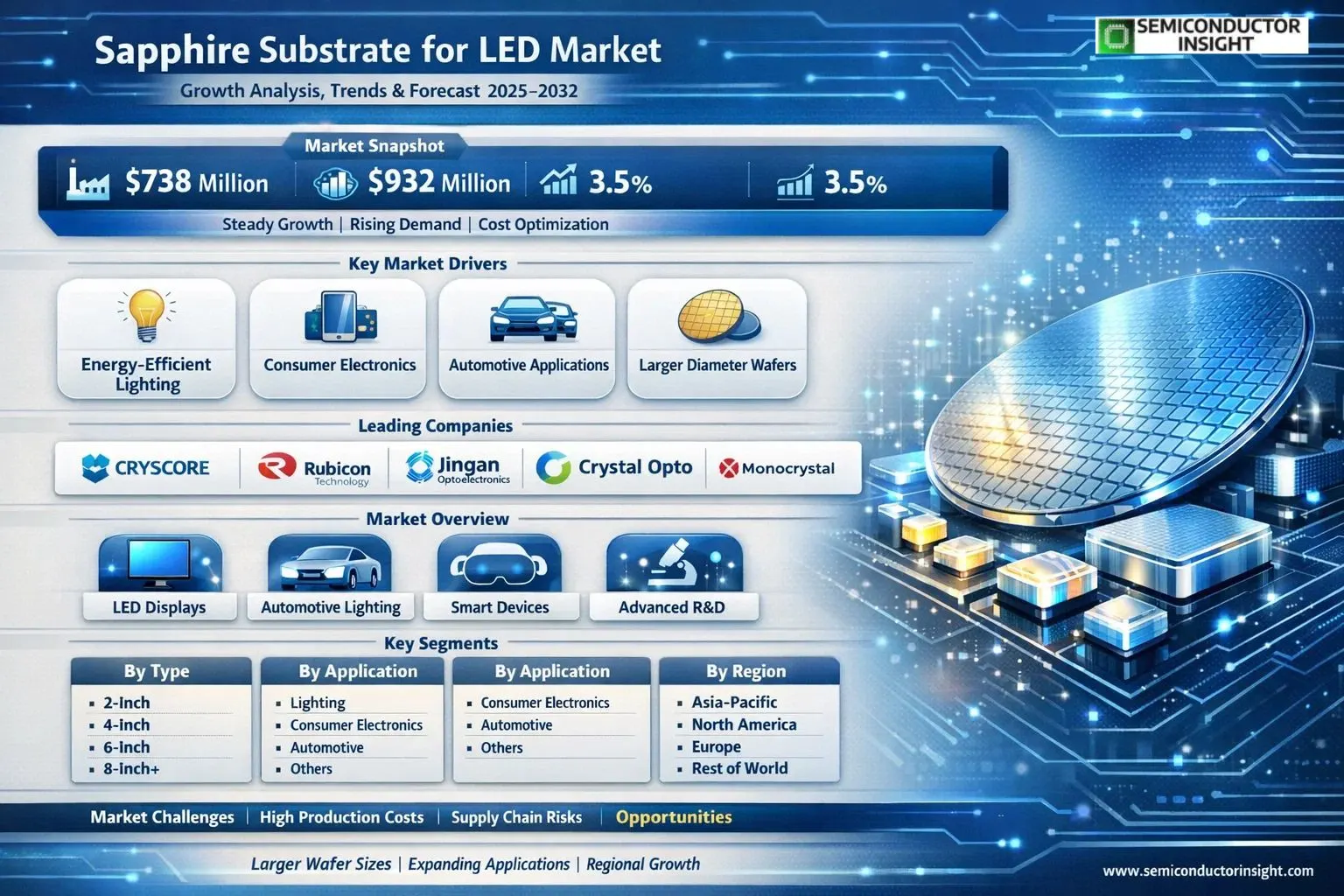
MARKET DRIVERS
Rising Demand for Energy-Efficient Lighting
Sapphire Substrate for LED Market is propelled by the global shift toward energy-efficient lighting solutions, where LEDs outperform traditional bulbs in efficiency and longevity. Sapphire substrates provide the lattice-matched foundation for gallium nitride (GaN) epitaxial growth, enabling high-brightness LEDs used in general lighting and backlighting applications.
Technological Advancements in High-Brightness LEDs
Innovations in vertical LED structures and laser lift-off techniques have enhanced sapphire substrate utilization, improving light extraction efficiency by up to 30%. The market benefits from increasing production scales, with Asia-Pacific leading at over 70% share due to semiconductor hubs in South Korea and Taiwan.
➤ Sapphire Substrate for LED Market projected to grow at a CAGR of 9.2% through 2030, driven by automotive and display sectors.
Government initiatives promoting LED adoption for smart cities further accelerate demand, positioning sapphire as a critical enabler for next-generation optoelectronics.
MARKET CHALLENGES
Manufacturing Complexities and Yield Issues
Producing high-quality sapphire substrates involves high-temperature Czochralski or Kyropoulos processes, leading to defects like dislocations that impact LED performance. Achieving 4-inch and larger wafer diameters remains challenging, with yield rates hovering around 85% in leading facilities.
Other Challenges
Supply Chain Vulnerabilities
Geopolitical tensions and raw material sourcing from limited alumina suppliers disrupt production, causing price volatility in Sapphire Substrate for LED Market. Scaling for 6-inch wafers demands substantial capex investments, straining smaller players.Competition from alternative substrates like silicon carbide adds pressure, requiring continuous R&D to maintain sapphire’s edge in thermal management.
MARKET RESTRAINTS
High Production Costs
Sapphire Substrate for LED Market faces significant restraints from elevated manufacturing expenses, with sapphire wafers costing 2-3 times more than silicon alternatives due to energy-intensive growth processes. This premium pricing limits adoption in cost-sensitive consumer segments.Technological maturity lags behind silicon, restricting wafer sizes and increasing epitaxial layer stress, which contributes to higher defect densities and reduced throughput.Environmental regulations on energy consumption in substrate production impose additional compliance costs, potentially slowing market expansion in regulated regions like Europe.
MARKET OPPORTUNITIES
Mini-LED and Micro-LED Expansion
Emerging mini-LED and micro-LED technologies present substantial opportunities for Sapphire Substrate for LED Market, as their high pixel densities require ultra-flat, low-defect sapphire for superior GaN performance. Display shipments for mini-LED TVs are expected to surge by 40% annually through 2027.Automotive lighting and adaptive headlights leverage sapphire’s robustness for high-power LEDs, with EV integration driving demand in advanced driver-assistance systems.AR/VR devices and horticultural lighting applications further unlock potential, where patterned sapphire substrates enhance quantum efficiency by 20-25%, fostering innovation-led growth.
Sapphire Substrate for LED Market Trends
Growth Driven by LED Efficiency Demands
Sapphire substrates, composed primarily of aluminum oxide, provide essential properties such as high temperature resistance, corrosion resistance, high hardness, and superior light transmittance, making them ideal for epitaxial growth of gallium nitride thin films in LED chip production. In Sapphire Substrate for LED Market, demand continues to rise as manufacturers prioritize materials that enhance LED performance in high-brightness applications. This trend reflects broader shifts toward energy-efficient lighting solutions where sapphire’s acoustic velocity and structural integrity support reliable crystalline growth, reducing defects and improving yield rates.
Other Trends
Shift Toward Larger Wafer Diameters
Moving from traditional 2-inch to larger formats like 4-inch, 6-inch, 8-inch, and 10-inch wafers is a prominent trend in Sapphire Substrate for LED Market. Larger diameters enable cost reductions through higher throughput in epitaxial processes, aligning with industry needs for scalable production. This evolution supports advancements in LED chip manufacturing, where bigger substrates facilitate uniform GaN layer deposition, critical for next-generation devices.
Expansion in Key Applications and Regions
Sapphire Substrate for LED Market sees strong momentum in lighting and consumer electronics segments, with additional growth in other displays and automotive uses. Asia, particularly China, Japan, and South Korea, dominates production and consumption due to robust semiconductor ecosystems. Leading players including CRYSCORE, Rubicon Technology, Jingan Optoelectronics, Jiaxing Jingdian, Crystal Optoelectronics, Bright Semiconductor, Qingdao Huaxin Wafer Technology, and Monocrystal are intensifying R&D to refine polishing and defect control techniques. North America and Europe follow with focused innovations in high-end applications. Competitive dynamics emphasize mergers and capacity expansions, fostering a consolidated landscape where top firms enhance supply chain resilience amid rising global LED adoption.
COMPETITIVE LANDSCAPE
Key Industry Players
Leading Sapphire Substrate for LED Manufacturers and 2025 Market Share Insights
Sapphire Substrate for LED Market is characterized by a concentrated structure dominated by a handful of specialized manufacturers, primarily based in Asia. Leading players such as CRYSCORE and Rubicon Technology command significant market shares due to their advanced production capabilities in high-purity aluminum oxide wafers essential for GaN epitaxial growth. In 2025, the global top five players collectively held a substantial revenue share, reflecting an oligopolistic landscape where scale, technological expertise in crystal growth, and supply chain integration provide competitive edges. Monocrystal, with its robust R&D in large-diameter substrates, further solidifies this leadership amid steady demand from LED lighting and consumer electronics sectors.
Beyond the frontrunners, several niche players contribute to innovation and regional supply dynamics. Companies like Jingan Optoelectronics and Jiaxing Jingdian focus on customized 2-inch to 6-inch substrates, catering to specialized applications and emerging markets in Southeast Asia. Crystal Optoelectronics and Bright Semiconductor emphasize cost-efficient production for consumer electronics, while Qingdao Huaxin Wafer Technology advances 8-inch and larger formats to support scaling needs. These mid-tier firms drive competition through process optimizations, enabling moderate CAGR of 3.5% through 2032 as the market grows from $738 million to $932 million.
List of Key Sapphire Substrate for LED Companies Profiled
- CRYSCORE
- Rubicon Technology
- Monocrystal
- Jingan Optoelectronics
- Crystal Optoelectronics
- Bright Semiconductor
- Qingdao Huaxin Wafer Technology
- Jiaxing Jingdian
- Schott AG
- Kyocera Corporation
- Sumitomo Electric
- Hansol Technodyne
- Beijing E-Town Semiconductor Technology
- Taiwan Crystal Technology
- Saphikon
Segment Analysis:
| Segment Category | Sub-Segments | Key Insights |
| By Type |
|
4-Inch
|
| By Application |
|
Lighting
|
| By End User |
|
LED Chip Manufacturers
|
| By Polishing Type |
|
EPI-Ready Polished
|
| By Crystal Growth Technique |
|
Kyropoulos Method
|
Regional Analysis: Sapphire Substrate for LED Market
Asia-Pacific
Asia-Pacific’s production hubs dominate sapphire substrate output for LED applications, leveraging advanced Kyropoulos and heat exchange methods for ingot production. Facilities in these areas prioritize large-diameter wafers to lower costs, supporting mass production of efficient LEDs. Proximity to LED assembly lines ensures seamless integration, bolstering regional competitiveness in global Sapphire Substrate for LED Market dynamics.
Innovation thrives in Asia-Pacific with developments in lattice-matched sapphire variants and nano-patterning for superior light extraction in LEDs. Research focuses on reducing threading dislocations during MOCVD growth, enhancing device reliability. These breakthroughs solidify the region’s leadership in Sapphire Substrate for LED Market, enabling brighter, more energy-efficient lighting solutions.
Streamlined supply chains in Asia-Pacific connect raw material suppliers to end-users, optimizing logistics for Sapphire Substrate for LED Market needs. Vertical integration by major players reduces costs and variability, while export-oriented strategies capture international demand from displays and backlighting sectors.
Supportive policies and heavy investments fuel Asia-Pacific’s Sapphire Substrate for LED Market growth. Subsidies for R&D and production expansion encourage adoption of advanced substrates in automotive and IoT applications, creating a fertile ground for sustained market expansion and global influence.
North America
North America plays a pivotal role in Sapphire Substrate for LED Market through its emphasis on high-performance applications and cutting-edge research. The region excels in developing premium substrates for specialized LEDs in aerospace, medical devices, and UV lighting. Strong intellectual property frameworks attract collaborations between universities and firms, advancing sapphire patterning for enhanced thermal management. Demand stems from automotive headlamps and horticultural lighting, where durability is paramount. Local producers focus on customization to meet stringent quality standards, though they import volumes to supplement domestic capacity. Emerging sustainability drives push for recyclable processes, positioning North America as an innovator in niche segments of Sapphire Substrate for LED Market.
Europe
Europe advances Sapphire Substrate for LED Market with rigorous standards and automotive-centric demand. Key markets in Germany and the Netherlands prioritize substrates for adaptive lighting systems and micro-LED displays. Emphasis on energy efficiency aligns with EU directives, spurring innovations in thin-film sapphire for flexible electronics. Collaborative R&D consortia develop defect-free wafers, improving yield in high-end LED production. The region benefits from a skilled workforce and proximity to display manufacturers, fostering balanced growth. Challenges like raw material costs are offset by recycling initiatives, ensuring Europe’s competitive edge in premium Sapphire Substrate for LED Market applications.
South America
South America is an emerging player in Sapphire Substrate for LED Market, driven by urbanization and infrastructure projects. Brazil and Chile lead with increasing adoption in public lighting and agriculture LEDs, where sapphire’s robustness withstands harsh environments. Local investments in fabrication plants aim to reduce import dependency, supported by trade agreements. Growing consumer electronics sectors boost demand for cost-effective substrates. While production scales gradually, partnerships with Asian suppliers bridge technology gaps, enabling South America to expand its footprint in Sapphire Substrate for LED Market through targeted applications in smart cities and renewable energy.
Middle East & Africa
The Middle East & Africa region grows steadily in Sapphire Substrate for LED Market, fueled by diversification from oil and solar-integrated lighting needs. Gulf countries invest in LED streetlights and displays, favoring durable sapphire substrates for extreme climates. Africa’s off-grid solar projects drive demand for reliable LED solutions. Initial reliance on imports shifts toward local assembly hubs, with training programs building expertise. Strategic locations enhance logistics, positioning the region for expansion in hospitality and data center cooling applications within Sapphire Substrate for LED Market.
Report Scope
This market research report provides a comprehensive analysis of Sapphire Substrate for LED Market, covering the forecast period 2026–2034. It offers detailed insights into market dynamics, technological advancements, competitive landscape, and key trends shaping the industry.
Key focus areas of the report include:
- Market Overview: The report begins with an overview outlining its current market scenario, key growth indicators, and industry transformation drivers. It discusses macroeconomic factors, demand–supply balance, regulatory landscape, and the strategic role of semiconductors in powering advancements across industries such as automotive, telecommunications, consumer electronics, and industrial automation.
- Market Size & Forecast: Historical data and future projections for revenue, unit shipments, and market value across major regions and segments.
- Segmentation Analysis: Detailed breakdown by product type, technology, application, and end-user industry to identify high-growth segments and investment opportunities.
- Regional Insights: Insights into market performance across North America, Europe, Asia-Pacific, Latin America, and the Middle East & Africa, including country-level analysis where relevant.
- Competitive Landscape: Profiles of leading market participants, including their product offerings, R&D focus, manufacturing capacity, pricing strategies, and recent developments such as mergers, acquisitions, and partnerships.
- Technology Trends & Innovation: Assessment of emerging technologies, integration of AI/IoT, semiconductor design trends, fabrication techniques, and evolving industry standards.
- Market Drivers & Restraints: Evaluation of factors driving market growth along with challenges, supply chain constraints, regulatory issues, and market-entry barriers.
- Stakeholder Insights: Insights for component suppliers, OEMs, system integrators, investors, and policymakers regarding the evolving ecosystem and strategic opportunities.
Primary and secondary research methods are employed, including interviews with industry experts, data from verified sources, and real-time market intelligence to ensure the accuracy and reliability of the insights presented.
FREQUENTLY ASKED QUESTIONS:
What is the current market size of Sapphire Substrate for LED Market?
-> Sapphire Substrate for LED Market was valued at USD 738 million in 2025 and is expected to reach USD 932 million by 2032, at a CAGR of 3.5% during the forecast period.
Which key companies operate in Sapphire Substrate for LED Market?
-> Key players include CRYSCORE, Rubicon Technology, Jingan Optoelectronics, Jiaxing Jingdian, Crystal Optoelectronics, Bright Semiconductor, Qingdao Huaxin Wafer Technology, and Monocrystal, among others.
What are the key growth drivers?
-> Key growth drivers include demand in lighting and consumer electronics applications, superior properties such as high temperature resistance, corrosion resistance, high hardness, and high light transmittance for epitaxial growth of GaN-based LED chips.
Which region dominates the market?
-> Asia dominates the market, with significant contributions from China, Japan, and South Korea.
What are the emerging trends?
-> Emerging trends include shift toward larger substrate diameters (4-inch, 6-inch, 8-inch, 10-inch), advancements in single-crystal wafer technology for high-quality LED production, and expanding applications beyond lighting.

Get Sample Report PDF for Exclusive Insights
Report Sample Includes
- Table of Contents
- List of Tables & Figures
- Charts, Research Methodology, and more...
 Download Sample Report PDF

