Robotics Vision AI Chip Market Insights
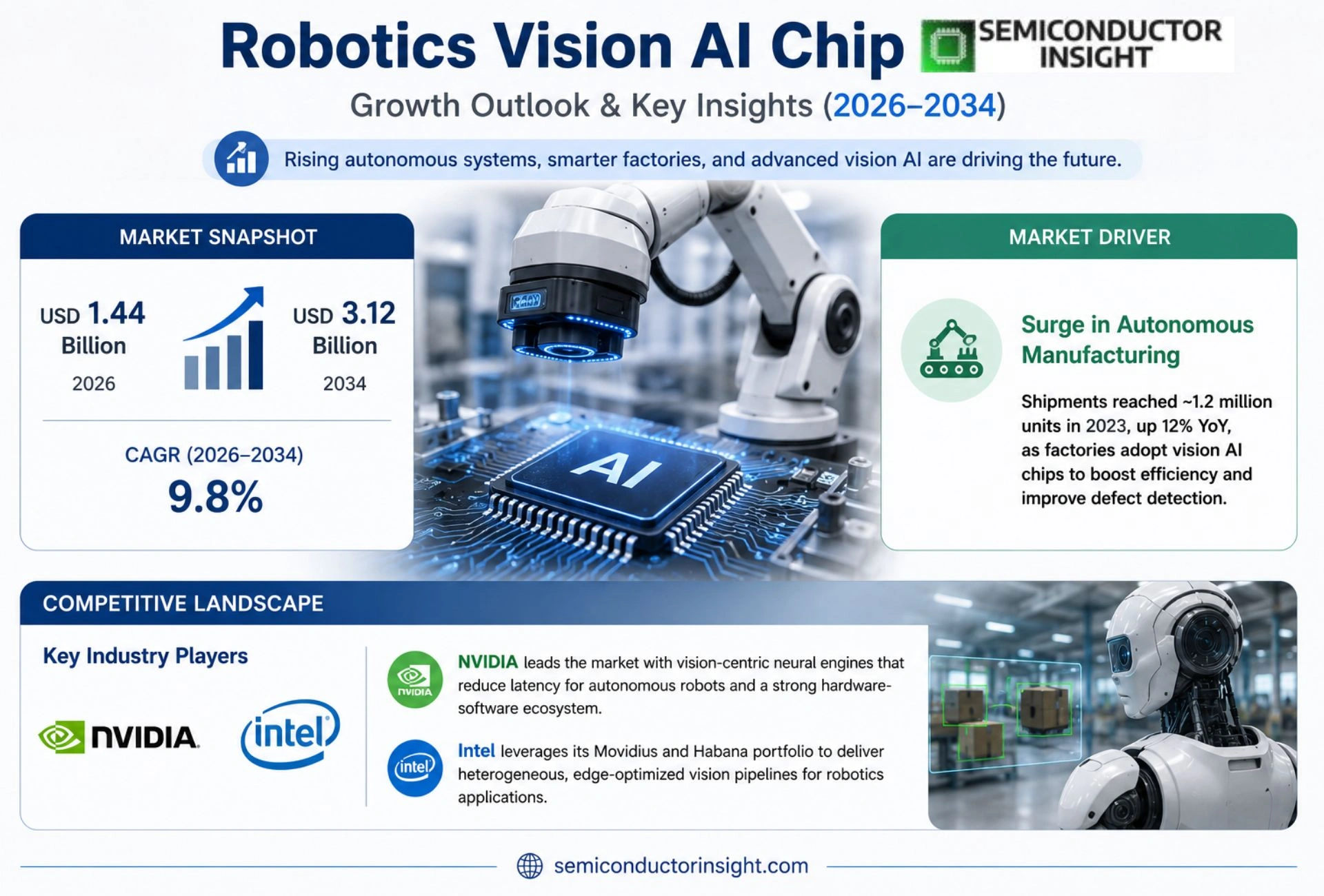
Global Robotics Vision AI Chip Market size was valued at USD 1.37 billion in 2025. The market is projected to grow from USD 1.44 billion in 2026 to USD 3.12 billion by 2034, exhibiting a CAGR of 9.8% during the forecast period.
Robotics vision AI chips are specialized semiconductor devices that integrate high‑performance image processing, deep‑learning inference, and low‑latency sensor fusion to enable autonomous perception in robots, drones, and industrial automation systems. These chips combine dedicated neural‑network accelerators with vision signal processors (VSP) to execute tasks such as object detection, depth estimation, and SLAM directly at the edge.
The expansion is fueled by growing adoption of collaborative robots in manufacturing, rising demand for autonomous mobile robots in logistics, and increasing investment in smart‑factory initiatives because manufacturers seek higher throughput with fewer errors. Furthermore, advances in edge‑AI architectures lower power consumption while delivering real‑time analytics, prompting OEMs to replace legacy CPUs with purpose‑built vision chips. Recent collaborations,such as a January 2024 partnership between NVIDIA and a leading European robotics integrator to co‑develop a next‑generation perception module,illustrate how ecosystem players are accelerating deployment across sectors.
MARKET DRIVERS
Surge in Autonomous Manufacturing
In 2023 Robotics Vision AI Chip Market recorded shipments of roughly 1.2 million units, a 12 % year‑over‑year rise that reflects factories’ shift toward fully autonomous lines. The lift in throughput stems from manufacturers’ need to reduce labor exposure and improve defect detection, prompting a swift adoption of vision‑centric AI silicon.
Expansion of Edge‑AI Deployments
Edge‑AI platforms are now handling more on‑device inference, eliminating latency associated with cloud round‑trips. This trend has lowered total cost of ownership for robot operators, because processing power resides on the chip itself, allowing real‑time adjustments to assembly tasks. Consequently, vendors are integrating higher‑density neural engines that keep power footprints under 5 W.
➤ “The convergence of 5 G connectivity and low‑power vision AI has unlocked new use‑cases in logistics, where robots must make split‑second decisions without relying on centralized servers.”
Beyond productivity, safety compliance is gaining prominence. Companies that embed advanced visual perception can meet stricter occupational health standards, thereby avoiding regulatory penalties and safeguarding brand reputation. This safety premium adds a compelling business case for upgrading to next‑generation AI vision chips.
MARKET CHALLENGES
High Development Costs
Designing custom vision AI silicon requires substantial R&D outlays, often exceeding $150 million per project. Small‑to‑mid‑size system integrators struggle to amortize these expenses across limited production volumes, leading many to postpone upgrades until economies of scale materialize.
Other Challenges
Supply‑Chain Volatility
Component shortages, especially for advanced lithography tools, have extended lead times for critical substrates. Manufacturers face the risk of bottlenecked deliveries that can delay robot deployment schedules by several months.
MARKET RESTRAINTS
Stringent Power Budgets
Industrial robots often operate in environments where power availability is capped at 10 W per module. Vision AI chips that exceed these limits trigger thermal management challenges, forcing designers to compromise on algorithm complexity.
Moreover, legacy control systems lack the interfaces to harness modern AI vision outputs, compelling manufacturers to invest in costly retrofits. This integration hurdle dampens the pace at which new chips can be introduced into existing fleets.
MARKET OPPORTUNITIES
Modular Chip Platforms
Companies that offer plug‑and‑play vision AI modules enable robot operators to upgrade capabilities without overhauling the entire hardware stack. Such modularity is attracting OEMs seeking flexible scaling as production demands fluctuate.
AI‑Optimized Software Stacks
Software ecosystems tailored to specific vision AI chips,featuring pre‑trained models for quality inspection, pick‑and‑place, and navigation,reduce time‑to‑value for end users. Vendors that bundle these stacks with hardware can command premium pricing while accelerating adoption across Robotics Vision AI Chip Market.
Robotics Vision AI Chip Market Trends
Edge‑AI Integration Accelerates Adoption
Robotics Vision AI Chip Market is seeing a decisive shift toward edge‑focused architectures that marry high‑throughput vision processing with ultra‑low power footprints. By embedding neural‑network accelerators and vision‑signal processors on a single die, manufacturers can execute object detection, depth mapping, and simultaneous localisation and mapping (SLAM) directly on the robot, eliminating the latency of cloud round‑trips. This technical evolution matters because it aligns with the operational imperative to run 24/7 production lines without incurring prohibitive energy bills. As a result, OEMs are replacing legacy CPUs with purpose‑built vision chips, a move that tightens the feedback loop between sensor input and actuation, thereby raising overall line efficiency and reducing scrap rates.
Other Trends
Collaborative Robots Drive Demand
In parallel, the rise of collaborative robots (cobots) in assembly and palletising tasks is creating a persistent demand for chips that can interpret unstructured environments safely. Factories investing in smart‑factory initiatives are scaling up deployments of cobots that must recognise human gestures, adjust force in real time, and navigate dynamic workspaces. Vision AI chips that provide deterministic inference at the edge satisfy these safety‑critical requirements while keeping the hardware footprint compact. This trend is not merely a statistical uptick; it reflects a strategic push by manufacturers to lower error‑related downtime and to meet stringent occupational safety standards, thereby unlocking new revenue streams from higher‑value, customised production runs.
Strategic Partnerships Expand Ecosystem
Another catalyst reshaping Robotics Vision AI Chip Market is the formation of cross‑industry alliances that accelerate time‑to‑market for perception modules. A notable example from early 2024 involved a leading European robotics integrator joining forces with a major semiconductor player to co‑develop a next‑generation perception solution tailored for autonomous mobile robots in logistics hubs. Such collaborations pool deep‑learning expertise with domain‑specific robotics knowledge, resulting in reference designs that can be adopted across multiple verticals. For vendors, the partnership model reduces development risk and opens distribution channels through established system integrators, while end‑users benefit from a more mature, interoperable technology stack that shortens integration cycles and improves overall ROI.
COMPETITIVE LANDSCAPE
Key Industry Players
Robotics Vision AI Chip Market – Competitive Outlook
NVIDIA remains the market’s anchor, leveraging its GPU heritage while integrating vision‑specific neural engines that cut latency for autonomous robots. Its recent collaboration with a European systems integrator demonstrates how large incumbents are reshaping the value chain, pairing hardware scale with software stacks that accelerate time‑to‑market for OEMs. Intel’s acquisition of Habana and its Movidius line provides a counterweight, offering a heterogeneous portfolio that blends general‑purpose compute with edge‑optimized vision pipelines. Ambarella, known for video‑centric SoCs, has expanded into robotics by embedding dedicated VSP blocks alongside deep‑learning cores, positioning itself as a cost‑effective alternative for mid‑range applications. Collectively, these firms dominate the high‑volume segment, dictating pricing benchmarks and setting performance expectations that smaller entrants must navigate.
Beyond the tier‑one tier, a constellation of niche innovators is shaping differentiated use‑cases. Horizon Robotics focuses on ultra‑low‑power perception for mobile robots, while China‑based Kneron supplies inference‑only chips that excel in battery‑constrained drones. CEVA’s DSP‑centric vision processors attract manufacturers seeking programmable flexibility without the overhead of full‑scale GPUs. Qualcomm’s Snapdragon Vision series blends communication capabilities with AI, appealing to logistics robots that need seamless connectivity. Synaptics and Lattice deliver FPGA‑based vision accelerators that enable rapid prototyping for bespoke automation solutions. Meanwhile, startups such as Edgecortix and Deephi (Alibaba) are piloting chip‑as‑a‑service models that lower entry barriers for niche verticals like agricultural robotics. This diversified ecosystem ensures that customers can match price, power, and performance to very specific operational constraints.
List of Key Robotics Vision AI Chip Companies Profiled
- NVIDIA Corporation
- Intel Corporation
- Ambarella, Inc.
- Horizon Robotics
- Kneron
- CEVA, Inc.
- Qualcomm Technologies, Inc.
- Synaptics Incorporated
- Lattice Semiconductor
- Edgecortix
- DeePhi Technology (Alibaba Group)
- Google Coral (Edge TPU)
- MediaTek Inc.
- SmartSens (Omnivision)
- Rockchip Electronics
Segment Analysis:
| Segment Category | Sub-Segments | Key Insights |
| By Type |
|
Neural‑Network Accelerators
|
| By Application |
|
Collaborative Manufacturing Robots
|
| By End User |
|
Automotive Assembly Plants
|
| By Technology Trend |
|
Edge‑AI Optimization
|
| By Integration Model |
|
OEM Embedded Solutions
|
Regional Analysis: Robotics Vision AI Chip Market
Integrated fabs and test houses within the region enable rapid design revisions, shortening the prototype cycle for vision AI chips. This proximity between design houses and manufacturing lines cuts lead times and allows OEMs to trial hardware updates within quarterly planning windows.
National programs that subsidize AI research and chip fab upgrades have lowered entry barriers for mid‑size players. These incentives foster a crowded competitive landscape where differentiation hinges on algorithm‑hardware co‑design rather than sheer transistor count.
From autonomous material handlers to precision surgical assistants, the variety of robot platforms demanding vision processing drives a portfolio of chips tailored for low‑latency inference, edge compute, and thermal efficiency.
Universities in Japan, South Korea, and Singapore churn out graduates versed in both deep‑learning theory and silicon design, ensuring a steady pipeline of engineers capable of bridging software demands with hardware constraints.
North America
In the United States and Canada, adoption of Robotics Vision AI chips is driven by a mature robotics software ecosystem and a focus on high‑value sectors such as aerospace and advanced manufacturing. While domestic fab capacity lags behind Asia‑Pacific, strategic partnerships with foundries overseas allow North American firms to access cutting‑edge process nodes. The market here emphasizes security‑focused architectures, reflecting the defense sector’s requirement for tamper‑resistant vision processing. Companies are also investing heavily in custom ASIC development to differentiate their autonomous solutions, positioning the region as a hub for premium, application‑specific chips.
Europe
European stakeholders prioritize sustainability and regulatory compliance, shaping chip designs that balance performance with low power draw. Nations such as Germany and France are leveraging public‑private consortia to fund joint R&D initiatives, accelerating the rollout of vision AI chips in logistics robots and smart factories. The region’s fragmented market structure encourages niche specialization, with firms targeting sectors like automotive assembly and precision agriculture. Cross‑border collaboration within the EU also standardizes interface protocols, simplifying integration for multinational system integrators.
South America
Growth in Brazil, Argentina, and Chile is anchored in the expansion of agricultural robotics and mining automation. Limited local semiconductor manufacturing means the market relies heavily on imports, but strategic government incentives are encouraging assembly and testing activities within the region. End‑users value ruggedized vision chips capable of operating in harsh environments, prompting OEMs to tailor solutions for dust, vibration, and temperature extremes. The emerging focus on localized supply chains is expected to reduce lead times and support broader adoption across mid‑size enterprises.
Middle East & Africa
In this diverse geography, Robotics Vision AI chip market is still nascent but gaining momentum thanks to sovereign wealth funds allocating capital to smart‑city projects and oil‑field automation. Countries such as the United Arab Emirates and South Africa are establishing innovation hubs that attract global chip designers seeking to test solutions in extreme temperature and lighting conditions. While import dependency remains high, joint ventures with Asian manufacturers are creating a foothold for localized assembly, laying the groundwork for a more resilient value chain as regional automation targets expand.
Report Scope
This market research report provides a comprehensive analysis of the Robotics Vision AI Chip Market , covering the forecast period 2026–2034. It offers detailed insights into market dynamics, technological advancements, competitive landscape, and key trends shaping the industry.
Key focus areas of the report include:
- Market Overview: The report begins with an overview outlining its current market scenario, key growth indicators, and industry transformation drivers. It discusses macroeconomic factors, demand–supply balance, regulatory landscape, and the strategic role of semiconductors in powering advancements across industries such as automotive, telecommunications, consumer electronics, and industrial automation.
- Market Size & Forecast: Historical data and future projections for revenue, unit shipments, and market value across major regions and segments.
- Segmentation Analysis: Detailed breakdown by product type, technology, application, and end-user industry to identify high-growth segments and investment opportunities.
- Regional Insights: Insights into market performance across North America, Europe, Asia-Pacific, Latin America, and the Middle East & Africa, including country-level analysis where relevant.
- Competitive Landscape: Profiles of leading market participants, including their product offerings, R&D focus, manufacturing capacity, pricing strategies, and recent developments such as mergers, acquisitions, and partnerships.
- Technology Trends & Innovation: Assessment of emerging technologies, integration of AI/IoT, semiconductor design trends, fabrication techniques, and evolving industry standards.
- Market Drivers & Restraints: Evaluation of factors driving market growth along with challenges, supply chain constraints, regulatory issues, and market-entry barriers.
- Stakeholder Insights: Insights for component suppliers, OEMs, system integrators, investors, and policymakers regarding the evolving ecosystem and strategic opportunities.
Primary and secondary research methods are employed, including interviews with industry experts, data from verified sources, and real-time market intelligence to ensure the accuracy and reliability of the insights presented.
FREQUENTLY ASKED QUESTIONS:
What is the current market size of Robotics Vision AI Chip Market?
-> Robotics Vision AI Chip Market is projected to grow from USD 1.44 billion in 2026 to USD 3.12 billion by 2034, exhibiting a CAGR of 9.8%
Which key companies operate in Robotics Vision AI Chip Market?
-> Key players include NVIDIA, Intel, Qualcomm, Google (Alphabet), Samsung Electronics, and MediaTek, among others.
What are the key growth drivers?
-> Key growth drivers include rising adoption of collaborative robots in manufacturing, increasing demand for autonomous mobile robots in logistics, and expanding smart‑factory initiatives that require low‑latency, edge‑AI vision processing.
Which region dominates the market?
-> Asia-Pacific is the fastest‑growing region, while Europe remains a dominant market due to strong industrial automation investments.
What are the emerging trends?
-> Emerging trends include advanced edge‑AI architectures that lower power consumption, integration of neural‑network accelerators with vision signal processors, and increasing collaborations between chip makers and robotics integrators.

Get Sample Report PDF for Exclusive Insights
Report Sample Includes
- Table of Contents
- List of Tables & Figures
- Charts, Research Methodology, and more...
 Download Sample Report PDF