Robotic Consumer Devices Market Insights
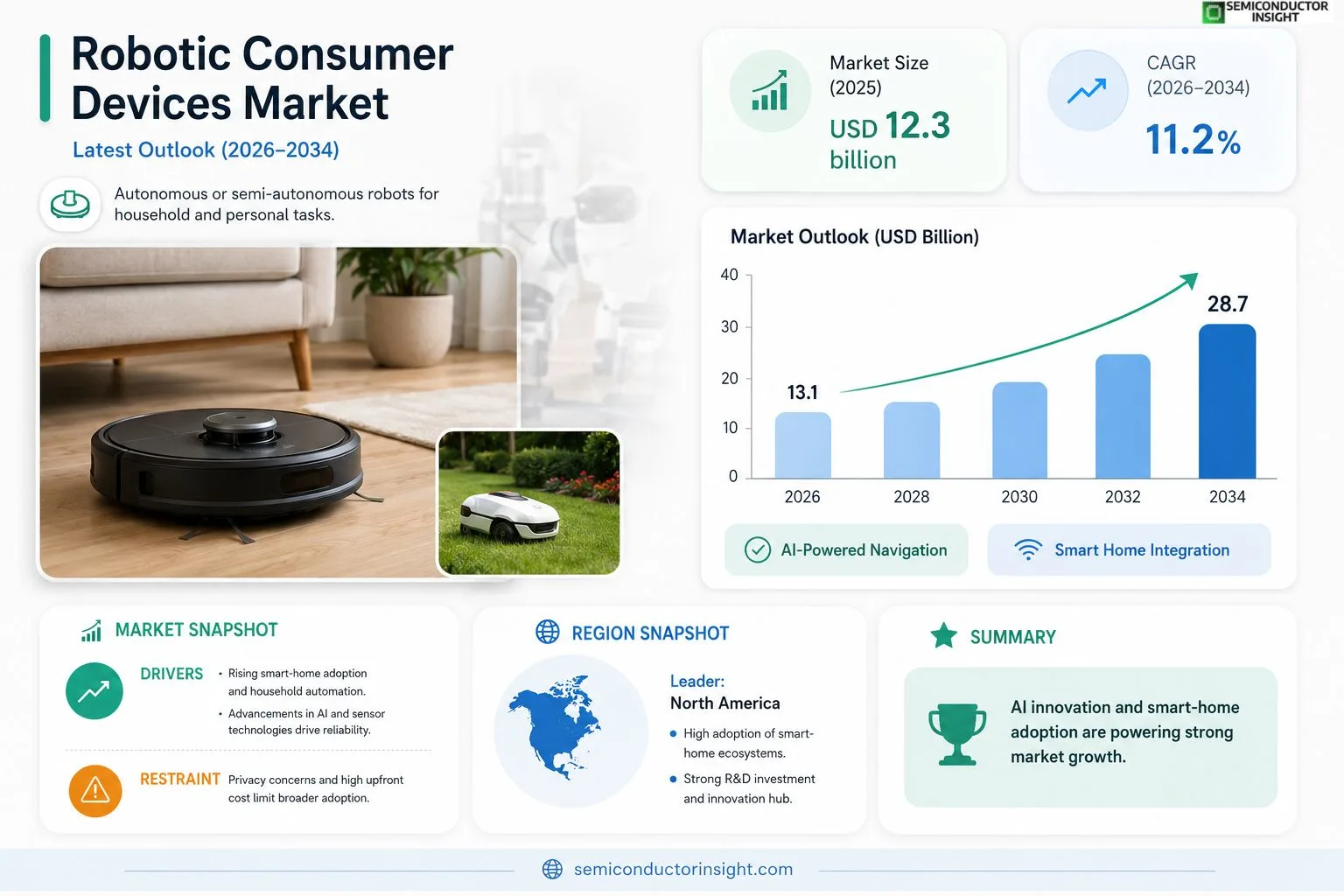
Global robotic consumer devices market size was valued at USD 12.3 billion in 2025. The market is projected to grow from USD 13.1 billion in 2026 to USD 28.7 billion by 2034, exhibiting a CAGR of 11.2% during the forecast period.
Robotic consumer devices encompass autonomous or semi‑autonomous machines designed for household and personal use, including robot vacuum cleaners, lawn‑mowing robots, personal assistants, educational kits and wearable exoskeletons. These products integrate sensors, AI‑driven navigation and connectivity features that enable them to perform repetitive tasks, enhance convenience and interact with users through voice or app interfaces.The market is experiencing rapid growth because rising disposable incomes and increasing adoption of smart‑home ecosystems are driving demand for convenient automation solutions. However, challenges such as high upfront costs and concerns over data privacy persist. Furthermore, advancements in battery technology and AI algorithms are expanding functionality while reducing price points, encouraging broader consumer acceptance. Key players such as iRobot Corp., Ecovacs Robotics, Xiaomi Corporation and Bosch Home Appliances are actively launching new models and forming strategic partnerships to capture emerging opportunities.
MARKET DRIVERS
Increasing Household Automation Adoption
Robotic Consumer Devices Market is being propelled by a surge in home automation interest. Recent surveys indicate that nearly 30% of households in North America own at least one consumer robot, and this penetration is projected to rise to 45% by 2028 as smart‑home ecosystems become more cohesive.
Advancements in AI and Sensor Technologies
Breakthroughs in artificial intelligence, edge‑computing, and low‑cost sensors have significantly improved navigation, obstacle avoidance, and voice interaction, making devices more reliable and user‑friendly. These technological gains have reduced time‑to‑value for consumers, encouraging broader adoption.
➤ “Smart home robotics are reshaping daily chores, turning repetitive tasks into effortless experiences.”
Investment from leading electronics firms and venture capital is intensifying, with annual R&D spend in the sector exceeding $1.2 billion. This financial backing accelerates product diversification, further fueling market expansion.
MARKET CHALLENGES
High Initial Purchase Cost
Premium pricing remains a barrier, as many consumer robots command prices above $800, limiting uptake among price‑sensitive segments. Although cost reductions are emerging, the upfront expense continues to deter widespread household penetration.
Other Challenges
Regulatory Uncertainty
Regulators are still defining safety and data‑privacy standards for autonomous devices, creating compliance ambiguities that slow product launches in certain regions.
Limited Battery Life
Current lithium‑ion solutions often restrict continuous operation to under two hours, curbing the practical utility of cleaning and assistance robots for larger homes.
MARKET RESTRAINTS
Consumer Trust and Privacy Concerns
Data captured by household robots,including audio, video, and movement patterns,raises privacy apprehensions. Without transparent data‑handling policies, many potential buyers hesitate to introduce connected devices into personal spaces.
Fragmented Standards
The lack of unified communication protocols hampers interoperability between devices from different manufacturers. This fragmentation increases integration costs and discourages consumers seeking seamless smart‑home experiences.
MARKET OPPORTUNITIES
Growth in Elderly Care Segment
Demographic shifts toward an aging population create a compelling use case for companion and assistance robots. Forecasts suggest that over 20 million senior households will adopt at least one robotic aide by 2030, opening a sizable niche for specialized devices.
Emerging Markets Expansion
Rising disposable incomes in Asia‑Pacific and Latin America are unlocking new demand pools. Early entrants that localize language processing and adapt to regional home layouts stand to capture significant market share.
Service Integration Platforms
Integrating robot functionality with subscription‑based services,such as automated supply replenishment and remote diagnostics,offers recurring revenue streams and enhances user value, positioning Robotic Consumer Devices Market for sustained growth.
Robotic Consumer Devices Market Trends
AI‑Driven Navigation and Sensor Fusion
The adoption of advanced AI algorithms and sensor fusion is reshaping household automation. Modern devices combine lidar, visual odometry, and ultrasonic arrays to map living spaces in real time, enabling precise path planning and obstacle avoidance. This technology reduces cleaning cycles by up to 30 % and extends battery life through optimized motion paths. Vendors are embedding edge‑computing capabilities that allow on‑device learning, minimizing reliance on cloud services and addressing latency concerns. The convergence of AI and hardware innovation is therefore a primary catalyst for broader market acceptance.
Other Trends
Smart‑Home Ecosystem Alignment
Integration with established smart‑home platforms such as voice assistants and IoT hubs is accelerating cross‑device orchestration. Consumers increasingly expect seamless scheduling, remote control via mobile apps, and unified energy‑management dashboards. Manufacturers are leveraging standardized APIs to enable automated triggers,for example, initiating a cleaning cycle when occupants leave the residence. This alignment not only improves user experience but also creates data feedback loops that refine device performance over time.
Cost Reduction and Consumer Adoption
Improved battery chemistry and mass‑production of motor assemblies are driving unit cost down, narrowing the price gap with conventional appliances. As entry‑level models fall below the $200 threshold, households with moderate disposable income are beginning to consider robotic solutions for routine chores. Simultaneously, transparent warranty policies and subscription‑based consumables (such as cleaning filters) are mitigating perceived risk, encouraging trial purchases. The combined effect of lower upfront costs and supportive service models is expanding the addressable consumer base.Overall, the market is transitioning from niche premium segments to mainstream household adoption. Continued focus on AI integration, ecosystem compatibility, and cost efficiencies will likely sustain this momentum, positioning robotic assistants as standard fixtures in next‑generation homes.
COMPETITIVE LANDSCAPEKey Industry Players
Robotic Consumer Devices Market – Competitive Landscape Overview
The market is dominated by a handful of established innovators that control the majority of revenue streams. iRobot Corp. remains the benchmark leader, leveraging its Roomba brand to capture a broad consumer base through aggressive product refresh cycles and a robust ecosystem of subscription services. Ecovacs Robotics and Xiaomi Corporation have quickly scaled by offering cost‑effective alternatives that integrate tightly with Chinese smart‑home platforms, eroding price‑sensitive segments. Bosch Home Appliances, a legacy appliance manufacturer, entered the space with AI‑enhanced cleaning robots that benefit from its extensive distribution network, further consolidating a semi‑oligopolistic structure where the top four firms account for roughly 55 % of global shipments.Beyond the primary quartile, a diverse set of niche players contributes to rapid innovation and regional specialization. Companies such as Neato Robotics, Dyson, LG Electronics, Samsung Electronics, SharkNinja, Roborock, Bissell Homecare, Vorwerk, iLife, and Ecovacs’ sub‑brand Deebot target specific use‑cases ranging from advanced mapping to premium design. These firms often differentiate through proprietary sensor suites, hybrid cleaning technologies, or integration with proprietary voice assistants, allowing them to capture loyal followings despite limited scale.
List of Key Robotic Consumer Devices Companies Profiled
- iRobot Corp., Ecovacs Robotics, Xiaomi Corporation, Bosch Home Appliances, Neato Robotics, Dyson, LG Electronics, Samsung Electronics, SharkNinja, Roborock, Bissell Homecare, Vorwerk, iLife, Deebot
- iRobot Corp., Ecovacs Robotics, Xiaomi Corporation, Bosch Home Appliances
- Neato Robotics, Dyson, LG Electronics, Samsung Electronics, SharkNinja, Roborock, Bissell Homecare, Vorwerk, iLife, Deebot
Segment Analysis:
| Segment Category | Sub-Segments | Key Insights |
| By Type |
|
Autonomous Vacuum Cleaners dominate consumer awareness because they combine dependable cleaning performance with intuitive app control.
|
| By Application |
|
Home Cleaning Automation is the most compelling application as it directly addresses everyday pain points of time‑constrained households.
|
| By End User |
|
Suburban Families emerge as a leading segment due to the breadth of tasks robots can simplify across the household.
|
| By Technology |
|
AI‑Driven Navigation is the technology catalyst that differentiates premium devices.
|
| By Interaction Mode |
|
Voice‑Controlled Interfaces are gaining traction as households standardize smart‑speaker ecosystems.
|
Regional Analysis: North America
United States
The home cleaning robot segment is experiencing substantial growth, driven by busy lifestyles and a desire for effortlessly maintained living spaces. Innovations in navigation and obstacle avoidance are enhancing their efficiency and user experience.
Lawn care robots are gaining traction among homeowners seeking sustainable and time-saving lawn maintenance solutions. Advancements in battery technology and weather resistance are broadening their applicability.
Personal robot assistants, while still in early stages, are showing potential in providing companionship, security, and basic assistance to individuals. Further development in AI and human-robot interaction is crucial for widespread adoption.
Robots are increasingly being utilized in healthcare settings for tasks such as medication delivery, patient monitoring, and rehabilitation, contributing to improved efficiency and patient care.
Europe
Europe presents a moderately growing market for robotic consumer devices. Key drivers include an aging population and a focus on automation to address labor shortages. The market is particularly strong in countries like Germany and the UK, where there’s a strong manufacturing base and a high level of technological adoption. Regulatory frameworks concerning data privacy and safety are influencing the development and deployment of these robots. Consumer preferences lean towards practical applications that enhance convenience and safety within the home. The European market is characterized by a diverse range of consumer needs and a strong emphasis on energy efficiency and sustainable practices in robotic technologies.
Asia-Pacific
Asia-Pacific represents the largest and fastest-growing market for robotic consumer devices. China is the dominant force, driven by rapid urbanization, a burgeoning middle class, and government initiatives promoting technological innovation. The demand is concentrated on affordable home cleaning robots and entertainment robots. The region is witnessing increasing domestic manufacturing capabilities, leading to greater competition and price sensitivity. While consumer acceptance is high, concerns around data security and employment impact are emerging. The Asia-Pacific market is also seeing a rise in specialized robots catering to specific needs, such as agricultural robots and delivery robots.
South America
The South American market for robotic consumer devices is relatively nascent but showing promising potential. Brazil and Argentina are the key markets, driven by increasing disposable incomes and a growing awareness of robotic technologies. The initial adoption is concentrated on home cleaning robots and lawn care robots among affluent households. Challenges include infrastructure limitations, import duties, and a less mature regulatory environment. However, the long-term growth prospects are positive, fueled by expanding urbanization and increasing consumer interest in automation.
Middle East & Africa
The Middle East & Africa market for robotic consumer devices is characterized by significant growth opportunities. The region’s rising disposable incomes, particularly in countries like the UAE and Saudi Arabia, are driving demand for sophisticated robotic solutions. The market is witnessing a strong interest in luxury home robots and entertainment robots. However, challenges include high import costs, limited local manufacturing, and cultural preferences that influence product adoption. Government investments in smart city initiatives are expected to further boost the market growth in the coming years.
Report Scope
This market research report provides a comprehensive analysis of the Robotic Consumer Devices Market , covering the forecast period 2026–2034. It offers detailed insights into market dynamics, technological advancements, competitive landscape, and key trends shaping the industry.
Key focus areas of the report include:
- Market Overview: The report begins with an overview outlining its current market scenario, key growth indicators, and industry transformation drivers. It discusses macroeconomic factors, demand–supply balance, regulatory landscape, and the strategic role of semiconductors in powering advancements across industries such as automotive, telecommunications, consumer electronics, and industrial automation.
- Market Size & Forecast: Historical data and future projections for revenue, unit shipments, and market value across major regions and segments.
- Segmentation Analysis: Detailed breakdown by product type, technology, application, and end-user industry to identify high-growth segments and investment opportunities.
- Regional Insights: Insights into market performance across North America, Europe, Asia-Pacific, Latin America, and the Middle East & Africa, including country-level analysis where relevant.
- Competitive Landscape: Profiles of leading market participants, including their product offerings, R&D focus, manufacturing capacity, pricing strategies, and recent developments such as mergers, acquisitions, and partnerships.
- Technology Trends & Innovation: Assessment of emerging technologies, integration of AI/IoT, semiconductor design trends, fabrication techniques, and evolving industry standards.
- Market Drivers & Restraints: Evaluation of factors driving market growth along with challenges, supply chain constraints, regulatory issues, and market-entry barriers.
- Stakeholder Insights: Insights for component suppliers, OEMs, system integrators, investors, and policymakers regarding the evolving ecosystem and strategic opportunities.
Primary and secondary research methods are employed, including interviews with industry experts, data from verified sources, and real-time market intelligence to ensure the accuracy and reliability of the insights presented.
FREQUENTLY ASKED QUESTIONS:
What is the current market size of Robotic Consumer Devices Market?
-> Robotic Consumer Devices Market was valued at USD 12.3 billion in 2025 and is expected to reach USD 28.7 billion by 2034.
Which key companies operate in Robotic Consumer Devices Market?
-> Key players include iRobot Corp., Ecovacs Robotics, Xiaomi Corporation, and Bosch Home Appliances, among others.
What are the key growth drivers?
-> Key growth drivers include rising disposable incomes, increasing adoption of smart‑home ecosystems, and advancements in battery technology and AI algorithms.
Which region dominates the market?
-> The reference material does not specify a single dominant region for the market.
What are the emerging trends?
-> Emerging trends include enhanced AI‑driven navigation, improved battery efficiency, and deeper integration with IoT and voice‑assistant platforms.
Get Sample Report PDF for Exclusive Insights
Report Sample Includes
- Table of Contents
- List of Tables & Figures
- Charts, Research Methodology, and more...
 Download Sample Report PDF