
Roadside Perception Radar Market Insights
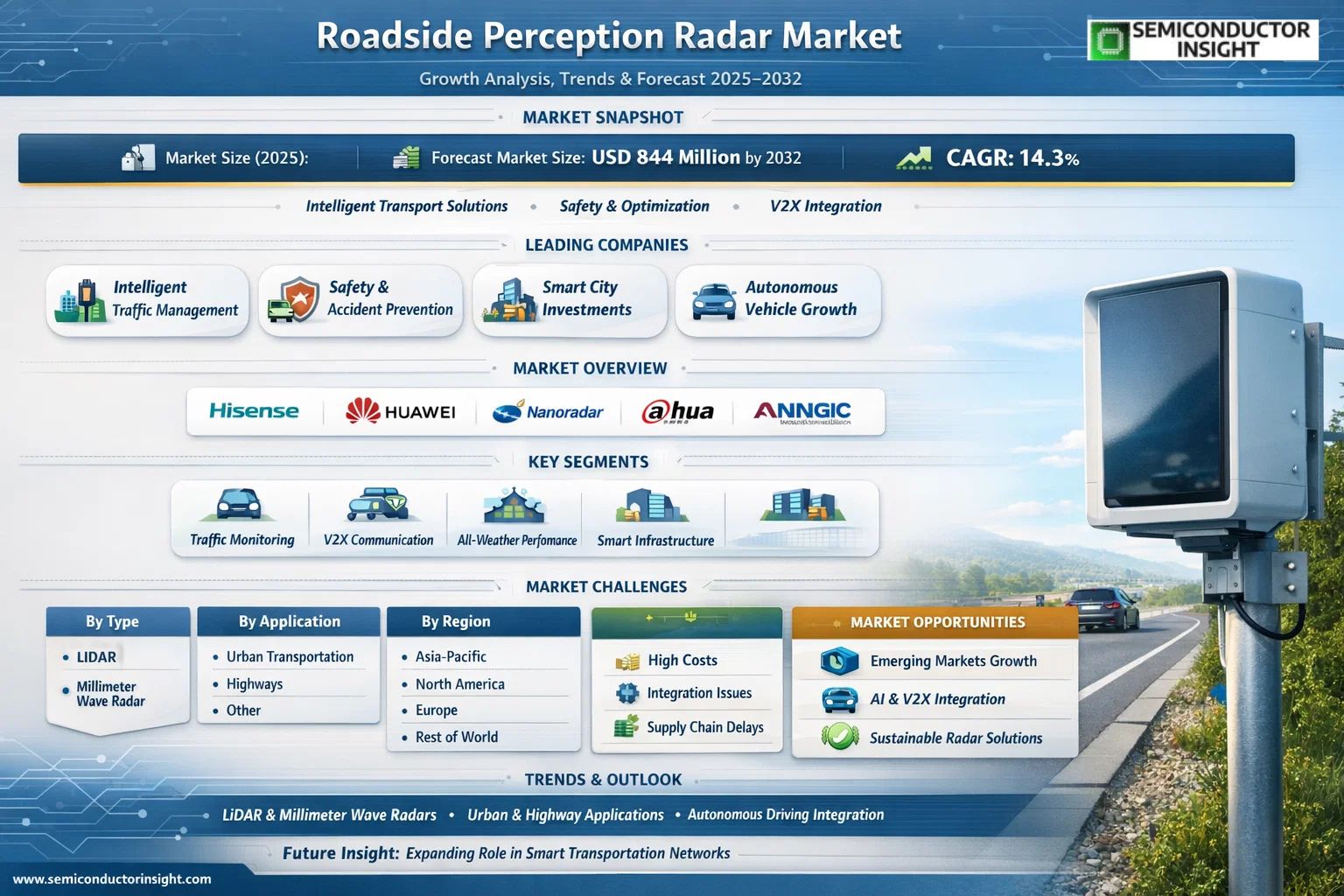
Global Roadside Perception Radar market size was valued at USD 339 million in 2025. The market is projected to reach USD 844 million by 2032, exhibiting a CAGR of 14.3% during the forecast period.
Roadside Perception Radar is a radar device installed on the sides of roads to detect and monitor the movement of traffic participants, such as vehicles, pedestrians, and cyclists, in real-time, providing data on their location, speed, and direction. This radar operates efficiently under complex weather and lighting conditions, offering reliable data support for intelligent transportation systems and autonomous driving, while enhancing traffic flow optimization and safety. It also enables vehicle-to-everything (V2X) applications and serves as a critical component of smart transportation infrastructure.
The market is experiencing rapid growth due to several factors, including rising demand for intelligent traffic management, advancements in sensor fusion technologies, and increasing investments in smart city initiatives. Furthermore, the expansion of autonomous vehicle deployments and V2X ecosystems is driving adoption. Key players are actively innovating to capture opportunities. For instance, companies like HUAWEI Technology and Nanoradar Science and Technology continue to develop high-resolution radars for urban and highway applications. Hisense Global, HUAWEI Technology, Nanoradar Science and Technology, Limradar, Dahua Technology, ANNGIC, and Microbrain Intelligent are some of the prominent players operating in the market with comprehensive portfolios.
MARKET DRIVERS
Growing Demand for Intelligent Transportation Systems
Roadside Perception Radar Market is propelled by the rapid expansion of intelligent transportation systems (ITS) worldwide. With urban congestion rising by an estimated 20% in major cities over the past decade, governments are investing heavily in radar-based solutions for real-time traffic monitoring and accident prevention. These systems enhance vehicle-to-infrastructure (V2I) communication, enabling precise detection of objects up to 300 meters away even in adverse weather.
Regulatory Mandates and Safety Initiatives
Stricter road safety regulations, such as Europe’s Vision Zero and similar programs in Asia-Pacific, are accelerating adoption. Roadside perception radars provide reliable perception data for vulnerable road user detection, reducing fatalities by up to 15% in pilot deployments. Integration with 5G networks further boosts data processing speeds, supporting the market’s projected growth to exceed $1.2 billion by 2028.
➤ Advancements in millimeter-wave technology allow for compact, cost-effective installations, driving scalability in smart city projects.
Additionally, the surge in electric and autonomous vehicle deployments amplifies demand, as these radars complement onboard sensors for comprehensive roadside perception in Roadside Perception Radar Market.
MARKET CHALLENGES
Technical Integration Complexities
One major hurdle in Roadside Perception Radar Market is the seamless integration with existing infrastructure. Retrofitting radars into legacy traffic systems demands significant engineering efforts, often leading to deployment delays and costs 30% higher than initial estimates. Variability in radar performance across diverse environments, including urban clutter, complicates accuracy.
Other Challenges
Cost Barriers for Widespread Adoption
High upfront investments, averaging $5,000 per unit including installation, deter small municipalities despite long-term savings in traffic management efficiency.
Supply chain disruptions, exacerbated by semiconductor shortages, have increased lead times by 25%, further straining market expansion efforts.
MARKET RESTRAINTS
Technological and Environmental Limitations
Roadside Perception Radar Market faces restraints from inherent radar limitations, such as reduced resolution for small objects compared to LiDAR. In heavy rain or fog, signal attenuation can drop detection reliability to 70%, limiting standalone use in critical applications.
Regulatory and Standardization Gaps persist globally, with inconsistent frequency allocations hindering cross-border deployments. Only 40% of regions have harmonized 77 GHz bands, slowing international scaling.
Competition from camera-LiDAR fusions, which offer richer data at similar costs, caps radar market share at around 25% in perception systems.
Privacy concerns over continuous roadside monitoring also impose data handling restraints, requiring compliance with GDPR-like frameworks that increase operational overhead.
MARKET OPPORTUNITIES
Expansion in Emerging Markets and AI Synergies
Roadside Perception Radar Market holds strong potential in Asia-Pacific and Latin America, where urbanization drives ITS investments surpassing $10 billion annually. AI-enhanced signal processing can improve object classification accuracy to 95%, unlocking new revenue streams.
Fusion with V2X ecosystems for cooperative perception offers differentiation, with pilot projects showing 20% better traffic flow optimization.
Sustainability trends favor low-power radars, aligning with green infrastructure mandates and projecting a 14% CAGR through 2030 in Roadside Perception Radar Market.
Roadside Perception Radar Market Trends
Integration with Intelligent Transportation Systems
Roadside Perception Radar devices detect vehicles, pedestrians, and cyclists in real-time, delivering precise data on location, speed, and direction. This capability persists effectively across diverse weather and lighting challenges, positioning the technology as a cornerstone for intelligent transportation systems. By enabling traffic flow optimization and safety enhancements, these radars facilitate seamless vehicle-to-everything (V2X) communications, supporting broader smart infrastructure deployments in Roadside Perception Radar Market.
Other Trends
Expansion in Urban Transportation Applications
Urban transportation represents a primary application area, where Roadside Perception Radar systems monitor dense traffic environments to reduce congestion and improve pedestrian safety. Cities worldwide are deploying these radars to gather actionable insights, driving efficiency in public transit and intersection management. This trend aligns with global urbanization pressures, amplifying demand for reliable perception technologies in metropolitan settings.
Highway applications follow closely, with radars providing continuous oversight of high-speed traffic. They aid in incident detection and adaptive speed limit adjustments, contributing to safer roadways. Water transportation and other niche segments also benefit, though urban and highway uses dominate adoption patterns in Roadside Perception Radar Market.
Technological Shifts Between LiDAR and Millimeter Wave Radar
Product types such as LiDAR and millimeter wave radar cater to varying needs within Roadside Perception Radar Market. Millimeter wave radar excels in adverse conditions due to its weather resilience, while LiDAR offers superior resolution for detailed object classification. Manufacturers are refining both to meet diverse deployment requirements, fostering innovation in detection accuracy and range.
Regional dynamics highlight Asia’s prominence, led by China, alongside growth in North America and Europe. Key players including Hisense Global, HUAWEI Technology, Nanoradar Science and Technology, Limradar, and Dahua Technology intensify competition through product enhancements and strategic expansions. Their focus on recent developments addresses industry drivers like safety mandates and smart city initiatives, while navigating challenges such as integration complexities and regulatory hurdles. This competitive landscape propels ongoing advancements, ensuring Roadside Perception Radar Market evolves with robust, scalable solutions for global infrastructure needs.
COMPETITIVE LANDSCAPE
Key Industry Players
Top Roadside Perception Radar Manufacturers by Market Share, 2025
Roadside Perception Radar Market is dominated by a few leading players, with the global top five companies collectively holding a significant revenue share in 2025. Hisense Global and HUAWEI Technology emerge as frontrunners, leveraging their advanced millimeter wave radar technologies and extensive integration into intelligent transportation systems (ITS). These leaders benefit from strong R&D capabilities, enabling robust detection of vehicles, pedestrians, and cyclists under adverse weather conditions. The market structure is moderately concentrated, characterized by high barriers to entry due to technological complexity and regulatory standards for V2X applications, fostering strategic partnerships with governments for urban and highway deployments.
Beyond the top tier, niche players like Nanoradar Science and Technology, Limradar, and Dahua Technology contribute through specialized offerings in LiDAR and millimeter wave segments, targeting applications in urban transportation and highways. Emerging firms such as ANNGIC, Microbrain Intelligent, and Hurys Intelligent Technology focus on cost-effective solutions for smart city infrastructure, while AKASAKATEC and MUNIU TECHNOLOGY innovate in real-time traffic monitoring. Additional competitors including LeiKe Defense Technology, SONDIT, and VANJEE TECHNOLOGY are gaining traction via recent developments in high-resolution perception radars, intensifying competition and driving innovations in safety and traffic optimization across global regions.
List of Key Roadside Perception Radar Companies Profiled
- Hisense Global
- HUAWEI Technology
- Nanoradar Science and Technology
- Limradar
- Dahua Technology
- ANNGIC
- Microbrain Intelligent
- Hurys Intelligent Technology
- AKASAKATEC
- MUNIU TECHNOLOGY
- LeiKe Defense Technology
- SONDIT
- VANJEE TECHNOLOGY
Segment Analysis:
| Segment Category | Sub-Segments | Key Insights |
| By Type |
|
Millimeter Wave Radar
|
| By Application |
|
Highway
|
| By End User |
|
Government Agencies
|
| By Range |
|
Mid Range
|
| By Frequency Band |
|
77 GHz
|
Regional Analysis: Roadside Perception Radar Market
North America
North America’s extensive highway networks enable smooth roadside perception radar integration, supporting V2X communication for proactive hazard detection. Cities like San Francisco and Toronto pioneer pilot programs, yielding efficient congestion management without disrupting legacy systems.
Leading radar developers collaborate with automakers and DOTs, advancing millimeter-wave technologies for superior resolution in complex environments. This fosters rapid prototyping and deployment, strengthening Roadside Perception Radar Market position.
Stringent safety standards and federal grants propel radar installations at intersections and tolls. Policies emphasize data privacy alongside performance, ensuring ethical scaling of roadside perception solutions across states.
Megacities prioritize radars for vulnerable road user protection, integrating with AI platforms for predictive analytics. This drives demand in Roadside Perception Radar Market, balancing growth with sustainability goals.
Europe
Europe exhibits robust growth in Roadside Perception Radar Market, propelled by ambitious EU-wide smart mobility frameworks. Germany and the Netherlands spearhead deployments along autobahns and urban corridors, leveraging radars for cooperative intelligent transport systems (C-ITS). Emphasis on pedestrian safety and emissions reduction aligns radar tech with green infrastructure goals. Cross-border projects like those under Horizon Europe standardize radar interoperability, mitigating fragmentation. France advances with radar-enhanced toll systems for smoother traffic. While mature automotive clusters support supply chains, varying national regulations pose integration hurdles. Nonetheless, Europe’s commitment to digital twin roadways positions it strongly for future expansions in roadside perception capabilities.
Asia-Pacific
Asia-Pacific emerges as a dynamic contender in Roadside Perception Radar Market, fueled by massive urbanization and smart city initiatives. China invests heavily in expressway radar networks for real-time monitoring, integrating with 5G for enhanced V2I. Japan refines radar precision for earthquake-prone zones, prioritizing reliability. India’s pilot schemes in Mumbai and Delhi address chaotic traffic via affordable radar solutions. Rapid infrastructure builds in Southeast Asia amplify demand, though standardization lags. Local manufacturers gain traction by tailoring tech to tropical climates, bolstering regional competitiveness in roadside perception radar advancements.
South America
South America shows nascent potential in Roadside Perception Radar Market, centered on Brazil and Chile’s infrastructure modernization. Urban centers like São Paulo deploy radars to combat congestion and enhance public transit safety. Partnerships with global firms introduce cost-effective solutions suited to diverse terrains. Governmental pushes for safer highways amid rising vehicle ownership drive adoption. Challenges include budget constraints and rugged landscapes, yet growing public-private collaborations signal upward trajectory for roadside perception technologies in the region.
Middle East & Africa
The Middle East & Africa region advances cautiously in Roadside Perception Radar Market, with UAE and Saudi Arabia leading via Vision 2030 smart city visions. Dubai’s radar-equipped roads optimize pilgrimage traffic, while South Africa trials urban detection systems. Harsh desert conditions demand durable radars, spurring specialized innovations. Africa’s fragmented infrastructure limits scale, but donor-funded projects in Kenya promote traffic safety. Incremental integrations promise gradual market maturation focused on resilience and connectivity.
Report Scope
This market research report provides a comprehensive analysis of the Roadside Perception Radar Market , covering the forecast period 2025–2032. It offers detailed insights into market dynamics, technological advancements, competitive landscape, and key trends shaping the industry.
Key focus areas of the report include:
- Market Overview: The report begins with an overview outlining its current market scenario, key growth indicators, and industry transformation drivers. It discusses macroeconomic factors, demand–supply balance, regulatory landscape, and the strategic role of roadside perception radars in powering advancements across industries such as automotive, intelligent transportation, public safety, and smart infrastructure.
- Market Size & Forecast: Historical data and future projections for revenue, unit shipments, and market value across major regions and segments.
- Segmentation Analysis: Detailed breakdown by product type, technology, application, and end-user industry to identify high-growth segments and investment opportunities.
- Regional Insights: Insights into market performance across North America, Europe, Asia-Pacific, Latin America, and the Middle East & Africa, including country-level analysis where relevant.
- Competitive Landscape: Profiles of leading market participants, including their product offerings, R&D focus, manufacturing capacity, pricing strategies, and recent developments such as mergers, acquisitions, and partnerships.
- Technology Trends & Innovation: Assessment of emerging technologies, integration of AI/IoT, semiconductor design trends, fabrication techniques, and evolving industry standards.
- Market Drivers & Restraints: Evaluation of factors driving market growth along with challenges, supply chain constraints, regulatory issues, and market-entry barriers.
- Stakeholder Insights: Insights for component suppliers, OEMs, system integrators, investors, and policymakers regarding the evolving ecosystem and strategic opportunities.
Primary and secondary research methods are employed, including interviews with industry experts, data from verified sources, and real-time market intelligence to ensure the accuracy and reliability of the insights presented.
FREQUENTLY ASKED QUESTIONS:
What is the current market size of Roadside Perception Radar Market?
-> Roadside Perception Radar Market was valued at USD 339 million in 2025 and is expected to reach USD 844 million by 2032, at a CAGR of 14.3% during the forecast period.
Which key companies operate in Roadside Perception Radar Market?
-> Key players include Hisense Global, HUAWEI Technology, Nanoradar Science and Technology, Limradar, Dahua Technology, among others.
What are the key growth drivers?
-> Key growth drivers include demand for intelligent transportation systems, enhancement of traffic safety and flow optimization, and enabling V2X applications under complex weather conditions.
Which region dominates the market?
-> Asia is the fastest-growing region, while North America remains a key market.
What are the emerging trends?
-> Emerging trends include LiDAR and millimeter wave radar technologies, applications in urban transportation and highways, and integration with autonomous driving systems.

Get Sample Report PDF for Exclusive Insights
Report Sample Includes
- Table of Contents
- List of Tables & Figures
- Charts, Research Methodology, and more...
 Download Sample Report PDF


