
RF Detectors for Wireless Devices Market Insights
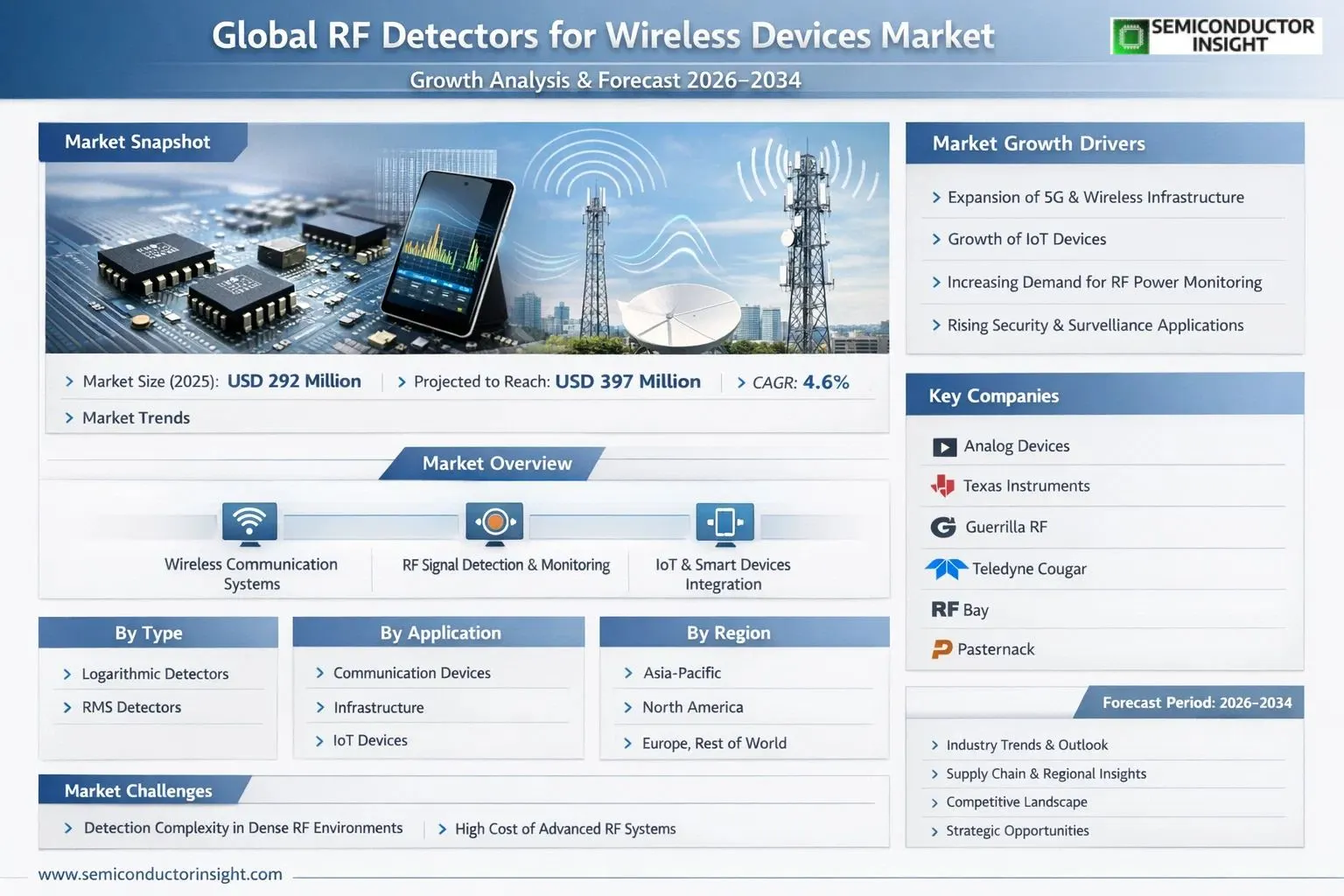
Global RF Detectors for Wireless Devices market size was valued at USD 292 million in 2025. The market is projected to grow from USD 305 million in 2026 to USD 397 million by 2034, exhibiting a CAGR of 4.6% during the forecast period.
An RF detector monitors or samples the output of an RF circuit and develops a dc output voltage proportional to the power at that point. RF detectors are used primarily to measure and control RF power in wireless systems. These components are fundamental to ensuring signal integrity and power management across a broad range of wireless applications, including communication devices, network infrastructure, and IoT devices. The two primary product types in this market are the Logarithmic Type and the RMS Type, each serving distinct performance and application requirements.
The market is experiencing steady growth driven by the accelerating global rollout of 5G infrastructure, the rapid proliferation of IoT-connected devices, and the rising demand for precise RF power measurement in both commercial and defense communication systems. Furthermore, increasing integration of wireless technologies in consumer electronics and industrial automation is reinforcing demand for reliable RF detection solutions. Analog Devices, Texas Instruments, Guerrilla RF, JFW Industries, RF Bay, Teledyne Cougar, and Pasternack are among the key players operating in Global RF Detectors for Wireless Devices market, collectively holding a significant share of global revenues in 2025.
MARKET DRIVERS
Rising Security Concerns and Proliferation of Wireless Communication Technologies
RF Detectors for Wireless Devices Market is experiencing robust growth, primarily driven by escalating concerns over unauthorized surveillance, data breaches, and the exponential rise in wireless communication infrastructure globally. As organizations across government, defense, corporate, and private sectors increasingly recognize the threat posed by clandestine wireless transmitters, demand for reliable RF detection solutions has intensified considerably. The widespread deployment of 5G networks, IoT-connected devices, and Bluetooth-enabled gadgets has expanded the attack surface for wireless eavesdropping, making RF detection an essential component of comprehensive security protocols.
Growing Adoption Across Defense, Government, and Corporate Sectors
Defense and intelligence agencies represent a significant demand base for RF Detectors for Wireless Devices Market, as these organizations require continuous monitoring of radio frequency environments to prevent information leakage and counter espionage activities. Similarly, corporate enterprises handling sensitive intellectual property are increasingly deploying RF detection equipment in boardrooms, research facilities, and secure communication zones. Governments worldwide are also mandating the use of RF detection tools in critical infrastructure environments, further propelling market expansion across multiple end-use verticals.
➤ The demand for advanced RF detectors capable of identifying signals across a broad frequency spectrum , from sub-1 GHz legacy bands to millimeter-wave 5G frequencies , is becoming a defining requirement in next-generation wireless security frameworks.
Technological advancements in wideband RF detection and software-defined radio (SDR) architectures are further accelerating market growth. Modern RF detectors now offer enhanced sensitivity, real-time spectrum analysis, and AI-assisted signal classification, enabling users to distinguish between legitimate and suspicious wireless transmissions with greater precision. These innovations are broadening the applicability of RF detectors for wireless devices across commercial, law enforcement, and personal security use cases, sustaining strong upward momentum in global market demand.
MARKET CHALLENGES
Technical Complexity in Detecting Modern Low-Power and Frequency-Hopping Wireless Signals
One of the foremost challenges confronting RF Detectors for Wireless Devices Market is the increasing sophistication of wireless transmission techniques employed by modern surveillance devices. Technologies such as frequency hopping spread spectrum (FHSS), direct-sequence spread spectrum (DSSS), and burst transmission make it considerably difficult for conventional RF detectors to reliably identify and localize illicit wireless signals. As covert surveillance hardware continues to evolve, the performance gap between detection capabilities and evasion techniques narrows, posing a persistent technical challenge for manufacturers and end-users alike.
Other Challenges
High False Positive Rates in Dense RF Environments
Urban and industrial environments characterized by high RF signal density present significant operational challenges for RF detection systems. The proliferation of Wi-Fi, cellular, Bluetooth, and IoT signals creates a complex electromagnetic environment where distinguishing between benign and malicious transmissions requires advanced signal processing capabilities. High false positive rates not only reduce operational efficiency but also contribute to alert fatigue among security personnel, undermining the overall effectiveness of RF surveillance countermeasures.
Lack of Standardization and Skilled Operators
The absence of universally accepted performance standards and certification frameworks for RF detectors for wireless devices creates inconsistency in product quality and end-user expectations across different markets. Furthermore, the effective operation of advanced RF detection equipment requires specialized technical knowledge in radio frequency engineering and signal analysis , a skill set that remains scarce across many commercial and governmental organizations. This skills gap limits the deployment and effective utilization of sophisticated RF detection platforms, particularly in developing economies.
MARKET RESTRAINTS
High Cost of Advanced RF Detection Systems Limiting Widespread Adoption
The elevated procurement and maintenance costs associated with high-performance RF detectors for wireless devices represent a significant restraint on broader market penetration. Professional-grade RF detection systems incorporating wideband coverage, real-time spectrum analysis, and AI-powered signal classification command substantial price premiums that place them beyond the budgetary reach of small and medium-sized enterprises (SMEs) and individual end-users. This cost barrier concentrates market demand primarily among large government bodies, defense contractors, and well-capitalized corporations, limiting the overall addressable market for premium RF detection solutions.
Regulatory Constraints and Export Control Regulations
RF Detectors for Wireless Devices Market is also constrained by complex and jurisdiction-specific regulatory frameworks governing the sale, export, and use of RF detection and spectrum monitoring equipment. In several regions, RF detectors are classified alongside counter-surveillance and electronic warfare equipment, subjecting them to stringent export control regimes such as the Wassenaar Arrangement and various national dual-use technology regulations. These regulatory barriers impede cross-border market expansion, create compliance burdens for manufacturers, and slow the pace of technology transfer to emerging markets where demand for wireless security solutions is growing rapidly.
Additionally, concerns over the potential misuse of RF detection technology for illegal surveillance or privacy violations have prompted regulatory authorities in multiple jurisdictions to impose restrictions on civilian access to certain classes of RF detection equipment. Such regulatory constraints, while designed to protect civil liberties, inadvertently dampen legitimate market demand and create uncertainty for vendors seeking to expand their commercial distribution networks globally.
MARKET OPPORTUNITIES
Integration of AI and Machine Learning for Intelligent RF Signal Classification
The convergence of artificial intelligence and RF detection technology presents a transformative opportunity for RF Detectors for Wireless Devices Market. AI and machine learning algorithms are increasingly being embedded into RF detection platforms to enable automated signal identification, anomaly detection, and threat classification with minimal operator intervention. This technological integration not only enhances detection accuracy in complex electromagnetic environments but also reduces the skill requirements for effective system operation, potentially expanding the addressable user base considerably across commercial and public sector segments.
Expanding Demand in Emerging Economies and Critical Infrastructure Protection
Rapid urbanization, accelerating digitalization, and growing awareness of wireless security threats in emerging economies across Asia-Pacific, Latin America, and the Middle East represent a substantial untapped opportunity for RF Detectors for Wireless Devices Market. Governments in these regions are progressively investing in critical infrastructure protection, border security, and public safety systems that increasingly incorporate RF monitoring capabilities. As these markets mature and procurement budgets expand, vendors offering cost-effective yet high-performance RF detection solutions are well-positioned to capitalize on significant new revenue streams.
The growing deployment of smart city infrastructure, connected transportation networks, and industrial IoT ecosystems is further creating demand for continuous RF environment monitoring across public and private sector installations. This trend is expected to generate sustained procurement opportunities for manufacturers of both fixed-installation and portable RF detectors for wireless devices, particularly those offering scalable, networked detection architectures capable of covering large geographic areas with centralized management and real-time alerting capabilities.
MAIN TITLE HERE () Trends
Rising Demand for RF Power Monitoring Across Wireless Communication Systems
RF Detectors for Wireless Devices Market is experiencing a notable shift driven by the rapid global expansion of wireless communication infrastructure. As next-generation networks continue to be deployed across regions, the need for precise RF power detection and monitoring has become increasingly critical. RF detectors, which develop a DC output voltage proportional to RF power, play a foundational role in ensuring signal integrity and system efficiency across a wide range of wireless platforms. Industries relying on communication devices, IoT systems, and broader network infrastructure are actively integrating advanced RF detection solutions to manage power levels and reduce signal degradation. This trend is particularly prominent in markets where connectivity density is rising rapidly, driving sustained interest in both logarithmic and RMS detector types.
Other Trends
IoT Expansion Fueling Adoption of Compact RF Detection Solutions
The proliferation of IoT devices globally is emerging as one of the most significant drivers shaping RF Detectors for Wireless Devices Market. As connected devices multiply across smart homes, industrial automation, and healthcare monitoring applications, the demand for miniaturized, low-power RF detectors capable of operating across diverse frequency bands has grown considerably. Manufacturers are responding by developing highly integrated solutions that deliver accurate power detection while meeting the stringent size and energy constraints typical of IoT hardware. This segment represents a strong area of commercial opportunity, particularly as global IoT deployments continue to scale across both developed and emerging economies.
Infrastructure Investments Supporting Market Development
Significant investments in telecommunications and wireless network infrastructure worldwide are reinforcing demand within RF Detectors for Wireless Devices Market. Infrastructure upgrades, including antenna systems, base stations, and distributed network nodes, require reliable RF detection components to optimize power management and ensure operational consistency. Leading manufacturers such as Analog Devices, Texas Instruments, and Teledyne Cougar are actively developing products tailored to infrastructure applications, reflecting the strategic importance of this segment. The continued build-out of wireless infrastructure in North America, Europe, and the Asia-Pacific region is expected to sustain this demand pattern over the coming years.
Technological Advancements Shaping Product Innovation in RF Detection
Continuous technological advancement is reshaping the competitive landscape of RF Detectors for Wireless Devices Market. Key players including Guerrilla RF, JFW Industries, RF Bay, and Pasternack are investing in research and development to introduce detectors with enhanced frequency range, improved accuracy, and greater integration capability. The evolution of logarithmic detector technology, in particular, is enabling more precise power measurement across wide dynamic ranges, a capability increasingly demanded by modern wireless systems. As the market matures, product differentiation through performance optimization, integration with semiconductor platforms, and application-specific design is becoming a central competitive strategy among global suppliers.
COMPETITIVE LANDSCAPEKey Industry Players
RF Detectors for Wireless Devices Market , Competitive Dynamics, Strategic Positioning, and Leading Manufacturer Profiles
Global RF Detectors for Wireless Devices market, valued at approximately USD 292 million in 2025 and projected to reach USD 397 million by 2034 at a CAGR of 4.6%, is characterized by moderate consolidation with a handful of dominant players commanding a significant share of total revenues. Analog Devices, Inc. stands out as a foremost leader in this space, leveraging its broad semiconductor portfolio, advanced signal processing expertise, and deep integration capabilities across communication devices, infrastructure, and IoT applications. Texas Instruments similarly holds a commanding position, offering a comprehensive range of RF power detection ICs that serve both Logarithmic and RMS detector segments. These tier-one players benefit from extensive R&D investment, global distribution networks, and long-standing relationships with OEMs across telecom, defense, and industrial sectors. Their ability to deliver high-precision, low-power RF detector solutions at scale has reinforced their dominance in both North American and Asia-Pacific markets, where demand from 5G infrastructure rollout and proliferating IoT device ecosystems continues to accelerate.
Beyond the market leaders, several specialized and niche players contribute meaningfully to the competitive fabric of the RF Detectors for Wireless Devices landscape. Guerrilla RF has gained recognition for its high-performance RF semiconductor solutions tailored to demanding wireless applications, while JFW Industries is well-regarded for its RF and microwave components including attenuators and switching systems that complement detector solutions. RF Bay offers a focused catalog of passive and active RF components serving laboratory and field measurement environments. Teledyne Cougar, a subsidiary of Teledyne Technologies, brings defense-grade RF detection capabilities with a strong emphasis on broadband performance and rugged design. Pasternack, operating under the Infinite Electronics umbrella, provides an extensive inventory of RF, microwave, and millimeter-wave products including detector modules suited for rapid prototyping and system integration. Additional players such as Skyworks Solutions, Qorvo, MACOM Technology Solutions, Mini-Circuits, API Technologies, Keysight Technologies, Broadcom Inc., NXP Semiconductors, and Infineon Technologies also maintain relevant product lines and competitive presence within adjacent RF and wireless component markets, collectively shaping the innovation trajectory and pricing dynamics of Global RF detector industry.
List of Key RF Detectors for Wireless Devices Companies Profiled
- Analog Devices, Inc.
- Texas Instruments
- Guerrilla RF
- JFW Industries
- RF Bay
- Teledyne Cougar
- Pasternack
- Skyworks Solutions
- Qorvo
- MACOM Technology Solutions
- Mini-Circuits
- API Technologies
- Keysight Technologies
- Broadcom Inc.
- NXP Semiconductors
Segment Analysis:
| Segment Category | Sub-Segments | Key Insights |
| By Type |
|
Logarithmic Type holds the leading position in RF Detectors for Wireless Devices Market, driven by its superior dynamic range and ability to handle widely varying signal amplitudes across diverse wireless environments.
RMS Type detectors are gaining traction in applications that demand high accuracy regardless of the modulation type, particularly in environments with complex waveforms such as OFDM-based wireless systems, making them an increasingly competitive alternative in specialized use cases. |
| By Application |
|
Communication Devices represent the dominant application segment, reflecting the widespread integration of RF detectors across smartphones, tablets, wireless modems, and other consumer-facing wireless hardware.
Infrastructure is emerging as a rapidly expanding application area, fueled by large-scale deployments of base stations, small cells, and repeaters associated with 5G network buildout globally. IoT Devices also represent a compelling growth frontier, with billions of connected sensors and edge devices requiring low-power, cost-efficient RF detection to manage their wireless communication modules effectively. |
| By End User |
|
Telecommunications Operators constitute the leading end-user segment, as they are at the forefront of deploying and maintaining expansive wireless network infrastructure that relies heavily on RF detection for power management, signal optimization, and equipment protection.
Defense & Aerospace Organizations represent a high-value end-user segment characterized by stringent performance and reliability requirements, driving demand for specialized RF detectors engineered to withstand harsh environmental conditions and operate reliably across mission-critical communication and electronic warfare systems. |
| By Frequency Range |
|
1 GHz – 10 GHz range dominates RF Detectors for Wireless Devices Market, encompassing the frequency bands most widely used by mainstream cellular, Wi-Fi, Bluetooth, and other established wireless communication standards.
|
| By Form Factor |
|
Integrated Circuit (IC) Based RF detectors lead this segment, reflecting the broader industry trend toward miniaturization, system-on-chip integration, and the demand for space-efficient solutions in modern wireless devices.
|
Regional Analysis: RF Detectors for Wireless Devices Market
North America
North America’s robust regulatory framework plays a pivotal role in shaping demand for RF detectors for wireless devices. Federal agencies mandate stringent electromagnetic compliance standards across defense, healthcare, and telecommunications sectors. These regulatory pressures compel organizations to adopt certified RF detection solutions, ensuring consistent market engagement from enterprise-level buyers and public sector institutions seeking to meet evolving security and compliance benchmarks.
The region benefits from substantial research and development activity concentrated in advanced signal intelligence and wireless security technologies. Leading universities, private laboratories, and defense research entities continuously refine RF detection methodologies, resulting in more sensitive, compact, and multi-band capable devices. This innovation cycle ensures North American products remain competitive globally and meet the increasingly complex demands of modern wireless threat environments.
Government and defense procurement represent cornerstone demand drivers in the North American RF detectors for wireless devices market. Military installations, intelligence agencies, and border security authorities routinely invest in advanced RF monitoring systems to detect unauthorized transmissions and maintain operational security. This sustained institutional demand provides a stable foundation for market growth and encourages manufacturers to develop purpose-built solutions tailored to classified operational environments.
Beyond government applications, the commercial sector in North America is rapidly expanding its use of RF detection technology. Financial institutions, legal firms, hospitality venues, and data centers are increasingly deploying wireless device detectors to prevent unauthorized recording and data leakage. The rise of hybrid work environments and bring-your-own-device policies has further amplified organizational awareness of RF-related vulnerabilities, driving broader enterprise-level adoption across diverse industries.
Europe
Europe represents a significant and steadily evolving market for RF detectors for wireless devices, underpinned by comprehensive data protection legislation, a sophisticated security culture, and the presence of prominent defense and telecommunications industries. The General Data Protection Regulation framework has heightened organizational sensitivity toward wireless surveillance threats, prompting businesses and institutions to adopt preventive RF monitoring measures. Countries such as Germany, the United Kingdom, and France lead regional demand, reflecting their advanced industrial bases and proactive approaches to cybersecurity and physical security integration. The European market also benefits from growing investments in smart city infrastructure and critical facility protection, where RF detection plays an essential role in maintaining secure operational environments. Additionally, heightened geopolitical considerations across the continent have reinforced government-led initiatives to strengthen signal intelligence capabilities. European manufacturers and distributors are increasingly focusing on developing compact, user-friendly RF detection tools that comply with regional electromagnetic compatibility standards, ensuring seamless integration into existing security architectures across public and private sector applications throughout the forecast period.
Asia-Pacific
The Asia-Pacific region is emerging as one of the most dynamic growth frontiers in RF Detectors for Wireless Devices Market, driven by rapid urbanization, expanding digital infrastructure, and escalating security priorities across both developed and developing economies. Countries such as China, Japan, South Korea, India, and Australia are witnessing rising adoption of RF detection solutions across government agencies, corporate campuses, financial institutions, and critical infrastructure facilities. The exponential proliferation of wireless-enabled devices across densely populated urban centers has amplified concerns around unauthorized signal transmission and electronic eavesdropping, creating fertile ground for market expansion. Governments across the region are progressively strengthening their national security frameworks, with dedicated procurement programs targeting advanced RF monitoring capabilities. Furthermore, a growing base of local manufacturers is enhancing product accessibility by offering cost-competitive solutions tailored to the region’s diverse regulatory and operational environments, accelerating market penetration across previously underserved segments of the Asia-Pacific RF detectors for wireless devices market.
South America
South America presents a gradually developing market landscape for RF detectors for wireless devices, characterized by increasing awareness of wireless security threats and a growing emphasis on protecting sensitive governmental and corporate communications. Brazil and Argentina lead regional demand, supported by investments in modernizing security infrastructure across public institutions, financial centers, and executive facilities. The region’s expanding telecommunications sector and rising adoption of wireless technologies in both urban and semi-urban settings are contributing to a broader understanding of RF-related vulnerabilities. Political and corporate intelligence concerns have further catalyzed procurement of RF detection equipment among high-profile organizations. While budgetary constraints and limited technical expertise continue to moderate the pace of adoption in certain markets, international vendors are increasingly establishing local partnerships and distribution networks to improve market accessibility, positioning South America as a promising long-term opportunity within Global RF detectors for wireless devices market across the forecast horizon.
Middle East & Africa
The Middle East and Africa region occupies a niche but progressively significant position in RF Detectors for Wireless Devices Market, with demand concentrated primarily among government agencies, defense establishments, and luxury commercial facilities across Gulf Cooperation Council nations and select African economies. The Middle East, led by Saudi Arabia, the United Arab Emirates, and Qatar, demonstrates considerable appetite for advanced security technologies, including RF detection solutions deployed in high-security venues, embassies, and critical national infrastructure. Ongoing investments in smart city development and national security modernization programs are creating new procurement opportunities for wireless device detection systems. In Africa, market development remains nascent but is gaining momentum as multinational corporations and international organizations seek to establish secure operational environments across key business hubs. The growing availability of internationally distributed RF detection products and increasing regional awareness of wireless surveillance risks are collectively supporting gradual but steady market development across the Middle East and Africa.
Report Scope
This market research report provides a comprehensive analysis of RF Detectors for Wireless Devices Market, covering the forecast period 2026–2034. It offers detailed insights into market dynamics, technological advancements, competitive landscape, and key trends shaping the industry.
Key focus areas of the report include:
- Market Overview: The report begins with an overview outlining its current market scenario, key growth indicators, and industry transformation drivers. It discusses macroeconomic factors, demand–supply balance, regulatory landscape, and the strategic role of RF detection technologies in powering advancements across industries such as telecommunications, IoT, communication devices, and infrastructure.
- Market Size & Forecast: Historical data and future projections for revenue, unit shipments, and market value across major regions and segments.
- Segmentation Analysis: Detailed breakdown by product type (Logarithmic Type, RMS Type), application (Communication Devices, Infrastructure, IoT Devices, Others), and end-user industry to identify high-growth segments and investment opportunities.
- Regional Insights: Insights into market performance across North America, Europe, Asia-Pacific, Latin America, and the Middle East & Africa, including country-level analysis where relevant.
- Competitive Landscape: Profiles of leading market participants, including their product offerings, R&D focus, manufacturing capacity, pricing strategies, and recent developments such as mergers, acquisitions, and partnerships.
- Technology Trends & Innovation: Assessment of emerging technologies, integration of AI/IoT, RF detector design trends, fabrication techniques, and evolving industry standards.
- Market Drivers & Restraints: Evaluation of factors driving market growth along with challenges, supply chain constraints, regulatory issues, and market-entry barriers.
- Stakeholder Insights: Insights for component suppliers, OEMs, system integrators, investors, and policymakers regarding the evolving ecosystem and strategic opportunities.
Primary and secondary research methods are employed, including interviews with industry experts, data from verified sources, and real-time market intelligence to ensure the accuracy and reliability of the insights presented.
FREQUENTLY ASKED QUESTIONS:
What is the current market size of RF Detectors for Wireless Devices Market?
-> RF Detectors for Wireless Devices Market was valued at USD 292 million in 2025 and is expected to reach USD 397 million by 2034, growing at a CAGR of 4.6% during the forecast period.
Which key companies operate in RF Detectors for Wireless Devices Market?
-> Key players include Analog Devices, Texas Instruments, Guerrilla RF, JFW Industries, RF Bay, Teledyne Cougar, and Pasternack, among others.
What are the key growth drivers?
-> Key growth drivers include rising demand for wireless communication systems, rapid expansion of IoT devices, growing infrastructure investments, and increasing need to measure and control RF power in wireless systems.
Which region dominates the market?
-> Asia (including China, Japan, South Korea, and Southeast Asia) is among the fastest-growing regions, while North America remains a significant market, with the U.S. representing a major share of Global RF Detectors for Wireless Devices market.
What are the emerging trends?
-> Emerging trends include integration of RF detectors in IoT devices, adoption of logarithmic and RMS type detectors for advanced wireless systems, and increased deployment across communication infrastructure and next-generation wireless networks.

Get Sample Report PDF for Exclusive Insights
Report Sample Includes
- Table of Contents
- List of Tables & Figures
- Charts, Research Methodology, and more...


