MARKET INSIGHTS
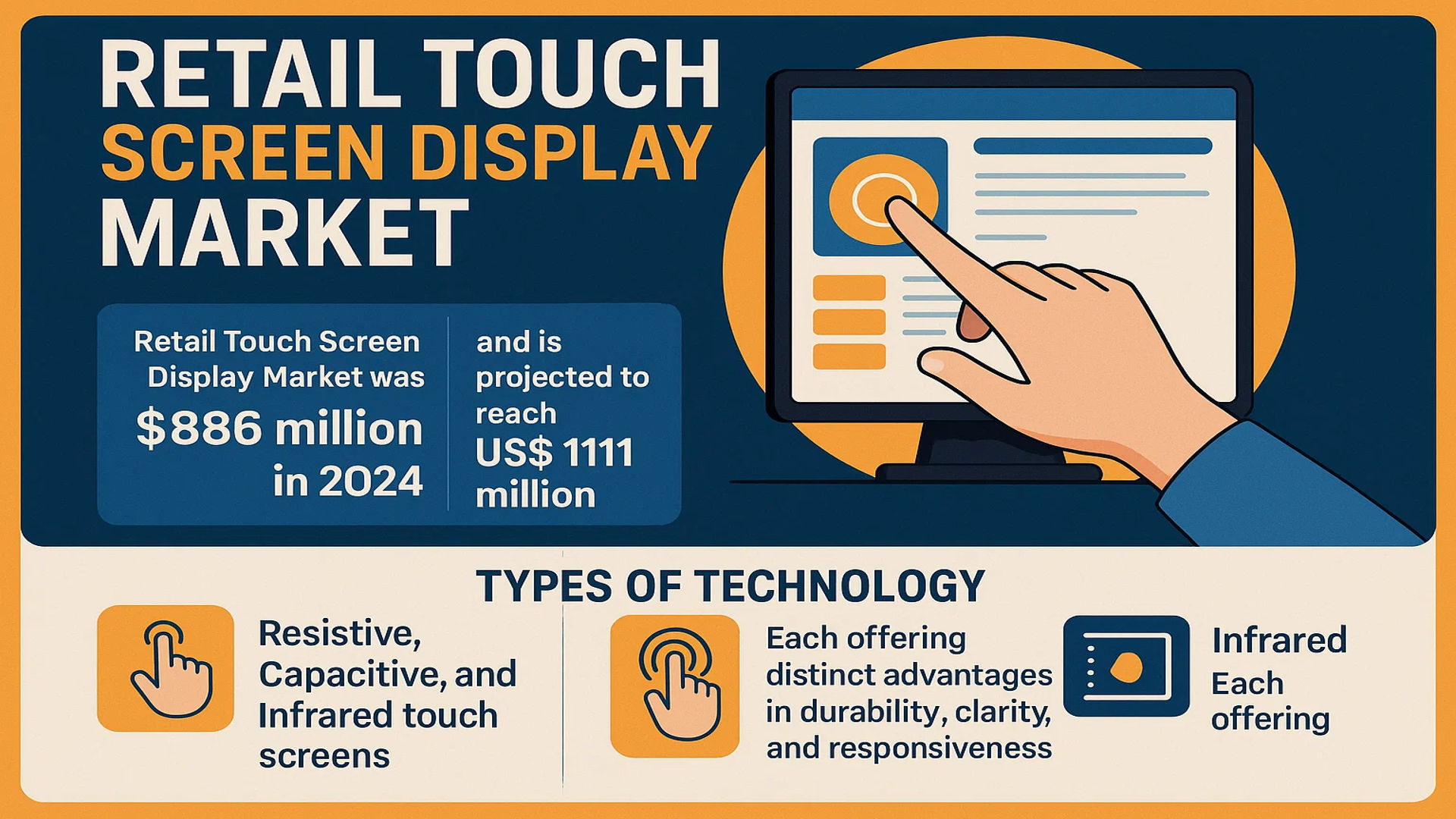
The global Retail Touch Screen Display Market was valued at 886 million in 2024 and is projected to reach US$ 1111 million by 2032, at a CAGR of 3.4% during the forecast period.
A retail touch screen display is an input device layered atop an electronic visual display, enabling users to interact with an information processing system through simple or multi-touch gestures using a stylus or fingers. These displays are fundamental components in modern retail environments, facilitating a wide range of applications from transaction processing to immersive customer engagement. The primary types of technology employed include Resistive, Capacitive, and Infrared touch screens, each offering distinct advantages in durability, clarity, and responsiveness.
The market’s steady growth is underpinned by the global retail sector’s ongoing digital transformation, driven by the demand for enhanced customer experiences and operational efficiency. The United States is the largest regional market, accounting for over 25% of global revenue, while Europe and China collectively represent over 40%. In terms of product technology, Resistive Touch Screens dominate, holding a market share exceeding 50% due to their cost-effectiveness and durability in high-traffic retail settings. The leading application segment is Point of Sale (POS) Equipment, followed closely by Interactive Point of Purchase (IPOP) systems, as retailers increasingly adopt self-service kiosks and interactive signage. Key players such as 3M, Elo Touch, and NEC continue to drive innovation and market consolidation.
MARKET DYNAMICS
MARKET DRIVERS
Rising Demand for Enhanced Customer Experience and Interactive Retail Solutions
The global retail industry is increasingly adopting touch screen displays to create immersive and interactive shopping experiences. Modern consumers expect seamless, engaging interactions with brands, driving retailers to invest in technologies that facilitate direct product exploration, information access, and personalized recommendations. Touch screen displays enable customers to browse catalogs, check inventory, compare products, and access detailed specifications without staff assistance. This technology significantly reduces perceived wait times and increases customer satisfaction. The integration of touch screens in point-of-sale systems, interactive kiosks, and digital signage has become a critical differentiator for retailers seeking to enhance brand perception and drive sales. The ability to provide real-time information and personalized content through these interfaces has transformed traditional retail spaces into dynamic, responsive environments.
Growth of Omnichannel Retailing and Digital Transformation Initiatives
Omnichannel retail strategies are accelerating the adoption of touch screen displays as bridges between physical and digital shopping experiences. Retailers are implementing these displays to create cohesive customer journeys that integrate online and offline channels. Touch screens in physical stores allow customers to access online inventories, place orders for out-of-stock items, and check alternative product options seamlessly. This integration reduces lost sales opportunities and improves inventory turnover. The digital transformation of retail operations, supported by investments in smart store technologies, is driving substantial demand for interactive displays. The capability to update content remotely, collect customer interaction data, and deliver targeted promotions makes touch screens invaluable tools for modern retailers implementing data-driven strategies.
Technological Advancements and Declining Production Costs
Continuous improvements in touch screen technology, including enhanced durability, better responsiveness, and reduced power consumption, are driving market expansion. Manufacturers have developed more robust displays capable of withstanding high-traffic retail environments while maintaining optical clarity and touch sensitivity. The evolution from resistive to capacitive and infrared technologies has improved user experience through multi-touch capabilities, gesture recognition, and enhanced accuracy. Simultaneously, economies of scale in manufacturing have significantly reduced production costs, making touch screen solutions more accessible to retailers across various segments. The development of larger format displays with higher resolutions has enabled more compelling visual merchandising applications, while smaller, more affordable units have expanded deployment opportunities in space-constrained environments.
MARKET RESTRAINTS
High Initial Investment and Maintenance Costs Limiting Small Retailer Adoption
Despite declining component costs, the comprehensive implementation of touch screen display systems requires significant capital investment that many smaller retailers find prohibitive. A complete interactive display solution includes not only the hardware but also content management systems, installation services, network infrastructure, and ongoing technical support. For multi-location retailers, the costs scale considerably, creating substantial barriers to widespread adoption. Maintenance expenses further compound these challenges, as touch screens in high-traffic retail environments require regular cleaning, calibration, and occasional repairs. The need for specialized technical expertise to address malfunctions adds to operational costs and complexity. These financial considerations particularly affect small and medium-sized retailers operating with limited capital budgets, restricting market penetration in certain segments.
Technical Reliability and Durability Concerns in High-Traffic Environments
Retail environments present unique challenges for electronic equipment, including constant public use, potential misuse, and varying environmental conditions. Touch screens must withstand thousands of interactions daily while maintaining performance accuracy and visual quality. Concerns about screen damage, calibration drift, and responsiveness degradation over time make some retailers hesitant to invest extensively in these technologies. The presence of liquids, cleaning chemicals, and physical impacts in retail settings creates durability issues that can affect product lifespan and reliability. Additionally, technical malfunctions can disrupt customer experiences and require immediate attention, creating operational challenges for retail staff untrained in troubleshooting sophisticated display systems.
Cybersecurity Risks and Data Privacy Considerations
As touch screen displays become more connected and integrated with retail management systems, they present potential vulnerabilities to cybersecurity threats. These devices often collect and process customer data, including touch patterns, browsing behaviors, and sometimes personal information, raising significant privacy concerns. Retailers must implement robust security measures to protect both customer data and internal systems from unauthorized access. Compliance with data protection regulations adds complexity and cost to deployment, particularly for international retailers operating across multiple jurisdictions with varying requirements. The potential for system breaches or data leaks creates apprehension among some retailers, slowing adoption rates despite the technology’s benefits.
MARKET CHALLENGES
Integration Complexity with Legacy Systems and Infrastructure
Many retailers operate with established point-of-sale systems, inventory management platforms, and customer relationship management tools that were not designed to interface with modern touch screen displays. Integrating new interactive technologies with these legacy systems presents significant technical challenges requiring custom solutions and extensive testing. The compatibility issues between different generations of technology can lead to implementation delays, increased costs, and functional limitations. Retailers must often choose between comprehensive system upgrades or developing complex integration frameworks, both of which require substantial investment and technical expertise. This integration complexity particularly affects established retail chains with deeply embedded existing technologies.
Other Challenges
Content Management and Update Requirements
Maintaining relevant, engaging content across multiple touch screen displays requires dedicated resources and continuous effort. Retailers must develop content strategies, create visually appealing materials, and ensure information remains current across all locations. The need for regular content updates to reflect changing promotions, inventory, and seasonal offerings creates ongoing operational demands. Without effective content management systems and processes, touch screen displays can quickly become outdated, reducing their effectiveness and potentially creating negative customer experiences.
Staff Training and Change Management
Implementing touch screen technologies often requires significant changes to staff roles and procedures. Employees must learn to troubleshoot basic technical issues, guide customers in using the systems, and integrate the technology into their sales approaches. Resistance to change and varying levels of technical proficiency among staff can hinder effective implementation. Comprehensive training programs and ongoing support are essential but add to the overall cost and complexity of deployment.
MARKET OPPORTUNITIES
Expansion into Emerging Markets and Untapped Retail Segments
Significant growth opportunities exist in emerging markets where retail modernization is accelerating and consumer expectations are evolving rapidly. As developing economies experience retail sector growth and increased competition, merchants are seeking technologies that differentiate their offerings and improve operational efficiency. The relatively lower penetration of touch screen displays in these markets presents substantial expansion potential for manufacturers and solution providers. Additionally, retail segments beyond traditional clothing and electronics, such as grocery, furniture, and automotive retail, are increasingly recognizing the value of interactive displays. These previously underserved segments represent considerable opportunity for market growth as awareness of technology benefits spreads across the retail industry.
Advancements in Augmented Reality and Interactive Technologies
The integration of augmented reality capabilities with touch screen displays creates new possibilities for immersive retail experiences. Technologies that allow customers to visualize products in different contexts, customize options in real-time, and access enhanced product information through interactive displays are gaining traction. These advanced applications provide retailers with opportunities to differentiate their offerings and create more engaging customer interactions. The development of more sophisticated gesture control, voice integration, and personalized content delivery systems further expands the potential applications of touch screen technology in retail environments. These technological innovations open new market segments and application possibilities beyond traditional interactive displays.
Sustainability Initiatives and Energy-Efficient Solutions
Growing emphasis on sustainability in retail operations creates opportunities for manufacturers developing energy-efficient touch screen solutions. Displays with lower power consumption, longer lifespans, and recyclable components align with corporate sustainability goals and environmental regulations. The ability to reduce energy costs while demonstrating environmental responsibility provides compelling value propositions for retailers. Additionally, the development of displays using more sustainable materials and manufacturing processes addresses increasing consumer and regulatory pressure for environmentally conscious business practices. These sustainability considerations are becoming important factors in purchasing decisions, creating competitive advantages for manufacturers prioritizing eco-friendly innovations.
RETAIL TOUCH SCREEN DISPLAY MARKET TRENDS
Integration of Advanced Interactive Technologies to Emerge as a Dominant Trend
The global retail touch screen display market is experiencing a paradigm shift driven by the integration of advanced interactive technologies. Retailers are increasingly adopting high-resolution capacitive and infrared touch screens to enhance customer engagement and streamline operations. This trend is particularly evident in the Point of Sale (POS) Equipment segment, which accounts for over 40% of market applications. The demand for more intuitive and responsive interfaces has led to innovations such as multi-touch capabilities, gesture recognition, and improved durability. Furthermore, the rise of omnichannel retail strategies necessitates seamless digital interactions, making touch screens indispensable. The market is projected to grow from 886 million in 2024 to 1111 million by 2032, reflecting a compound annual growth rate of 3.4%. This growth is underpinned by continuous technological advancements that improve user experience and operational efficiency.
Other Trends
Expansion of Interactive Point of Purchase (IPOP) Solutions
The expansion of Interactive Point of Purchase (IPOP) solutions is significantly driving market growth. IPOP displays, which include interactive kiosks and digital signage, are becoming essential tools for enhancing in-store customer experiences and boosting sales. These solutions allow retailers to provide personalized promotions, product information, and navigation assistance, thereby increasing consumer engagement. The adoption of IPOP is particularly strong in North America and Europe, where retailers invest heavily in digital transformation. The resistive touch screen segment, which holds over 50% market share due to its cost-effectiveness and reliability, is widely used in these applications. Additionally, the integration of AI and data analytics with IPOP systems enables retailers to gather valuable consumer insights and tailor marketing strategies effectively.
Growing Demand for Enhanced Retail Brand Experience
The growing emphasis on creating immersive retail brand experiences is another key trend propelling the touch screen display market. Retailers are leveraging large-format touch screens and interactive tables to offer unique, engaging environments that differentiate their brands. These technologies facilitate virtual try-ons, interactive catalogs, and gamified shopping experiences, which are especially popular in sectors like fashion, electronics, and automotive. The capacitive touch screen segment, known for its superior clarity and responsiveness, is increasingly preferred for these high-end applications. Moreover, the post-pandemic recovery has accelerated investments in touchless and hygienic solutions, such as infrared touch screens, which allow interaction without physical contact. This focus on customer safety and experience is expected to sustain market growth, with significant contributions from emerging markets in Asia-Pacific.
COMPETITIVE LANDSCAPE
Key Industry Players
Companies Focus on Technological Innovation and Strategic Partnerships to Maintain Market Position
The global retail touch screen display market exhibits a semi-consolidated structure, characterized by the presence of multinational corporations, specialized technology firms, and emerging regional players competing intensely. 3M Company stands as a dominant force, leveraging its extensive R&D capabilities and robust global distribution network to secure a significant market share. The company’s diverse portfolio, which includes advanced projected capacitive (PCAP) and resistive touch solutions, caters to various retail applications from point-of-sale systems to interactive kiosks.
Elo Touch Solutions and NEC Display Solutions are also major contributors, collectively holding a substantial portion of the market. Elo’s strength lies in its dedicated focus on commercial-grade touch displays, known for durability and high performance in demanding retail environments. Meanwhile, NEC capitalizes on its strong brand reputation and integrated display technologies, particularly in large-format digital signage and POS systems. Both companies benefit from established relationships with retail chains and system integrators worldwide.
Market competition is further intensified by strategic activities such as mergers, acquisitions, and partnerships. For instance, the acquisition of Planar Systems by Leyard Optoelectronic has strengthened its product offerings and global reach. Similarly, companies are heavily investing in developing more intuitive, energy-efficient, and durable touch technologies to meet the evolving demands of modern retail, including enhanced multi-touch capabilities and improved optical clarity.
Meanwhile, Asian manufacturers like TPK Holding and Chimei Innolux compete aggressively on cost-efficiency and scale, supplying touch sensors and modules to numerous brands and OEMs. Their growth is propelled by massive production capacities and continuous innovation in touch panel manufacturing. These players are increasingly focusing on expanding their footprint in North American and European markets through competitive pricing and reliable supply chains.
List of Key Retail Touch Screen Display Companies Profiled
- 3M Company (U.S.)
- Elo Touch Solutions (U.S.)
- Planar Systems (Leyard) (U.S.)
- Touch International (U.S.)
- NEC Display Solutions (Japan)
- TPK Holding (Taiwan)
- Chimei Innolux Corporation (Taiwan)
- AOPEN Inc. (Taiwan)
- Sharp Corporation (Japan)
- Posiflex Technology Inc. (Taiwan)
- Hisense Visual Technology (China)
- Flytech Technology Co., Ltd. (Taiwan)
Segment Analysis:
By Type
Resistive Touch Screen Segment Dominates the Market Due to its Cost-Effectiveness and High Durability
The market is segmented based on type into:
- Resistive Touch Screen
- Capacitive Touch Screen
- Infrared Touch Screen
- Other
By Application
Point of Sale (POS) Equipment Segment Leads Due to its Critical Role in Streamlining Retail Transactions
The market is segmented based on application into:
- Interactive Point of Purchase (IPOP)
- Retail Brand Experience (Table)
- Point of Sale (POS) Equipment
- ATM
- Others
By End User
Retail Stores Segment Leads the Market Owing to Widespread Adoption for Enhanced Customer Engagement
The market is segmented based on end user into:
- Retail Stores
- Subtypes: Supermarkets, Hypermarkets, Specialty Stores, and others
- Hospitality
- Banking & Financial Services
- Transportation Hubs
- Others
By Screen Size
Medium-Sized Displays (15-30 inches) Segment Leads Due to Optimal Versatility Across Retail Applications
The market is segmented based on screen size into:
- Small (Below 15 inches)
- Medium (15-30 inches)
- Large (Above 30 inches)
Regional Analysis: Retail Touch Screen Display Market
North America
The United States is the largest market globally, holding over 25% of the total market share. This dominance is driven by a highly developed retail sector, widespread adoption of advanced point-of-sale (POS) systems, and significant investments in interactive kiosks and digital signage. The region is characterized by a strong preference for capacitive touch screen technology due to its superior responsiveness and multi-touch capabilities. Major players like 3M and Elo Touch Solutions have a significant presence here, fueling innovation. The market is mature but continues to grow steadily, supported by the ongoing retail digitalization trend and the need for enhanced customer engagement solutions.
Europe
Europe represents a substantial market, collectively holding a share of over 40% when combined with specific key countries. The region is characterized by stringent quality standards and a high adoption rate of retail technology. Countries like Germany, the UK, and France are at the forefront, driven by a robust retail infrastructure and a focus on creating immersive brand experiences. The demand is particularly strong for Interactive Point of Purchase (IPOP) displays and advanced POS equipment. European retailers are increasingly integrating touch screens for self-service kiosks and information terminals, with a noticeable shift towards more durable and higher-resolution displays to withstand high traffic environments.
Asia-Pacific
Led overwhelmingly by China, the Asia-Pacific region is a powerhouse of both consumption and manufacturing. China alone commands a massive share of the global market, driven by its vast manufacturing base for electronic components and a rapidly modernizing retail landscape. The region shows a distinct product preference, with resistive touch screens still holding the majority share due to their cost-effectiveness, particularly in price-sensitive markets. However, there is a palpable and accelerating shift towards capacitive technology, especially in premium retail segments and urban centers in countries like Japan and South Korea. The growth is fueled by massive urbanization, the expansion of organized retail, and the proliferation of ATMs and self-service kiosks.
South America
The market in South America is in a growth phase, presenting emerging opportunities for display suppliers. Countries like Brazil and Argentina are seeing gradual modernization of their retail sectors. The adoption of touch screen displays is primarily driven by the need for basic POS equipment and simple interactive kiosks. However, economic volatility and budgetary constraints often mean that retailers prioritize cost-effective solutions, which can slow the adoption of the latest high-end capacitive or infrared technologies. The market potential is significant but is closely tied to regional economic stability and increased investment in retail infrastructure.
Middle East & Africa
This is an emerging market with notable growth potential, particularly in the Gulf Cooperation Council (GCC) nations like the UAE and Saudi Arabia. Development is fueled by investments in luxury retail, shopping malls, and tourism infrastructure, which demand high-quality digital signage and interactive brand experience tables. However, progress across the broader region is uneven. While demand for durable displays is rising, wider adoption is often tempered by funding limitations and a less developed retail ecosystem in many nations. The long-term outlook remains positive, anchored by urban development projects and a growing focus on enhancing the retail customer journey.
Report Scope
This market research report provides a comprehensive analysis of the global and regional Retail Touch Screen Display markets, covering the forecast period 2025–2032. It offers detailed insights into market dynamics, technological advancements, competitive landscape, and key trends shaping the industry.
Key focus areas of the report include:
- Market Size & Forecast: Historical data and future projections for revenue, unit shipments, and market value across major regions and segments.
- Segmentation Analysis: Detailed breakdown by product type, technology, application, and end-user industry to identify high-growth segments and investment opportunities.
- Regional Outlook: Insights into market performance across North America, Europe, Asia-Pacific, Latin America, and the Middle East & Africa, including country-level analysis where relevant.
- Competitive Landscape: Profiles of leading market participants, including their product offerings, R&D focus, manufacturing capacity, pricing strategies, and recent developments such as mergers, acquisitions, and partnerships.
- Technology Trends & Innovation: Assessment of emerging technologies, integration of AI/IoT, semiconductor design trends, fabrication techniques, and evolving industry standards.
- Market Drivers & Restraints: Evaluation of factors driving market growth along with challenges, supply chain constraints, regulatory issues, and market-entry barriers.
- Stakeholder Analysis: Insights for component suppliers, OEMs, system integrators, investors, and policymakers regarding the evolving ecosystem and strategic opportunities.
Primary and secondary research methods are employed, including interviews with industry experts, data from verified sources, and real-time market intelligence to ensure the accuracy and reliability of the insights presented.
FREQUENTLY ASKED QUESTIONS:
What is the current market size of Global Retail Touch Screen Display Market?
-> Retail Touch Screen Display Market was valued at 886 million in 2024 and is projected to reach US$ 1111 million by 2032, at a CAGR of 3.4% during the forecast period.
Which key companies operate in Global Retail Touch Screen Display Market?
-> Key players include 3M, Elo Touch, Planar Systems, Touch International, and NEC, among others.
What are the key growth drivers?
-> Key growth drivers include digital transformation in retail, demand for interactive customer experiences, and expansion of self-service kiosks and POS systems.
Which region dominates the market?
-> North America is the largest market, with a share over 25%, while Asia-Pacific is the fastest-growing region.
What are the emerging trends?
-> Emerging trends include integration of AI-powered analytics, adoption of larger and bezel-less displays, and increased use of capacitive touch technology.

Get Sample Report PDF for Exclusive Insights
Report Sample Includes
- Table of Contents
- List of Tables & Figures
- Charts, Research Methodology, and more...
 Download Sample Report PDF