Resistance Aging Test System Market Insights
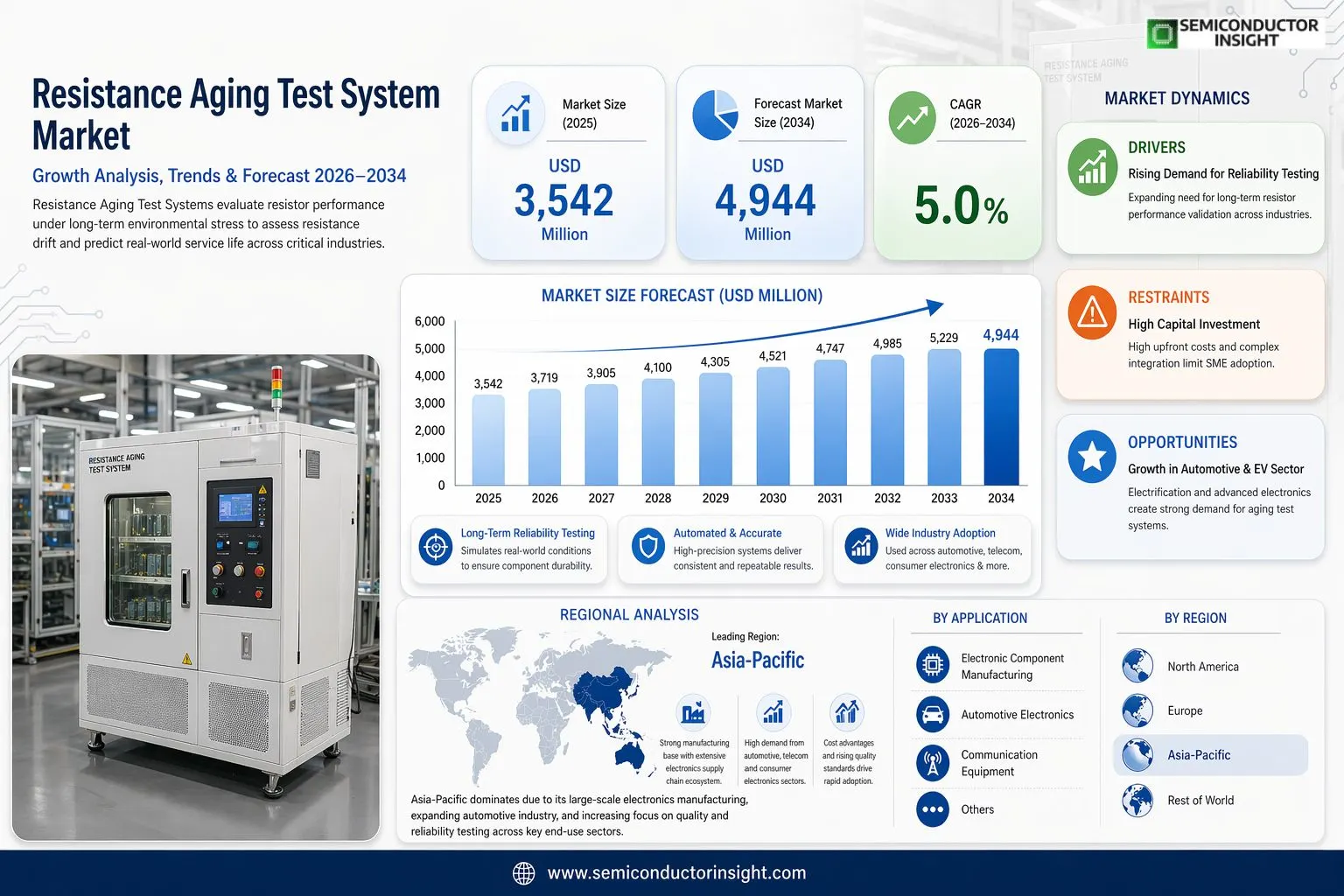
Global Resistance Aging Test System market size was valued at USD 3,542 million in 2025. The market is projected to grow from USD 3,719 million in 2026 to USD 4,944 million by 2034, exhibiting a CAGR of 5.0% during the forecast period.
A Resistance Aging Test System is a specialized testing platform designed to evaluate the performance changes and service life of resistors subjected to long-term use or specific environmental conditions. The system simulates actual operating environments to conduct extended performance assessments on resistors, enabling manufacturers to evaluate their anti-aging capability and accurately predict their real-world service life. It typically comprises core components such as a control system, a loading system, a test chamber, and a data acquisition system, all of which work in concert to allow tested resistors to operate continuously under controlled, constant environmental parameters while recording performance variations over time. The underlying working principle is grounded in long-term stability testing under defined temperature, humidity, and voltage conditions , replicating harsh environments including high temperature, low temperature, and damp heat scenarios , to observe critical performance indicators such as resistance drift and operational stability. Test durations generally range from a few hours to several thousand hours, depending on the intended application and the expected service life of the resistor under evaluation.
The market is steadily expanding, driven by the growing complexity of electronic systems across industries such as automotive electronics, communication equipment, and electronic component manufacturing. The rising adoption of automated testing technologies and the increasing demand for precision reliability validation in mission-critical applications are key factors accelerating market growth. Leading players operating in Global Resistance Aging Test System market include Micro Control, KES Systems, Keysight Technologies, Guangdong Bell Experiment Equipment, Shenzhen Zhongkeyuan Electronics, Shenzhen Feisitech Technology, Shenzhen Antosun Instruments, Shenzhen Tester System Technology, Shenzhen Jiesite Electronic Equipment, and Hangzhou Zhongan Electronics, among others.
MARKET DRIVERS
Rising Demand for Reliability Testing in Electronics and Automotive Industries
Resistance Aging Test System Market is experiencing notable growth driven by the expanding need for component reliability verification across electronics manufacturing and automotive sectors. As electronic assemblies become more complex and mission-critical, manufacturers are under increasing pressure to validate the long-term performance of resistive components under thermal, electrical, and environmental stress conditions. Resistance aging test systems provide the controlled, repeatable test environments necessary to simulate years of operational wear within compressed timeframes, making them indispensable in modern quality assurance workflows.
Stringent Quality and Compliance Standards Accelerating Adoption
Increasingly rigorous international standards such as IEC, MIL-STD, and AEC-Q200 are compelling manufacturers across defense, aerospace, consumer electronics, and industrial automation to adopt advanced resistance aging test systems as part of their standard qualification processes. Compliance with these standards is not optional for suppliers entering high-reliability supply chains, and this regulatory environment directly stimulates demand for precision aging and endurance test equipment. The push for zero-defect manufacturing philosophies further reinforces the strategic importance of these systems on production floors globally.
➤ The growing electrification of vehicles and proliferation of advanced driver-assistance systems (ADAS) have significantly elevated the criticality of resistance component testing, positioning Resistance Aging Test System Market for sustained long-term expansion.
The rapid proliferation of electric vehicles (EVs) and hybrid powertrains is generating a substantial secondary driver for Resistance Aging Test System Market. High-voltage battery management systems, power inverters, and charging infrastructure components all require exhaustive resistance stability verification before deployment. Automotive OEMs and Tier-1 suppliers are consequently scaling up their in-house testing capabilities, driving procurement of sophisticated aging test platforms capable of handling high-current and high-temperature test profiles with precision and repeatability.
MARKET CHALLENGES
High Capital Investment and Total Cost of Ownership Limiting SME Adoption
One of the primary challenges facing Resistance Aging Test System Market is the significant upfront capital expenditure associated with acquiring and integrating advanced test platforms. High-precision aging systems equipped with multi-channel measurement capabilities, environmental chambers, and automated data acquisition infrastructure carry substantial procurement and installation costs. For small and medium-sized enterprises (SMEs) in electronics manufacturing or contract testing, these costs can represent a meaningful barrier to entry, potentially restricting market penetration in price-sensitive geographies and industry segments.
Other Challenges
Technical Complexity and Skilled Workforce Requirements
Operating and maintaining resistance aging test systems demands a trained technical workforce capable of configuring test parameters, interpreting aging data, and performing system calibration to traceable standards. The shortage of qualified metrology and reliability engineering professionals in several emerging markets creates operational bottlenecks and increases the risk of measurement error, which can compromise test validity and delay product qualification timelines.
Integration with Legacy Test Infrastructure
Many established manufacturers operate mixed-generation test environments where newer resistance aging test systems must interface with legacy data management platforms and older automated test equipment (ATE) frameworks. Achieving seamless integration requires custom software development and middleware solutions, adding time and cost to deployment cycles. Incompatibility issues between proprietary hardware interfaces and modern industrial communication protocols remain a practical challenge for procurement and IT teams managing complex laboratory environments.
MARKET RESTRAINTS
Supply Chain Disruptions Affecting Precision Instrument Manufacturing
Resistance Aging Test System Market has encountered measurable restraints from global supply chain disruptions affecting the availability of precision electronic components, specialty materials, and semiconductor-based measurement modules used in system manufacturing. Prolonged lead times for critical sub-components have strained the production schedules of test equipment manufacturers, contributing to order backlogs and extended delivery timelines. These supply-side constraints have, in certain cases, prompted end-users to defer capital equipment investments, temporarily moderating market growth rates.
Slow Replacement Cycles in Mature Industrial Markets
In mature markets across North America and Western Europe, many industrial and electronics manufacturers operate resistance aging test systems with extended service lifespans, often spanning a decade or more. The long operational life of well-maintained precision test equipment naturally suppresses replacement demand, creating modest growth ceilings in established markets. Vendors operating in these regions must increasingly focus on value-added service contracts, calibration services, and software upgrade offerings to sustain revenue streams between capital equipment refresh cycles, representing a structural restraint on hardware-driven market expansion.
MARKET OPPORTUNITIES
Expansion of Semiconductor and Advanced Packaging Applications Creating New Demand
The ongoing advancement of semiconductor packaging technologies, including system-in-package (SiP), chiplet architectures, and three-dimensional integrated circuits, is creating substantial new opportunities for Resistance Aging Test System Market. These next-generation packaging formats introduce novel resistive interconnect structures whose long-term reliability under thermal cycling and electromigration stress must be rigorously characterized. Test system providers capable of delivering high-resolution, multi-site resistance aging measurement solutions tailored to advanced packaging geometries are well-positioned to capture growing demand from semiconductor manufacturers and OSATs worldwide.
Integration of Automation and Industry 4.0 Capabilities into Test Platforms
The convergence of resistance aging test systems with Industry 4.0 frameworks presents a compelling commercial opportunity for equipment manufacturers. By embedding automated test sequencing, real-time data analytics, cloud connectivity, and machine learning-based anomaly detection into next-generation platforms, vendors can offer significantly enhanced value propositions to quality-conscious manufacturers. End-users benefit from reduced operator dependency, faster test cycle completion, and richer aging data insights that support predictive quality models. This technological differentiation is increasingly becoming a key purchase criterion, particularly among Tier-1 automotive suppliers and aerospace integrators seeking to modernize their reliability verification infrastructure.
Emerging Market Growth Fueled by Expanding Electronics Manufacturing Ecosystems
Rapid industrialization and the establishment of domestic electronics manufacturing ecosystems across Southeast Asia, South Asia, and select Latin American markets are generating meaningful long-term opportunities for resistance aging test system suppliers. Government-backed initiatives to develop local semiconductor and electronics supply chains in countries such as India, Vietnam, and Mexico are driving investment in quality assurance infrastructure, including reliability and endurance testing capabilities. As these markets mature and align with international quality standards, demand for calibrated, standards-compliant resistance aging test systems is expected to grow steadily, offering vendors significant greenfield expansion potential beyond saturated Western markets.
Resistance Aging Test System Market Trends
Rising Demand for Long-Term Resistor Reliability Drives Growth in Resistance Aging Test System Market
Global Resistance Aging Test System market is witnessing steady growth, driven by the increasing need to evaluate resistor performance under prolonged operational and environmental stress conditions. As electronic components become more deeply embedded in mission-critical applications across automotive electronics, communication equipment, and consumer electronics manufacturing, the demand for precise, reliable aging test systems continues to expand. These systems simulate harsh environments , including high temperature, low temperature, and damp heat , to assess resistance changes, stability, and long-term service life, making them indispensable quality assurance tools across modern electronics supply chains.
Other Trends
Shift Toward Automatic Test Systems
One of the most prominent trends reshaping Resistance Aging Test System Market is the accelerating transition from manual to automatic test configurations. Automatic test systems offer enhanced throughput, reduced human error, and the ability to conduct continuous long-term testing , sometimes spanning thousands of hours , without operator intervention. As manufacturers face tighter production tolerances and stricter component qualification standards, automated resistance aging test platforms are increasingly being integrated into quality control workflows, particularly in high-volume electronic component manufacturing environments.
Expansion in Automotive Electronics Applications
The automotive electronics segment is emerging as a significant application area for resistance aging test systems. The proliferation of advanced driver-assistance systems (ADAS), electric vehicle powertrains, and in-vehicle communication modules has heightened the importance of component-level reliability validation. Resistors used in automotive-grade electronics must demonstrate stable performance across wide temperature ranges and extended operational lifespans, making aging test systems a standard requirement in automotive electronics qualification processes.
Growing Adoption in Communication Equipment Manufacturing
With Global rollout of 5G infrastructure and the expanding deployment of high-frequency communication equipment, manufacturers are placing greater emphasis on component-level durability testing. Resistance aging test systems are increasingly utilized to validate resistors deployed in base stations, network switching hardware, and telecommunications modules, where component failure can result in significant operational disruption. This trend is expected to sustain demand across both established and emerging communication technology markets.
Asia-Pacific Manufacturers Strengthen Global Market Presence
Resistance Aging Test System Market features a competitive landscape with key global players including Micro Control, KES Systems, Keysight Technologies, and a growing cluster of specialized Chinese manufacturers such as Guangdong Bell Experiment Equipment, Shenzhen Zhongkeyuan Electronics, and Shenzhen Feisitech Technology, among others. China-based manufacturers have notably expanded their product portfolios and technical capabilities, intensifying competition and broadening market access for mid-tier buyers. This regional manufacturing strength, combined with rising domestic demand for electronic component testing, positions Asia-Pacific as both a major production hub and a rapidly growing consumer of resistance aging test solutions.
COMPETITIVE LANDSCAPE
Key Industry Players
Resistance Aging Test System Market , Global Competitive Overview and Manufacturer Landscape
Global Resistance Aging Test System market, valued at approximately USD 3,542 million in 2025 and projected to reach USD 4,944 million by 2034 at a CAGR of 5.0%, is characterized by a moderately fragmented competitive environment. Keysight Technologies stands out as a globally recognized leader, leveraging its extensive portfolio of electronic test and measurement solutions, advanced R&D capabilities, and broad international distribution network. The company’s established reputation in precision instrumentation gives it a competitive advantage in high-end resistor aging and reliability testing applications, particularly within the automotive electronics and communication equipment sectors. Micro Control and KES Systems also hold notable positions in the North American segment, offering specialized burn-in and aging test platforms that cater to electronic component manufacturers seeking high-throughput automated solutions.
In the Asia-Pacific region, which represents a significant and fast-growing share of global demand, Chinese manufacturers have emerged as influential niche players driving competitive pricing and localized innovation. Companies such as Guangdong Bell Experiment Equipment, Shenzhen Zhongkeyuan Electronics, Shenzhen Feisitech Technology, Shenzhen Antosun Instruments, Shenzhen Tester System Technology, and Shenzhen Jiesite Electronic Equipment collectively serve a substantial portion of the domestic Chinese market, benefiting from proximity to major electronics manufacturing hubs. Additional regional players including Hangzhou Zhongan Electronics, Guangdong Aisrui Instrument Technology, Xiamen Yisite Instrument, Jinan Yisite Test Equipment, Guangzhou Yuexin Testing Equipment, and Shenzhen Changbao Electromechanical Equipment further intensify competition within the Asia-Pacific landscape. These companies compete on product customization, cost efficiency, and responsiveness to the evolving testing requirements of China’s booming electronic component manufacturing sector. In 2025, the top five global players collectively accounted for a significant portion of total market revenue, underscoring the ongoing consolidation dynamic within this specialized test equipment industry.
List of Key Resistance Aging Test System Companies Profiled
- Micro Control
- KES Systems
- Keysight Technologies
- Guangdong Bell Experiment Equipment
- Shenzhen Zhongkeyuan Electronics
- Shenzhen Feisitech Technology
- Shenzhen Antosun Instruments
- Shenzhen Tester System Technology
- Shenzhen Jiesite Electronic Equipment
- Hangzhou Zhongan Electronics
- Guangdong Aisrui Instrument Technology
- Xiamen Yisite Instrument
- Jinan Yisite Test Equipment
- Guangzhou Yuexin Testing Equipment
- Shenzhen Changbao Electromechanical Equipment
Segment Analysis:
| Segment Category | Sub-Segments | Key Insights |
| By Type |
|
Automatic Test systems represent the leading and fastest-growing segment within Resistance Aging Test System Market, driven by the increasing demand for precision, repeatability, and reduced human intervention in resistor performance evaluation.
|
| By Application |
|
Electronic Component Manufacturing stands as the dominant application segment for Resistance Aging Test Systems, underpinned by the critical need to validate resistor reliability across a wide spectrum of passive and active electronic assemblies destined for consumer, industrial, and defense applications.
|
| By End User |
|
Resistor and Passive Component Manufacturers constitute the primary end-user base for Resistance Aging Test Systems, as these entities are directly responsible for characterizing product lifespan and certifying component reliability prior to commercial distribution.
|
| By Test Environment |
|
High Temperature Aging is the most widely adopted test environment configuration in Resistance Aging Test Systems, as elevated thermal stress remains one of the most prevalent and deterministic accelerators of resistor performance degradation across virtually all application domains.
|
| By System Component |
|
Data Acquisition System has emerged as the most strategically critical component within the Resistance Aging Test System architecture, as the ability to capture, store, and interpret high-resolution performance data throughout extended test cycles is increasingly viewed as a core competitive differentiator among system manufacturers.
|
Regional Analysis: Resistance Aging Test System Market
North America
North America’s robust regulatory environment, enforced by bodies such as ASTM International and UL Standards, compels manufacturers across multiple sectors to integrate resistance aging test systems into their quality assurance workflows. Compliance is not optional but a foundational requirement, ensuring sustained and growing demand for standardized, high-accuracy aging test solutions across the United States and Canada.
The region consistently leads in adopting next-generation resistance aging test systems equipped with automated data acquisition, real-time monitoring capabilities, and IoT-enabled diagnostics. North American manufacturers and testing laboratories are early adopters of digitally integrated platforms, reinforcing the region’s technological leadership and driving continuous product evolution within Resistance Aging Test System Market.
Aerospace, automotive, consumer electronics, and defense industries represent the primary demand generators for resistance aging test systems in North America. Each sector requires rigorous material durability validation under simulated stress conditions, making aging test systems indispensable to product lifecycle management. The growing electric vehicle segment further expands the scope of application, particularly for battery component resistance testing.
North America hosts a competitive landscape where both established global players and specialized domestic vendors compete on technological differentiation and service capabilities. Strategic partnerships between test system manufacturers and research universities, alongside active participation in industry consortiums, strengthen the innovation pipeline and ensure that Resistance Aging Test System Market in the region remains highly dynamic and forward-looking.
Europe
Europe represents a mature and strategically significant region within Resistance Aging Test System Market, shaped by the continent’s deep commitment to manufacturing excellence, environmental sustainability, and rigorous product quality standards. Germany, France, the United Kingdom, and the Nordic nations serve as primary demand centers, where precision engineering industries and advanced electronics manufacturing sectors rely extensively on resistance aging test systems to validate component durability. The European Union’s evolving regulatory directives around product safety, environmental compliance, and energy efficiency indirectly stimulate demand for aging test solutions, as manufacturers must demonstrate extended product lifespans and material reliability. Europe’s strong focus on sustainable manufacturing practices further aligns with the capabilities of modern resistance aging test systems, which enable manufacturers to optimize material selection and reduce premature product failures. The region’s well-funded industrial research institutions and collaborative innovation ecosystems between academia and industry consistently generate new application areas for aging test technologies, reinforcing Europe’s position as a key contributor to global market advancement.
Asia-Pacific
Asia-Pacific is the fastest-evolving region in Resistance Aging Test System Market, propelled by rapid industrialization, expanding electronics manufacturing hubs, and growing awareness of product quality benchmarks across emerging economies. China, Japan, South Korea, and India are at the forefront of regional demand, with China’s vast electronics and automotive production base generating substantial requirements for resistance aging test systems at scale. Japan and South Korea contribute through their precision manufacturing industries and high-technology component sectors, where stringent internal quality standards drive consistent adoption of advanced aging test solutions. India’s expanding manufacturing sector, supported by government initiatives promoting domestic production capabilities, is progressively emerging as a significant market participant. The region also benefits from increasing foreign direct investment in manufacturing infrastructure, which brings international quality standards and, consequently, demand for reliable aging test systems. Asia-Pacific’s cost-sensitive market dynamics are gradually shifting toward value-driven procurement as quality consciousness deepens across the supply chain.
South America
South America occupies a developing but progressively relevant position within Global Resistance Aging Test System Market, with Brazil and Argentina serving as the primary regional demand centers. The region’s industrial base, while smaller in scale compared to North America or Asia-Pacific, is undergoing gradual modernization across sectors such as automotive assembly, oil and gas equipment manufacturing, and consumer goods production, all of which generate demand for material durability and aging validation tools. Regulatory harmonization efforts aligned with international standards are encouraging manufacturers in South America to adopt more rigorous testing protocols, including resistance aging test systems. Infrastructure investment programs and growing foreign industrial partnerships are further expanding the addressable market in the region. However, economic volatility and inconsistent regulatory enforcement remain challenges that temper the pace of adoption. Over the forecast period, improving industrial maturity and rising quality awareness are expected to gradually elevate South America’s contribution to Global Resistance Aging Test System Market landscape.
Middle East & Africa
The Middle East and Africa region represents an emerging frontier for Resistance Aging Test System Market, characterized by nascent but expanding industrial activity and a growing emphasis on infrastructure development and manufacturing localization. Gulf Cooperation Council nations, particularly Saudi Arabia and the United Arab Emirates, are investing significantly in diversifying their industrial bases beyond hydrocarbons, which is generating new demand for quality assurance and testing technologies, including resistance aging test systems. South Africa serves as the primary market anchor in the African continent, supported by its relatively advanced manufacturing and mining sectors. The region’s adoption of international quality and safety standards, driven in part by export-oriented manufacturing ambitions, is creating incremental demand for aging test solutions. While the market remains in its early stages relative to other global regions, long-term industrial diversification strategies and increasing participation in global supply chains position the Middle East and Africa as a market of growing strategic interest within the broader Resistance Aging Test System Market landscape.
Report Scope
This market research report provides a comprehensive analysis of Resistance Aging Test System Market, covering the forecast period 2026–2034. It offers detailed insights into market dynamics, technological advancements, competitive landscape, and key trends shaping the industry.
Key focus areas of the report include:
- Market Overview: The report begins with an overview outlining its current market scenario, key growth indicators, and industry transformation drivers. It discusses macroeconomic factors, demand–supply balance, regulatory landscape, and the strategic role of resistor aging test systems in powering advancements across industries such as automotive electronics, telecommunications, consumer electronics, and industrial automation.
- Market Size & Forecast: Historical data and future projections for revenue, unit shipments, and market value across major regions and segments.
- Segmentation Analysis: Detailed breakdown by product type, technology, application, and end-user industry to identify high-growth segments and investment opportunities.
- Regional Insights: Insights into market performance across North America, Europe, Asia-Pacific, Latin America, and the Middle East & Africa, including country-level analysis where relevant.
- Competitive Landscape: Profiles of leading market participants, including their product offerings, R&D focus, manufacturing capacity, pricing strategies, and recent developments such as mergers, acquisitions, and partnerships.
- Technology Trends & Innovation: Assessment of emerging technologies, integration of AI/IoT, semiconductor design trends, fabrication techniques, and evolving industry standards.
- Market Drivers & Restraints: Evaluation of factors driving market growth along with challenges, supply chain constraints, regulatory issues, and market-entry barriers.
- Stakeholder Insights: Insights for component suppliers, OEMs, system integrators, investors, and policymakers regarding the evolving ecosystem and strategic opportunities.
Primary and secondary research methods are employed, including interviews with industry experts, data from verified sources, and real-time market intelligence to ensure the accuracy and reliability of the insights presented.
FREQUENTLY ASKED QUESTIONS:
What is the current market size of Resistance Aging Test System Market?
-> Global Resistance Aging Test System Market was valued at USD 3,542 million in 2025 and is expected to reach USD 4,944 million by 2034, growing at a CAGR of 5.0% during the forecast period.
Which key companies operate in Resistance Aging Test System Market?
-> Key players include Micro Control, KES Systems, Keysight Technologies, Guangdong Bell Experiment Equipment, Shenzhen Zhongkeyuan Electronics, Shenzhen Feisitech Technology, Shenzhen Antosun Instruments, Shenzhen Tester System Technology, Shenzhen Jiesite Electronic Equipment, and Hangzhou Zhongan Electronics, among others.
What are the key growth drivers?
-> Key growth drivers include rising demand for long-term resistor performance testing, growth in electronic component manufacturing, expansion of automotive electronics, and increasing adoption of automated test systems across communication equipment and industrial sectors.
Which region dominates the market?
-> Asia-Pacific is a dominant and fast-growing region, driven by major manufacturing hubs in China, Japan, South Korea, and Southeast Asia, while North America remains a significant market supported by advanced electronics and automotive industries.
What are the emerging trends?
-> Emerging trends include automation of resistor aging test systems, integration of data acquisition and real-time monitoring technologies, simulation of harsh environments such as high temperature, low temperature, and damp heat conditions, and growing adoption of automatic test segments to improve testing efficiency and accuracy.

Get Sample Report PDF for Exclusive Insights
Report Sample Includes
- Table of Contents
- List of Tables & Figures
- Charts, Research Methodology, and more...