Market Insights
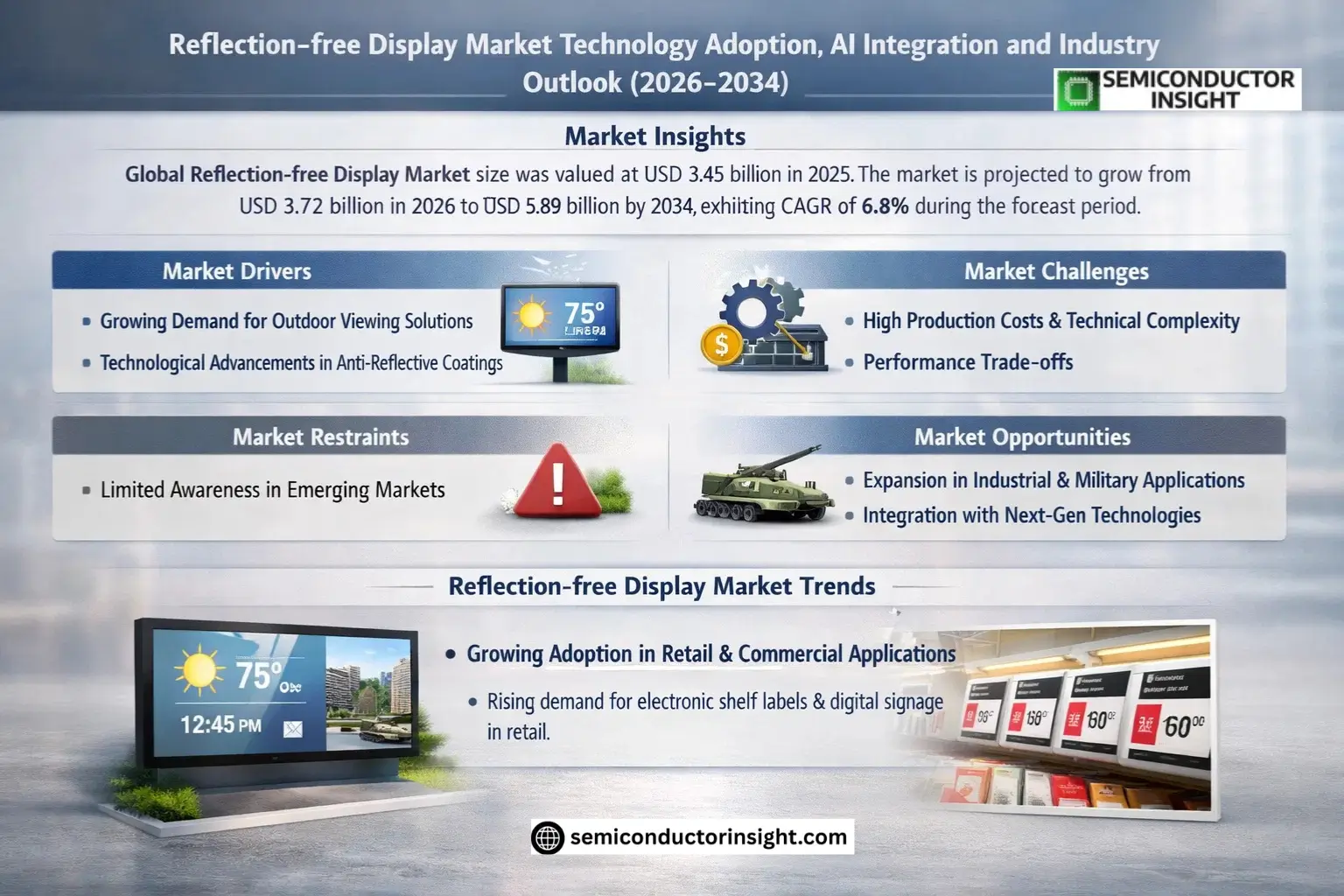
Global Reflection-free Display Market size was valued at USD 3.45 billion in 2025. The market is projected to grow from USD 3.72 billion in 2026 to USD 5.89 billion by 2034, exhibiting a CAGR of 6.8% during the forecast period.
Reflection-free displays are advanced screen technologies designed to minimize glare and reflections, enhancing visibility in high-ambient-light environments. These displays utilize specialized coatings, polarizers, and anti-reflective layers to reduce light scattering, making them ideal for applications such as outdoor digital signage, eReaders, and industrial monitors.
The market is experiencing steady growth due to increasing demand for high-visibility screens in retail, automotive, and healthcare sectors. Furthermore, advancements in display technologies like OLED and micro-LED are driving adoption. Key players such as Sharp, BOE, and Sony are investing in R&D to improve anti-reflective properties while maintaining energy efficiency.
MARKET DRIVERS
Growing Demand for Outdoor Viewing Solutions
Reflection-free Display Market is witnessing significant growth due to increasing demand for outdoor digital signage and consumer electronics with improved visibility. Over 60% of commercial displays currently face usability challenges in bright environments, creating opportunities for reflection-free technology. Industries such as retail, transportation, and advertising are adopting these solutions for better sunlight readability.
Technological Advancements in Anti-Reflective Coatings
Recent innovations in nano-coating technologies and optical film development have enhanced the performance of reflection-free displays. Leading manufacturers are achieving reflectivity rates below 1%, making these displays viable for critical applications like aviation and medical diagnostics. Global market for advanced optical coatings is projected to grow at 8.5% CAGR through 2030.
Healthcare and automotive sectors are increasingly specifying reflection-free displays as standard features, with OEMs reporting 35% higher adoption rates compared to five years ago.
MARKET CHALLENGES
High Production Costs and Technical Complexity
Current manufacturing processes for reflection-free displays remain 20-25% more expensive than conventional display production. The multi-layer optical stack requires precision alignment and specialized materials, increasing production time and yield challenges.
Other Challenges
Performance Trade-offs
While eliminating glare, some reflection-free technologies show 15% reduction in color saturation and viewing angles compared to premium conventional displays. This creates adoption barriers in graphic-intensive applications.
MARKET RESTRAINTS
Limited Awareness in Emerging Markets
In price-sensitive regions, only 23% of display purchasers actively seek reflection-free options despite growing outdoor digitalization. Education about total cost of ownership and productivity benefits remains a key barrier to wider adoption in developing economies.
MARKET OPPORTUNITIES
Expansion in Industrial and Military Applications
Reflection-free Display Market is finding new growth avenues in industrial control systems and defense applications where sunlight readability is mission-critical. Ruggedized versions with military-grade specifications now command 45% premium pricing over commercial models.
Integration with Next-Gen Technologies
Manufacturers are developing reflection-free OLED and microLED prototypes that promise to combine glare reduction with superior image quality. These advancements could expand the technology’s appeal to consumer electronics markets currently dominated by conventional displays.
Reflection-free Display Market Trends
Growing Adoption in Retail and Commercial Applications
Reflection-free Display Market is seeing increased demand in retail environments, particularly for electronic shelf labels and digital signage. These displays reduce glare and improve readability in brightly lit stores, enhancing the shopping experience. Major retailers worldwide are upgrading to reflection-free solutions to maintain visibility under varying lighting conditions.
Other Trends
Technological Advancements in LCD and LED Panels
Manufacturers are developing advanced LCD and LED panels with specialized coatings and anti-reflective layers. Companies like Sharp and BOE are leading innovation in this space, offering displays with under 1% reflectivity while maintaining high brightness levels. These technical improvements are critical for outdoor applications and high-ambient-light environments.
Expansion in E-reader and Education Sectors
The e-reader market continues to drive demand for reflection-free displays, with new models offering paper-like reading experiences. Educational institutions are also adopting these displays for digital whiteboards and classroom screens, as they reduce eye strain and improve visibility from all angles. This sector is expected to show steady growth through 2034.
Regional Market Developments
Asia-Pacific dominates the Reflection-free Display Market, with China, Japan, and South Korea accounting for over 45% of global production. North America follows closely, driven by retail digital transformation and smart office solutions. European markets are adopting these displays for public transportation information systems and museum exhibitions.
Competitive Landscape and Strategic Partnerships
Reflection-free Display Market features strong competition among key players like HITACHI, KYOCERA, and SONY. Recent industry developments include strategic partnerships between display manufacturers and software providers to create integrated solutions. Companies are also focusing on vertical integration to control supply chains and reduce production costs.
COMPETITIVE LANDSCAPE
Key Industry Players
Global Reflection-free Display Market Dominated by Asian Display Giants
Global Reflection-free Display Market is characterized by strong competition among established Asian display manufacturers, with Sharp Corporation and BOE Technology leading the market. These top players account for a significant combined market share, leveraging their advanced LCD and LED manufacturing capabilities. The market structure shows a clear hierarchy, with Japanese and Chinese firms dominating the landscape due to their technological expertise in anti-reflective coatings and energy-efficient display solutions.
Niche players like TopoVision Technology and Kent Displays are gaining traction through specialized applications in eReaders and digital signage. These companies focus on innovative reflective display technologies that offer superior visibility in high-ambient light conditions. European and North American participants like Laurel Electronics and BMG MIS maintain strong positions in specific vertical markets, particularly in electronic shelf labels and industrial applications.
List of Key Reflection-free Display Companies Profiled
- Sharp Corporation
- BOE Technology
- HITACHI
- KYOCERA
- TopoVision Technology
- CASIO
- JDI (Japan Display Inc.)
- SONY
- AU Optronics (AUO)
- Innolux Display Group
- Laurel Electronics
- TIANMA
- Kent Displays
- BMG MIS
- IRIS Optronics
Segment Analysis:
| Segment Category | Sub-Segments | Key Insights |
| By Type |
|
LCD Display dominates due to superior anti-glare properties and cost-efficiency in large-scale deployments.
|
| By Application |
|
Digital Signage emerges as the fastest-growing application segment with strong adoption across sectors.
|
| By End User |
|
Retail Sector leads adoption as stores upgrade to reflection-free electronic price tags.
|
| By Technology Innovation |
|
Anti-glare Coatings represent the most impactful innovation with significant performance improvements.
|
| By Price Range |
|
Mid-range displays capture the largest market share by balancing cost and features.
|
Regional Analysis: Reflection-free Display Market
Asia-Pacific remains the innovation hub for reflection-free display technologies, with Japanese companies developing novel nano-coating solutions. Korean manufacturers lead in large-format commercial displays, while Chinese firms focus on cost-effective smartphone applications. Regional R&D centers collaborate closely with academic institutions to push boundaries in display optics.
The region’s mature display manufacturing ecosystem enables rapid prototyping and scaling of reflection-free technologies. Clustering of component suppliers, panel producers, and OEMs creates efficiency advantages. Specialized coating application facilities are concentrated in Taiwan and South Korea, serving both regional and global markets with turnkey solutions.
Premium smartphone adoption drives reflection-free display demand, particularly in urban centers. Automotive applications are growing rapidly, with Japanese and Korean automakers specifying glare-free dash displays. Outdoor digital signage deployments across tropical regions accelerate technology refinement for extreme lighting conditions.
The region is poised to maintain leadership through 2034, with increasing focus on foldable and flexible reflection-free displays. Emerging applications in AR/VR devices and smart retail displays will create new growth avenues. Regional standards for outdoor display visibility are shaping global technology development priorities.
North America
North America represents a high-value market for reflection-free displays, particularly in specialty applications. U.S. tech companies prioritize display quality in premium devices, driving adoption in professional monitors and tablets. The region hosts several key technology licensors and material science innovators. Military and aerospace applications create demand for extreme-environment display solutions. Canadian markets show growing interest in reflection-free technologies for outdoor kiosks in harsh winter conditions. Healthcare sector adoption is rising for glare-free diagnostic displays in radiology and surgical environments.
Europe
European markets emphasize reflection-free displays in automotive and industrial applications, with strict regulations on workplace display visibility. German and French automakers integrate advanced anti-reflection coatings across vehicle dashboards. The region shows strong adoption in premium consumer electronics, with Scandinavian countries leading in outdoor display solutions for harsh lighting conditions. EU-funded research initiatives support development of eco-friendly reflection control technologies. Luxury watchmakers are adopting micro-displays with specialized anti-glare treatments.
Middle East & Africa
The Middle East presents unique requirements for reflection-free displays due to intense sunlight conditions. Digital signage and outdoor displays dominate market demand, particularly in Gulf Cooperation Council countries. African markets show emerging potential for mobile devices with sunlight-readable displays. Regional solar conditions create opportunities for displays optimized for variable ambient lighting. Localized manufacturing is limited, creating import opportunities for display suppliers with region-specific solutions.
South America
South America’s Reflection-free Display Market focuses primarily on consumer electronics and public information displays. Brazil leads in adoption for both smartphone and digital signage applications. Unique regional requirements include solutions for high humidity coastal environments. Local assembly of display products is growing, though core technology components remain imported. Automotive applications show promising growth potential as regional vehicle manufacturers upgrade dashboard display technologies.
Report Scope
This market research report provides a comprehensive analysis of the Reflection-free Display Market , covering the forecast period 2025–2034. It offers detailed insights into market dynamics, technological advancements, competitive landscape, and key trends shaping the industry.
Key focus areas of the report include:
- Market Overview: The report begins with an overview outlining its current market scenario, key growth indicators, and industry transformation drivers. It discusses macroeconomic factors, demand–supply balance, regulatory landscape, and the strategic role of semiconductors in powering advancements across industries such as automotive, telecommunications, consumer electronics, and industrial automation.
- Market Size & Forecast: Historical data and future projections for revenue, unit shipments, and market value across major regions and segments.
- Segmentation Analysis: Detailed breakdown by product type, technology, application, and end-user industry to identify high-growth segments and investment opportunities.
- Regional Insights: Insights into market performance across North America, Europe, Asia-Pacific, Latin America, and the Middle East & Africa, including country-level analysis where relevant.
- Competitive Landscape: Profiles of leading market participants, including their product offerings, R&D focus, manufacturing capacity, pricing strategies, and recent developments such as mergers, acquisitions, and partnerships.
- Technology Trends & Innovation: Assessment of emerging technologies, integration of AI/IoT, semiconductor design trends, fabrication techniques, and evolving industry standards.
- Market Drivers & Restraints: Evaluation of factors driving market growth along with challenges, supply chain constraints, regulatory issues, and market-entry barriers.
- Stakeholder Insights: Insights for component suppliers, OEMs, system integrators, investors, and policymakers regarding the evolving ecosystem and strategic opportunities.
Primary and secondary research methods are employed, including interviews with industry experts, data from verified sources, and real-time market intelligence to ensure the accuracy and reliability of the insights presented.
FREQUENTLY ASKED QUESTIONS:
What is the current market size of Reflection-free Display Market?
-> Reflection-free Display Market size was valued at USD 3.45 billion in 2025. The market is projected to grow from USD 3.72 billion in 2026 to USD 5.89 billion by 2034, exhibiting a CAGR of 6.8% during the forecast period.
Which key companies operate in Reflection-free Display Market?
-> Key players include Sharp, BOE, HITACHI, KYOCERA, TopoVision Technology, CASIO, JDI, SONY, AUO, and Innolux Display Group, among others.
What are the key growth segments?
-> The LCD Display segment is projected to reach USD million by 2034, growing at a CAGR of % over the next six years.
Which region dominates the market?
-> Asia is expected to be the fastest-growing market, with China projected to reach USD million by 2034, while the U.S. market is estimated at USD million in 2025.
What are the key applications?
-> Major applications include eReaders, Electronic Shelf Tags, Digital Signage, and others.
Get Sample Report PDF for Exclusive Insights
Report Sample Includes
- Table of Contents
- List of Tables & Figures
- Charts, Research Methodology, and more...
 Download Sample Report PDF