Market Insights
Global Reflectarray Antenna Market size was valued at USD 1.45 billion in 2025. The market is projected to grow from USD 1.58 billion in 2026 to USD 2.75 billion by 2034, exhibiting a CAGR of 7.2% during the forecast period.
Reflectarray antennas are advanced antenna systems composed of multiple small radiating elements arranged in a specific geometric configuration. These antennas operate by spatially adjusting the phase of incident electromagnetic waves through resonant elements on a dielectric substrate, enabling precise beamforming and high directivity. They combine the benefits of traditional reflector antennas and phased arrays, offering lightweight, low-profile designs with flexible beam-steering capabilities.
The market growth is driven by increasing demand for high-performance communication systems in satellite, radar, and aerospace applications. Technological advancements in beamforming techniques and material science are further enhancing antenna efficiency and reducing production costs. Key industry players such as Airbus Defence and Space, Lockheed Martin, and Northrop Grumman are investing in R&D to develop next-generation reflectarray solutions for emerging 5G and defense applications.
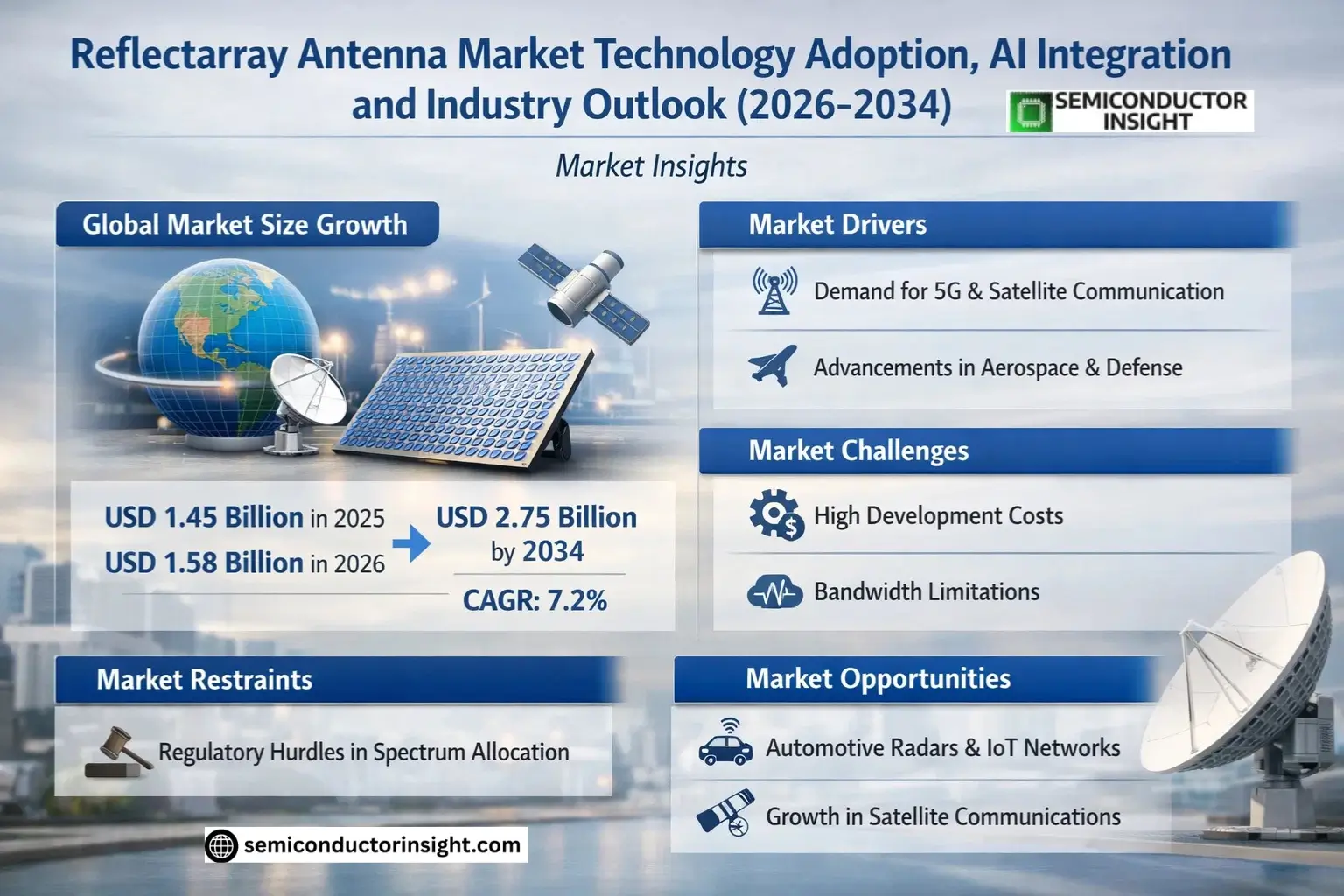
MARKET DRIVERS
Increasing Demand for High-Gain Antennas in 5G and Satellite Communication
Reflectarray Antenna Market is experiencing growth due to rising demand for high-gain, low-profile antennas in 5G networks and satellite communication systems. These antennas offer superior beam steering capabilities while maintaining a compact design, making them ideal for modern telecommunication infrastructure. Market analysis indicates a 12% year-over-year increase in adoption for 5G base stations.
Advancements in Aerospace and Defense Applications
Military and aerospace sectors are driving innovation in the Reflectarray Antenna Market, with applications in radar systems, unmanned aerial vehicles, and satellite communication. The ability to provide electronically reconfigurable beams with reduced weight compared to traditional parabolic antennas is accelerating adoption. Defense budgets allocating approximately 8-10% annual increases for advanced communication systems further support this trend.
Emerging technologies like phased array systems integrated with reflectarray designs are creating new avenues for market expansion across multiple industries.
MARKET CHALLENGES
High Development Costs and Manufacturing Complexity
Despite their advantages, reflectarray antennas face challenges related to high R&D expenditure and complex manufacturing processes. The precision required in microstrip patch elements and substrate materials increases production costs by 15-20% compared to conventional antennas, potentially limiting adoption in price-sensitive markets.
Other Challenges
Technical Limitations in Bandwidth
While offering excellent beam steering, reflectarray antennas typically have narrower operational bandwidth (5-10%) compared to competing technologies, creating implementation challenges for wideband applications.
MARKET RESTRAINTS
Regulatory Hurdles in Telecommunication Spectrum Allocation
Strict regulations governing frequency spectrum allocation across different regions create implementation barriers for reflectarray antenna systems. Compliance with varying international standards adds 10-15% to deployment timelines, particularly affecting global satellite communication projects.
MARKET OPPORTUNITIES
Emerging Applications in Automotive Radars and IoT Networks
Reflectarray Antenna Market is poised for growth through integration with automotive radar systems and IoT networks. As autonomous vehicle development accelerates, demand for compact, high-performance antennas capable of 360-degree coverage is expected to grow by 18% annually through 2030. Similarly, smart city initiatives are creating opportunities for reflectarray antennas in distributed IoT sensor networks.
Reflectarray Antenna Market Trends
Increasing Adoption in Satellite Communications
Reflectarray Antenna Market is witnessing significant growth due to rising demand in satellite communication applications. These antennas combine the benefits of parabolic reflectors and phased arrays, offering lightweight, low-profile solutions with flexible beam shaping capabilities. The aerospace and defense sectors are increasingly adopting reflectarray technology for satellite payloads, where weight reduction and beam scanning flexibility are critical requirements. Major satellite operators are leveraging these antennas for both GEO and LEO satellite constellations.
Other Trends
Advancements in 5G Infrastructure
Reflectarray antennas are gaining traction in 5G network deployments due to their ability to support beamforming and multi-beam operations. Telecom operators are implementing these solutions for mmWave applications, where high-gain directional antennas are essential for maintaining signal quality. The technology enables cost-effective base station solutions with improved coverage patterns compared to traditional antenna systems.
Emerging Radar System Applications
The defense sector continues to drive innovation in reflectarray antenna technology, particularly for radar applications. These antennas are being deployed in advanced radar systems for aircraft, missiles, and ground stations due to their low observability characteristics and electronic beam steering capabilities. Military modernization programs across major economies are incorporating reflectarray solutions for their surveillance and targeting systems.
Material Science Breakthroughs
Recent developments in metamaterials and tunable dielectric substrates are enhancing the performance characteristics of reflectarray antennas. Manufacturers are experimenting with reconfigurable designs that can dynamically adjust radiation patterns, enabling more versatile applications across communication and sensing systems. These material innovations are opening new possibilities for beam agility and frequency reconfiguration.
Regional Market Developments
Asia-Pacific is emerging as a high-growth region for the Reflectarray Antenna market, driven by increasing investments in satellite communication infrastructure and defense modernization programs. North America maintains technological leadership with key manufacturers investing in R&D for next-generation solutions. European markets are focusing on integration with existing communication systems while exploring novel industrial applications.
COMPETITIVE LANDSCAPE
Key Industry Players
Strategic Positioning in the Evolving Reflectarray Antenna Market
Reflectarray Antenna Market is characterized by the dominance of aerospace and defense giants, with Airbus Defence and Space, Lockheed Martin, and Northrop Grumman leading technological innovations. These players leverage extensive R&D capabilities to cater to high-performance satellite communication and radar applications. L3Harris Technologies and Thales Group have also established strong positions through strategic military contracts, particularly in phased array radar systems.
Emerging competitors like Kymeta Corporation and ViaSat are disrupting the market with cost-effective, reconfigurable reflectarray solutions for commercial communications. Chinese manufacturers including Huawei, ZTE, and Beijing Xingsheng Technology are rapidly gaining traction in the Asia-Pacific region through government-backed space programs and 5G infrastructure development projects, creating a dynamic competitive environment.
List of Key Reflectarray Antenna Companies Profiled
- Airbus Defence and Space
- Lockheed Martin
- Northrop Grumman
- L3Harris Technologies
- Kymeta Corporation
- ViaSat
- Thales Group
- Honeywell Aerospace
- Huawei
- ZTE
- Beijing Xingsheng Technology
- Xi’an Hengda Microwave Technology Development
- Molex
- Jibit Electronics
- Kunshan Ruichengda Electronics
Segment Analysis:
| Segment Category | Sub-Segments | Key Insights |
| By Type |
|
Directly Adjust the Unit Resonance Characteristics
|
| By Application |
|
Satellite Communication
|
| By End User |
|
Defense & Government
|
| By Deployment |
|
Fixed Deployment
|
| By Frequency Band |
|
Ku/Ka Band
|
Regional Analysis: Reflectarray Antenna Market
U.S. telecom providers leverage reflectarray antennas to overcome urban signal blockage. Their compact, low-profile design enables seamless integration with existing cellular infrastructure while providing superior beam steering for mmWave frequencies.
Cutting-edge satellite communication systems in North America increasingly adopt reflectarray technology. The antennas’ lightweight properties and reconfigurability make them ideal for military UAVs and next-generation airborne radar platforms.
Leading research institutions collaborate with industry players to develop AI-driven reflectarray systems. These adaptive antennas automatically optimize radiation patterns based on environmental conditions using machine learning algorithms.
Reflectarray antennas enable improved in-flight connectivity solutions. Airlines partner with technology providers to implement these low-profile antennas that minimize drag while delivering high-speed airborne internet services.
Europe
The European Reflectarray Antenna Market is growing with emphasis on satellite communications and automotive radar systems. Strict EU regulations on spectrum efficiency drive adoption in telecom networks. Germany leads in automotive radar applications, while the UK focuses on space technology integration. Research projects under Horizon Europe program foster university-industry collaborations for next-generation smart antennas.
Asia-Pacific
APAC shows the fastest growth in reflectarray antenna adoption, particularly in China’s 5G expansion and Japan’s satellite programs. South Korean manufacturers develop compact reflectarray solutions for consumer electronics. India’s defense modernization creates demand for indigenous radar systems utilizing this technology. The region benefits from cost-effective manufacturing capabilities.
Middle East & Africa
Gulf countries invest heavily in reflectarray-based satellite communication infrastructure for oil and gas operations. Israel leads in military applications, integrating these antennas with drone surveillance systems. Africa adopts reflectarray technology for rural broadband connectivity solutions through low-earth orbit satellite partnerships.
South America
Brazil spearheads reflectarray adoption for Amazon monitoring and military communications. Argentina’s space agency collaborates with European partners on satellite projects. The region sees growing interest from telecom operators seeking cost-effective alternatives to traditional phased array systems for 5G backhaul.
Report Scope
This market research report provides a comprehensive analysis of the Reflectarray Antenna Market , covering the forecast period 2025–2034. It offers detailed insights into market dynamics, technological advancements, competitive landscape, and key trends shaping the industry.
Key focus areas of the report include:
- Market Overview: The report begins with an overview outlining its current market scenario, key growth indicators, and industry transformation drivers. It discusses macroeconomic factors, demand–supply balance, regulatory landscape, and the strategic role of reflectarray antennas in powering advancements across industries such as wireless communication, satellite communication, radar systems, and aerospace.
- Market Size & Forecast: Historical data and future projections for revenue, unit shipments, and market value across major regions and segments.
- Segmentation Analysis: Detailed breakdown by product type, technology, application, and end-user industry to identify high-growth segments and investment opportunities.
- Regional Insights: Insights into market performance across North America, Europe, Asia, South America, and Middle East & Africa, including country-level analysis where relevant.
- Competitive Landscape: Profiles of leading market participants, including their product offerings, R&D focus, manufacturing capacity, pricing strategies, and recent developments such as mergers, acquisitions, and partnerships.
- Technology Trends & Innovation: Assessment of emerging technologies, integration of AI/IoT, antenna design trends, fabrication techniques, and evolving industry standards.
- Market Drivers & Restraints: Evaluation of factors driving market growth along with challenges, supply chain constraints, regulatory issues, and market-entry barriers.
- Stakeholder Insights: Insights for component suppliers, OEMs, system integrators, investors, and policymakers regarding the evolving ecosystem and strategic opportunities.
Primary and secondary research methods are employed, including interviews with industry experts, data from verified sources, and real-time market intelligence to ensure the accuracy and reliability of the insights presented.
FREQUENTLY ASKED QUESTIONS:
What is the current market size of Reflectarray Antenna Market?
-> Reflectarray Antenna Market size was valued at USD 1.45 billion in 2025. The market is projected to grow from USD 1.58 billion in 2026 to USD 2.75 billion by 2034, exhibiting a CAGR of 7.2% during the forecast period.
Which key companies operate in Reflectarray Antenna Market?
-> Key players include Molex, Airbus Defence and Space, Lockheed Martin, Northrop Grumman, L3Harris Technologies, Kymeta Corporation, ViaSat, Jibit Electronics, Kunshan Ruichengda Electronics, Huawei, and ZTE, among others.
What are the key growth drivers?
-> Key growth drivers include increasing demand in satellite communication, technological advancements in wireless communication, and the advantages of reflectarray antennas such as low profile, light weight, and flexible beam shape.
Which region dominates the market?
-> Asia is a significant market, with North America and Europe also holding substantial shares.
What are the emerging trends?
-> Emerging trends include advancements in phased array technology, integration with 5G networks, and increasing applications in aerospace and defense.

Get Sample Report PDF for Exclusive Insights
Report Sample Includes
- Table of Contents
- List of Tables & Figures
- Charts, Research Methodology, and more...
 Download Sample Report PDF