Reconfigurable Computing Semiconductor Market Insights
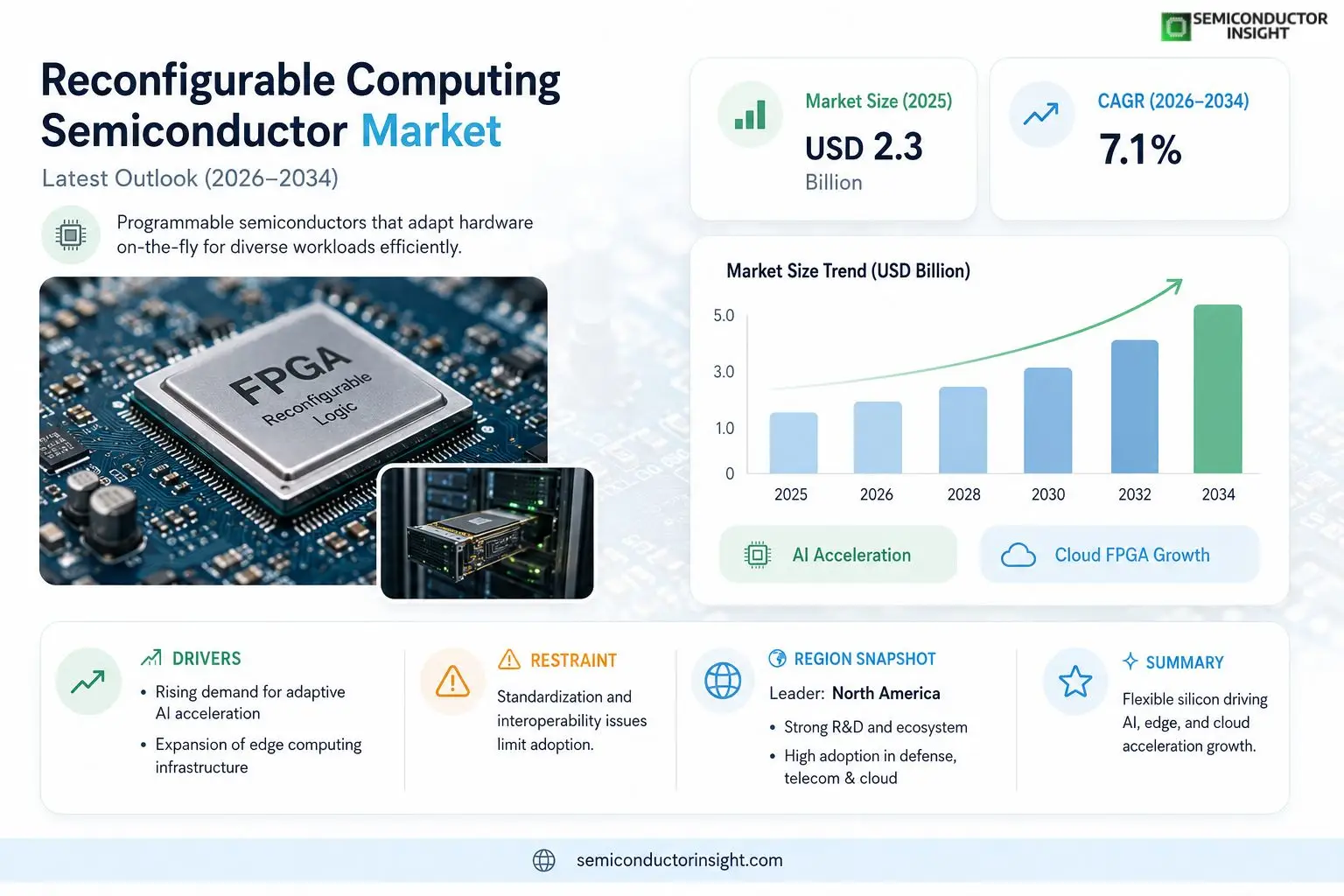
Global Reconfigurable Computing Semiconductor market size was valued at USD 2.3 billion in 2025. The market is projected to grow from USD 2.45 billion in 2026 to USD 4.12 billion by 2034, exhibiting a CAGR of 7.1% during the forecast period.
Reconfigurable computing semiconductors are programmable hardware devices,such as field‑programmable gate arrays (FPGAs) and coarse‑grained reconfigurable architectures,that enable on‑the‑fly adaptation of logic functions to meet diverse workload demands while delivering lower power consumption than fixed ASICs.The market is accelerating because enterprises seek flexible acceleration for AI inference, edge analytics, and high‑performance computing workloads. Moreover, rising adoption of cloud‑based FPGA services and increased R&D investment by leading vendors,Xilinx (now part of AMD), Intel (Altera), Lattice Semiconductor, and Microchip,are further driving expansion.
MARKET DRIVERS
Rising Demand for Adaptive AI Acceleration
Reconfigurable Computing Semiconductor Market is being propelled by the need for hardware that can adapt to rapidly evolving AI algorithms. Unlike fixed-function ASICs, reconfigurable devices allow manufacturers to update logic post‑fabrication, delivering shorter time‑to‑market for new AI features.
Expansion of Edge Computing Infrastructure
Edge nodes require compute that balances performance, power, and flexibility. Reconfigurable semiconductors meet this triad, enabling data centers and IoT gateways to handle heterogeneous workloads without deploying separate chips for each function.
➤ “Flexibility is the new performance metric for next‑generation silicon.”
Telecommunications firms are also integrating reconfigurable logic into 5G base stations, where dynamic bandwidth allocation demands chips that can be reprogrammed on‑the‑fly, further cementing the market’s upward trajectory.
MARKET CHALLENGES
High Development Costs and Design Complexity
Designing reconfigurable solutions involves significant non‑recurring engineering (NRE) expenses and specialized expertise. Smaller firms often lack the resources to create optimized architectures, limiting broader adoption.
Other Challenges
Software Ecosystem Maturity
The success of Reconfigurable Computing Semiconductor Market hinges on robust development tools and libraries. While progress is evident, many AI frameworks still favor GPUs and fixed ASICs, creating a barrier for widespread deployment.
MARKET RESTRAINTS
Standardization and Interoperability Issues
Fragmented standards across vendors make it difficult for system integrators to source interchangeable reconfigurable components, restraining scale‑up potential.Power efficiency remains a critical metric; while reconfigurable devices offer flexibility, they can consume more energy than purpose‑built ASICs under certain workloads, restricting use in ultra‑low‑power applications.Supply‑chain volatility for advanced silicon substrates adds further uncertainty, especially for long‑lead projects that rely on consistent material availability.
MARKET OPPORTUNITIES
Emerging Automotive and Autonomous Systems
Automakers are seeking reconfigurable silicon to support over‑the‑air updates for driver‑assist features. The ability to reprogram safety‑critical functions without hardware replacement creates a sizable growth avenue for Reconfigurable Computing Semiconductor Market.
Data‑Center Acceleration and Modular Design
Data‑center operators are exploring modular accelerator cards that can be reconfigured for diverse workloads,from AI inference to cryptographic processing,reducing capital expenditure and enhancing fleet flexibility.
Reconfigurable Computing Semiconductor Market Trends
Emerging Demand for Adaptive AI Acceleration
Enterprises are accelerating the shift toward adaptive hardware to satisfy growing AI inference and edge‑analytics workloads. The programmable nature of reconfigurable silicon enables on‑the‑fly modification of logic blocks, allowing manufacturers to fine‑tune performance without redesigning chips. Major vendors have broadened their product portfolios, integrating higher bandwidth transceivers, hardened AI cores, and system‑level tools that simplify deployment across data‑center and edge environments. This flexibility reduces time‑to‑market for new algorithms and supports power‑constrained applications where traditional ASICs would consume significantly more energy. Consequently, customers are favoring solutions that can be reprogrammed post‑deployment, reinforcing the strategic importance of Reconfigurable Computing Semiconductor Market in next‑generation compute ecosystems.
Other Trends
Growth of Cloud‑Based FPGA Services
Cloud providers are embedding FPGA instances into their public‑cloud portfolios, offering customers on‑demand acceleration without upfront hardware investment. This service model abstracts the complexity of device configuration, delivering pre‑validated hardware stacks that integrate seamlessly with popular machine‑learning frameworks. Users benefit from elastic scaling, reduced capital expenditure, and the ability to experiment with custom data paths in a production‑grade environment. The resulting increase in utilization rates drives higher shipment volumes for FPGA manufacturers and motivates further development of cloud‑optimized toolchains, creating a virtuous cycle of adoption and innovation.
Increased Investment in Coarse‑Grained Reconfigurable Architectures
Beyond traditional fine‑grained FPGAs, the industry is investing in coarse‑grained reconfigurable fabrics that target high‑performance computing and scientific simulation workloads. These architectures simplify datapath design by employing larger, configurable functional units, which reduces latency and improves energy efficiency compared to both conventional FPGAs and fixed ASIC solutions. Vendors are collaborating with research institutions to validate these designs against real‑world benchmarks, reinforcing confidence in their ability to handle emerging workloads such as genomics analysis and fluid dynamics modeling. As ecosystem support expands,including compiler extensions and third‑party IP libraries,the coarse‑grained approach is poised to become a complementary pillar within the broader reconfigurable semiconductor landscape.
COMPETITIVE LANDSCAPEKey Industry Players
Reconfigurable Computing Semiconductor Market: A Highly Concentrated Yet Increasingly Dynamic Competitive Arena
Global reconfigurable computing semiconductor market is characterized by a moderately consolidated competitive structure, with a handful of dominant players commanding significant market share. AMD (following its acquisition of Xilinx) and Intel (through its Altera division) collectively represent the largest revenue contributors in the FPGA and reconfigurable logic segment. AMD’s Xilinx portfolio,spanning the Versal ACAP and UltraScale+ FPGA families,continues to set benchmarks in adaptive compute acceleration for AI inference, data center, and aerospace applications. Intel’s Agilex and Stratix FPGA product lines similarly address high-performance computing, 5G networking, and cloud acceleration workloads. Both companies have made substantial R&D investments to integrate hardened AI engines and high-bandwidth memory interfaces, reinforcing their technological leadership. The competitive intensity at the top tier is further shaped by aggressive cloud deployment partnerships, with hyperscalers such as Amazon Web Services and Microsoft Azure offering FPGA-as-a-service capabilities built around these leading silicon platforms.Beyond the two dominant players, the market features a robust ecosystem of specialized and emerging competitors addressing niche but fast-growing application segments. Lattice Semiconductor has carved a strong position in low-power, small-form-factor FPGAs targeting edge AI, industrial automation, and automotive applications. Microchip Technology, through its PolarFire FPGA family, competes effectively in power-sensitive and radiation-tolerant markets including space and defense. Achronix Semiconductor focuses on high-performance embedded FPGA (eFPGA) IP and standalone devices for networking and data center acceleration. QuickLogic Corporation addresses ultra-low-power edge AI inference use cases with its EOS and ArcticLink product families. Efinix Inc. offers differentiated Quantum FPGA architecture targeting cost-sensitive and power-efficient deployment scenarios, while Flex Logix Technologies advances the embedded FPGA IP licensing model, enabling SoC designers to integrate reconfigurable compute fabric. Additionally, companies such as Menta, Cologne Chip, and Renesas Electronics are expanding their presence in automotive-grade and industrial reconfigurable computing segments, further diversifying the competitive landscape and intensifying innovation across the value chain.
List of Key Reconfigurable Computing Semiconductor Companies Profiled
- AMD (Xilinx)
- Intel Corporation (Altera)
- Lattice Semiconductor
- Microchip Technology
- Achronix Semiconductor
- QuickLogic Corporation
- Efinix Inc.
- Flex Logix Technologies
- Menta
- Cologne Chip
- Renesas Electronics
- Cypress Semiconductor (Infineon Technologies)
- Tabula (acquired)
- Actel Corporation (Microsemi/Microchip)
- GOWIN Semiconductor
Segment Analysis:
| Segment Category | Sub-Segments | Key Insights |
| By Type |
|
FPGA‑based Solutions
|
| By Application |
|
AI Inference
|
| By End User |
|
Cloud Service Providers
|
| By Architecture |
|
Fine‑grained FPGA
|
| By Deployment Model |
|
Cloud‑Based
|
Regional Analysis: North America
North America
Government funding and strategic initiatives are playing a crucial role in fostering the growth of Reconfigurable Computing Semiconductor Market in North America. These efforts focus on promoting innovation, supporting research collaborations between academia and industry, and encouraging the adoption of advanced computing technologies across various sectors.
The aerospace and defense industries represent a significant market segment for reconfigurable computing semiconductors in North America. The need for high-performance, reliable, and adaptable computing solutions in these sectors drives demand for devices that can handle complex computations and varying operational environments.
The automotive sector is witnessing a rapid shift towards intelligent and connected vehicles, creating substantial opportunities for reconfigurable computing semiconductors. These devices are essential for applications such as autonomous driving, advanced driver-assistance systems, and in-vehicle infotainment.
North America’s advanced telecommunications infrastructure is a key driver for the adoption of reconfigurable computing semiconductors. These devices are utilized in network infrastructure to enhance processing power, improve network efficiency, and support the growing demand for bandwidth and low-latency applications.
Europe
Europe’s Reconfigurable Computing Semiconductor Market is characterized by a strong emphasis on energy efficiency and security. The region’s commitment to sustainable technologies and stringent data privacy regulations are influencing the development and adoption of these semiconductor solutions. Reconfigurable computing is finding increasing applications in areas such as industrial automation and advanced manufacturing. Semiconductor market trends in Europe also reflect a growing focus on domestic chip production and supply chain resilience. Reconfigurable computing semiconductor is key to enhancing the capabilities of edge computing deployments across Europe.
Asia-Pacific
Asia-Pacific represents a dynamic and rapidly expanding market for Reconfigurable Computing Semiconductor Market. Driven by substantial investments in technology and a burgeoning electronics industry, the region offers significant growth potential. Reconfigurable computing is gaining traction in sectors such as high-performance computing, artificial intelligence, and 5G infrastructure. The increasing demand for adaptable and efficient computing solutions is fueling the adoption of these semiconductors across various applications. Semiconductor market dynamics in Asia Pacific are strongly influenced by government policies promoting technological self-reliance.
South America
South America’s Reconfigurable Computing Semiconductor Market is in an early stage of development but holds promising future potential. Growing investments in technology and increasing adoption of digital solutions are creating opportunities for the adoption of reconfigurable computing semiconductors. Key application areas include telecommunications, industrial automation, and cloud computing. The region’s focus on cost-effective and adaptable computing solutions is driving demand for reconfigurable hardware. Reconfigurable Computing Semiconductor Market in South America is expected to witness substantial growth in the coming years.
Middle East & Africa
The Middle East and Africa offer a relatively nascent but rapidly growing market for Reconfigurable Computing Semiconductor. Increasing investments in infrastructure development, particularly in areas such as smart cities and digital transformation, are driving demand for advanced computing solutions. The region’s focus on technological innovation and the growing adoption of cloud services are creating opportunities for reconfigurable computing semiconductors. The semiconductor market in this region is expected to experience significant expansion in the coming decade, fueled by government initiatives and private sector investments in reconfigurable computing.
Report Scope
This market research report provides a comprehensive analysis of the Reconfigurable Computing Semiconductor Market , covering the forecast period 2026–2034. It offers detailed insights into market dynamics, technological advancements, competitive landscape, and key trends shaping the industry.
Key focus areas of the report include:
- Market Overview: The report begins with an overview outlining its current market scenario, key growth indicators, and industry transformation drivers. It discusses macroeconomic factors, demand–supply balance, regulatory landscape, and the strategic role of semiconductors in powering advancements across industries such as automotive, telecommunications, consumer electronics, and industrial automation.
- Market Size & Forecast: Historical data and future projections for revenue, unit shipments, and market value across major regions and segments.
- Segmentation Analysis: Detailed breakdown by product type, technology, application, and end-user industry to identify high-growth segments and investment opportunities.
- Regional Insights: Insights into market performance across North America, Europe, Asia-Pacific, Latin America, and the Middle East & Africa, including country-level analysis where relevant.
- Competitive Landscape: Profiles of leading market participants, including their product offerings, R&D focus, manufacturing capacity, pricing strategies, and recent developments such as mergers, acquisitions, and partnerships.
- Technology Trends & Innovation: Assessment of emerging technologies, integration of AI/IoT, semiconductor design trends, fabrication techniques, and evolving industry standards.
- Market Drivers & Restraints: Evaluation of factors driving market growth along with challenges, supply chain constraints, regulatory issues, and market-entry barriers.
- Stakeholder Insights: Insights for component suppliers, OEMs, system integrators, investors, and policymakers regarding the evolving ecosystem and strategic opportunities.
Primary and secondary research methods are employed, including interviews with industry experts, data from verified sources, and real-time market intelligence to ensure the accuracy and reliability of the insights presented.
FREQUENTLY ASKED QUESTIONS:
What is the current market size of Reconfigurable Computing Semiconductor Market?
-> Reconfigurable Computing Semiconductor Market was valued at USD 2.3 billion in 2025 and is expected to reach USD 4.12 billion by 2034.
Which key companies operate in Reconfigurable Computing Semiconductor Market?
-> Key players include Xilinx (AMD), Intel (Altera), Lattice Semiconductor, and Microchip, among others.
What are the key growth drivers?
-> Key growth drivers include AI inference acceleration, edge analytics, high‑performance computing workloads, and increasing adoption of cloud‑based FPGA services.
Which region dominates the market?
-> The reference does not specify a dominant region.
What are the emerging trends?
-> Emerging trends include cloud‑native FPGA offerings, heterogeneous integration with AI accelerators, and advanced power‑efficiency architectures.
Get Sample Report PDF for Exclusive Insights
Report Sample Includes
- Table of Contents
- List of Tables & Figures
- Charts, Research Methodology, and more...
 Download Sample Report PDF