MARKET INSIGHTS
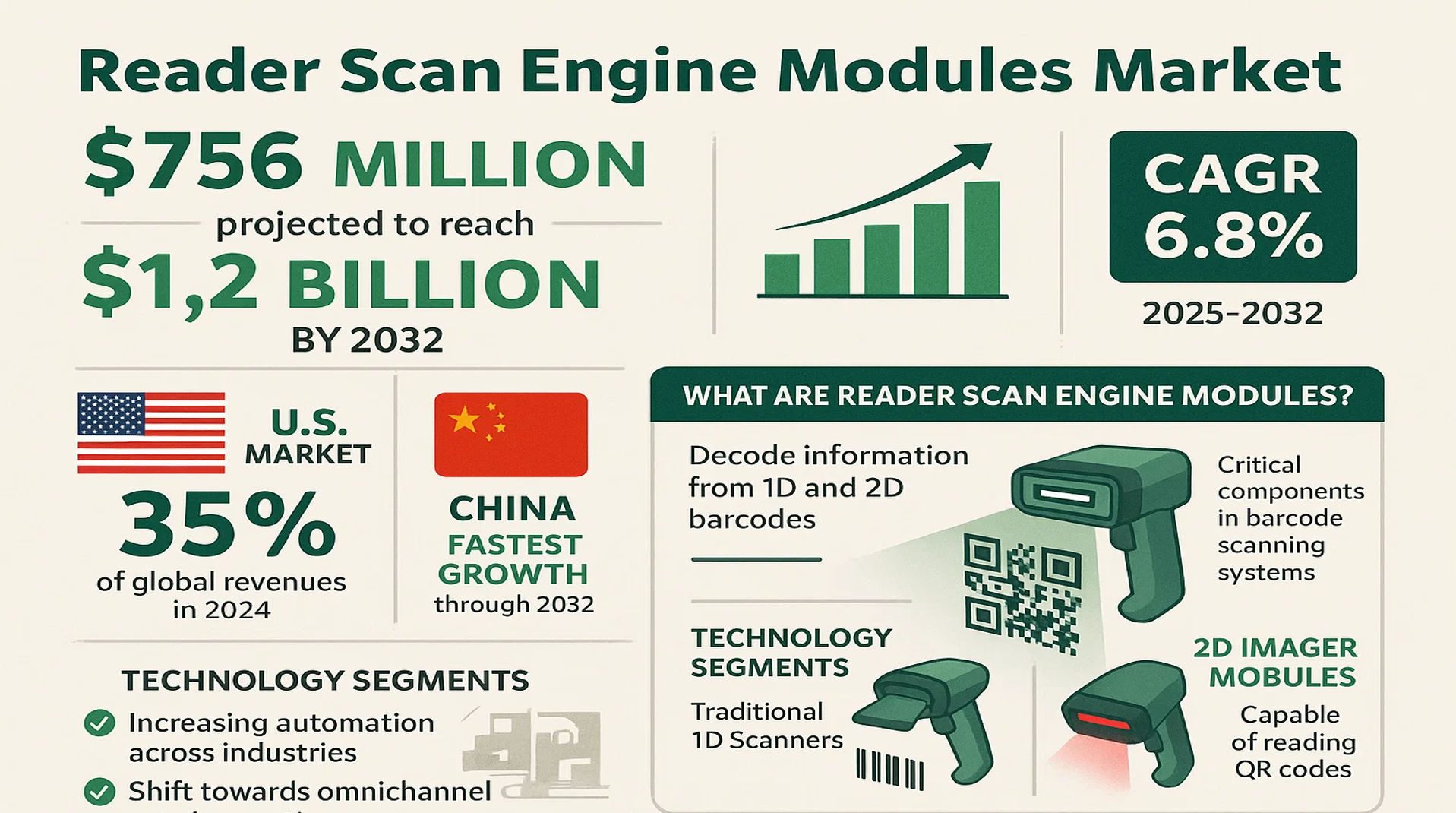
The global Reader Scan Engine Modules Market size was valued at US$ 756 million in 2024 and is projected to reach US$ 1.2 billion by 2032, at a CAGR of 6.8% during the forecast period 2025-2032. The U.S. market accounted for 35% of global revenues in 2024, while China is expected to witness the fastest growth with a projected CAGR of 7.1% through 2032.
Reader scan engine modules are critical components in barcode scanning systems that decode information from 1D and 2D barcodes. These compact imaging devices combine optical sensors, illumination systems, and decoding algorithms to capture and process barcode data across various applications including retail POS systems, warehouse management, and industrial automation. The market primarily consists of two technology segments: traditional laser-based 1D scanners and more advanced 2D imager modules capable of reading QR codes and other complex symbologies.
The market growth is driven by increasing automation across industries and the shift towards omnichannel retail operations. While traditional retail applications continue to dominate, emerging use cases in healthcare (patient ID verification) and smart manufacturing (component tracking) are creating new opportunities. Major players like Zebra Technologies and Honeywell are investing in AI-powered scanning solutions to improve reading accuracy and speed, with recent product launches featuring enhanced capabilities for damaged or poorly printed barcodes. The competitive landscape remains concentrated, with the top five manufacturers holding over 60% market share as of 2024.
MARKET DYNAMICS
MARKET DRIVERS
Automation Across Industries Accelerates Adoption of Scan Engine Modules
The global push towards industrial automation is driving unprecedented demand for reader scan engine modules. These components are becoming essential for inventory management, logistics tracking, and quality control across manufacturing and retail sectors. Automated identification solutions utilizing 1D and 2D scanning technologies are experiencing 25-30% annual growth in deployment, as businesses prioritize operational efficiency. Leading manufacturers are responding with compact, high-performance modules that integrate seamlessly with IoT ecosystems, enabling real-time data capture in smart factories and warehouses.
E-Commerce Boom Creates Sustained Demand for Scanning Solutions
Explosive growth in e-commerce, projected to exceed $6 trillion globally by 2024, is fundamentally changing supply chain requirements. Modern fulfillment centers now process 30-50% more packages daily compared to pre-pandemic levels, necessitating robust scanning infrastructure. Reader scan engine modules have become critical for package sorting, inventory reconciliation, and last-mile delivery verification. This is driving innovation in scanning technologies, with advanced image processing algorithms enabling near-100% first-pass read rates even on damaged or poorly printed barcodes.
The healthcare sector’s digital transformation represents another key growth avenue, where scan modules ensure medication safety and patient identification accuracy. Recent hospital implementions demonstrate 40-60% reduction in medication administration errors through barcode medication administration systems.
MARKET RESTRAINTS
High Implementation Costs Limit Adoption in Emerging Markets
While developed markets rapidly adopt advanced scanning solutions, price sensitivity remains a significant barrier in cost-conscious regions. Complete scanning system implementations can require capital expenditures 3-5 times higher than traditional manual processes, creating resistance among SMEs. The total cost of ownership, including maintenance and software integration, often surprises budget planners in developing economies, slowing market penetration despite clear operational benefits.
Technology Fragmentation Creates Integration Challenges
The proliferation of proprietary scanning technologies and communication protocols presents ongoing compatibility issues. Enterprises frequently encounter difficulties when attempting to integrate new scanning modules with legacy warehouse management or ERP systems. Industry surveys indicate 35-45% of scanning system implementations experience unexpected delays due to integration complexities. This technical debt discourages some organizations from upgrading existing infrastructure despite performance limitations.
MARKET OPPORTUNITIES
AI-Enhanced Scanning Opens New Application Horizons
Emerging machine learning capabilities are transforming basic scanning into intelligent data capture solutions. Next-generation modules now incorporate on-device AI to interpret damaged codes, read directly from curved surfaces, and even verify product authenticity through microscopic surface patterns. Early adopters in luxury goods authentication report 98% detection rates for counterfeit items using these advanced systems.
Miniaturization Trend Enables Embedded Solutions
The drive toward smaller form factors is creating opportunities across mobile and wearable devices. Manufacturers have reduced module sizes by 60% over five years while maintaining performance, enabling integration into smart glasses, handheld terminals, and even robotic picking systems. This miniaturization is particularly impactful in healthcare, where wearable scanners help clinicians maintain sterile fields while accessing patient data.
MARKET CHALLENGES
Durable Goods Longevity Impacts Replacement Cycles
The exceptional durability of quality scan engines presents an unexpected challenge – extended product lifecycles frequently exceed 7-10 years in industrial environments. This longevity, while testament to engineering quality, slows the adoption of newer technologies as organizations delay upgrades of still-functional equipment. Manufacturers must increasingly compete on total solution value rather than hardware alone to accelerate refresh cycles.
Global Chip Shortages Disrupt Supply Chains
Ongoing semiconductor supply constraints have forced scanning equipment manufacturers to redesign products around available components, delaying new model introductions by 6-12 months in some cases. The industry faces particular challenges sourcing high-performance image sensors and processing chips critical for advanced 2D scanning. These constraints come at a time when demand growth would normally support rapid product iteration and feature advancement.
READER SCAN ENGINE MODULES MARKET TRENDS
Adoption of 2D Scan Engines Accelerates Market Growth
The global reader scan engine modules market is witnessing a significant shift toward 2D scan engine adoption, driven by the increasing need for advanced data capture across industries. While 1D scan engines dominated the market in past years, 2D imaging technology now accounts for over 60% of total demand due to its ability to read both barcodes and QR codes simultaneously. This transition is particularly prominent in retail and logistics, where omnichannel operations and real-time inventory tracking require high-speed, high-accuracy scanning solutions. Additionally, advancements in miniaturization and image processing have enabled 2D scanners to deliver faster decode speeds and broader scanning ranges.
Other Trends
Rise of AI-Enabled Smart Scanners
Artificial Intelligence is increasingly being integrated into scan engine modules to enhance decoding accuracy and adaptability. Modern AI-powered scanners can now auto-adjust focus and lighting, recognize damaged or poorly printed barcodes, and even classify products based on captured data. This trend is particularly impactful in automated warehouses and smart retail environments, where efficiency and error reduction are critical. Industry reports suggest that AI-enabled scanning solutions could achieve a CAGR of over 12% in the next five years, outpacing traditional barcode scanners by a considerable margin.
Expansion in Logistics and E-Commerce Fuels Demand
The logistics and e-commerce boom is one of the most significant drivers for scan engine module adoption. With global e-commerce sales projected to exceed $7 trillion by 2025, companies are investing heavily in automated sorting systems and handheld scanners to improve supply chain efficiency. Parcel tracking, reverse logistics, and last-mile deliveries are particularly reliant on high-performance scan engines with long-range scanning capabilities and low failure rates. Furthermore, regulatory pressures for accurate shipment tracking in pharmaceuticals and food logistics are pushing demand for ruggedized and high-precision scanning solutions that can operate in harsh environments.
COMPETITIVE LANDSCAPE
Key Industry Players
Market Leaders Focus on Innovation and Expansion to Gain Competitive Edge
The global Reader Scan Engine Modules market demonstrates a moderately consolidated structure, dominated by established players with strong technological expertise and extensive distribution networks. Zebra Technologies and Datalogic currently lead the market, collectively accounting for over 30% revenue share in 2024. Their dominance stems from robust product portfolios that cater to diverse industry verticals including retail, logistics, and healthcare.
Honeywell maintains a significant market presence through its advanced scanning solutions and strategic acquisitions. The company has recently expanded its industrial-grade scanning capabilities to capture growing demand in manufacturing automation. Similarly, Cognex Corporation continues to strengthen its position in high-performance 2D scanning modules, particularly for quality control applications.
Emerging Asian manufacturers like HIKROBOT are gaining traction through competitive pricing and localized support services. This has compelled established players to enhance their value propositions through improved product features and customized solutions. Many competitors are investing heavily in AI-powered scanning technologies to differentiate their offerings in an increasingly crowded marketplace.
The competitive landscape is further shaped by strategic partnerships, with companies collaborating with software providers to create integrated scanning ecosystems. OMRON recently partnered with several warehouse management system providers to optimize its scanning solutions for logistics applications, demonstrating this trend.
List of Key Reader Scan Engine Module Manufacturers
- Datalogic S.p.A. (Italy)
- Zebra Technologies Corporation (U.S.)
- Cognex Corporation (U.S.)
- Honeywell International Inc. (U.S.)
- Keyence Corporation (Japan)
- Shenzhen Newlan Science & Technology Co., Ltd. (China)
- Mindeo (China)
- HIKROBOT (China)
- OMRON Corporation (Japan)
- RIOTEC Co., Ltd. (South Korea)
The market continues to evolve with increasing emphasis on compact form factors, extended reading ranges, and enhanced data processing capabilities. While established players leverage their brand reputation and service networks, smaller innovators are challenging the status quo through disruptive technologies in areas like mobile scanning and IoT integration.
Segment Analysis:
By Type
2D Scan Engine Modules Segment Leads Due to Advanced Image Capture Capabilities
The market is segmented based on type into:
- 1D Scan Engine Modules
- 2D Scan Engine Modules
By Application
Retail Segment Dominates with Growing Demand for Barcode Scanning Solutions
The market is segmented based on application into:
- Retail
- Transportation & Logistics
- Healthcare
- Manufacturing
By End User
Large Enterprises Lead Adoption Due to Higher Technology Budgets
The market is segmented based on end user into:
- Large Enterprises
- SMEs
By Technology
Laser Scanning Technology Maintains Strong Position in Industrial Settings
The market is segmented based on technology into:
- Laser Scanning
- Image-based Scanning
- Linear Imagers
Regional Analysis: Reader Scan Engine Modules Market
Asia-Pacific
The Asia-Pacific region is the dominant player in the global Reader Scan Engine Modules market, driven by rapid industrialization and digital transformation initiatives in countries like China, India, and Japan. China leads the regional market due to strong demand from manufacturing, retail, and logistics sectors, supported by government initiatives like “Made in China 2025” and widespread automation in supply chains. India follows closely, with increasing adoption in e-commerce and retail applications. The region benefits from cost-competitive manufacturing ecosystems and a growing focus on smart technology adoption, though market fragmentation remains a challenge.
North America
North America represents the second-largest market for Reader Scan Engine Modules, characterized by high technological adoption and early implementation of advanced scanning solutions. The U.S. accounts for the majority of demand, particularly in healthcare, retail, and logistics sectors, where barcode scanning is critical for inventory management and point-of-sale systems. Stringent industry standards and high investment in R&D by major players like Zebra Technologies and Honeywell drive innovation in this region. However, market maturity and price sensitivity limit exponential growth compared to emerging economies.
Europe
Europe maintains steady growth in Reader Scan Engine Module adoption, with Germany, France, and the U.K. leading the region. The market is driven by strict regulatory compliance requirements in pharmaceuticals and logistics, along with high automation penetration in manufacturing. The EU’s focus on Industry 4.0 and smart retail solutions further propels demand for high-performance 2D scanning technologies. However, slower economic growth in some regions and preference for local suppliers over imports create challenges for global vendors expanding in this market.
South America
South America shows moderate growth potential in the Reader Scan Engine Modules market, with Brazil and Argentina as primary adopters. Increasing retail modernization and logistics sector development create opportunities, particularly for cost-effective 1D scan modules. However, economic instability and limited technology budgets hinder widespread adoption of advanced scanning solutions. The region shows preference for refurbished and mid-range devices, with more sophisticated applications primarily limited to multinational corporations operating locally.
Middle East & Africa
The MEA region presents an emerging market for Reader Scan Engine Modules, with growth concentrated in GCC countries, South Africa, and increasingly in North African markets. Development of smart cities, modern retail chains, and port logistics drives demand, particularly for rugged and high-performance scanning solutions. While the market remains relatively small compared to other regions, increasing foreign investment in infrastructure projects and gradual digital transformation point toward long-term growth potential for scanning technologies in this region.
Technology Focus Across Regions
While 1D scan modules continue to dominate price-sensitive emerging markets, developed regions show faster adoption of advanced 2D imaging technology. Wireless and mobile scanning solutions gain traction globally, particularly in logistics and field service applications. Regional differences in connectivity infrastructure, industry requirements, and cost sensitivity continue to shape product development and marketing strategies for major manufacturers.
Report Scope
This market research report provides a comprehensive analysis of the Global and Regional Reader Scan Engine Modules markets, covering the forecast period 2025–2032. It offers detailed insights into market dynamics, technological advancements, competitive landscape, and key trends shaping the industry.
Key focus areas of the report include:
- Market Size & Forecast: Historical data and future projections for revenue, unit shipments, and market value across major regions and segments. The Global Reader Scan Engine Modules market was valued at US$ 756 million in 2024 and is projected to reach US$ 1.2 billion by 2032, with a significant CAGR of 6.8%.
- Segmentation Analysis: Detailed breakdown by product type (1D Scan Engine Modules and 2D Scan Engine Modules), technology, application (Retail, Transportation & Logistics, Healthcare, Manufacturing), and end-user industry to identify high-growth segments.
- Regional Outlook: Insights into market performance across North America, Europe, Asia-Pacific, Latin America, and the Middle East & Africa, including country-level analysis. The U.S. market size is estimated at USD million in 2024, while China is projected to reach USD million.
- Competitive Landscape: Profiles of leading market participants such as Datalogic, Zebra Technologies, Cognex Corporation, Honeywell, Keyence, Newlan, Mindeo, HIKROBOT, OMRON, RIOTEC, including their product offerings, R&D focus, and recent developments.
- Technology Trends & Innovation: Assessment of emerging technologies, integration of AI/IoT in scan engines, and evolving industry standards in barcode scanning solutions.
- Market Drivers & Restraints: Evaluation of factors driving market growth along with challenges, supply chain constraints, regulatory issues, and market-entry barriers.
- Stakeholder Analysis: Insights for component suppliers, OEMs, system integrators, investors, and policymakers regarding the evolving ecosystem and strategic opportunities.
Primary and secondary research methods are employed, including interviews with industry experts, data from verified sources, and real-time market intelligence to ensure the accuracy and reliability of the insights presented.
FREQUENTLY ASKED QUESTIONS:
What is the current market size of Global Reader Scan Engine Modules Market?
-> Reader Scan Engine Modules Market size was valued at US$ 756 million in 2024 and is projected to reach US$ 1.2 billion by 2032, at a CAGR of 6.8% during the forecast period 2025-2032.
Which key companies operate in Global Reader Scan Engine Modules Market?
-> Key players include Datalogic, Zebra Technologies, Cognex Corporation, Honeywell, Keyence, Newlan, Mindeo, HIKROBOT, OMRON, RIOTEC, among others.
What are the key growth drivers?
-> Key growth drivers include increasing automation in retail & logistics, demand for contactless scanning solutions, and technological advancements in barcode reading technologies.
Which region dominates the market?
-> North America holds a significant market share, while Asia-Pacific is expected to witness the highest growth during the forecast period.
What are the emerging trends?
-> Emerging trends include AI-powered scanning solutions, integration of IoT in scanning devices, and development of ultra-compact scan engine modules.

Get Sample Report PDF for Exclusive Insights
Report Sample Includes
- Table of Contents
- List of Tables & Figures
- Charts, Research Methodology, and more...
 Download Sample Report PDF