MARKET INSIGHTS
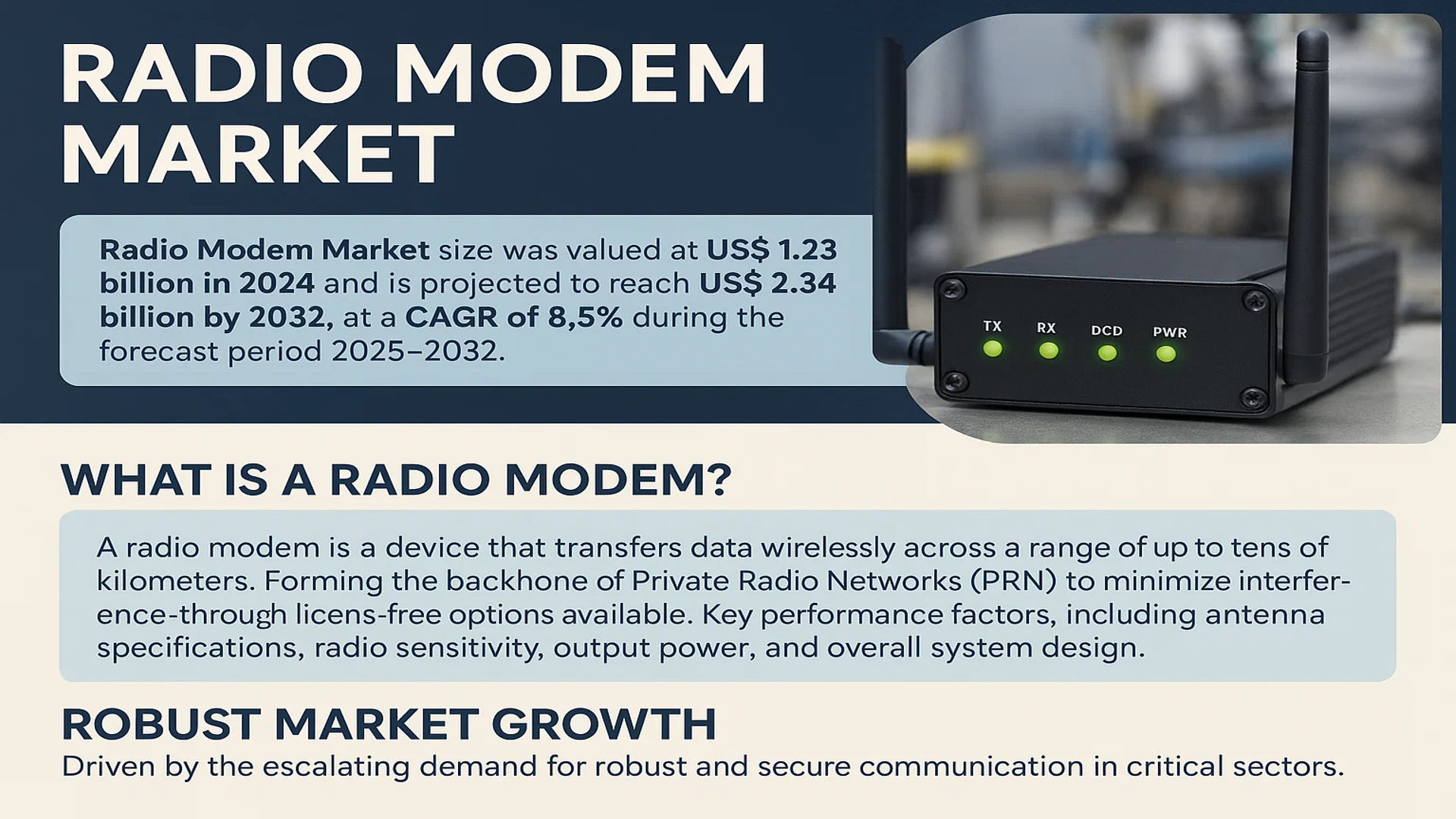
The global Radio Modem Market size was valued at US$ 1.23 billion in 2024 and is projected to reach US$ 2.34 billion by 2032, at a CAGR of 8.5% during the forecast period 2025-2032.
A radio modem is a device that transfers data wirelessly across a range of up to tens of kilometers, forming the backbone of Private Radio Networks (PRN). These networks are critical for industrial applications requiring real-time, reliable data communication independent of public telecommunication or satellite operators. Radio modems typically operate on licensed frequencies in the UHF or VHF bands to minimize interference, though license-free options are also available. Key performance factors include antenna specifications, radio sensitivity, output power, and overall system design.
The market is experiencing robust growth driven by the escalating demand for robust and secure communication in critical sectors. This includes the need for real-time data in transportation and government & defense applications, which collectively represent a significant share of the market. Furthermore, advancements in industrial automation and the Internet of Things (IoT) are creating new use cases, necessitating reliable wireless data links. Europe is a dominant regional market, with Germany holding over 20% of the regional share. In terms of product type, UHF modems lead the segment, accounting for over 40% of the market. Key players such as Digi, Campbell Scientific, and SATEL are actively driving innovation and market expansion through strategic developments.
MARKET DYNAMICS
MARKET DRIVERS
Rising Demand for Industrial Automation and IoT Integration to Propel Market Expansion
The global radio modem market is experiencing robust growth driven by the accelerating adoption of industrial automation and Internet of Things (IoT) technologies across multiple sectors. Industries are increasingly deploying private radio networks to ensure reliable, real-time data communication in environments where traditional cellular or satellite networks are impractical or cost-prohibitive. Radio modems provide critical connectivity for supervisory control and data acquisition (SCADA) systems, remote monitoring, and machine-to-machine communication. The manufacturing sector’s push towards Industry 4.0 has significantly increased demand, with automated systems requiring uninterrupted data transmission for operational efficiency. The transportation sector represents the largest application segment, accounting for over 30% of market share, as radio modems enable fleet management, traffic control systems, and railway communications where continuous connectivity is essential for safety and operational coordination.
Enhanced Security Requirements in Critical Infrastructure to Drive Licensed Frequency Adoption
Growing cybersecurity concerns and the need for secure data transmission in critical infrastructure sectors are driving increased adoption of licensed frequency radio modems. Government and defense applications require secure, interference-free communication channels, making licensed UHF and VHF bands particularly valuable. These sectors represent approximately 25% of the total market application share, with continued growth expected as nations modernize their infrastructure security systems. Licensed frequencies ensure dedicated spectrum access, significantly reducing the risk of signal interference or unauthorized access that can compromise operational security. The mining and oil industries also prioritize licensed frequency solutions for their remote operations, where reliable communication can directly impact worker safety and operational continuity. The assurance of uninterrupted service and enhanced data protection makes licensed frequency radio modems the preferred choice for mission-critical applications.
Expansion of Smart City Initiatives to Accelerate Market Growth
Global smart city development initiatives are creating substantial opportunities for radio modem deployment in urban infrastructure management. Municipalities are implementing intelligent transportation systems, smart grid networks, and public safety solutions that require robust wireless communication infrastructure. Radio modems provide the backbone for these applications, offering reliable connectivity without dependency on commercial cellular networks. The ability to operate during network outages or emergencies makes them particularly valuable for public safety and critical service applications. Urban population growth and increasing infrastructure investments in developing regions are further accelerating this trend, with Asian markets showing particularly strong growth potential. The integration of radio modems with existing infrastructure allows cities to enhance services without complete system overhauls, making them a cost-effective solution for municipal connectivity needs.
MARKET CHALLENGES
Spectrum Congestion and Regulatory Compliance to Challenge Market Penetration
The radio modem market faces significant challenges related to spectrum availability and complex regulatory environments. As wireless communication demand increases across all sectors, available radio spectrum becomes increasingly congested, particularly in urban areas and industrial zones. License-free frequency bands, while easier to implement, face growing interference issues as multiple users compete for limited spectrum resources. This congestion can lead to signal degradation, data packet loss, and reduced operational reliability, particularly affecting applications requiring real-time data transmission. The problem is exacerbated in industrial settings where multiple wireless systems operate simultaneously, creating electromagnetic compatibility issues that can compromise communication integrity.
Other Challenges
Technical Integration Complexities
Integrating radio modem systems with existing infrastructure presents technical challenges that can hinder market adoption. Legacy systems often lack compatibility with modern radio modem technologies, requiring additional interface equipment or system modifications. The need for specialized technical expertise during installation and maintenance creates implementation barriers, particularly in regions with limited access to qualified radio frequency engineers. System configuration requires careful planning of antenna placement, power settings, and network topology to ensure optimal performance, adding complexity to deployment processes.
Power Consumption and Environmental Constraints
Power management represents another significant challenge, particularly for remote and mobile applications. Radio modems require continuous power supply, which can be problematic in off-grid locations or battery-operated devices. Environmental factors such as extreme temperatures, humidity, and physical obstructions can affect signal propagation and equipment durability, requiring specially designed hardware that increases overall system costs. These constraints limit deployment flexibility and can affect the reliability of communication systems in challenging operational environments.
MARKET RESTRAINTS
Competition from Alternative Wireless Technologies to Limit Market Growth
The radio modem market faces increasing competition from emerging wireless technologies that offer alternative connectivity solutions. Cellular technologies, particularly 4G LTE and 5G networks, provide high-speed data transmission capabilities that appeal to many industrial applications. While cellular networks typically involve ongoing subscription costs, their decreasing service prices and improving coverage make them attractive alternatives for many users. Low-Power Wide-Area Network (LPWAN) technologies such as LoRaWAN and Sigfox offer long-range communication with significantly lower power consumption, appealing to battery-operated IoT devices. These competing technologies continue to evolve, offering improved performance and lower implementation costs that challenge the value proposition of traditional radio modem systems.
High Initial Investment and Total Cost of Ownership to Deter Small-scale Users
The substantial initial investment required for radio modem systems acts as a significant restraint, particularly for small and medium-sized enterprises. Licensed frequency systems involve spectrum licensing fees, regulatory compliance costs, and specialized equipment that can be prohibitively expensive for organizations with limited budgets. While license-free options reduce upfront costs, they often require more sophisticated equipment and installation expertise to overcome interference issues, increasing the total cost of ownership. The need for professional installation, periodic maintenance, and potential system upgrades adds to the overall financial burden, making organizations carefully evaluate return on investment before committing to radio modem deployments.
Technological Obsolescence Concerns to Impact Long-term Planning
Rapid technological advancement in wireless communication creates concerns about system obsolescence that restrain market growth. Organizations hesitate to invest in radio modem systems fearing they may become outdated as newer technologies emerge. The relatively long lifespan of industrial equipment means that communication systems must remain functional and supported for extended periods, creating uncertainty about future compatibility and service availability. This concern is particularly acute in fast-evolving sectors where technological standards change frequently, making long-term investment decisions challenging for potential users.
MARKET OPPORTUNITIES
Emerging Applications in Renewable Energy and Environmental Monitoring to Create New Growth Avenues
The expanding renewable energy sector presents substantial growth opportunities for radio modem applications. Wind farms, solar power installations, and remote energy infrastructure require reliable communication systems for monitoring and control operations. Radio modems provide ideal solutions for these applications, offering long-range connectivity without dependency on existing communication infrastructure. Environmental monitoring networks also represent a growing market segment, with governments and research institutions deploying sensor networks for climate study, disaster prevention, and ecological conservation. These applications often operate in remote locations where traditional communication methods are unavailable, creating natural demand for robust radio modem systems that can function in challenging environmental conditions.
Advancements in Radio Technology to Enable New Application Areas
Technological innovations in radio modem design are creating opportunities in previously underserved market segments. Modern radio modems offer improved power efficiency, smaller form factors, and enhanced data security features that make them suitable for mobile and portable applications. The development of software-defined radio technology allows for greater flexibility in frequency usage and protocol support, enabling systems to adapt to changing regulatory requirements and operational needs. These advancements open new application possibilities in healthcare device connectivity, mobile asset tracking, and temporary infrastructure deployments where flexibility and reliability are paramount.
Integration with Cloud Platforms and Data Analytics to Enhance Value Proposition
The integration of radio modem systems with cloud-based platforms and advanced data analytics represents a significant opportunity for market expansion. Modern radio modems can serve as data collection points for cloud analytics platforms, enabling real-time monitoring and predictive maintenance applications. This integration enhances the value proposition of radio modem systems by transforming them from simple communication devices into intelligent network components that contribute to operational intelligence. The ability to provide reliable data transmission for analytics applications in remote or infrastructure-limited locations creates competitive advantages that alternative technologies cannot easily replicate, particularly for industrial IoT applications where data reliability is critical for operational decision-making.
RADIO MODEM MARKET TRENDS
Industrial IoT Integration Driving Demand for Robust Wireless Communication
The proliferation of Industrial Internet of Things (IIoT) applications across sectors such as manufacturing, utilities, and logistics is significantly accelerating the adoption of radio modems. These devices provide reliable, low-latency data transmission in environments where traditional cellular networks are either unavailable or impractical. Recent market analyses indicate that over 60% of new IIoT deployments in remote or harsh environments utilize private radio networks enabled by radio modems. This trend is particularly pronounced in the mining and oil & gas sectors, where real-time monitoring of equipment and environmental conditions is critical for operational safety and efficiency. Furthermore, advancements in modem technology have enabled higher data throughput rates, with some UHF models now supporting speeds up to 115.2 kbps, making them suitable for transmitting not just sensor data but also video feeds and complex control signals.
Other Trends
Transition to Software-Defined Radio (SDR) Technology
A pivotal shift occurring within the radio modem market is the gradual migration towards Software-Defined Radio (SDR) architectures. This technology allows for greater flexibility, as modem parameters such as frequency, modulation, and bandwidth can be reconfigured via software updates rather than hardware changes. This is particularly valuable for users operating on licensed frequencies, as it future-proofs investments and simplifies compliance with evolving regulatory requirements. Market feedback suggests that SDR-based modems are capturing an increasing share, estimated at nearly 25% of new unit sales in 2024, as they reduce long-term operational costs and enhance system adaptability. This trend is empowering industries to create more agile and scalable private networks that can evolve alongside their operational technology (OT) infrastructure.
Enhanced Security Protocols Addressing Critical Infrastructure Concerns
As radio modems become integral to critical infrastructure and Supervisory Control and Data Acquisition (SCADA) systems, there is a heightened focus on embedding advanced cybersecurity measures directly into the hardware. The threat landscape for industrial control systems has evolved, prompting manufacturers to integrate features like end-to-end encryption, secure key exchange protocols, and intrusion detection systems at the modem level. This is not merely an added feature but a fundamental requirement, especially in government & defense and energy applications where a security breach could have catastrophic consequences. Investments in R&D for secure communication have increased substantially, with leading manufacturers dedicating over 15% of their annual R&D expenditure solely to enhancing security functionalities. This trend ensures that private radio networks remain a trusted and resilient backbone for mission-critical data transfer, immune to the vulnerabilities often associated with public cellular networks.
Expansion in Smart City and Intelligent Transportation Systems
The global push towards developing smart cities is creating substantial opportunities for radio modem deployment in intelligent transportation systems (ITS) and urban utility management. Radio modems are being deployed for applications ranging from traffic signal control and variable message signs to remote management of water and electrical grids. Their ability to operate reliably in urban canyons and their independence from commercial cellular networks make them ideal for these applications. In Europe, a leader in smart city initiatives, projects involving traffic management and public safety communications are driving demand, with the transportation segment accounting for approximately 30% of the regional market’s application share. This trend is supported by municipal governments seeking to build dedicated, secure communication networks for city services that guarantee uptime and data integrity without recurring subscription fees.
COMPETITIVE LANDSCAPE
Key Industry Players
Companies Focus on Innovation and Strategic Expansion to Maintain Market Position
The global radio modem market exhibits a semi-consolidated competitive structure, characterized by the presence of both established multinational corporations and specialized regional players. Digi International Inc. stands as a dominant force, leveraging its extensive product portfolio that spans multiple frequency bands and its robust distribution network across North America, Europe, and Asia-Pacific. The company’s emphasis on developing IoT-centric solutions has significantly strengthened its market leadership.
Campbell Scientific and SATEL also command considerable market shares, primarily due to their strong foothold in critical industrial applications and their reputation for providing highly reliable, ruggedized modems designed for harsh environments. Their growth is further propelled by continuous investment in research and development, ensuring their products meet evolving industry standards for data integrity and transmission range.
Furthermore, these key players are actively engaging in strategic initiatives, including geographic expansion into emerging markets and the launch of advanced, energy-efficient modem variants. Such moves are anticipated to substantially enhance their global footprint and market penetration over the coming years.
Meanwhile, companies like RACOM and Advantech B+B SmartWorx are bolstering their competitive standing through targeted R&D investments and forging strategic partnerships with system integrators. Their focus on developing application-specific solutions for sectors like transportation and smart grid infrastructure is crucial for sustaining growth in an increasingly competitive environment.
List of Key Radio Modem Companies Profiled
- Digi International Inc. (U.S.)
- Campbell Scientific, Inc. (U.S.)
- SATEL Oy (Finland)
- RACOM s.r.o. (Czech Republic)
- RF DataTech (U.S.)
- Raveon Technologies Corp. (U.S.)
- Advantech B+B SmartWorx (U.S.)
- Westermo Network Technologies AB (Sweden)
- Warwick Wireless (U.K.)
- ATIM (France)
- Radiometrix Ltd (U.K.)
- ADEUNIS RF (France)
Segment Analysis:
By Type
UHF Segment Dominates the Market Due to Superior Range and Penetration in Industrial Environments
The market is segmented based on type into:
- License-free frequency
- UHF
- Wi-Fi
- VHF
By Application
Transportation Segment Leads Due to Critical Need for Real-Time Data Communication in Logistics and Fleet Management
The market is segmented based on application into:
- Government & Defense
- Transportation
- Electronic and Electricity
- Mining & Oil
- Others
Regional Analysis: Radio Modem Market
Europe
Europe represents a mature and technologically advanced market for radio modems, characterized by stringent regulatory frameworks and a strong emphasis on industrial automation and critical infrastructure. The region’s market is largely driven by the adoption of Private Radio Networks (PRN) in sectors requiring robust, real-time data communication independent of public networks. Germany stands as the largest national market within Europe, accounting for over 20% of the regional share, fueled by its extensive manufacturing base and advanced logistics sector. Key applications include Transportation for railway signaling and fleet management, and Government & Defense for secure communications. The top five manufacturers, including Digi, SATEL, and RACOM, collectively hold over 50% market share, indicating a consolidated competitive landscape. A significant trend is the preference for licensed UHF and VHF bands to ensure interference-free operation, with UHF modems constituting over 40% of product sales. Recent developments involve integration with IoT platforms and enhanced cybersecurity features to protect critical data streams.
North America
The North American radio modem market is propelled by significant investments in modernizing critical infrastructure and the need for reliable communication in remote or harsh environments. In the United States, sectors like Mining & Oil and Utilities are major consumers, utilizing these devices for supervisory control and data acquisition (SCADA) systems in areas with limited cellular coverage. Regulatory compliance, particularly with FCC standards for spectrum usage, shapes product development and deployment strategies. While the market is advanced, growth is steady rather than explosive, with a focus on upgrading existing systems to newer, more efficient models that offer greater range and data throughput. Companies are increasingly developing solutions that can operate in both licensed and license-free spectra to offer flexibility, though licensed bands are preferred for mission-critical applications to avoid congestion and ensure reliability.
Asia-Pacific
The Asia-Pacific region is the fastest-growing market for radio modems, driven by rapid industrialization, massive infrastructure projects, and expanding transportation networks. China and India are the primary growth engines, with extensive investments in smart cities, industrial automation, and rail networks creating substantial demand. The market here is notably cost-sensitive, leading to a higher volume of license-free frequency modems, though there is a parallel and growing demand for licensed UHF solutions in critical applications to ensure operational integrity. The Transportation sector is the largest application segment, utilizing modems for traffic management systems and railway communications. However, the market faces challenges such as varying regulatory standards across countries and potential spectrum congestion in urban areas using license-free bands. Local manufacturers are gaining traction by offering cost-competitive products, but international players remain significant due to their technological edge.
South America
The South American radio modem market is emerging, characterized by gradual industrial modernization and infrastructure development. Countries like Brazil and Argentina are seeing increased adoption in the Mining & Oil and Agriculture sectors, where reliable long-range communication is essential for operational efficiency and monitoring remote assets. Economic volatility remains a key challenge, often limiting large-scale investments in advanced communication technologies. Consequently, the market exhibits a preference for robust and cost-effective solutions, with a significant portion of demand met by license-free modems. Regulatory frameworks for spectrum allocation are still evolving in many countries, which can create uncertainty for network planning. Nonetheless, the ongoing need to improve operational visibility in key industries presents a solid foundation for long-term, albeit gradual, market growth.
Middle East & Africa
The market in the Middle East & Africa is nascent but holds potential, primarily driven by infrastructure development, oil & gas exploration, and urban security projects. Nations like Saudi Arabia, the UAE, and Israel are at the forefront, deploying radio modems for applications in Government & Defense and critical infrastructure monitoring. The harsh climatic conditions and vast geographical areas in these regions make radio modems a practical solution for establishing communication networks where other forms are impractical. However, market expansion is often constrained by budgetary limitations and a lack of standardized regulations across the region. The demand is primarily for highly durable and secure devices capable of operating in extreme environments. While the adoption of advanced, licensed-band systems is growing in wealthier nations, the broader region still shows a strong inclination towards more affordable, license-free alternatives for non-critical applications.
Report Scope
This market research report provides a comprehensive analysis of the global and regional Radio Modem markets, covering the forecast period 2025–2032. It offers detailed insights into market dynamics, technological advancements, competitive landscape, and key trends shaping the industry.
Key focus areas of the report include:
- Market Size & Forecast: Historical data and future projections for revenue, unit shipments, and market value across major regions and segments.
- Segmentation Analysis: Detailed breakdown by product type, technology, application, and end-user industry to identify high-growth segments and investment opportunities.
- Regional Outlook: Insights into market performance across North America, Europe, Asia-Pacific, Latin America, and the Middle East & Africa, including country-level analysis where relevant.
- Competitive Landscape: Profiles of leading market participants, including their product offerings, R&D focus, manufacturing capacity, pricing strategies, and recent developments such as mergers, acquisitions, and partnerships.
- Technology Trends & Innovation: Assessment of emerging technologies, integration of AI/IoT, semiconductor design trends, fabrication techniques, and evolving industry standards.
- Market Drivers & Restraints: Evaluation of factors driving market growth along with challenges, supply chain constraints, regulatory issues, and market-entry barriers.
- Stakeholder Analysis: Insights for component suppliers, OEMs, system integrators, investors, and policymakers regarding the evolving ecosystem and strategic opportunities.
Primary and secondary research methods are employed, including interviews with industry experts, data from verified sources, and real-time market intelligence to ensure the accuracy and reliability of the insights presented.
FREQUENTLY ASKED QUESTIONS:
What is the current market size of Global Radio Modem Market?
-> Radio Modem Market size was valued at US$ 1.23 billion in 2024 and is projected to reach US$ 2.34 billion by 2032, at a CAGR of 8.5% during the forecast period 2025-2032.
Which key companies operate in Global Radio Modem Market?
-> Key players include Digi, Campbell Scientific, SATEL, RACOM, RF DataTech, Raveon Technologies, Advantech B+B SmartWorx, Westermo, Warwick Wireless, ATIM, Radiometrix, and ADEUNIS RF, among others.
What are the key growth drivers?
-> Key growth drivers include increasing demand for real-time data communication in critical industrial applications, expansion of Private Radio Networks (PRN), and the need for operational independence from telecommunication networks.
Which region dominates the market?
-> Europe is the dominant market, with Germany holding over 20% share, while Asia-Pacific is experiencing rapid growth.
What are the emerging trends?
-> Emerging trends include advancements in UHF and VHF technologies, integration of AI for enhanced network management, and increased adoption in smart infrastructure and IoT applications.

Get Sample Report PDF for Exclusive Insights
Report Sample Includes
- Table of Contents
- List of Tables & Figures
- Charts, Research Methodology, and more...
 Download Sample Report PDF