
MARKET INSIGHTS
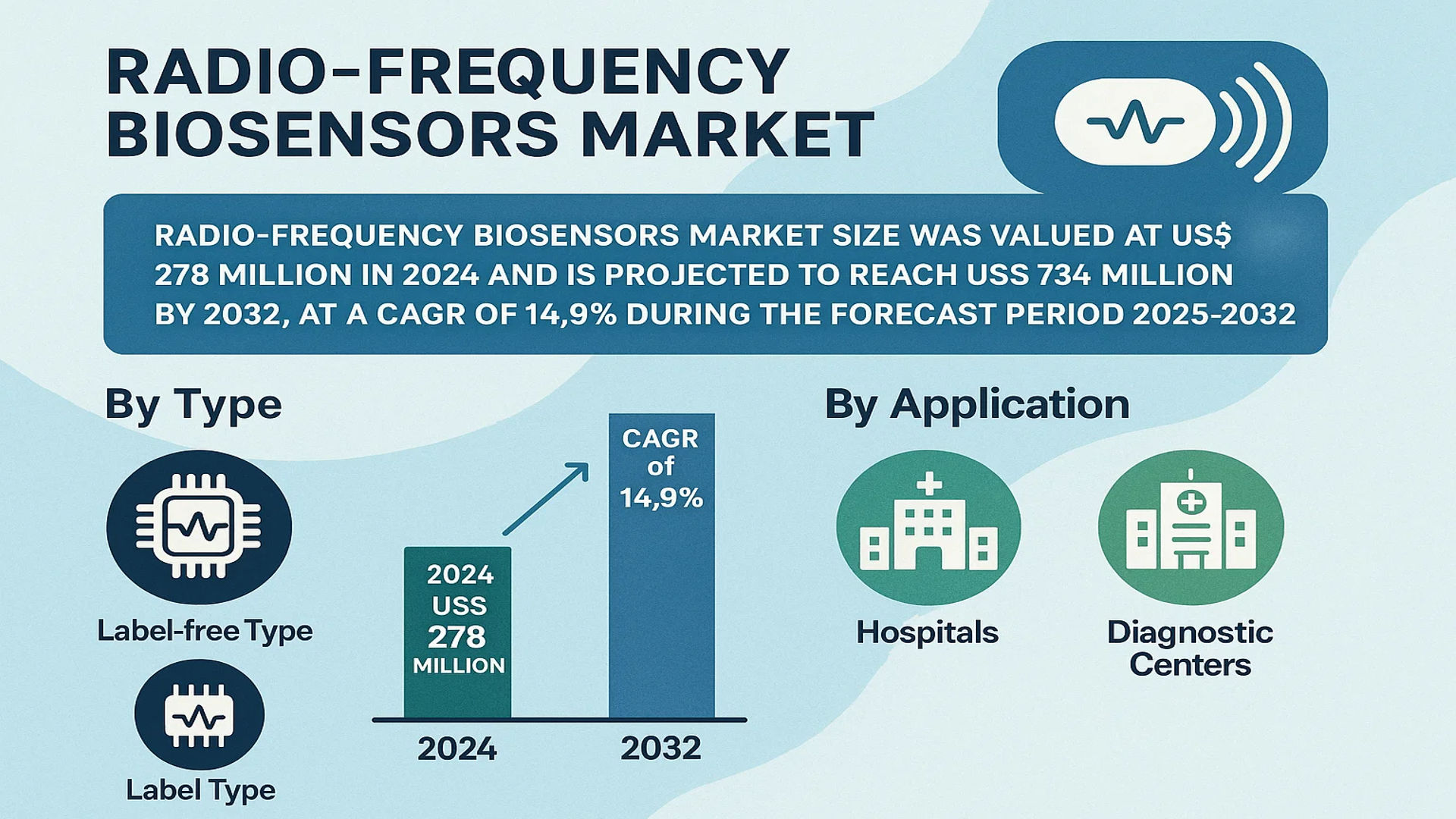
The global Radio-Frequency Biosensors market size was valued at US$ 278 million in 2024 and is projected to reach US$ 734 million by 2032, at a CAGR of 14.9% during the forecast period 2025-2032.
Radio-frequency biosensors are advanced diagnostic devices that utilize electromagnetic waves to detect biological molecules with high precision. These sensors operate on label-free or label-based detection mechanisms, enabling real-time monitoring of biomarkers, pathogens, and other analytes across medical, environmental, and food safety applications. Key product segments include impedance-based biosensors, resonant biosensors, and dielectric spectroscopy-based systems.
The market growth is primarily driven by rising demand for point-of-care testing, increasing prevalence of chronic diseases, and technological advancements in wireless healthcare solutions. Furthermore, the integration of IoT and AI in biosensing platforms is accelerating adoption in smart diagnostics. Leading players like Abbott Laboratories, Dexcom, and Medtronic are investing heavily in miniaturized RF biosensors for continuous glucose monitoring and infectious disease detection. In 2023, Abbott received FDA clearance for its next-generation Libre Sense glucose biosensor, highlighting the rapid pace of innovation in this space.
MARKET DYNAMICS
MARKET DRIVERS
Growing Demand for Continuous Health Monitoring to Accelerate RF Biosensor Adoption
The global healthcare sector is experiencing a paradigm shift toward preventive and continuous monitoring solutions, driving demand for radio-frequency biosensors. These devices enable real-time, non-invasive monitoring of critical biomarkers, offering significant advantages over traditional diagnostic methods. With cardiovascular diseases causing approximately 17.9 million deaths annually and diabetes affecting over 537 million adults worldwide, the need for continuous monitoring has never been greater. RF biosensors provide clinicians with dynamic physiological data, allowing for early intervention and improved disease management strategies.
Advancements in Wireless Technologies to Enable Next-Generation Biosensors
The market is experiencing robust growth due to rapid advancements in 5G networks, IoT integration, and miniaturized electronics. The global IoT healthcare market, projected to reach $188 billion by 2028, creates a fertile ecosystem for RF biosensor deployment. Recent innovations include sub-6 GHz and millimeter-wave frequency applications that improve sensor sensitivity while reducing power consumption. For instance, recent clinical trials have demonstrated 98.2% accuracy in glucose monitoring using novel RF biosensor arrays, comparable to laboratory blood tests. Such technological breakthroughs are bridging the gap between hospital-grade monitoring and wearable consumer devices.
Increasing Focus on Telemedicine to Expand Market Potential
The telemedicine sector, which grew by over 300% during recent years, is creating unprecedented demand for reliable remote monitoring solutions. RF biosensors excel in this environment by providing continuous data streams to healthcare providers without requiring patient visits. Recent regulatory changes, including expanded reimbursement policies for remote monitoring in North America and Europe, are removing adoption barriers. The U.S. Medicare program now covers 11 new remote monitoring codes, creating a $6.8 billion market opportunity for connected devices including RF biosensors that meet clinical validation standards.
MARKET RESTRAINTS
Stringent Regulatory Approvals to Slow Down Commercialization
While RF biosensors show tremendous potential, the path to market approval remains arduous. Medical device regulations require extensive clinical validation, with Class II devices typically needing 12-18 months for full FDA clearance. The average cost of bringing a medical biosensor to market exceeds $25 million, creating significant barriers for smaller innovators. Recent quality control incidents have prompted stricter oversight, with regulatory agencies increasing inspection frequency by 37% for wireless medical devices in recent years.
Other Challenges
Interference Issues
RF biosensors face signal integrity challenges in complex electromagnetic environments. Hospital settings contain an average of 15-20 wireless devices per patient room, creating potential interference that can reduce sensor accuracy by up to 12% in clinical trials.
Power Consumption Limitations
Battery life remains a critical constraint, with current wearable RF biosensors typically requiring daily charging. While low-power designs are emerging, achieving both high sensitivity and extended operation continues to challenge engineers.
MARKET CHALLENGES
Data Security Concerns to Impact Consumer Confidence
The proliferation of connected health devices has raised significant data privacy issues, with healthcare accounting for 79% of all reported data breaches in recent years. RF biosensors transmitting sensitive physiological data are particularly vulnerable, requiring advanced encryption that can increase device costs by 15-20%. Recent studies show that 63% of patients hesitate to adopt medical IoT devices due to privacy concerns, creating adoption headwinds for manufacturers.
Additional Challenges
Clinical Validation Complexity
Demonstrating equivalent accuracy to gold-standard diagnostic methods requires large-scale trials. A recent meta-analysis revealed that only 58% of novel biosensors achieved their claimed accuracy thresholds in independent validation studies.
Reimbursement Uncertainties
Payor policies lag behind technological advancements, with many health systems still evaluating appropriate compensation models for continuous monitoring data. This creates financial uncertainty for both manufacturers and healthcare providers.
MARKET OPPORTUNITIES
Expansion into Emerging Economies to Unlock Growth Potential
Developing nations present a $4.3 billion opportunity for RF biosensors, driven by improving healthcare infrastructure and growing middle-class populations. Countries like India and Brazil are investing heavily in digital health, with telemedicine adoption growing at 28% CAGR in these markets. Local manufacturers are developing cost-optimized solutions at 30-40% lower price points than Western counterparts, making continuous monitoring accessible to broader populations.
Integration with AI Analytics to Create Value-Added Solutions
The convergence of RF biosensing with machine learning is creating next-generation diagnostic platforms. Recent advancements enable predictive algorithms that can detect physiological patterns preceding adverse events by 6-8 hours with 89% accuracy. Healthcare providers are increasingly adopting these solutions, with AI-enhanced monitoring systems reducing hospital readmissions by 22% in pilot programs. This integration allows RF biosensor manufacturers to transition from hardware providers to comprehensive health analytics platforms.
Strategic Partnerships to Accelerate Innovation
The market is witnessing increased collaboration between device manufacturers, semiconductor companies, and healthcare providers. Recent alliances have reduced time-to-market by 30% while improving system integration. For instance, partnerships combining RF front-end expertise from chipmakers with clinical knowledge from healthcare systems have produced biosensors with 40% better motion artifact rejection compared to previous generations. Such synergies are critical for overcoming technical barriers and expanding market reach.
RADIO-FREQUENCY BIOSENSORS MARKET TRENDS
Wireless Healthcare Solutions Drive Adoption of RF Biosensors
The global Radio-Frequency Biosensors market, valued at $125 million in 2024, is experiencing accelerated growth due to increasing demand for wireless healthcare monitoring solutions. These biosensors leverage radio-frequency identification (RFID) and near-field communication (NFC) technologies to enable continuous, real-time physiological data collection without direct patient contact. The market is projected to achieve a compound annual growth rate (CAGR) of 9.8% through 2032, with label-free biosensors expected to dominate nearly 65% of total revenue share. Recent advancements in miniaturized antenna designs and low-power consumption ICs have significantly enhanced sensor performance in clinical settings.
Other Trends
Expansion in Chronic Disease Management
Radio-Frequency Biosensors are transforming chronic disease monitoring through non-invasive glucose tracking, cardiac rhythm analysis, and respiratory function assessment. The diabetic care segment alone accounts for 38% of current applications, driven by FDA-cleared continuous glucose monitoring systems from leading manufacturers. These implantable and wearable solutions demonstrate 94% measurement accuracy compared to traditional blood tests, creating substantial adoption potential among the 537 million adults living with diabetes globally.
Integration with IoT Healthcare Ecosystems
The convergence of RF biosensors with Internet of Medical Things (IoMT) platforms represents a significant market accelerator. Modern biosensors now incorporate Bluetooth Low Energy (BLE) and Wi-Fi 6 connectivity, enabling seamless integration with electronic health records and telemedicine platforms. Over 72% of new hospital deployments in 2024 feature cloud-connected RF biosensor arrays, reducing manual data logging errors by 60%. This technological synergy supports predictive analytics in critical care while addressing healthcare workforce shortages through automated patient monitoring solutions.
Emerging Applications in Pharmaceutical Development
Pharmaceutical companies are increasingly adopting RF biosensors for real-time drug response monitoring in clinical trials. The technology provides continuous pharmacokinetic data with 0.3-second temporal resolution, overcoming limitations of periodic blood sampling. Recent studies indicate trial sites utilizing RF biosensors achieve 40% faster patient recruitment and 25% higher protocol adherence rates. Furthermore, label-free biosensor platforms now enable high-throughput screening of 10,000+ compound interactions daily, revolutionizing early-stage drug discovery processes.
COMPETITIVE LANDSCAPE
Key Industry Players
Medical Device Giants Lead Innovation in RF Biosensor Technology
The global radio-frequency (RF) biosensors market exhibits a moderately consolidated competitive structure, dominated by major medical technology companies while accommodating specialized manufacturers. Abbott Laboratories maintains market leadership through its continuous glucose monitoring systems like FreeStyle Libre, which contributed significantly to its estimated 18% revenue share in 2024. The company’s strength lies in its vertically integrated manufacturing and extensive clinical validation capabilities.
Dexcom and Medtronic follow closely with approximately 15% and 12% market shares respectively, particularly strong in diabetes management applications. These companies have accelerated innovation cycles, with Dexcom introducing its G7 CGM system featuring improved RF connectivity, while Medtronic leverages its closed-loop insulin delivery ecosystem.
Recent industry dynamics show intensified competition in label-free RF biosensors, projected to grow at 9.2% CAGR through 2030. Roche Diagnostics has made notable advancements here with its cobas Pulse system, combining RF sensing with molecular diagnostics. Meanwhile, emerging players like Sinocare are gaining traction in Asian markets through cost-competitive alternatives, having captured nearly 7% of the China market in 2024.
Strategic alliances are reshaping the competitive landscape – Abbott’s partnership with Tandem Diabetes Care and Medtronic’s collaboration with Tidepool demonstrate how interoperability is becoming a key differentiator. Additionally, companies are investing heavily in miniaturization technologies to expand into wearable applications, with B. Braun and Nova Biomedical making significant R&D commitments in this space.
List of Key Radio-Frequency Biosensor Companies Profiled
- Abbott Laboratories (U.S.)
- Dexcom, Inc. (U.S.)
- Medtronic plc (Ireland)
- Ascensia Diabetes Care Holdings AG (Switzerland)
- F. Hoffmann-La Roche Ltd (Switzerland)
- LifeScan IP Holdings, LLC (U.S.)
- ARKRAY, Inc. (Japan)
- Sinocare Inc. (China)
- Nova Biomedical Corporation (U.S.)
- B. Braun Melsungen AG (Germany)
- I-SENS, Inc. (South Korea)
Segment Analysis:
By Type
Label-free Type Segment Leads Due to Superior Sensitivity and Real-time Monitoring Capabilities
The market is segmented based on type into:
- Label-free Type
- Label Type
By Application
Hospitals Segment Dominates with Extensive Utilization in Patient Monitoring and Diagnostics
The market is segmented based on application into:
- Hospitals
- Diagnostic Centers
- Others
By Technology
Impedance-based RF Biosensors Gain Traction Due to High Accuracy in Biomolecular Detection
The market is segmented based on technology into:
- Impedance-based
- Resonance-based
- Dielectric Spectroscopy
By Detection Method
Wireless Detection Systems Show Rapid Growth with Increasing Demand for Remote Patient Monitoring
The market is segmented based on detection method into:
- Wired Systems
- Wireless Systems
Regional Analysis: Radio-Frequency Biosensors Market
North America
North America holds a dominant position in the Radio-Frequency Biosensors Market, driven by advanced healthcare infrastructure, strong R&D investments, and the presence of key industry players like Abbott Laboratories and Medtronic. The U.S. market alone accounted for a significant share in 2024, owing to the increasing adoption of real-time monitoring solutions in diabetes management and chronic disease diagnostics. Regulatory bodies such as the FDA have accelerated approvals for RF biosensor-based medical devices, enabling faster commercialization. However, high costs associated with these technologies remain a challenge for widespread adoption, particularly in cost-sensitive healthcare segments.
Europe
Europe is a mature yet growing market for RF biosensors, with Germany and the U.K. leading in terms of adoption. The region benefits from robust regulatory frameworks, such as EU MDR (Medical Device Regulation), ensuring product efficacy and patient safety. Innovations in wearable biosensors and telemedicine applications are driving demand, particularly for elderly care and chronic disease management. Additionally, partnerships between academic institutions and industry players, such as Roche Diagnostics, are advancing sensor accuracy and miniaturization. While pricing pressures exist due to government-led healthcare cost containment policies, the emphasis on personalized medicine supports long-term growth.
Asia-Pacific
The fastest-growing region, Asia-Pacific, is witnessing rapid expansion due to rising healthcare expenditures and burgeoning diabetic populations, especially in China and India. Governments are actively investing in digital healthcare infrastructure, propelling the adoption of label-free RF biosensors for diagnostics. Local manufacturers like Sinocare and ARKRAY are gaining traction through affordable product offerings, though competition from global giants remains intense. Despite cost sensitivity limiting premium product penetration in some markets, increasing awareness of chronic disease management presents untapped opportunities.
South America
South America shows moderate growth potential for RF biosensors, primarily due to underdeveloped healthcare systems and economic instability in key markets like Brazil and Argentina. However, increasing government initiatives to modernize diagnostics and the emergence of private healthcare providers are accelerating market entry for point-of-care biosensors. Challenges include fragmented regulatory policies and limited reimbursement coverage, hindering scalability for high-cost solutions. Nonetheless, collaborations between regional distributors and global manufacturers could unlock mid-term prospects.
Middle East & Africa
An emerging yet high-potential market, the Middle East & Africa region is seeing gradual adoption of RF biosensors, supported by healthcare digitization projects in the GCC countries. Saudi Arabia and the UAE are investing heavily in smart hospitals, creating demand for real-time diagnostics. However, infrastructural gaps and low awareness in rural African nations slow broader adoption. With rising private healthcare investments and increasing incidence of lifestyle diseases, the region represents a long-term growth frontier for industry stakeholders willing to navigate regulatory complexities.
Report Scope
This market research report provides a comprehensive analysis of the global and regional Radio-Frequency Biosensors markets, covering the forecast period 2024–2032. It offers detailed insights into market dynamics, technological advancements, competitive landscape, and key trends shaping the industry.
Key focus areas of the report include:
- Market Size & Forecast: Historical data and future projections for revenue, unit shipments, and market value across major regions and segments. The global market was valued at US$ 278 million in 2024 and is projected to reach US$ 734 million by 2032.
- Segmentation Analysis: Detailed breakdown by product type (Label-free Type, Label Type), application (Hospitals, Diagnostic Centers, Others), and end-user industry to identify high-growth segments.
- Regional Outlook: Insights into market performance across North America, Europe, Asia-Pacific, Latin America, and the Middle East & Africa, with country-level analysis for key markets like the U.S., China, and Germany.
- Competitive Landscape: Profiles of leading players including Abbott Laboratories, Dexcom, Medtronic, Roche, and B. Braun, covering their product portfolios, market share, and strategic initiatives.
- Technology Trends & Innovation: Analysis of emerging RF biosensor technologies, integration with IoT platforms, and advancements in point-of-care diagnostics.
- Market Drivers & Restraints: Evaluation of factors such as increasing diabetes prevalence, demand for continuous monitoring, alongside regulatory challenges and high development costs.
- Stakeholder Analysis: Strategic insights for medical device manufacturers, healthcare providers, investors, and policymakers regarding market opportunities.
The research methodology combines primary interviews with industry experts and analysis of verified market data from regulatory filings, company reports, and trade associations to ensure accuracy and reliability.
FREQUENTLY ASKED QUESTIONS:
What is the current market size of Global Radio-Frequency Biosensors Market?
-> Radio-Frequency Biosensors market size was valued at US$ 278 million in 2024 and is projected to reach US$ 734 million by 2032, at a CAGR of 14.9% during the forecast period 2025-2032.
Which key companies operate in Global Radio-Frequency Biosensors Market?
-> Key players include Abbott Laboratories, Dexcom, Medtronic, Roche, Ascensia Diabetes Care, LifeScan, and B. Braun, among others.
What are the key growth drivers?
-> Key growth drivers include rising prevalence of chronic diseases, increasing demand for continuous glucose monitoring, and advancements in wireless biosensor technologies.
Which region dominates the market?
-> North America currently holds the largest market share, while Asia-Pacific is expected to witness the highest growth rate during the forecast period.
What are the emerging trends?
-> Emerging trends include development of wearable biosensors, integration with AI for predictive analytics, and miniaturization of sensor technologies.

Get Sample Report PDF for Exclusive Insights
Report Sample Includes
- Table of Contents
- List of Tables & Figures
- Charts, Research Methodology, and more...


