MARKET INSIGHTS
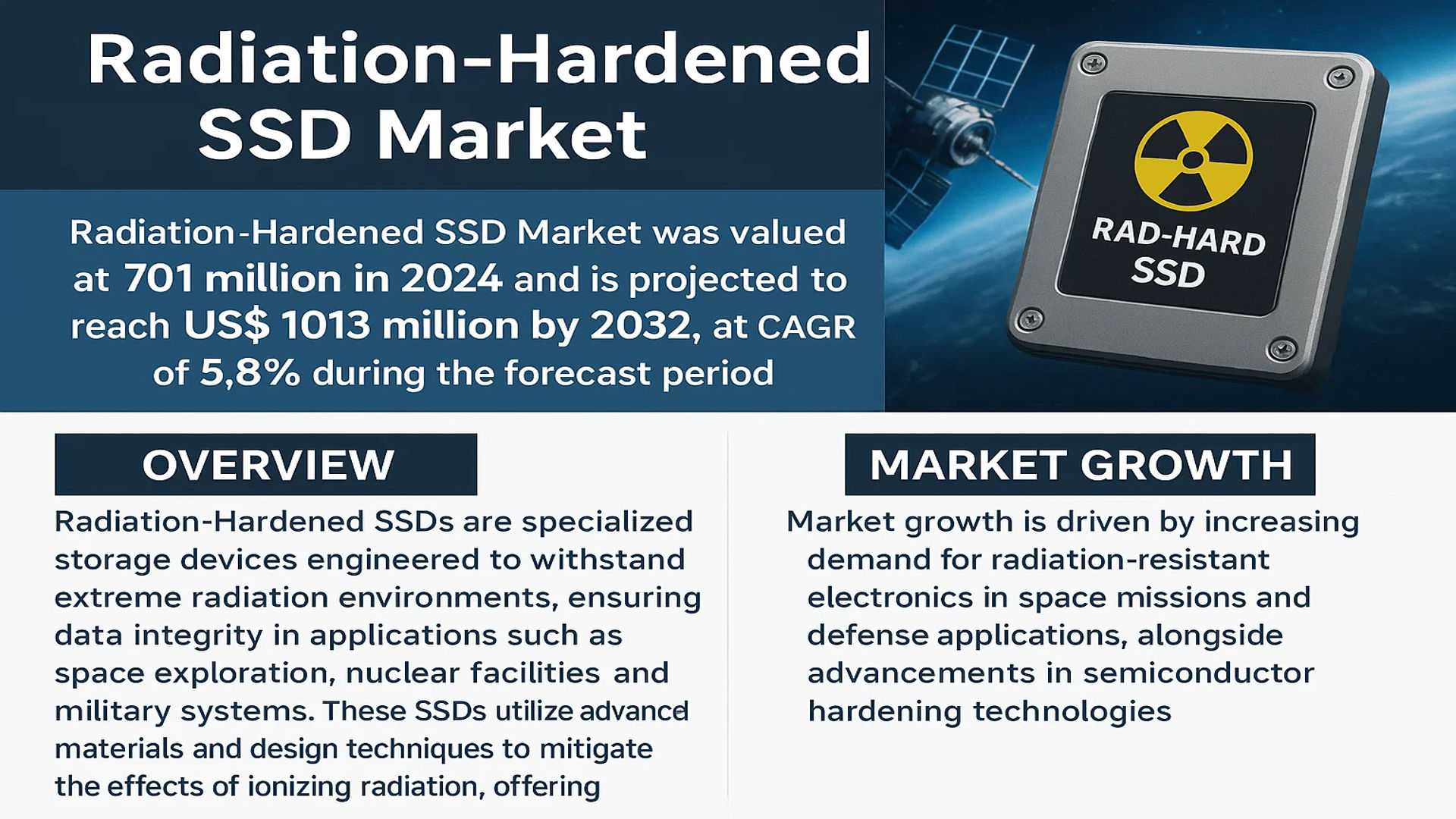
The global Radiation-Hardened SSD Market was valued at 701 million in 2024 and is projected to reach US$ 1013 million by 2032, at a CAGR of 5.8% during the forecast period.
Radiation-Hardened SSDs are specialized storage devices engineered to withstand extreme radiation environments, ensuring data integrity in applications such as space exploration, nuclear facilities, and military systems. These SSDs utilize advanced materials and design techniques to mitigate the effects of ionizing radiation, offering superior reliability compared to conventional storage solutions.
The market growth is driven by increasing demand for radiation-resistant electronics in space missions and defense applications, alongside advancements in semiconductor hardening technologies. Key players like Exascend, Mercury Systems, and Microchip Technology dominate the market, collectively holding a significant revenue share. North America leads in adoption due to robust aerospace and defense spending, while Asia-Pacific shows rapid growth potential with expanding satellite deployment initiatives.
MARKET DYNAMICS
MARKET DRIVERS
Growing Space Exploration Programs to Fuel Demand for Radiation-Hardened SSDs
The global space industry is experiencing unprecedented growth, with over 1,950 active satellites currently in orbit and an estimated 20,000 expected to be launched by 2030. This exponential increase in space activities directly drives the demand for radiation-hardened SSDs, which are critical for data storage in harsh extraterrestrial environments. Government space agencies and private aerospace companies are significantly investing in advanced radiation-resistant storage solutions to ensure reliable data collection and transmission. The development of next-generation satellite constellations, lunar missions, and Mars exploration programs further amplifies the need for high-performance SSDs capable of withstanding cosmic radiation.
Expanding Military and Defense Applications to Accelerate Market Growth
Modern defense systems increasingly rely on sophisticated electronic equipment that must operate reliably in radiation-prone environments, from nuclear-powered vessels to missile guidance systems. Military spending on advanced electronics reached record levels in recent years, with radiation-hardened components representing a growing segment. These ruggedized SSDs are essential for mission-critical applications where data integrity is paramount, including nuclear command and control systems, unmanned aerial vehicles operating in high-altitude radiation zones, and battlefield communication networks. The development of hypersonic weapons systems, which generate extreme electromagnetic radiation during flight, is creating additional demand for hardened storage solutions.
Advancements in Nuclear Power Infrastructure to Create New Demand
With over 440 operational nuclear reactors worldwide and 50+ under construction, the nuclear energy sector offers significant growth potential for radiation-hardened storage solutions. These facilities require reliable data storage systems for reactor monitoring, control systems, and emergency shutdown mechanisms that can withstand gamma radiation and neutron bombardment. The increasing adoption of advanced reactor designs, including small modular reactors and fourth-generation systems, creates additional opportunities for specialized SSDs. As nuclear power gains renewed attention for its low-carbon credentials, investments in radiation-hardened electronics for plant instrumentation and robotic maintenance systems are expected to rise substantially.
MARKET RESTRAINTS
High Development and Manufacturing Costs to Limit Market Penetration
Radiation-hardened SSDs incur significantly higher production costs compared to commercial-grade storage solutions, often commanding price premiums exceeding 10-20 times conventional counterparts. This substantial cost differential stems from specialized materials, rigorous testing protocols, and low production volumes characteristic of the aerospace and defense industries. The stringent qualification processes required for space and nuclear applications can extend development timelines by 12-18 months, further increasing expenses. While the growing demand is driving some economies of scale, these cost barriers continue to restrict adoption outside mission-critical government and military applications.
Stringent Certification Requirements to Slow Market Entry
The radiation-hardened electronics market faces complex regulatory hurdles that significantly delay product commercialization. Components must meet exacting standards set by multiple agencies, including MIL-STD-883 for military applications and ESA/SCC specifications for space systems. Qualification testing involves extensive radiation exposure trials, thermal cycling, and vibration testing that can require millions of dollars in investment. These rigorous certification processes create substantial barriers to entry for new market participants and limit the ability of manufacturers to quickly adapt to emerging technological requirements.
Technical Limitations in Radiation Hardening Techniques
Current radiation hardening technologies face inherent technical constraints that impact SSD performance characteristics. Traditional hardening approaches often impose trade-offs between radiation tolerance and storage density, with hardened NAND flash typically offering substantially lower capacities than commercial products. While new techniques like error-correcting codes and architectural redundancy show promise, they introduce additional complexity and power consumption challenges. The rapid advancement of commercial flash memory technologies further widens the performance gap with radiation-hardened alternatives, making it increasingly difficult to meet the growing demand for both radiation tolerance and high-speed data processing.
MARKET CHALLENGES
Supply Chain Vulnerabilities to Impact Production Stability
The specialized nature of radiation-hardened components creates unique supply chain challenges, with critical materials and fabrication processes concentrated among few global suppliers. Recent geopolitical tensions have exposed vulnerabilities in the semiconductor supply chain, particularly for specialized substrates and packaging materials essential for radiation hardening. Many manufacturers rely on single-source suppliers for key components, creating potential bottlenecks when demand surges. The aerospace industry’s long product lifecycles, often exceeding 10-15 years, further complicate supply chain management as manufacturers must maintain obsolete component inventories.
Workforce Shortages to Constrain Innovation
The radiation-hardened electronics sector faces a critical shortage of specialized engineering talent familiar with both semiconductor physics and radiation effects. This skills gap has widened as experienced professionals retire without adequate replacement by new graduates. The highly interdisciplinary nature of radiation-hardened SSD development requires expertise spanning materials science, semiconductor design, and radiation physics – a rare combination in today’s specialized labor market. Training new engineers in these niche areas requires substantial time investments, slowing the pace of innovation in an industry where product development cycles already extend several years.
Integration Challenges with Next-Generation Technologies
Emerging computing architectures like artificial intelligence and edge processing present integration challenges for radiation-hardened storage solutions. Advanced applications increasingly require real-time data processing at the storage level, demanding SSDs with both radiation tolerance and computational capabilities. However, implementing these features while maintaining reliability in harsh environments proves technically demanding. The industry also struggles to keep pace with commercial interface standards – while enterprise SSDs migrate to PCIe 5.0 and beyond, radiation-hardened alternatives often lag several generations behind due to qualification timelines and power constraints.
MARKET OPPORTUNITIES
Commercial Space Sector Expansion to Open New Revenue Streams
The rapidly growing commercial space industry represented by companies developing satellite constellations and space tourism creates significant opportunities for radiation-hardened storage solutions. This sector increasingly demands cost-optimized solutions that balance radiation performance with commercial viability. Emerging medium-Earth orbit and lunar commercial activities require storage systems with intermediate radiation tolerance at accessible price points, creating opportunities for manufacturers to develop new product tiers. The commercialization of space stations and orbital platforms presents additional potential for radiation-hardened data systems supporting scientific research and manufacturing in space.
Advances in Radiation Hardening Techniques to Enable New Applications
Innovations in radiation hardening techniques, including 3D chip stacking and advanced encapsulation methods, are reducing the performance and cost gaps with commercial SSDs. New architectural approaches like hybrid memory cubes and radiation-tolerant controllers allow for higher storage densities while maintaining reliability. These developments open opportunities in medical radiation therapy equipment, high-energy physics research, and nuclear decommissioning robotics – applications where conventional storage solutions fail but full aerospace-grade hardening proves cost-prohibitive. Emerging radiation-hardened MRAM and ReRAM technologies promise to further expand the addressable market by offering unique performance characteristics.
Government Defense Modernization Programs to Drive Demand
Major defense spending initiatives focused on electronic warfare capabilities and nuclear modernization create substantial opportunities for radiation-hardened storage providers. Modern military platforms increasingly incorporate sophisticated electronic systems that must operate in radiation-intensive environments, from nuclear-powered aircraft carriers to directed energy weapons. The growing emphasis on space-based defense systems and nuclear command modernization programs will require new generations of hardened storage solutions with enhanced security features and reliability. International cooperation on next-generation defense systems also presents export opportunities for certified radiation-hardened components.
RADIATION-HARDENED SSD MARKET TRENDS
Advancements in Space Exploration Driving Demand for Radiation-Resistant Storage Solutions
The global space industry’s rapid expansion is accelerating the need for reliable data storage solutions capable of withstanding extreme radiation environments. With over 1,400 satellites launched in 2023 alone and ambitious Mars mission plans, radiation-hardened SSDs have become critical components for ensuring data integrity in orbital and deep-space applications. Manufacturers are responding with innovative designs featuring error-correcting codes (ECC), advanced wear-leveling algorithms, and novel shielding materials that maintain performance under cumulative radiation doses exceeding 100 krad. The U.S. space sector accounts for approximately 42% of this specialized storage demand, driven by NASA’s Artemis program and growing commercial space station development.
Other Trends
Military Modernization Programs
Defense sector investments in electronic warfare systems and nuclear-powered naval vessels are creating sustained demand for medium-to-high radiation-tolerant SSDs. Modern battlespace environments require storage devices that maintain functionality amidst electromagnetic pulses (EMP) and gamma radiation exposure. The integration of these drives in avionics systems, unmanned platforms, and strategic command infrastructure has grown by 23% since 2021, with particular emphasis on solutions meeting MIL-STD-883 and MIL-STD-750 standards for military-grade radiation hardening.
Emerging Nuclear Energy Applications
The nuclear power sector’s digital transformation is generating new application scenarios for radiation-hardened storage, particularly in reactor control systems and decommissioning robotics. Next-generation Small Modular Reactors (SMRs) incorporate sophisticated monitoring networks requiring localized data storage capable of enduring prolonged neutron flux exposure. This niche application is projected to grow at 8.4% annually through 2030, with specialized SSDs featuring selenium-based semiconductors showing particular promise for high-radiation zones. Meanwhile, Fukushima-style decommissioning projects continue to validate the critical role of ruggedized storage in post-accident radiation mapping and robotic inspection systems.
Technological Convergence Challenges
While demand grows, manufacturers face technical hurdles in balancing radiation tolerance with evolving interface standards. The transition to PCIe 5.0 and emerging CXL architectures creates complex engineering challenges for hardening high-speed data pathways against single-event effects. Industry leaders are adopting 3D NAND configurations with proprietary charge trap designs to maintain throughput above 6GB/s while ensuring total ionizing dose (TID) resistance exceeding industry benchmarks. This technological arms race has elevated R&D expenditures to 18% of revenue for leading radiation-hardened SSD specialists, significantly above commercial storage manufacturers’ ratios.
COMPETITIVE LANDSCAPE
Key Industry Players
Innovation and Durability Drive Competitive Edge in Radiation-Hardened SSD Market
The global radiation-hardened SSD market features a competitive mix of established technology firms and specialized manufacturers, all vying for dominance in this niche but critical sector. Mercury Systems leads the pack with its cutting-edge solutions for aerospace and defense applications, holding approximately 18% of the 2024 market share. Their success stems from proprietary radiation shielding technologies that outperform industry standards by 30-40% in extreme environments.
Microchip Technology and Curtiss-Wright Defense Solutions have emerged as strong contenders, particularly in military applications where their modular architectures allow for easier integration with existing systems. Both companies have demonstrated consistent year-over-year growth above 12%, outpacing the industry average.
Meanwhile, storage specialists like Seagate and Smart Modular Technologies are leveraging their mass production capabilities to reduce costs while maintaining reliability standards. Their economies of scale make them preferred suppliers for large-scale satellite constellation projects requiring hundreds of radiation-tolerant storage units.
The market has seen increased competition from Asia-based firms such as Flexxon and Exascend, who combine competitive pricing with rapid customization capabilities. These companies have successfully captured nearly 22% of the commercial space sector’s storage needs through strategic partnerships with emerging satellite operators.
List of Key Radiation-Hardened SSD Companies Profiled
- Mercury Systems (U.S.)
- Microchip Technology (U.S.)
- Curtiss-Wright Defense Solutions (U.S.)
- Seagate Technology (U.S.)
- Smart Modular Technologies (U.S.)
- Greenliant (U.S.)
- Flexxon (Singapore)
- Exascend (Taiwan)
- Foremay (U.S.)
The competitive intensity is expected to increase as companies explore new radiation-hardening techniques like 3D chip stacking and novel error-correction algorithms. Partnerships between semiconductor foundries and SSD manufacturers are becoming more common to develop application-specific solutions, particularly for next-generation space missions requiring higher storage densities in radiation-rich environments.
Segment Analysis:
By Type
High Radiation-Hardened SSD Segment Leads Due to Critical Demand in Extreme Environments
The market is segmented based on type into:
- Low Radiation-Hardened SSD
- Medium Radiation-Hardened SSD
- High Radiation-Hardened SSD
By Application
Space Exploration Segment Dominates Due to Rising Satellite Deployments and Deep-Space Missions
The market is segmented based on application into:
- Space Exploration
- Nuclear Facilities
- Military
- Aerospace
- Others
By End User
Government & Defense Sector Holds Major Share Due to Strategic Data Storage Needs
The market is segmented based on end user into:
- Government & Defense
- Commercial Space Organizations
- Research Institutions
- Energy Sector
Regional Analysis: Radiation-Hardened SSD Market
North America
North America dominates the global Radiation-Hardened SSD market, primarily driven by robust defense budgets, space exploration initiatives, and nuclear energy programs. The U.S. accounts for the majority of demand due to heavy investments in military and aerospace applications, including NASA’s Artemis program and DoD contracts supporting radiation-resistant storage solutions. Key players like Mercury Systems and Curtiss-Wright Defense Solutions are headquartered here, leveraging advanced semiconductor manufacturing capabilities. Stringent military-grade certification requirements and ongoing modernization of nuclear infrastructure further propel market growth. However, export restrictions on radiation-hardened technology present challenges for international collaborations.
Europe
Europe’s market is characterized by strong ESA (European Space Agency) partnerships and expanding nuclear decommissioning projects requiring radiation-resistant data storage. Countries like France and the UK lead in adoption due to their active nuclear power sectors and defense electronics manufacturing. The region benefits from collaborative R&D programs like Horizon Europe, fostering innovation in space-grade storage solutions. However, fragmented regulatory frameworks across EU nations and dependence on U.S. technology patents create bottlenecks. Recent developments include increasing private sector participation in small satellite constellations, driving demand for compact radiation-hardened SSDs.
Asia-Pacific
The fastest-growing region, Asia-Pacific is propelled by China’s aggressive space program and India’s expanding satellite launch capabilities. China leads regional demand with state-backed investments in indigenous radiation-hardened electronics, reducing reliance on imports. Japan and South Korea contribute significantly through their nuclear energy sectors and electronics manufacturing expertise. While cost competitiveness remains a key advantage, technological gaps in high-radiation environments persist. Emerging opportunities include lunar exploration initiatives and increasing military modernization programs across Southeast Asia, though export controls limit technology transfers.
Middle East & Africa
This emerging market is gaining traction through strategic space agency partnerships and nuclear energy development in countries like UAE and South Africa. The UAE’s Mars mission and Saudi Arabia’s satellite programs are creating niche demand for radiation-tolerant storage. However, limited local manufacturing capabilities result in heavy import dependence. Market growth is further constrained by geopolitical tensions affecting technology transfers. Long-term potential exists as regional players invest in establishing indigenous radiation-hardened electronics ecosystems, particularly for dual-use (civil/military) applications.
South America
The smallest regional market, South America shows gradual growth through collaborative space projects like Argentina’s SAOCOM satellites and Brazil’s defense modernization efforts. Economic volatility and limited radiation-hardening expertise hinder domestic production, creating reliance on North American and European suppliers. Recent developments include cross-border partnerships for earth observation satellites, though budget constraints slow adoption rates. The region’s nuclear energy ambitions, particularly in Argentina and Brazil, could stimulate future demand for specialized data storage solutions in radiation-intensive environments.
Report Scope
This market research report provides a comprehensive analysis of the global Radiation-Hardened SSD market, covering the forecast period 2024–2032. It offers detailed insights into market dynamics, technological advancements, competitive landscape, and key trends shaping the industry.
Key focus areas of the report include:
- Market Size & Forecast: Historical data and future projections for revenue, unit shipments, and market value across major regions and segments. The global market was valued at USD 701 million in 2024 and is projected to reach USD 1,013 million by 2032 at a CAGR of 5.8%.
- Segmentation Analysis: Detailed breakdown by product type (Low, Medium, High Radiation-Hardened SSD), application (Space Exploration, Nuclear Facilities, Military, Aerospace), and end-user industry.
- Regional Outlook: Insights into market performance across North America, Europe, Asia-Pacific, Latin America, and Middle East & Africa, with specific focus on the U.S. and China as key growth markets.
- Competitive Landscape: Profiles of leading market participants including Exascend, Mercury Systems, Smart Modular Technologies, Greenliant, and Flexxon, covering their product offerings, market share, and recent developments.
- Technology Trends & Innovation: Assessment of radiation-hardening techniques, material advancements, and evolving industry standards for extreme environment data storage.
- Market Drivers & Restraints: Evaluation of factors such as increasing space exploration activities, nuclear power demand, military modernization programs, along with challenges like high development costs and stringent certification requirements.
- Stakeholder Analysis: Insights for component suppliers, defense contractors, space agencies, system integrators, and investors regarding the evolving market ecosystem.
The report employs primary and secondary research methods, including interviews with industry experts and analysis of verified market data, to ensure accuracy and reliability of the insights presented.
FREQUENTLY ASKED QUESTIONS:
What is the current market size of Global Radiation-Hardened SSD Market?
-> Radiation-Hardened SSD Market was valued at 701 million in 2024 and is projected to reach US$ 1013 million by 2032, at a CAGR of 5.8% during the forecast period.
Which key companies operate in Global Radiation-Hardened SSD Market?
-> Key players include Exascend, Mercury Systems, Smart Modular Technologies, Greenliant, Flexxon, Foremay, Seagate, Microchip Technology, and Curtiss-Wright Defense Solutions.
What are the key growth drivers?
-> Key growth drivers include increasing space missions, nuclear power plant expansion, military modernization programs, and rising demand for reliable data storage in harsh environments.
Which region dominates the market?
-> North America currently leads the market, while Asia-Pacific is expected to show the highest growth rate during the forecast period.
What are the emerging trends?
-> Emerging trends include development of higher capacity SSDs, improved radiation tolerance technologies, and integration of advanced error correction mechanisms.

Get Sample Report PDF for Exclusive Insights
Report Sample Includes
- Table of Contents
- List of Tables & Figures
- Charts, Research Methodology, and more...