Key Statistics
Key Takeaways
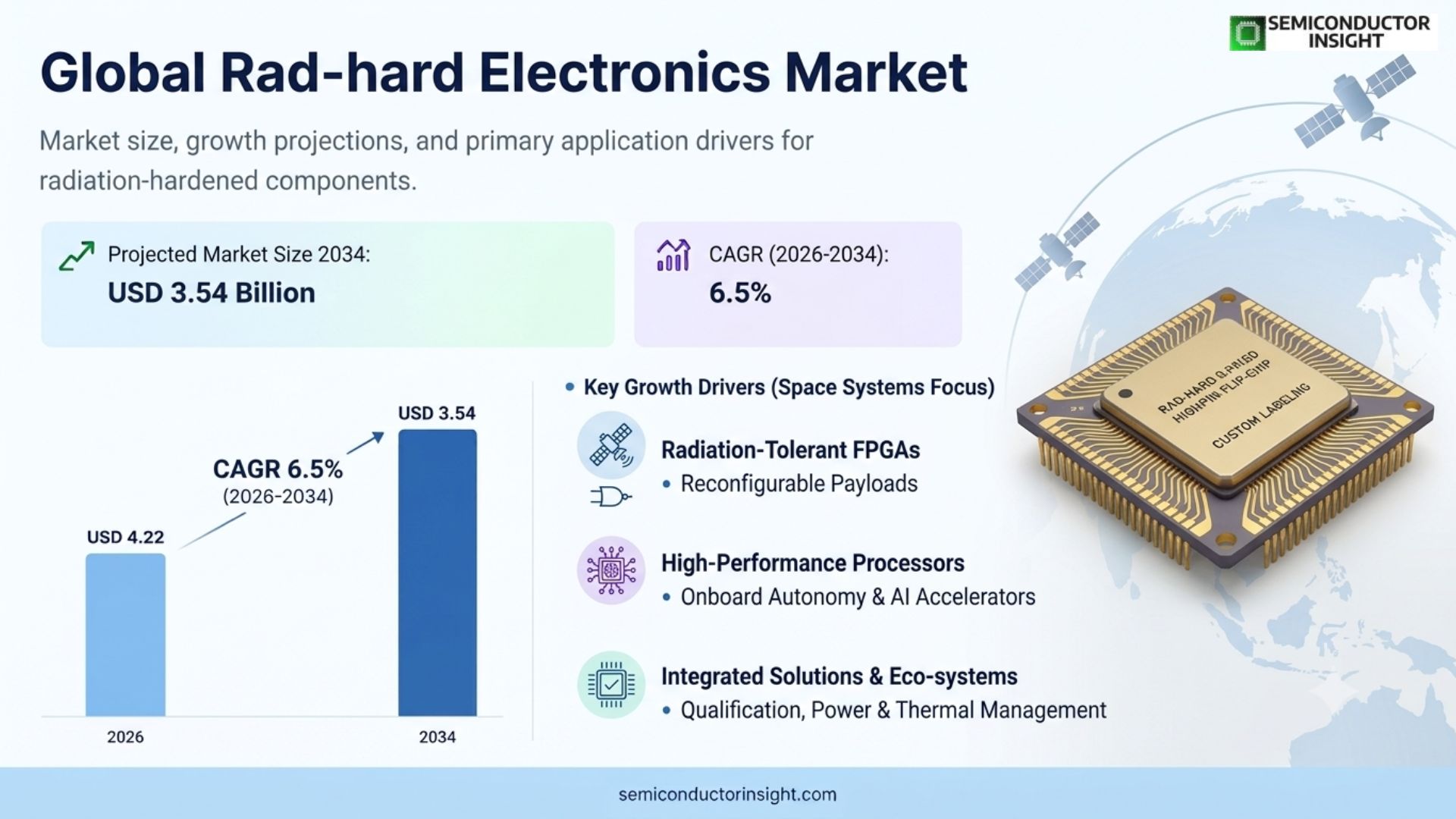
- Radiation-hardened-by-design (RHBD) is the leading type because system architects can implement radiation tolerance at circuit and architecture level across processors, logic and mixed-signal functions.
- Aerospace is the largest application, with satellites, launch vehicles and deep-space missions requiring electronics that remain functional under ionizing radiation and particle events.
- North America leads the market through U.S. space, defense and radiation-testing infrastructure, while Asia Pacific has the strongest expansion profile.
- Processors and controllers are the leading component segment because mission computers and control functions require qualified computing capability across long program lifecycles.
- Qualification cost and long lead times restrain supplier entry, but they also protect incumbents once components are designed into flight or defense platforms.
Rad-hard Electronics Market Overview
Rad-hard Electronics Market was valued at USD 2.01 billion in 2025 and is projected to reach USD 3.54 billion by 2034, representing a 6.5% CAGR during 2026–2034. The 2026 estimated market size is USD 2.14 billion. North America is the largest market in 2025, supported by U.S. space and defense programs, while Asia Pacific is the fastest-growing regional opportunity.
Radiation-hardened electronics are components and assemblies engineered to continue operating in environments where ionizing radiation, heavy ions, protons, neutrons or cumulative dose can disrupt or permanently damage conventional electronics. The source scope covers radiation-hardened-by-design, radiation-hardened-by-process and radiation-hardened-by-shielding approaches across aerospace, medical, nuclear, military and other applications. This matters commercially because qualification, integration effort, supplier continuity and total system risk shape purchasing decisions as strongly as component price, so vendors that solve deployment constraints can retain specification positions even when technically similar alternatives exist.
The commercial market differs from mainstream semiconductors because qualification evidence is part of the product. Spacecraft and defense buyers need characterization for total ionizing dose, single-event effects and mission-specific operating conditions, which makes radiation testing, traceability and change control central to supplier selection. A lower-cost part cannot easily displace an incumbent if the replacement requires a new qualification campaign.
Technology evolution creates a trade-off between computing performance and radiation robustness. Advanced nodes provide more logic density and lower power, but shrinking geometries can alter sensitivity to single-event effects and make assurance more complex. Suppliers therefore combine circuit-hardening techniques, specialized processes, redundancy, error correction and package-level strategies to meet mission requirements without freezing customers on obsolete architectures.
Segment Analysis: By Type
The source page segments the market into radiation-hardened-by-design (RHBD), radiation-hardened-by-process (RHBP), radiation-hardened-by-shielding (RHBS) and other approaches. RHBD leads because circuit and architecture techniques can be applied across ASICs, FPGAs and other functions while allowing suppliers to use a broader range of semiconductor processes. This matters commercially because qualification, integration effort, supplier continuity and total system risk shape purchasing decisions as strongly as component price, so vendors that solve deployment constraints can retain specification positions even when technically similar alternatives exist.
| Type | Technical / purchasing role | Market position |
|---|---|---|
| RHBD | Radiation tolerance is created through circuit topology, redundancy, layout, error correction and architecture; source subtypes include ASICs, FPGAs and others. | Leading type because it supports programmable and application-specific devices while reducing dependence on a single specialized wafer process. |
| RHBP | Radiation tolerance is built into the semiconductor process; the source lists SOI, bulk silicon and other process variants. | Important where process isolation and device physics provide intrinsic radiation advantages, especially for mission-critical analog and digital functions. |
| RHBS | Physical shielding is used to reduce radiation exposure reaching sensitive electronics. | Used as a complementary system-level technique where mass, geometry and mission dose permit shielding to reduce component stress. |
| Others | Hybrid mitigation, redundancy and application-specific assurance methods outside the primary source categories. | Niche but relevant where designers combine commercial or tolerant components with system-level mitigation to balance cost and mission risk. |
Component and technology-node mix
Additional source segmentation covers processors and controllers, memory, ASICs, FPGAs, power converters and other components, plus technology nodes above 100 nm, 65–100 nm and below 65 nm. Older and specialized nodes remain important because proven radiation behavior and long qualification histories can outweigh density, while newer nodes are adopted when performance requirements justify additional assurance work.
Segment Analysis: By Application
Applications are segmented into aerospace, medical, nuclear power, military and defense, and other uses. Aerospace is the largest application because satellites, launch vehicles and deep-space systems operate beyond the protection available to terrestrial electronics and require mission-assured processors, memories, power devices and programmable logic with documented radiation performance. This matters commercially because qualification, integration effort, supplier continuity and total system risk shape purchasing decisions as strongly as component price, so vendors that solve deployment constraints can retain specification positions even when technically similar alternatives exist.
| Application | Demand characteristics |
|---|---|
| Aerospace | Satellite electronics, launch vehicles and deep-space missions require components qualified for total dose and single-event environments. Long mission lifetimes and limited repair access make reliability evidence, lot traceability and configuration control essential, so space-qualified parts command value through assurance and program continuity rather than through raw semiconductor performance alone. This matters commercially because qualification, integration effort, supplier continuity and total system risk shape purchasing decisions as strongly as component price, so vendors that solve deployment constraints can retain specification positions even when technically similar alternatives exist. |
| Medical | Radiation therapy and diagnostic imaging systems place electronics near ionizing-radiation sources, creating demand for tolerant control, sensing and power functions. Medical equipment makers balance radiation robustness with regulatory documentation and long product lifecycles, favoring suppliers that can maintain stable components and provide detailed reliability information across many years. This matters commercially because qualification, integration effort, supplier continuity and total system risk shape purchasing decisions as strongly as component price, so vendors that solve deployment constraints can retain specification positions even when technically similar alternatives exist. |
| Nuclear Power | Nuclear facilities use electronics for monitoring, control and safety functions in radiation-exposed areas. Qualification is application specific and replacement cycles are long, so market access depends on environmental testing, documentation and the ability to supply functionally consistent devices long after mainstream semiconductor generations have moved to newer products. This matters commercially because qualification, integration effort, supplier continuity and total system risk shape purchasing decisions as strongly as component price, so vendors that solve deployment constraints can retain specification positions even when technically similar alternatives exist. |
| Military & Defense | Defense platforms require electronics that can withstand radiation from high-altitude, space, nuclear or specialized mission environments. Procurement emphasizes assured supply, security, temperature range and long-term availability, allowing qualified suppliers to sustain design positions across extended aircraft, missile, satellite and sensor-system lifecycles. This matters commercially because qualification, integration effort, supplier continuity and total system risk shape purchasing decisions as strongly as component price, so vendors that solve deployment constraints can retain specification positions even when technically similar alternatives exist. |
| Others | Other applications include scientific instruments, high-energy physics and specialized industrial systems. Volumes are smaller, but these users can demand extreme performance and generate valuable qualification data that suppliers later apply to commercial space or defense products, making research deployments strategically important even when unit demand is limited. This matters commercially because qualification, integration effort, supplier continuity and total system risk shape purchasing decisions as strongly as component price, so vendors that solve deployment constraints can retain specification positions even when technically similar alternatives exist. |
Regional Analysis
North America is the largest rad-hard electronics market because U.S. space, defense and radiation-effects testing infrastructure creates the deepest pool of qualified demand. Europe follows with ESA and national programs, while Asia Pacific is expanding rapidly through satellite, launch and nuclear investment. South America and the Middle East & Africa remain project-driven emerging markets.
How does regional demand differ across the rad-hard electronics market?
Regional differences reflect mission portfolios and qualification infrastructure rather than general electronics consumption. North America is defense and commercial-space heavy; Europe emphasizes agency programs and supply sovereignty; Asia Pacific is expanding national launch and satellite capabilities; South America relies on selective aerospace projects; and the Middle East and Africa are building demand through government-backed space and defense programs.
| Region | Position | Growth outlook | Demand profile | What decides supplier selection |
|---|---|---|---|---|
| North America | Largest | Steady | Research, defense, cloud and advanced-system led | Qualification depth, domestic support, reliability and ecosystem integration |
| Europe | Major established market | Steady | Research, industrial and regulation influenced | Technical documentation, long lifecycle support and regional supply assurance |
| Asia Pacific | Large growth market | High | Manufacturing, electronics and capacity-expansion led | Local manufacturing support, cost, scale and customer qualification |
| South America | Emerging | Selective | Import and project led | Distributor availability, landed cost and service reach |
| Middle East & Africa | Emerging | Selective | Infrastructure, defense and research-project led | Project qualification, supply continuity and local channel capability |
Rad-hard Electronics Competitive Landscape
Competition is shaped by qualification heritage, radiation test data, trusted manufacturing, long product availability and application engineering. Semiconductor performance matters, but customers also buy confidence that a device will behave predictably after years in orbit or in another radiation environment. That makes historical flight heritage and stable process control powerful competitive assets.
Microchip, BAE Systems, Honeywell, Analog Devices, Renesas, Infineon, STMicroelectronics and other established suppliers compete across processors, logic, analog, power and mixed-signal functions. Their advantage is the ability to combine semiconductor design with documented radiation characterization, configuration control and support for programs whose procurement windows can extend far beyond commercial electronics cycles. This matters commercially because qualification, integration effort, supplier continuity and total system risk shape purchasing decisions as strongly as component price, so vendors that solve deployment constraints can retain specification positions even when technically similar alternatives exist.
FPGAs are strategically important because spacecraft designers can configure logic late in the development cycle and update functions without a new ASIC. Radiation-tolerant programmable logic therefore competes on usable logic density, power, single-event immunity, toolchain maturity and flight heritage. A strong development ecosystem can be as important as the FPGA die because mission software and verification costs are substantial.
New entrants often target gaps created by obsolete legacy products or by demand for more compute at lower power. The challenge is converting a promising architecture into qualified production: radiation testing, package qualification, lot control and customer validation can take years. Once completed, however, those barriers can create durable positions because customers avoid unnecessary component changes during long-lived programs.
Tier structure
| Competitive tier | Representative participants | How suppliers compete |
|---|---|---|
| Mission-proven leaders | Microchip; BAE Systems; Honeywell; Analog Devices; Teledyne | Compete through flight heritage, radiation data, qualification depth and long lifecycle support. |
| Diversified semiconductor suppliers | Renesas; Infineon; STMicroelectronics; Texas Instruments; Xilinx | Leverage broad analog, power, logic and processing portfolios while qualifying selected devices for radiation environments. |
| Specialists & subsystem suppliers | Cobham Advanced Electronic Solutions; Data Device Corporation; Vorago Technologies; VPT; TTM Technologies | Compete in specialized processors, interfaces, power, boards and radiation-assured subsystems. |
Key companies profiled
The source report profiles Microchip Technology Inc.; BAE Systems; Renesas Electronics Corporation; Infineon Technologies AG; STMicroelectronics; Xilinx, Inc.; Texas Instruments; Honeywell International Inc.; Teledyne Technologies Inc.; TTM Technologies, Inc.; Cobham Advanced Electronic Solutions; Data Device Corporation; Analog Devices; Vorago Technologies; VPT. The list covers semiconductor manufacturers, programmable-logic suppliers, radiation-hard specialists and subsystem providers, illustrating that mission electronics are assembled from processors, memory, power conversion, interfaces and interconnect products that must all satisfy radiation, temperature, lifecycle and traceability requirements.
Rad-hard Electronics Production Capacity Analysis
Capacity is constrained less by raw wafer starts than by qualified process lines, packaging, radiation testing and the engineering resources required to maintain configuration control. A commercial fab can produce many more die than the space market needs, but only devices manufactured under controlled processes and supported by radiation characterization can enter high-assurance missions, making qualified capacity much scarcer than nominal semiconductor capacity.
Radiation-hard-by-process products depend on specialized wafer technologies such as SOI or controlled bulk-silicon processes, so process migrations require extensive requalification. Suppliers often keep mature nodes in production because customers value known radiation behavior and long-term availability. That creates tension with foundry economics, since low-volume legacy processes must remain viable even as mainstream semiconductor investment moves elsewhere.
Radiation-hard-by-design allows suppliers to use more conventional processes, but the design and verification burden moves into circuits, layout and system mitigation. Libraries, redundant architectures and error-correction schemes need validation across radiation conditions and operating corners. Engineering talent and access to beam facilities therefore become practical capacity constraints alongside wafers and packages. This matters commercially because qualification, integration effort, supplier continuity and total system risk shape purchasing decisions as strongly as component price, so vendors that solve deployment constraints can retain specification positions even when technically similar alternatives exist.
Radiation test infrastructure is a strategic bottleneck. Heavy-ion, proton and total-dose testing requires specialized facilities, scheduling and expert interpretation, and test campaigns must often be repeated after process or design changes. Suppliers that maintain strong relationships with test laboratories and disciplined configuration management can move qualified products to customers faster than competitors that treat radiation assurance as a late-stage activity.
Rad-hard Electronics Market Dynamics: Drivers, Restraints and Opportunities
Growth is supported by expanding satellite constellations, deeper-space missions, defense electronics and the need for higher onboard computing capability. Restraints come from lengthy qualification, specialized testing capacity, mature-node dependence and high assurance costs. Opportunities are strongest in programmable logic, high-performance processors, power management and components designed for proliferated commercial-space platforms that need radiation tolerance at lower cost.
MARKET DRIVERS
Drivers Impact Analysis*
| Factor | Relative impact* | Commercial mechanism |
|---|---|---|
| Satellite and launch activity | High | More spacecraft create recurring demand for processors, memory, power and programmable logic with radiation assurance. |
| Higher onboard computing | High | Autonomy, sensing and communications require more capable rad-hard processors and accelerators. |
| Defense modernization | Medium-High | Missile, space and high-altitude systems require long-life mission-assured electronics. |
Proliferated space architectures increase qualified component demand
Commercial and government satellite constellations increase the number of platforms requiring radiation-tolerant processing, memory, power and interfaces. Even when individual spacecraft use lower-cost parts than flagship missions, the higher platform count broadens the market and creates demand for product families that balance radiation performance, availability and cost across different mission classes. This matters commercially because qualification, integration effort, supplier continuity and total system risk shape purchasing decisions as strongly as component price, so vendors that solve deployment constraints can retain specification positions even when technically similar alternatives exist.
Spacecraft autonomy requires more onboard computing
Imaging, communications, navigation and scientific missions increasingly process data onboard to reduce downlink burden and improve response time. That pushes designers toward higher-performance processors, FPGAs and memory while preserving radiation assurance. Suppliers that deliver more compute per watt without sacrificing qualification can capture content growth even when spacecraft unit counts remain unchanged.
Long defense program lifecycles sustain replacement demand
Defense and strategic-space systems can remain in service for decades, creating demand for form-fit-function replacements when older components become obsolete. Rad-hard suppliers that maintain controlled processes or develop qualified replacement products can monetize lifecycle support, while customers reduce the cost and risk of redesigning complete avionics or mission electronics around a new semiconductor generation.
Power electronics become more important as payload capability rises
Higher compute, communications and sensing capability increases spacecraft power demand and makes conversion efficiency more valuable. Radiation-tolerant power converters, regulators and power semiconductors therefore gain content alongside digital electronics. Suppliers can differentiate through efficiency, temperature performance, fault response and radiation data tailored to the intended orbit or mission environment. This matters commercially because qualification, integration effort, supplier continuity and total system risk shape purchasing decisions as strongly as component price, so vendors that solve deployment constraints can retain specification positions even when technically similar alternatives exist.
MARKET RESTRAINTS
Restraints Impact Analysis*
| Factor | Relative impact* | Commercial mechanism |
|---|---|---|
| Qualification time and cost | High | Radiation testing and mission assurance extend product-development and customer-approval cycles. |
| Specialized test availability | Medium-High | Beam-facility access can delay characterization and redesign decisions. |
| Mature-node supply risk | Medium | Long-lived qualified processes may face foundry consolidation or obsolescence pressure. |
Qualification creates a long path from design to revenue
A new rad-hard device must prove electrical function, package reliability and radiation behavior before it can enter a high-assurance program. Testing may expose single-event modes that require design changes and another fabrication cycle. The resulting development timeline increases capital needs for suppliers and makes customers cautious about adopting parts without established production and support histories.
Radiation testing capacity can delay commercialization
Heavy-ion and proton test facilities are limited compared with ordinary semiconductor laboratories, and suitable beam time must be scheduled around many research and defense programs. Delays affect not only initial qualification but also process-change validation, so suppliers need careful test planning and multiple facility relationships to keep product roadmaps aligned with customer program milestones.
Legacy process dependence creates supply-chain exposure
Many rad-hard products remain on mature or specialized semiconductor processes because their radiation behavior is understood and already qualified. Foundry consolidation can threaten those lines even when customer demand remains stable. Moving the product to a new process can change device physics and trigger expensive requalification, making lifecycle planning a major commercial requirement.
Cost pressure from commercial-space architectures changes specifications
Not every satellite needs the same radiation margin as a deep-space mission, and proliferated constellations can accept different risk trade-offs. This encourages use of radiation-tolerant or screened commercial components in selected applications, putting price pressure on traditional fully hardened parts and forcing suppliers to create tiered product families matched to mission class and replacement economics.
MARKET OPPORTUNITIES
Radiation-tolerant FPGAs for reconfigurable payloads
Reconfigurable logic allows satellite builders to update processing and interfaces after launch or late in system development. Suppliers can capture this opportunity by combining useful logic density with radiation robustness, low power, qualified packages and mature design tools, reducing the engineering risk of implementing complex payload functions in a fixed custom ASIC.
High-performance rad-hard processors and AI accelerators
Onboard autonomy and sensor processing create demand for more compute than legacy mission processors can deliver. Vendors that adapt multicore, vector or accelerator architectures to radiation environments can gain content in imaging, navigation and communications systems, provided they also solve power, thermal and software-ecosystem constraints that determine actual mission usability. This matters commercially because qualification, integration effort, supplier continuity and total system risk shape purchasing decisions as strongly as component price, so vendors that solve deployment constraints can retain specification positions even when technically similar alternatives exist.
Lower-cost products for proliferated commercial space
Large constellations create demand for components that provide sufficient radiation tolerance at lower unit cost than traditional strategic-space parts. This opens room for plastic-packaged radiation-tolerant devices, screened commercial technologies and scalable qualification methods, enabling suppliers to serve high-volume missions without applying the cost structure of the most demanding deep-space programs. This matters commercially because qualification, integration effort, supplier continuity and total system risk shape purchasing decisions as strongly as component price, so vendors that solve deployment constraints can retain specification positions even when technically similar alternatives exist.
European and Asian supply-sovereignty initiatives
Governments and space agencies want dependable access to critical electronics without excessive reliance on a single foreign supply chain. Domestic processor, FPGA and power-device development programs can create funded design opportunities for regional suppliers, while established global vendors may respond through local manufacturing partnerships, licensing or deeper qualification support within those markets.
Rad-hard Electronics Supply Chain Analysis
Qualified semiconductor processes
The upstream process determines transistor behavior, isolation, leakage and sensitivity to radiation. Qualified processes are valuable because customers rely on accumulated characterization data, so foundry changes are not simple sourcing substitutions. Suppliers must manage process longevity and document changes carefully to protect existing mission approvals. This matters commercially because qualification, integration effort, supplier continuity and total system risk shape purchasing decisions as strongly as component price, so vendors that solve deployment constraints can retain specification positions even when technically similar alternatives exist.
Rad-hard design & verification
Design translates radiation requirements into architectures that can tolerate upsets and cumulative dose. Verification includes conventional functional checks plus fault injection and radiation-specific analysis, making engineering effort much higher than for a comparable commercial component and creating intellectual property around proven libraries and mitigation methods. This matters commercially because qualification, integration effort, supplier continuity and total system risk shape purchasing decisions as strongly as component price, so vendors that solve deployment constraints can retain specification positions even when technically similar alternatives exist.
Packaging & radiation testing
Packaging and test create the evidence customers need to trust a part in a mission environment. Lot traceability, screening and radiation campaigns add time and cost, but they also create a defensible commercial barrier because a competing device without equivalent data cannot be substituted easily in a qualified spacecraft or defense design.
Space, defense & nuclear integration
System integrators select devices using mission radiation models, temperature, lifetime and redundancy requirements, then freeze qualified bills of materials. Once a component is accepted, change becomes expensive because software, boards and qualification artifacts depend on it, allowing suppliers with reliable lifecycle support to retain revenue across long production and maintenance periods. This matters commercially because qualification, integration effort, supplier continuity and total system risk shape purchasing decisions as strongly as component price, so vendors that solve deployment constraints can retain specification positions even when technically similar alternatives exist.
Recent Developments in the Rad-hard Electronics Market
Recent supplier and agency activity shows the market prioritizing programmable logic, domestic capability and qualification for newer device families. The commercial direction is toward more compute and reconfigurability without abandoning radiation assurance, which increases demand for advanced FPGAs, processors and verification tools while preserving the importance of flight heritage and controlled manufacturing.
Microchip announced a new RT PolarFire family addition for space applications. Expanding a qualified FPGA portfolio gives spacecraft designers more reconfigurable processing choices and illustrates how suppliers are moving higher-density commercial-style logic into radiation-tolerant product lines while maintaining the documentation and qualification required for mission use. This matters commercially because qualification, integration effort, supplier continuity and total system risk shape purchasing decisions as strongly as component price, so vendors that solve deployment constraints can retain specification positions even when technically similar alternatives exist.
ESA has supported development intended to strengthen European access to space-grade computing technology. The initiative is commercially relevant because processor sovereignty programs can create local design ecosystems, verification tools and future component demand, reducing dependence on a small number of imported mission processors and broadening the qualified supplier base. This matters commercially because qualification, integration effort, supplier continuity and total system risk shape purchasing decisions as strongly as component price, so vendors that solve deployment constraints can retain specification positions even when technically similar alternatives exist.
NASA JPL technical guidance on radiation effects remains foundational for component selection and assurance. The continuing need to characterize total dose and single-event behavior explains why rad-hard electronics compete on validated environmental performance and why design or process changes can trigger substantial retesting before a component is accepted for flight. This matters commercially because qualification, integration effort, supplier continuity and total system risk shape purchasing decisions as strongly as component price, so vendors that solve deployment constraints can retain specification positions even when technically similar alternatives exist.
REPORT SCOPE & SEGMENTATION
The standardized scope retains the source page’s type, application, component and technology-node segmentation while rebasing the market to 2025, estimating 2026 and extending the same anchor-implied growth path to 2034. It therefore preserves the published market definition while providing a consistent time window for comparison with the other semiconductor and electronics topics in this workbook.
| Report attribute | Coverage |
|---|---|
| Market | Rad-hard Electronics |
| Base year | 2025 |
| Estimated year | 2026 |
| Forecast period | 2026–2034 |
| 2025 market size | USD 2.01 billion |
| 2034 forecast size | USD 3.54 billion |
| CAGR | 6.5% during 2026–2034 |
| Largest market in 2025 | North America |
| By Type | Radiation-Hardened-by-Design (RHBD: ASICs, FPGAs, Others); Radiation-Hardened-by-Process (RHBP: SOI, Bulk Silicon, Others); Radiation-Hardened-by-Shielding (RHBS); Others |
| By Application | Aerospace (Satellite Electronics; Launch Vehicles; Deep Space Exploration); Medical (Radiation Therapy Equipment; Diagnostic Imaging Systems); Nuclear Power; Military & Defense; Others |
| Additional segmentation | By Component: Processors & Controllers; Memory; ASICs; FPGAs; Power Converters; Others. By Technology Node: Above 100 nm; 65–100 nm; Below 65 nm. |
| Regions | North America; Europe; Asia Pacific; South America; Middle East & Africa |
| Companies profiled | Microchip Technology Inc.; BAE Systems; Renesas Electronics Corporation; Infineon Technologies AG; STMicroelectronics; Xilinx, Inc.; Texas Instruments; Honeywell International Inc.; Teledyne Technologies Inc.; TTM Technologies, Inc.; Cobham Advanced Electronic Solutions; Data Device Corporation; Analog Devices; Vorago Technologies; VPT |
Frequently Asked Questions
What is the rad-hard electronics market size in 2025?
The global rad-hard electronics market is valued at USD 2.01 billion in 2025 under the standardized series used in this overview. The figure is the base-year reference for comparing technology adoption, segment mix, regional demand and supplier positioning, and it is carried consistently through the Key Statistics, Market Overview and report-scope sections.
What is the forecast size of the rad-hard electronics market by 2034?
The market is projected to reach USD 3.54 billion by 2034. The forecast endpoint is linked to the same published market-size anchors used for the 2025 base year, so the size series and the stated growth rate remain mathematically consistent rather than mixing values from different scopes or forecast windows. This matters commercially because qualification, integration effort, supplier continuity and total system risk shape purchasing decisions as strongly as component price, so vendors that solve deployment constraints can retain specification positions even when technically similar alternatives exist.
What CAGR is expected for the rad-hard electronics market during 2026–2034?
The standardized outlook corresponds to a 6.5% CAGR during 2026–2034. The rate reflects the compound annual growth implied by the market-size anchors and is used consistently throughout this overview, enabling direct comparison of drivers, restraints, regional momentum and technology adoption without introducing an unrelated growth assumption. This matters commercially because qualification, integration effort, supplier continuity and total system risk shape purchasing decisions as strongly as component price, so vendors that solve deployment constraints can retain specification positions even when technically similar alternatives exist.
Which region is the largest rad-hard electronics market in 2025?
North America is identified as the largest market in 2025 based on the source-page regional positioning and supporting industry structure. Its leadership is reinforced by the concentration of relevant customers, manufacturing or deployment activity, while supplier qualification and ecosystem depth help established vendors convert that structural demand into sustained component revenue. This matters commercially because qualification, integration effort, supplier continuity and total system risk shape purchasing decisions as strongly as component price, so vendors that solve deployment constraints can retain specification positions even when technically similar alternatives exist.
Which product type leads the rad-hard electronics market?
Radiation-hardened-by-design (RHBD) is the leading product or technology type in the source segmentation. Its position reflects the combination of installed-base relevance, customer qualification, system compatibility and the breadth of applications it can address, giving suppliers a larger accessible revenue pool than narrower alternatives even as newer architectures gain share. This matters commercially because qualification, integration effort, supplier continuity and total system risk shape purchasing decisions as strongly as component price, so vendors that solve deployment constraints can retain specification positions even when technically similar alternatives exist.
Which application is most important in the rad-hard electronics market?
Aerospace is the principal application identified in the source scope. Demand is supported by system-level performance requirements and by the need for qualified, reliable components that can be integrated without creating disproportionate redesign or certification burden, which makes application engineering and customer support important competitive variables. This matters commercially because qualification, integration effort, supplier continuity and total system risk shape purchasing decisions as strongly as component price, so vendors that solve deployment constraints can retain specification positions even when technically similar alternatives exist.
Which region is growing fastest in the rad-hard electronics market?
Asia Pacific has the strongest growth profile in this overview. Growth is tied to new capacity, system deployment, research investment or electronics manufacturing expansion depending on the market, and suppliers benefit most where they can support local qualification, shorten lead times and align products with region-specific customer requirements. This matters commercially because qualification, integration effort, supplier continuity and total system risk shape purchasing decisions as strongly as component price, so vendors that solve deployment constraints can retain specification positions even when technically similar alternatives exist.
What are the main growth drivers for the rad-hard electronics market?
The main drivers are expanding system performance requirements, higher integration density, new infrastructure or compute deployments, and the migration toward components that improve reliability while reducing board or system-level constraints. These forces create purchasing events when customers redesign platforms, qualify new suppliers or move from laboratory or pilot use into repeat production.
What are the main restraints on the rad-hard electronics market?
The main restraints are qualification time, cost pressure, long development cycles, supply concentration and the risk that alternative architectures absorb functions previously served by discrete or specialized devices. These constraints do not eliminate demand, but they can delay design wins, lengthen revenue conversion cycles and favor suppliers with established manufacturing and application-support capabilities.
Who are the key suppliers in the rad-hard electronics market?
The competitive landscape includes the companies listed in the source report scope together with other qualified ecosystem participants discussed in this overview. Competitive advantage depends on technology performance, manufacturability, reliability evidence, customer-specific engineering, production continuity and the ability to support long qualification cycles, rather than on headline component specifications alone. This matters commercially because qualification, integration effort, supplier continuity and total system risk shape purchasing decisions as strongly as component price, so vendors that solve deployment constraints can retain specification positions even when technically similar alternatives exist.
Research Sources & Evidence Base
Get Sample Report PDF for Exclusive Insights
Report Sample Includes
- Table of Contents
- List of Tables & Figures
- Charts, Research Methodology, and more...
 Download Sample Report PDF