MARKET INSIGHTS
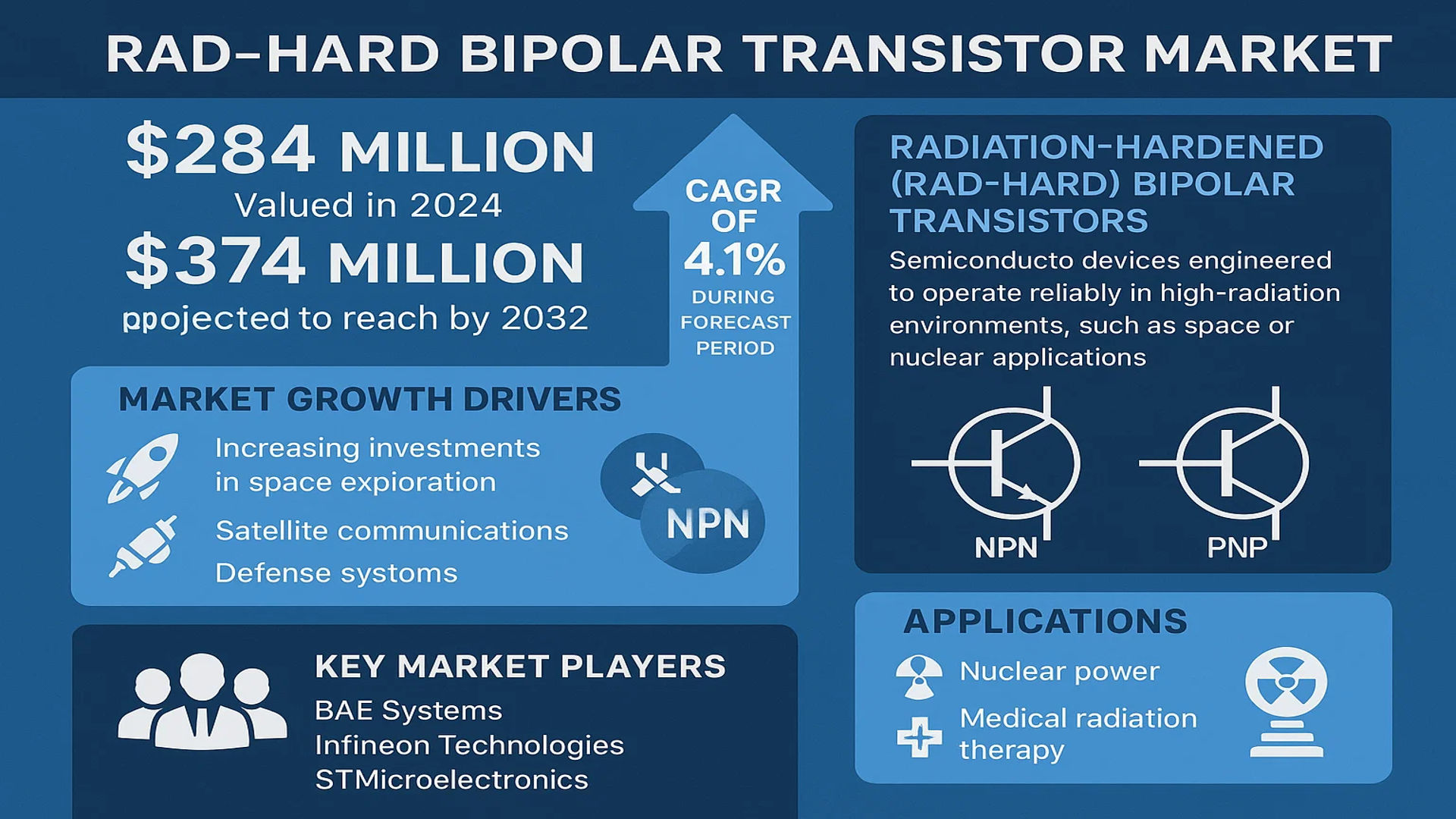
The global Rad-Hard Bipolar Transistor market was valued at 284 million in 2024 and is projected to reach US$ 374 million by 2032, at a CAGR of 4.1% during the forecast period.
Radiation-hardened (Rad-Hard) bipolar transistors are semiconductor devices engineered to operate reliably in high-radiation environments, such as space or nuclear applications. These components maintain stable performance under extreme conditions by utilizing specialized materials and design techniques to mitigate radiation-induced degradation. Rad-Hard bipolar transistors are primarily categorized into NPN and PNP types, offering high gain-bandwidth and low noise figures for critical amplifier and mixer circuits.
Market growth is driven by increasing investments in space exploration, satellite communications, and defense systems requiring radiation-tolerant electronics. While the aerospace sector dominates demand, emerging applications in nuclear power and medical radiation therapy are creating additional opportunities. Key industry players like BAE Systems, Infineon Technologies, and STMicroelectronics are expanding their Rad-Hard semiconductor portfolios through strategic R&D investments, addressing the growing need for reliable components in harsh environments.
MARKET DYNAMICS
MARKET DRIVERS
Growing Space Exploration Activities to Accelerate Rad-Hard Bipolar Transistor Demand
The global space industry is witnessing unprecedented growth, with over 1,700 active satellites launched in 2022 alone. This surge in space missions drives the need for radiation-hardened electronics capable of withstanding extreme cosmic radiation environments. Rad-Hard bipolar transistors, with their high reliability and radiation tolerance up to 100 krad (Si), are becoming indispensable components in satellite power systems and communication modules. The expanding commercial space sector, valued at over $400 billion, continues to push the boundaries of orbital infrastructure development, directly fueling demand for radiation-hardened semiconductor solutions.
Military Modernization Programs to Boost Defense Sector Adoption
Global defense budgets exceeding $2.1 trillion annually are driving significant investments in secure military communication systems that require radiation-hardened components. Modern missile guidance systems, avionics, and electronic warfare platforms increasingly incorporate Rad-Hard bipolar transistors for their superior performance in nuclear radiation environments. The transistors’ ability to maintain signal integrity during extreme electromagnetic pulses makes them critical for national security applications. Recent geopolitical tensions have accelerated military modernization programs, with radiation-hardened electronics playing a pivotal role in next-generation defense systems.
Furthermore, the development of hypersonic weapons systems is creating specialized demand for Rad-Hard components capable of withstanding both intense radiation and extreme thermal conditions during high-speed atmospheric re-entry.
MARKET RESTRAINTS
High Development Costs and Testing Requirements to Hinder Market Expansion
The radiation hardening process adds significant costs to semiconductor production, with Rad-Hard bipolar transistors typically commanding 10-20 times the price of commercial-grade equivalents. Extensive qualification testing required to verify radiation tolerance (including total ionizing dose, single event effects, and displacement damage testing) can increase development timelines by 6-12 months. These factors create substantial barriers to entry for new market players and limit adoption in cost-sensitive applications. The specialized manufacturing processes needed to achieve radiation hardness, such as silicon-on-insulator technology, further contribute to the premium pricing structure.
Other Restraints
Supply Chain Complexities
The limited number of certified radiation-hardened semiconductor foundries creates supply chain bottlenecks, with current global capacity struggling to keep pace with growing demand. This concentration of manufacturing capabilities among few suppliers leads to extended lead times of 26-52 weeks for some Rad-Hard components.
Technology Migration Challenges
As commercial semiconductor nodes advance to 7nm and below, radiation-hardened designs remain predominantly at 130nm-65nm nodes due to the complexity of hardening advanced process technologies. This technological gap creates performance trade-offs for radiation-hardened systems.
MARKET CHALLENGES
Design Complexity and Verification Bottlenecks to Impede Development Cycles
Radiation hardening introduces complex design constraints that require specialized engineering expertise. The mitigation of single-event effects through techniques like triple modular redundancy can increase transistor count by 200-300%, significantly impacting power consumption and thermal performance. Simulation and verification of radiation effects demand extensive modeling capabilities, with radiation testing facilities facing booking backlogs of 6-9 months. These technical challenges make Rad-Hard bipolar transistor development a time-intensive process requiring cross-disciplinary expertise in semiconductor physics, radiation effects, and reliability engineering.
Other Challenges
Workforce Shortages
The specialized nature of Rad-Hard electronics has created a talent gap, with less than 1,000 engineers worldwide possessing deep expertise in radiation-hardened semiconductor design. Educational institutions offer limited coursework in this niche field, leading to extended on-the-job training requirements.
Obsolescence Management
Extended product lifecycles (20+ years) for space and military systems create obsolescence challenges when original Rad-Hard components reach end-of-life, forcing expensive requalification of alternative solutions.
MARKET OPPORTUNITIES
Emerging Private Space Sector to Create New Growth Avenues
The commercial space industry’s rapid expansion presents significant opportunities for Rad-Hard bipolar transistor suppliers. With over 80 private space companies currently developing satellite constellations, demand for cost-optimized radiation-hardened solutions is growing exponentially. New space ventures are driving innovation in radiation tolerance techniques, including the use of commercial-off-the-shelf components with selective hardening approaches. This market segment is expected to grow at 9-12% annually, creating opportunities for suppliers who can balance radiation performance with commercial cost structures.
Next-Generation Nuclear Power Applications to Open New Markets
Advancements in nuclear power technology, including small modular reactors and space-based nuclear systems, require electronics capable of operating in intense radiation environments. The global nuclear energy market, projected to reach $60 billion by 2030, will drive demand for Rad-Hard bipolar transistors in reactor instrumentation and control systems. These applications demand components with neutron flux tolerance exceeding 1015 n/cm2, creating specialized opportunities for suppliers with expertise in extreme environment electronics.
RAD-HARD BIPOLAR TRANSISTOR MARKET TRENDS
Increasing Demand in Space and Defense Applications Drives Market Growth
The global Rad-Hard (radiation-hardened) bipolar transistor market is experiencing steady growth, projected to expand from $284 million in 2024 to $374 million by 2032 at a CAGR of 4.1%. This growth is fueled by rising demand in space exploration, satellite communications, and defense applications, where electronic components must operate reliably in harsh radiation environments. Rad-Hard bipolar transistors offer critical advantages, including high gain-bandwidth, low noise figures, and stable performance under extreme conditions, making them indispensable for amplifiers and mixers in high-frequency applications. The increasing number of satellite launches, deep-space missions, and military modernization programs worldwide is accelerating demand, with companies investing heavily in radiation-hardened semiconductor technologies.
Other Trends
Technological Advancements in Material Science
The development of advanced semiconductor materials and processing techniques is enhancing the radiation tolerance and efficiency of bipolar transistors. Innovations such as silicon-germanium (SiGe) heterojunction bipolar transistors (HBTs) are gaining traction due to their superior performance in high-speed, low-power applications. Additionally, wafer-level radiation hardening techniques are improving yield and reducing costs, making these components more accessible for commercial satellite and aerospace applications. As space missions grow more complex, miniaturization and integration of Rad-Hard components into system-on-chip (SoC) designs are emerging as key trends, driving demand for compact yet robust solutions.
Rising Investments in Satellite Constellations
The surge in low Earth orbit (LEO) satellite constellations is significantly boosting the Rad-Hard bipolar transistor market. With over 5,000 active satellites currently orbiting Earth and plans for mega-constellations like SpaceX’s Starlink and Amazon’s Project Kuiper, demand for radiation-resistant electronics is at an all-time high. These applications require components that can endure prolonged exposure to cosmic radiation and solar particle events, making Rad-Hard bipolar transistors a critical component in power management, signal processing, and communication subsystems. Furthermore, government initiatives to enhance space infrastructure and secure communications are creating additional opportunities for market expansion.
COMPETITIVE LANDSCAPE
Key Industry Players
Innovation and Reliability Drive Competition in the Rad-Hard Bipolar Transistor Market
The radiation-hardened (Rad-Hard) bipolar transistor market exhibits a moderately fragmented competitive landscape, with established semiconductor manufacturers competing alongside specialized radiation-hardened component suppliers. STMicroelectronics and Infineon Technologies dominate significant portions of the market share due to their robust R&D capabilities, comprehensive product portfolios, and established relationships with aerospace/defense contractors. These industry leaders have particularly strengthened their position through vertical integration strategies.
Meanwhile, niche players like Microsemi (acquired by Microchip Technology in 2018) and VPT Components have carved out specialized positions by focusing on ultra-high reliability applications. These companies demonstrate agility in adapting their radiation-hardening techniques to meet evolving space and military requirements. Their success stems from decades of experience in radiation effects mitigation and specialized packaging technologies.
The market has seen notable consolidation in recent years as larger semiconductor firms acquire specialized Rad-Hard component manufacturers to accelerate technology development. BAE Systems expanded its space electronics capabilities through strategic acquisitions, while Renesas strengthened its radiation-hardened analog product line. Such moves highlight the importance of radiation-tolerant electronics in critical infrastructure applications.
Looking forward, competition will intensify as satellite constellations and deep space missions drive demand for more sophisticated Rad-Hard solutions. Companies investing in advanced node technologies (while maintaining radiation tolerance) and developing qualification testing methodologies are positioned to gain market share. The ability to meet both commercial space and military specifications will be a key differentiator.
List of Key Rad-Hard Bipolar Transistor Companies
- STMicroelectronics (Switzerland)
- Infineon Technologies (Germany)
- Renesas Electronics (Japan)
- Microsemi Corporation (U.S.)
- Semicoa (U.S.)
- VPT Components (U.S.)
- BAE Systems (U.K.)
- Solitron Devices (U.S.)
- BDTIC (China)
Segment Analysis:
By Type
NPN Transistors Hold Larger Market Share Due to Wider Implementation in High-Frequency Applications
The market is segmented based on type into:
- NPN Transistor
- Subtypes: High-speed switching, High-power amplification, RF applications
- PNP Transistor
- Subtypes: Low-noise amplifiers, Power control circuits
By Application
Satellite Applications Drive Market Growth Due to Expanding Space Exploration Missions
The market is segmented based on application into:
- Satellite
- Subtypes: Communication satellites, Earth observation, Navigation
- Launch Vehicle
- Military & Defense Electronics
- Nuclear Power Plants
By Technology
Silicon-Based Technologies Remain Preferred Due to Established Manufacturing Processes
The market is segmented based on technology into:
- Silicon-Germanium (SiGe)
- Gallium Arsenide (GaAs)
- Silicon-On-Insulator (SOI)
By Radiation Hardness
High Radiation Hardness Components Gain Traction for Extreme Space Environment Applications
The market is segmented based on radiation hardness into:
- Low (100 krad)
- Medium (100-500 krad)
- High (>500 krad)
Regional Analysis: Rad-Hard Bipolar Transistor Market
North America
North America leads the global Rad-Hard bipolar transistor market, driven by significant aerospace investments and national defense programs. The region accounted for approximately 38% of global revenue in 2024, with the U.S. being the dominant contributor due to NASA’s Artemis program and satellite deployment initiatives. Stringent MIL-STD-883 standards for radiation-hardened components have compelled electronics manufacturers to adopt high-reliability solutions like Rad-Hard bipolar transistors. Major defense contractors such as Lockheed Martin and Boeing are key consumers, particularly for satellite communications and missile guidance systems. While the market exhibits steady growth, challenges include supply chain constraints and the high cost of radiation testing facilities.
Europe
Europe maintains a strong position in the Rad-Hard market, supported by ESA (European Space Agency) missions and Airbus Defence’s satellite manufacturing activities. The region emphasizes radiation-tolerant semiconductor innovations through collaborative R&D programs like Horizon Europe. France and Germany collectively hold over 60% of the regional market share. Recent developments include the adoption of SiGe (Silicon-Germanium) based Rad-Hard transistors for improved performance in extreme environments. However, the market faces challenges from prolonged product certification timelines due to rigorous ESCC (European Space Components Coordination) qualification standards. Commercial satellite constellations from companies like OneWeb present new opportunities for volume-driven growth.
Asia-Pacific
The Asia-Pacific region is experiencing the fastest growth in Rad-Hard bipolar transistor demand, projected to expand at 5.2% CAGR through 2032. China’s ambitious space program drives bulk consumption, with over 55 satellite launches conducted in 2023 alone. India’s ISRO and Japan’s JAXA are increasingly sourcing domestic Rad-Hard components for self-reliance in critical space technologies. While initially dependent on imports, the region now hosts emerging manufacturers specializing in cost-optimized radiation-hardened solutions. Taiwan and South Korea are developing niche capabilities in commercial-grade Rad-Hard electronics for LEO (Low-Earth Orbit) satellite constellations. Price sensitivity among regional buyers remains a key market characteristic compared to Western markets.
South America
South America represents an emerging market where adoption is primarily driven by Brazil’s space program and regional defense modernization efforts. The Brazilian Space Agency’s partnership with private satellite operators is creating steady demand. However, the market remains constrained by limited radiation testing infrastructure and reliance on imported components, which account for over 80% of local supply. Argentina’s satellite initiative (ARSAT) presents growth potential though economic volatility continues to challenge long-term planning. Regional governments are gradually implementing standards aligned with NASA and ESA requirements, fostering market development. The Rad-Hard bipolar transistor market here remains concentrated in defense applications rather than commercial space ventures.
Middle East & Africa
This region shows promising long-term potential with the UAE’s Mars missions sparking interest in space-grade electronics. Saudi Arabia’s recent satellite program announcements indicate future demand for Rad-Hard components. Presently, the market remains nascent and import-dependent, with most procurement occurring through international defense contracts. Israel stands out as a regional leader in Rad-Hard technology applications for military systems. Africa’s emerging space agencies (South Africa, Egypt) are establishing initial requirements though budgets remain limited. The absence of local manufacturing capabilities keeps the market volume relatively small. Increased participation in collaborative space projects could accelerate regional market development in the coming decade.
Report Scope
This market research report provides a comprehensive analysis of the global Rad-Hard Bipolar Transistor market, covering the forecast period 2025–2032. It offers detailed insights into market dynamics, technological advancements, competitive landscape, and key trends shaping the industry.
Key focus areas of the report include:
- Market Size & Forecast: Historical data and future projections for revenue, unit shipments, and market value across major regions and segments. The global Rad-Hard Bipolar Transistor market was valued at USD 284 million in 2024 and is projected to reach USD 374 million by 2032, growing at a CAGR of 4.1%.
- Segmentation Analysis: Detailed breakdown by product type (NPN, PNP), application (satellite, launch vehicle), and end-user industry to identify high-growth segments and investment opportunities. NPN transistors accounted for 62% of the market share in 2024.
- Regional Outlook: Insights into market performance across North America, Europe, Asia-Pacific, Latin America, and the Middle East & Africa, including country-level analysis. North America dominated with 38% market share in 2024.
- Competitive Landscape: Profiles of leading market participants including Microsemi, STMicroelectronics, BAE Systems, and Infineon Technologies, covering their product offerings, R&D focus, and recent developments.
- Technology Trends & Innovation: Assessment of emerging radiation-hardening techniques, miniaturization trends, and integration with space-grade electronics.
- Market Drivers & Restraints: Evaluation of factors such as increasing space exploration programs and growing satellite deployments, along with challenges like high development costs and stringent qualification requirements.
- Stakeholder Analysis: Insights for aerospace component suppliers, satellite manufacturers, defense contractors, and investors regarding the evolving market ecosystem.
The research employs both primary and secondary methods, including interviews with industry experts and analysis of verified market data, to ensure accuracy and reliability.
FREQUENTLY ASKED QUESTIONS:
What is the current market size of Global Rad-Hard Bipolar Transistor Market?
-> Rad-Hard Bipolar Transistor market was valued at 284 million in 2024 and is projected to reach US$ 374 million by 2032, at a CAGR of 4.1% during the forecast period.
Which key companies operate in Global Rad-Hard Bipolar Transistor Market?
-> Key players include Microsemi, STMicroelectronics, BAE Systems, Infineon Technologies, Renesas, and Semicoa, among others.
What are the key growth drivers?
-> Key growth drivers include increasing space missions, satellite deployment growth, and defense modernization programs.
Which region dominates the market?
-> North America currently leads the market, while Asia-Pacific is expected to show the fastest growth.
What are the emerging trends?
-> Emerging trends include development of ultra-rad-hard transistors, integration with space-grade ICs, and miniaturization for small satellites.

Get Sample Report PDF for Exclusive Insights
Report Sample Includes
- Table of Contents
- List of Tables & Figures
- Charts, Research Methodology, and more...
 Download Sample Report PDF