Quantum Well Infrared Photodetector (QWIP) Market Insights
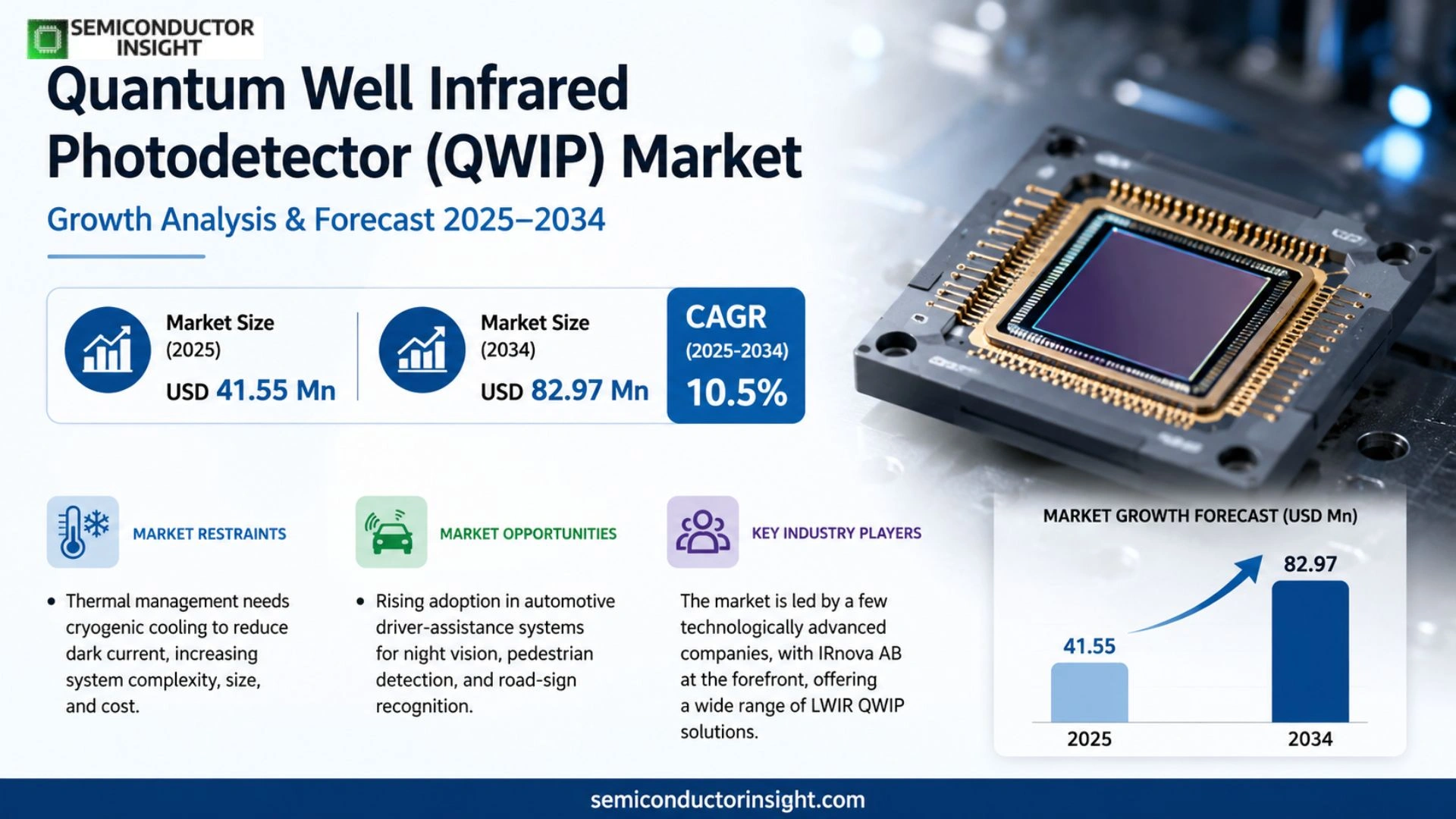
Quantum Well Infrared Photodetector (QWIP) market size was valued at USD 41.55 million in 2025 and is projected to reach USD 82.97 million by 2034, exhibiting a CAGR of 10.5% during the forecast period.
Quantum Well Infrared Photodetector, or QWIP, is a cooled photon‑detection technology that exploits intersubband transitions within quantum‑well structures to sense mid‑wave and long‑wave infrared radiation. Its commercial appeal lies not in low‑cost consumer devices but in delivering high uniformity, strong stability, customizable spectral response and scalable focal‑plane‑array capability for high‑end thermal imaging, long‑range surveillance, specialty gas‑leak visualization and professional infrared measurement.
The market’s expansion is underpinned by continued investment in high‑value professional scenarios such as industrial safety inspections and environmental monitoring. Leading firms,including IRnova AB with its Tor LW, Idun 1055, Embla 1055 and Fenrir LW Pol families; QmagiQ LLC offering standard and custom FPA solutions; and Teledyne Technologies’ FLIR brand integrating cooled QWIP into systems like the G306,are driving adoption by providing end‑to‑end solutions that combine detector performance with robust packaging and system integration.
MARKET DRIVERS
Performance Superiority in Infrared Imaging
Quantum Well Infrared Photodetector (QWIP) Market benefits from an intrinsic ability to deliver high‑resolution detection across the mid‑wave infrared band. This spectral reach aligns with the growing demand for precise thermal‑signature imaging in defense and aerospace platforms, where even modest improvements in signal‑to‑noise ratio translate into tactical advantages.
System‑Level Cost Efficiency
Recent advances in epitaxial layer engineering have allowed QWIP arrays to be bonded directly to silicon read‑out integrated circuits. The resulting monolithic architecture reduces interconnect complexity, shortens assembly cycles, and drives down the bill of materials,factors that resonate strongly with OEMs seeking to balance performance with budget constraints.
➤ “Tuning well thickness grants manufacturers a wavelength‑specific advantage that few competing detector technologies can match.”
Strategic government investment, particularly in nations prioritizing next‑generation surveillance capabilities, injects steady funding into research programs. This financial support accelerates technology maturation, shortens time‑to‑market, and creates a cascade of downstream opportunities for component suppliers.
MARKET CHALLENGES
Manufacturing Complexity
Producing QWIP devices demands ultra‑precise molecular‑beam epitaxy to achieve the required quantum‑well uniformity. Even marginal deviations in layer thickness can cause a shift in detection wavelength, compelling manufacturers to invest heavily in process control and yield‑improvement initiatives.
Other Challenges
Supply Chain Vulnerabilities
Dependence on high‑purity source materials and specialized equipment creates bottlenecks; disruptions in any tier of the supply chain can cascade into delayed product launches and inflated costs.
MARKET RESTRAINTS
Thermal Management Requirements
QWIP arrays typically operate at cryogenic temperatures to suppress dark current. The need for compact, reliable cooling solutions adds a layer of engineering complexity and escalates system cost, especially in applications where size, weight, and power (SWaP) constraints are paramount.
MARKET OPPORTUNITIES
Emerging Automotive Driver‑Assistance Systems
Automakers are exploring mid‑wave infrared sensing to enhance night‑time pedestrian detection and road‑sign recognition. The QWIP’s ability to deliver stable performance under diverse temperature conditions makes it a compelling candidate for integration into next‑generation driver‑assist modules, opening a sizeable new revenue stream beyond traditional defense contracts.
Parallel advances in miniaturized cryocooler technology are lowering the barrier to entry for automotive OEMs, allowing them to adopt infrared sensors without compromising vehicle packaging or cost targets.
Quantum Well Infrared Photodetector (QWIP) Market Trends
System‑Level Integration Gains Traction
Quantum Well Infrared Photodetector (QWIP) sector is witnessing a shift from isolated detector sales to full‑system solutions. Leading firms such as IRnova, QmagiQ, and FLIR under Teledyne now bundle arrays, cooler modules, and read‑out electronics into turnkey platforms for long‑wave imaging, optical‑gas inspection, and polarimetric sensing. This integration reduces engineering risk for end users, shortens deployment cycles, and justifies the premium price structure that characterises the market. By delivering a calibrated package, vendors capture downstream value that previously escaped as separate system‑integrator margins. The trend also invites larger equipment manufacturers to partner with QWIP specialists, expanding the addressable base beyond niche research labs to utility‑scale field programs and defense contracts.
Other Trends
Specialised Spectral Tailoring
Customers increasingly demand custom spectral bands that isolate specific gas absorption lines, such as those of SF6, NH3, and C2H4. IRnova’s Idun 1055 and FLIR’s G306 exemplify this direction, offering selectable wavelength windows that align with regulatory inspection protocols. The ability to target a narrow band improves signal‑to‑noise ratio, reduces false‑positive rates, and lowers the number of required scan passes, which in turn cuts labor costs and downtime for industrial sites. Because compliance penalties for leak‑related incidents are steep, a detector that delivers definitive identification becomes a strategic asset, encouraging capital‑budget approvals even in cost‑conscious environments.
Geographic Concentration Reinforces Barrier to Entry
Production capability for QWIP arrays remains clustered in Europe and the United States, where deep R&D expertise and specialised cooling technology are co‑located. This geography creates a natural moat: new entrants would need to replicate a full stack of quantum‑well epitaxy, cryogenic packaging, and high‑precision read‑out design,each requiring multi‑year engineering programmes and substantial capital outlay. Consequently, the competitive landscape is defined by a few well‑funded players that can sustain long‑term investment cycles, rather than by rapid turnover of niche startups. For incumbent firms, the barrier translates into pricing power and the ability to negotiate long‑term supply agreements with system integrators, reinforcing the overall stability of Quantum Well Infrared Photodetector (QWIP) Market.
COMPETITIVE LANDSCAPE
Key Industry Players
Quantum Well Infrared Photodetector Market: High‑Performance Imaging for Specialized Applications
The QWIP segment remains tightly clustered around a handful of technologically deep firms. IRnova AB leads the European front with a portfolio that spans general long‑wave imaging (Tor LW), optical‑gas detection (Idun 1055, Embla 1055) and polarimetric solutions (Fenrir LW Pol). Its strategy of modular spectral tuning and close cooler integration has translated into a reputation for uniformity that end‑users cite when selecting leak‑visualization or hazardous‑gas platforms. In the United States, QmagiQ LLC leverages a lean fabrication line to deliver custom focal‑plane arrays (FPAs) on short‑notice, allowing system integrators to address niche spectral bands without re‑engineering the detector core. Teledyne Technologies, operating the FLIR brand, closes the value chain by embedding QWIP arrays into turnkey systems such as the G306, a platform preferred by utility and industrial customers for its robust packaging and field‑qualified readout electronics. The competitive geometry therefore pivots on depth of detector engineering, the ability to co‑design cooler‑readout assemblies, and the delivery of ready‑made system solutions rather than volume‑oriented pricing.
Beyond the three primary players, a constellation of smaller but technically capable firms reinforces the market’s high‑entry barrier. Opgal Optronic Industries (Israel) has introduced a long‑wave gas imaging camera that leverages a QWIP FPA optimized for SF₆ detection, while Raytheon Technologies embeds QWIP modules in defense‑grade thermal sensors that demand stringent reliability under temperature extremes. European defense contractor Leonardo and UK‑based BAE Systems both maintain niche development programs focused on airborne long‑range surveillance, where QWIP’s spectral stability offers an advantage over competing technologies. L3Harris and Lockheed Martin have each signed limited‑scope supply agreements with niche manufacturers to incorporate QWIP in select maritime and aerospace platforms. Additional entrants such as Sensors Unlimited (a Collins Aerospace brand), Airbus Defence and Space, and the German‑based company Hensoldt provide complementary readout ASICs and cooling subsystems that complete the ecosystem. This layered supplier network ensures that, while the market is small, it is resilient and capable of meeting the exacting demands of industrial safety, environmental monitoring, and high‑end defense applications.
List of Key Quantum Well Infrared Photodetector Companies Profiled
- IRnova AB
- QmagiQ LLC
- Teledyne Technologies Incorporated
- Opgal Optronic Industries
- Raytheon Technologies
- Leonardo S.p.A.
- BAE Systems plc
- L3Harris Technologies
- Lockheed Martin Corporation
- Sensors Unlimited (Collins Aerospace)
- Airbus Defence and Space
- Hensoldt GmbH
- FLIR (Teledyne)
- Nordic Semiconductor AB
- Rohde & Schwarz GmbH
Segment Analysis:
| Segment Category | Sub-Segments | Key Insights |
| By Type |
|
Cooled Photon Detectors
|
| By Application |
|
Optical Gas Imaging
|
| By End User |
|
Industrial Utilities
|
| By Spectral Band |
|
Long‑Wave Infrared (LWIR)
|
| By System Integration |
|
System Integrators
|
Regional Analysis: Quantum Well Infrared Photodetector (QWIP) Market
Europe
The European Union’s defense‑innovation framework allocates earmarked funds for infrared sensor technologies, prompting vendors to align roadmaps with stipulated performance thresholds. Simultaneously, environmental directives encourage low‑waste manufacturing, compelling firms to refine wet‑chemistry steps without sacrificing yield.
Concentrated wafer‑fab capacity in Germany and France offers a reliable substrate pipeline, allowing small‑volume runs that match the bespoke demand patterns of aerospace integrators. Proximity to key customers shortens feedback loops, accelerating design‑to‑production cycles.
High‑altitude reconnaissance platforms and space‑borne telescopes dominate the demand profile, with each segment favoring high‑sensitivity, low‑noise detectors. Emerging interest in hyperspectral imaging for environmental monitoring adds a new, albeit modest, revenue stream.
Recent consolidation among raw‑material suppliers has reduced variability in indium‑gallium‑arsenide sources, while logistics providers specialize in temperature‑controlled transport, preserving device integrity from fab to end‑user.
North America
North America continues to leverage its substantial defense budget to sustain a vibrant QWIP ecosystem. Federal procurement programs prioritize devices that can be integrated into unmanned aerial systems, prompting domestic manufacturers to fine‑tune quantum‑well designs for compact form factors. The presence of leading semiconductor equipment suppliers accelerates technology transfer, while venture‑capital inflows support start‑ups exploring novel wave‑band extensions, creating a fertile ground for incremental market diversification.
Asia‑Pacific
In Asia‑Pacific, rapid industrialization and rising security concerns drive interest in infrared detection. Countries such as Japan and South Korea invest heavily in space exploration, demanding high‑performance QWIP modules for satellite payloads. Meanwhile, emerging economies view infrared imaging as a strategic capability for border surveillance, spurring local production initiatives that emphasize cost‑effective fabrication methods.
South America
South America’s market remains modest but is characterized by targeted adoption in scientific research stations located in remote mountainous regions. Collaborative projects between regional universities and European institutes foster technology exchange, allowing local partners to assemble niche QWIP systems for atmospheric studies, where reliability outweighs scale considerations.
Middle East & Africa
The Middle East & Africa exhibit selective engagement, largely driven by oil‑field monitoring and defense contracts that seek infrared solutions capable of operating in harsh desert climates. Partnerships with European OEMs provide access to proven QWIP architectures, while regional initiatives aim to develop in‑house testing capabilities to reduce reliance on external validation.
Report Scope
This market research report provides a comprehensive analysis of the Quantum Well Infrared Photodetector (QWIP) Market , covering the forecast period 2026–2034. It offers detailed insights into market dynamics, technological advancements, competitive landscape, and key trends shaping the industry.
Key focus areas of the report include:
- Market Overview: The report begins with an overview outlining its current market scenario, key growth indicators, and industry transformation drivers. It discusses macroeconomic factors, demand–supply balance, regulatory landscape, and the strategic role of semiconductors in powering advancements across industries such as automotive, telecommunications, consumer electronics, and industrial automation.
- Market Size & Forecast: Historical data and future projections for revenue, unit shipments, and market value across major regions and segments.
- Segmentation Analysis: Detailed breakdown by product type, technology, application, and end-user industry to identify high-growth segments and investment opportunities.
- Regional Insights: Insights into market performance across North America, Europe, Asia-Pacific, Latin America, and the Middle East & Africa, including country-level analysis where relevant.
- Competitive Landscape: Profiles of leading market participants, including their product offerings, R&D focus, manufacturing capacity, pricing strategies, and recent developments such as mergers, acquisitions, and partnerships.
- Technology Trends & Innovation: Assessment of emerging technologies, integration of AI/IoT, semiconductor design trends, fabrication techniques, and evolving industry standards.
- Market Drivers & Restraints: Evaluation of factors driving market growth along with challenges, supply chain constraints, regulatory issues, and market-entry barriers.
- Stakeholder Insights: Insights for component suppliers, OEMs, system integrators, investors, and policymakers regarding the evolving ecosystem and strategic opportunities.
Primary and secondary research methods are employed, including interviews with industry experts, data from verified sources, and real-time market intelligence to ensure the accuracy and reliability of the insights presented.
FREQUENTLY ASKED QUESTIONS:
What is the current market size of Quantum Well Infrared Photodetector (QWIP) Market?
-> Quantum Well Infrared Photodetector (QWIP) market is projected to reach USD 82.97 million by 2034, exhibiting a CAGR of 10.5% during the forecast period.
Which key companies operate in Quantum Well Infrared Photodetector (QWIP) Market?
-> Key players include IRnova AB, QmagiQ LLC, and Teledyne Technologies Incorporated (FLIR), among others.
What are the key growth drivers?
-> Key growth drivers include high‑performance thermal imaging, long‑range surveillance, optical gas leak visualization, and professional infrared measurement requiring high uniformity and stability.
Which region dominates the market?
-> Europe hosts the majority of active QWIP production capability, while North America (particularly the United States) remains a strong secondary hub.
What are the emerging trends?
-> Emerging trends include higher‑specification long‑wave focal‑plane arrays, enhanced gas‑detection bands, and polarimetric imaging solutions for advanced target recognition.

Get Sample Report PDF for Exclusive Insights
Report Sample Includes
- Table of Contents
- List of Tables & Figures
- Charts, Research Methodology, and more...