Quantum Encryption Card Market Insights
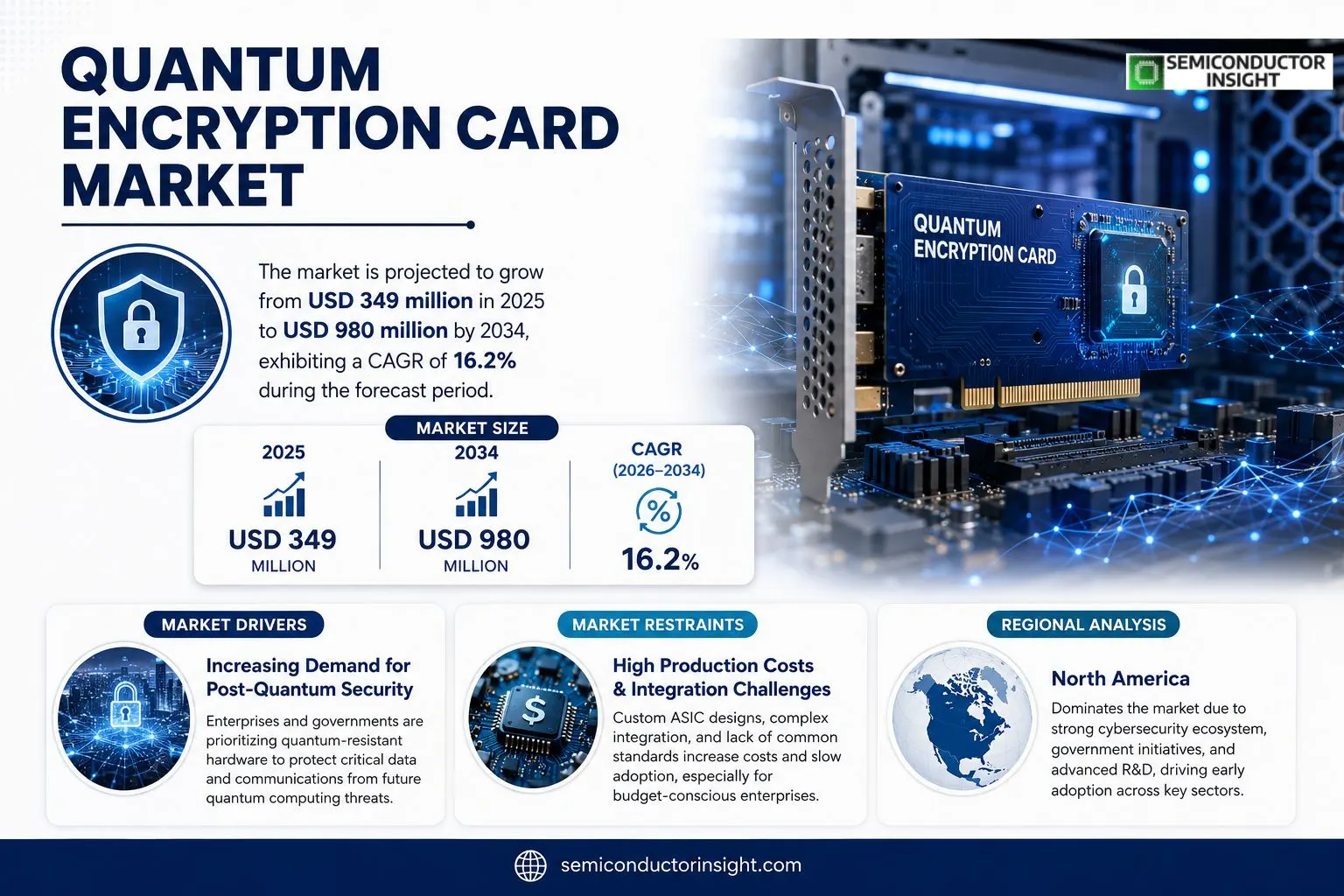
Quantum Encryption Card market size was valued at USD 349 million in 2025. The market is projected to grow from USD 349 million in 2025 to USD 980 million by 2034, exhibiting a CAGR of 16.2% during the forecast period.
A quantum encryption card is a hardware module that augments conventional cryptographic systems with quantum‑based security mechanisms. Deployed as a board or plug‑in within servers, encryption appliances or network devices, it generates and manages keys using quantum random number generators (QRNG) or quantum key distribution (QKD). These quantum‑derived keys are combined with established symmetric (e.g., AES) and asymmetric algorithms to deliver resistance against eavesdropping and future quantum‑computing attacks. Primary adopters include government agencies, financial institutions, energy utilities and other critical‑infrastructure operators.The market momentum stems from heightened concern over post‑quantum threats, increased investment in secure communications infrastructure, and regulatory pressures for stronger data protection. Leading manufacturers such as ID Quantique, Toshiba, Quantum Xchange, Hefei Guizhen Chip Technology Co., Ltd., Shudun Information Technology Co., Ltd., C*Core Technology Co., Ltd., Hangzhou Post Quantum Cryptography Technology Co., Ltd., Shenzhen Kedun Quantum Information Technology Co., Ltd., Nanjing Shouchuan Xin’an Technology Co., Ltd., QuintessenceLabs and others are expanding product portfolios and forging strategic alliances to capture emerging demand.
MARKET DRIVERS
Increasing Demand for Post‑Quantum Security
Enterprises are accelerating the rollout of quantum‑resistant solutions as breaches involving classical encryption become increasingly public. In Quantum Encryption Card Market, this shift is reflected in procurement cycles that now prioritize hardware capable of withstanding future quantum attacks. The migration is not merely a compliance exercise; it represents a strategic hedge against a technology‑driven security paradigm.
Government Investment in Quantum‑Resistant Infrastructure
National security agencies across North America, Europe, and parts of Asia have earmarked multi‑year budgets for quantum‑ready cryptographic hardware. Their procurement guidelines frequently cite the need for tamper‑proof execution environments, a requirement that directly fuels sales of dedicated encryption cards. Companies that align their roadmaps with these policy signals are positioning themselves to capture a sizable share of upcoming contracts.
➤ “Adopting quantum‑grade encryption hardware today translates into long‑term cost avoidance once quantum computers become commercially viable.”
Venture capital flows further reinforce the upside: portfolios now include start‑ups that specialize in ASIC‑based key exchange mechanisms, indicating that private capital perceives a durable upside for Quantum Encryption Card Market. As these firms secure follow‑on rounds, their R&D pipelines are likely to deliver performance improvements that make integration easier for end users.
MARKET CHALLENGES
Technical Complexity and Integration Hurdles
Deploying quantum‑secure cards often entails redesigning server firmware, re‑certifying operating systems, and retraining security staff. The learning curve is steep, especially for organizations bound by legacy IT stacks. Consequently, project timelines extend, and budget overruns become a real risk, tempering enthusiasm among risk‑averse CIOs.
Other Challenges
Supply Chain Constraints
The semiconductor supply chain continues to experience volatility, with wafer fab capacity tightly booked for mainstream processors. Allocating silicon wafers for low‑volume, high‑security products requires dedicated fabs, driving lead times upward and squeezing margins for manufacturers operating in Quantum Encryption Card Market.
MARKET RESTRAINTS
High Production Costs
Quantum‑grade cryptographic engines rely on custom ASIC designs and rigorous validation protocols, both of which inflate unit costs compared with conventional TPM modules. For budget‑constrained enterprises, the price premium can outweigh perceived security benefits, limiting adoption to niche segments.
Standardization Gaps
Absent a universally accepted set of standards, vendors implement divergent APIs and key‑management interfaces. This fragmentation forces system integrators to develop bespoke adapters, eroding the economies of scale that typically drive hardware market growth.Regulatory ambiguity also acts as a brake: while some jurisdictions mandate quantum‑ready encryption for critical infrastructure, others lack clear directives, creating an uneven playing field that discourages broad‑scale investment.
MARKET OPPORTUNITIES
Emerging Use Cases in Cloud Edge Nodes
Edge computing platforms process sensitive data close to the source, making them prime candidates for hardware‑based quantum protection. Providers that embed quantum encryption cards within edge racks can differentiate their services by offering provable resistance to future quantum threats, a capability that enterprise customers are beginning to demand.
Strategic Partnerships with Chipmakers
Collaborations between security firms and leading semiconductor designers are unlocking new form‑factors that integrate quantum‑secure cores directly onto motherboards. These joint ventures reduce BOM complexity and open channels to OEMs that have previously shied away from add‑on cards.
Growth in Defense and Critical Infrastructure Sectors
Defense ministries are revising procurement frameworks to incorporate quantum‑resistant hardware across communication, command, and control systems. Early pilots demonstrate that embedding dedicated encryption cards can simplify key‑distribution logistics while meeting stringent tamper‑evidence criteria, signaling a sizable, long‑term demand reservoir for Quantum Encryption Card Market.
Quantum Encryption Card Market Trends
Escalating Demand for Quantum‑Resistant Hardware
The market recorded $349 million in 2025 and is set to reach $980 million by 2034, reflecting a compound annual growth of 16.2 %. This expansion is anchored by the rising awareness of quantum‑era vulnerabilities in legacy cryptographic systems. Enterprises handling sensitive dataparticularly in government, finance, and energyare substituting conventional encryption modules with cards that embed quantum random number generators (QRNG) or quantum key distribution (QKD) capabilities. The shift is not driven merely by hype; it stems from concrete risk assessments that quantify the cost of a successful quantum breach far exceeding current compliance expenditures. Consequently, procurement cycles now prioritize hardware that can guarantee entropy sourced from quantum phenomena, reshaping vendor‑buyer negotiations.
Other Trends
Supply‑Chain Consolidation Among Key Players
Manufacturers such as ID Quantique, Toshiba, Quantum Xchange, and several Chinese firms have accelerated partnership programs and joint‑R&D initiatives. In 2025, the top five suppliers collectively commanded roughly one‑third of global revenue, a share that has stabilized as the industry moves toward a limited‑partner ecosystem. High utilization rates92 % on averagepaired with a 64 % gross margin indicate mature production lines, yet the concentration of component sourcing (e.g., single‑photon detectors) pressures smaller entrants to align with larger players. This consolidation is prompting strategic acquisitions, especially in the QRNG segment, where scale economies are essential to sustain price competitiveness without sacrificing security benchmarks.
Emerging Applications in Critical Infrastructure
Beyond traditional data‑center deployments, quantum‑enhanced cards are infiltrating SCADA networks and smart‑grid control systems. The appeal lies in the cards’ ability to generate truly unpredictable keys, a prerequisite for protecting real‑time operational data against future quantum attacks. As regional standards bodies endorse quantum‑grade encryption for critical utilities, vendors are adapting form factorsmoving from server‑mounted cards to embedded modules suited for harsh industrial environments. This migration creates a parallel market for retrofitting legacy infrastructure, where the average unit price of $2,985 in 2025 signals willingness to invest in high‑value upgrades. The trend underscores a broader strategic imperative: safeguarding the backbone of national economies before quantum capabilities become operationally viable.
COMPETITIVE LANDSCAPE
Key Industry Players
Quantum Encryption Card Market – Competitive Overview
Among the handful of firms that dominate global sales, ID Quantique remains the most visible banner, leveraging its early‑stage QRNG patents and a mature QKD service platform that has secured contracts with several European sovereign cloud providers. The company’s ability to integrate quantum‑grade randomness directly into PCIe‑form factor cards allows data centers to retrofit existing servers without wholesale hardware replacement. Toshiba follows closely, converting its long‑standing secure‑channel expertise into a line of server‑grade cards that bundle QRNG cores with post‑quantum cryptographic suites. Both players benefit from a relatively high utilization rateabove 90 % in 2025reflecting institutional confidence in their supply chains and compliance certifications. Quantum Xchange distinguishes itself by focusing on hosted key‑distribution services that complement its on‑premise cards, a hybrid model that reduces upfront capital expense for financial institutions while preserving end‑to‑end security guarantees. This trio accounts for roughly half of worldwide revenue, creating a market structure where scale, certification depth, and service integration dictate competitive advantage.The remainder of the landscape is populated by a diverse set of Asian manufacturers that address regional demand through cost‑effective production and close ties to government‑led cryptography standards. Hefei Guizhen Chip Technology, Shudun Information Technology, and C*Core Technology each operate fabs capable of delivering QRNG chips at volume pricing, enabling them to capture mid‑tier contracts in China’s energy and telecom sectors. Hangzhou Post Quantum Cryptography Technology and Shenzhen Kedun Quantum Information Technology specialize in embedded modules for edge devices, a niche that aligns with the rollout of smart‑grid infrastructure. Nanjing Shouchuan Xin’an Technology and QuintessenceLabs broaden the ecosystem by offering hybrid software‑hardware suites that support both legacy AES and emerging lattice‑based algorithms. Smaller innovators such as MagiQ Technologies, QNu Labs, LuxQuanta and KETS Quantum Security pursue differentiated roadmapsranging from silicon‑photonic QKD engines to cloud‑native quantum key servicesproviding pockets of differentiation that could reshape procurement preferences as regulatory frameworks tighten.
List of Key Quantum Encryption Card Companies Profiled
- ID Quantique
- Toshiba
- Quantum Xchange
- Hefei Guizhen Chip Technology Co., Ltd.
- Shudun Information Technology Co., Ltd.
- C*Core Technology Co., Ltd.
- Hangzhou Post Quantum Cryptography Technology Co., Ltd.
- Shenzhen Kedun Quantum Information Technology Co., Ltd.
- Nanjing Shouchuan Xin’an Technology Co., Ltd.
- QuintessenceLabs
- MagiQ Technologies
- QNu Labs
- LuxQuanta
- KETS Quantum Security
Segment Analysis:
| Segment Category | Sub-Segments | Key Insights |
| By Type |
|
Quantum Key Distribution Card
|
| By Application |
|
Financial & Critical Infrastructure
|
| By End User |
|
Government agencies
|
| By Form Factor |
|
Server Cryptographic Card
|
| By Integration Level |
|
Hybrid Quantum‑Classical Solutions
|
Regional Analysis: Quantum Encryption Card Market
North America
Recent updates to data‑privacy statutes in the United States and Canada specifically reference hardware‑based encryption, compelling organizations to evaluate quantum‑grade cards as part of compliance roadmaps. This regulatory shift incentivizes early adoption among sectors handling sensitive personal information.
Enterprise concerns about future‑proofing against quantum attacks intertwine with the rise of edge computing, prompting firms to embed quantum‑resistant cards directly into routers and IoT gateways to safeguard data at the source.
The market features a handful of well‑capitalized incumbents complemented by agile startups. Alliances between chipmakers and software security firms are redefining value chains, fostering integrated solutions that simplify deployment for large‑scale users.
Advanced lithography facilities in the region assure reliable production capacity, yet geopolitical tensions highlight the importance of diversifying component sources to mitigate potential disruptions for quantum‑critical hardware.
Europe
European nations exhibit a collaborative approach to Quantum Encryption Card Market, with cross‑border initiatives that align research agendas across EU member states. The European Union’s digital strategy explicitly calls for quantum‑ready cryptographic modules, encouraging public‑private partnerships that accelerate prototype refinements. While adoption rates lag behind North America, the region benefits from a dense network of academic centers and a regulatory environment that emphasizes privacy by design, prompting enterprises to integrate quantum cards early in product lifecycles. Market participants are leveraging this environment to position themselves as trusted suppliers for the financial services sector, which remains highly sensitive to any potential quantum vulnerability.
Asia‑Pacific
The Asia‑Pacific landscape is characterized by rapid modernization of telecom infrastructure and a burgeoning demand for secure mobile communications. Nations such as Japan, South Korea, and Singapore are investing heavily in quantum research, translating into a growing appetite for quantum‑grade encryption cards among telecom operators and government agencies. Although the market is still nascent, local manufacturers are increasingly collaborating with global players to acquire intellectual property, aiming to reduce time‑to‑market for home‑grown solutions. This strategic alignment augments the region’s capacity to serve its massive consumer base, positioning Quantum Encryption Card Market for an accelerated trajectory as data privacy concerns intensify.
South America
In South America, the drive toward digital transformation within financial and energy sectors fuels interest in quantum‑resistant hardware. While overall market maturity remains modest, countries like Brazil and Chile are instituting national cybersecurity frameworks that reference quantum‑ready encryption, prompting early pilot projects. Vendors seeking footholds are focusing on localized support models and educational programs to build expertise, recognizing that skill gaps present a barrier to broader adoption. The region’s evolution will likely be shaped by how effectively stakeholders can translate policy intent into tangible deployments of quantum encryption cards.
Middle East & Africa
The Middle East & Africa region presents a heterogeneous picture, with affluent Gulf nations spearheading initiatives to safeguard sovereign data assets through quantum‑grade solutions. These governments are allocating resources to establish dedicated quantum laboratories, thereby attracting niche vendors eager to demonstrate capabilities. Conversely, many African markets contend with limited infrastructure, making large‑scale rollout of quantum encryption cards a longer‑term prospect. Nonetheless, emerging fintech ecosystems across the continent are beginning to recognize the strategic advantage of early adoption, setting the stage for incremental market penetration as broader digitalization efforts gain momentum.
Report Scope
This market research report provides a comprehensive analysis of the Quantum Encryption Card Market , covering the forecast period 2026–2034. It offers detailed insights into market dynamics, technological advancements, competitive landscape, and key trends shaping the industry.
Key focus areas of the report include:
- Market Overview: The report begins with an overview outlining its current market scenario, key growth indicators, and industry transformation drivers. It discusses macroeconomic factors, demand–supply balance, regulatory landscape, and the strategic role of semiconductors in powering advancements across industries such as automotive, telecommunications, consumer electronics, and industrial automation.
- Market Size & Forecast: Historical data and future projections for revenue, unit shipments, and market value across major regions and segments.
- Segmentation Analysis: Detailed breakdown by product type, technology, application, and end-user industry to identify high-growth segments and investment opportunities.
- Regional Insights: Insights into market performance across North America, Europe, Asia-Pacific, Latin America, and the Middle East & Africa, including country-level analysis where relevant.
- Competitive Landscape: Profiles of leading market participants, including their product offerings, R&D focus, manufacturing capacity, pricing strategies, and recent developments such as mergers, acquisitions, and partnerships.
- Technology Trends & Innovation: Assessment of emerging technologies, integration of AI/IoT, semiconductor design trends, fabrication techniques, and evolving industry standards.
- Market Drivers & Restraints: Evaluation of factors driving market growth along with challenges, supply chain constraints, regulatory issues, and market-entry barriers.
- Stakeholder Insights: Insights for component suppliers, OEMs, system integrators, investors, and policymakers regarding the evolving ecosystem and strategic opportunities.
Primary and secondary research methods are employed, including interviews with industry experts, data from verified sources, and real-time market intelligence to ensure the accuracy and reliability of the insights presented.
FREQUENTLY ASKED QUESTIONS:
What is the current market size of Quantum Encryption Card Market?
-> Quantum Encryption Card Market was valued at USD 349 million in 2025 and is expected to reach USD 980 million by 2034, growing at a CAGR of 16.2% during the forecast period.
Which key companies operate in Quantum Encryption Card Market?
-> Key players include ID Quantique, Toshiba, Quantum Xchange, Hefei Guizhen Chip Technology Co., Ltd., Shudun Information Technology Co., Ltd., C*Core Technology Co., Ltd., Hangzhou Post Quantum Cryptography Technology Co., Ltd., Shenzhen Kedun Quantum Information Technology Co., Ltd., Nanjing Shouchuan Xin’an Technology Co., Ltd., QuintessenceLabs, among others.
What are the key growth drivers?
-> Key growth drivers include rising demand for quantum‑resistant encryption in government, finance, energy and critical infrastructure sectors, and the need for high‑security hardware that leverages quantum random number generators (QRNG) and quantum key distribution (QKD).
Which region dominates the market?
-> The reference highlights the United States and China as major markets, but does not specify a single dominant region.
What are the emerging trends?
-> Emerging trends include integration of QRNG and QKD technologies into board‑level encryption cards, development of server cryptographic cards and embedded quantum crypto modules, and increasing adoption of standalone quantum crypto cards for critical infrastructure protection.
Get Sample Report PDF for Exclusive Insights
Report Sample Includes
- Table of Contents
- List of Tables & Figures
- Charts, Research Methodology, and more...
 Download Sample Report PDF