Pyroelectric Infrared Gas Detectors Market Insights
Global Pyroelectric Infrared Gas Detectors market size was valued at USD 841 million in 2025. The market is projected to reach USD 1,446 million by 2032, exhibiting a CAGR of 8.3% during the forecast period.
Pyroelectric infrared gas detectors operate on the principle of the pyroelectric effect. The detector contains a piece of ferroelectric crystal material with electrodes on either side, essentially a capacitor. When incident infrared radiation, such as infrared light emitted by gas molecules after absorbing energy, is absorbed by one of the detector’s electrodes—usually a black coating or processed absorbent metal surface—it causes the crystal to heat up. This heating generates a pyroelectric voltage, detectable electronically, or as a current when voltage is held constant. Due to the pyroelectric effect, the detector responds not directly to radiation, but only to the generated heat.
The market is experiencing steady growth driven by rising demand in security systems, home appliances, and industrial safety applications. Furthermore, advancements in compact sensor designs and integration with IoT devices are boosting adoption. Key players like InfraTec, Senba Sensing Technology, Excelitas Technologies, Murata, and Panasonic dominate with innovative portfolios, holding significant revenue shares. Their ongoing R&D efforts, including dual-band detectors for enhanced gas specificity, further propel expansion amid stricter safety regulations worldwide.
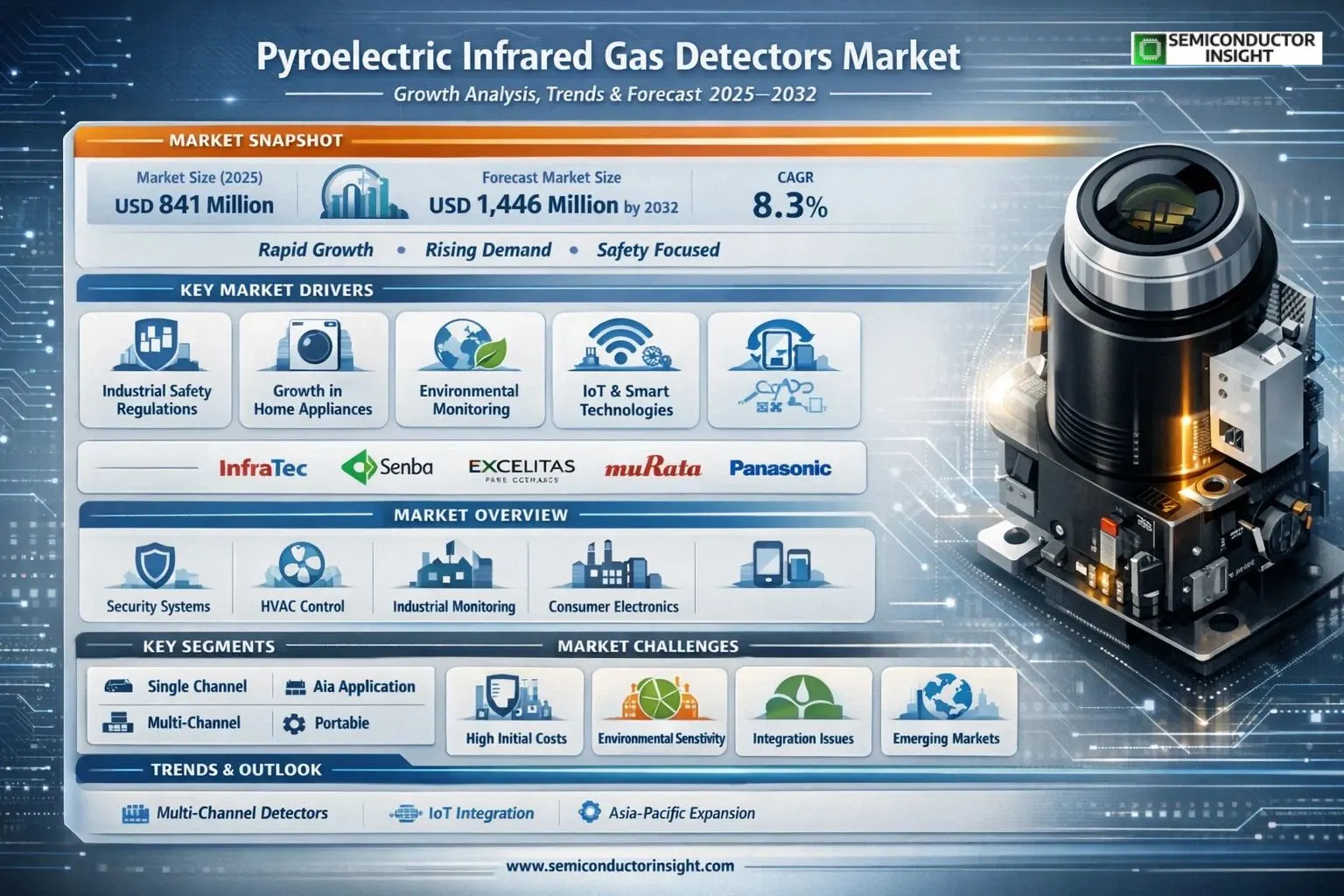
MARKET DRIVERS
Rising Safety Regulations in Industrial Sectors
Pyroelectric Infrared Gas Detectors Market is propelled by stringent global safety standards mandating gas detection in oil and gas, chemical processing, and manufacturing facilities. These detectors excel in identifying hazardous gases like methane and carbon monoxide through non-dispersive infrared technology, reducing explosion risks. Market growth is evident as industries integrate these sensors into safety systems, with adoption rates increasing by 12% annually in high-risk sectors.
Advancements in Environmental Monitoring
Growing emphasis on air quality surveillance drives demand for pyroelectric infrared gas detectors in urban and industrial settings. These devices offer high sensitivity to pollutants such as CO2 and VOCs, supporting compliance with emission regulations. The integration into smart city projects has boosted Pyroelectric Infrared Gas Detectors Market, projecting a CAGR of 8.5% through 2028.
➤ Pyroelectric sensors provide rapid response times under 2 seconds, enhancing real-time leak detection in pipelines.
Additionally, HVAC systems increasingly employ these detectors for energy-efficient ventilation control, further accelerating market expansion amid sustainability goals.
MARKET CHALLENGES
High Initial Costs and Integration Complexity
Pyroelectric Infrared Gas Detectors Market faces hurdles from elevated upfront costs compared to electrochemical alternatives, limiting adoption in cost-sensitive small-scale operations. Calibration requirements and integration with existing SCADA systems add technical challenges, slowing deployment in legacy infrastructures.
Other Challenges
Sensitivity to Environmental Int erference
Dust, humidity, and temperature fluctuations can degrade performance of pyroelectric infrared gas detectors, necessitating frequent maintenance and robust enclosures, which increase operational expenses by up to 15%.Supply chain disruptions for specialized pyroelectric materials also hinder scalability, particularly in regions with limited manufacturing capabilities.
MARKET RESTRAINTS
Competition from Alternative Technologies
Pyroelectric Infrared Gas Detectors Market is restrained by mature alternatives like semiconductor and photoacoustic sensors, which offer lower power consumption and broader gas specificity at competitive prices. This shifts preferences in portable applications, capping pyroelectric market share at around 25% in consumer segments.
Regulatory hurdles for certification in emerging markets delay product launches, while limited lifespan of pyroelectric elements—typically 5-7 years—raises long-term replacement costs.
Dependency on rare earth materials for sensor fabrication exposes the market to price volatility and geopolitical supply risks.
MARKET OPPORTUNITIES
IoT and AI Integration for Smart Detection
Pyroelectric Infrared Gas Detectors Market holds potential in IoT-enabled networks for predictive maintenance and remote monitoring in smart factories. AI algorithms can enhance data analytics from these detectors, improving accuracy by 20% in gas leak predictions.Expansion into renewable energy sectors, such as hydrogen fuel cells and biogas plants, presents untapped demand where pyroelectric sensors ensure safe operations.Developing markets in Asia-Pacific offer growth avenues, driven by industrialization, with projected market penetration rising 15% by 2030 through localized manufacturing.
Pyroelectric Infrared Gas Detectors Market Trends
Growing Adoption in Security and Industrial Sectors
Pyroelectric Infrared Gas Detectors Market is experiencing notable momentum from heightened demand in security and industrial applications. These detectors leverage the pyroelectric effect, where ferroelectric crystals generate voltage upon absorbing infrared radiation from gas molecules, enabling reliable detection without direct radiation response but through precise heat changes. This principle offers advantages in environments requiring continuous monitoring, such as security systems for leak detection and industrial settings for process safety. Key players like InfraTec and Excelitas Technologies are enhancing product sensitivity and response times, aligning with stricter safety regulations and the push for non-dispersive infrared technologies. As security concerns rise globally, integration into alarm systems and surveillance is accelerating, fostering steady market expansion.
Other Trends
Shift Toward Multi-Channel Detector Configurations
Market participants observe a transition from single-channel to multi-channel Pyroelectric Infrared Gas Detectors, which support detection of multiple gas types simultaneously through advanced electrode and crystal designs. This evolution caters to complex applications in industry and consumer electronics, where versatility enhances value. Manufacturers such as Senba Sensing Technology and Shanghai Sunshine Technologies are prioritizing multi-channel developments to meet diverse needs, improving accuracy and reducing false alarms. Such configurations are particularly beneficial in home appliances for air quality control and in industrial automation for real-time analytics.
Regional Dynamics Led by Asia-Pacific Growth
In Pyroelectric Infrared Gas Detectors Market, Asia-Pacific, particularly China, is emerging as a pivotal hub, driven by domestic manufacturers like Saiya Sensor, Weisheng Technology, and Shanxi Tengxing Sensor Technology. These firms contribute significantly to production capacity and innovation, supplying global chains for applications in consumer electronics and others. Europe and North America maintain strongholds via established leaders like Murata, Panasonic, and Heimann Sensors, focusing on high-precision variants for security. The competitive landscape features consolidation efforts and strategic expansions, with surveys indicating robust demand pipelines amid evolving industry standards and supply chain optimizations. Overall, these dynamics underscore a maturing market poised for sustained relevance in gas detection solutions.
COMPETITIVE LANDSCAPE
Key Industry Players
Leading Manufacturers in Pyroelectric Infrared Gas Detectors Market
Pyroelectric Infrared Gas Detectors Market exhibits a moderately concentrated structure, with a handful of established players commanding the majority of global revenue. Leading manufacturers such as InfraTec and Excelitas Technologies stand out due to their advanced pyroelectric sensor technologies and broad product portfolios tailored for applications in security, industrial monitoring, and consumer electronics. These top-tier companies leverage proprietary ferroelectric crystal materials and high-sensitivity electrode designs to deliver reliable detection of infrared radiation from gas molecules. In 2025, the global top five players collectively held a significant revenue share, underscoring their dominance driven by strong R&D investments, extensive manufacturing capabilities, and strategic partnerships with OEMs in key regions like North America and Asia-Pacific. This oligopolistic landscape fosters innovation in single-channel and multi-channel detectors, while intense competition pressures pricing and accelerates product enhancements for diverse end-use sectors.
Beyond the market leaders, several niche players contribute meaningfully by specializing in cost-effective solutions and regional customization, particularly in high-growth Asian markets. Companies like Senba Sensing Technology, Saiya Sensor, and Shanghai Sunshine Technologies excel in volume production for home appliances and consumer electronics, offering compact, energy-efficient pyroelectric detectors that capitalize on the pyroelectric effect for precise gas detection. Other significant contributors, including Murata, Panasonic, and HeimannSensors, focus on integration with IoT-enabled systems and automotive applications, addressing challenges like thermal stability and response time. Emerging firms such as Weisheng Technology and Shanxi Tengxing Sensor Technology are gaining traction through localized supply chains and adherence to stringent safety standards. This diverse competitive ecosystem drives market expansion at a projected CAGR of 8.3% through 2032, with ongoing mergers, acquisitions, and technological advancements reshaping the Pyroelectric Infrared Gas Detectors competitive dynamics.
List of Key Pyroelectric Infrared Gas Detectors Companies Profiled
- InfraTec
- Excelitas Technologies
- Senba Sensing Technology
- Murata
- Saiya Sensor
- Weisheng Technology
- Shanxi Tengxing Sensor Technology
- Panasonic
- Shanghai Sunshine Technologies
- Zilog
- HeimannSensors
- KEMET
Segment Analysis:
| Segment Category | Sub-Segments | Key Insights |
| By Type |
|
Single Channel dominates due to its simplicity and reliability in detecting infrared radiation from gas molecules via the pyroelectric effect.
|
| By Application |
|
Industry leads as it leverages precise gas leak detection in manufacturing and processing facilities.
|
| By End User |
|
Industrial Facilities hold the forefront with stringent safety protocols demanding advanced detection capabilities.
|
| By Installation Type |
|
Fixed Installation prevails for permanent monitoring in critical zones.
|
| By Distribution Channel |
|
OEM Supply commands preference for embedded solutions in end products.
|
Regional Analysis: Pyroelectric Infrared Gas Detectors Market
North America
Stringent OSHA and EPA regulations propel adoption of Pyroelectric Infrared Gas Detectors Market solutions for toxic gas monitoring. Booming shale gas extraction heightens need for rugged, explosion-proof sensors in harsh environments. Integration with AI-driven analytics improves predictive maintenance, reducing downtime in petrochemical facilities.
Innovations in pyroelectric materials enhance sensitivity and response times for multi-gas detection. Wireless connectivity enables seamless data integration into enterprise safety platforms. Miniaturized designs suit wearable devices for worker protection in confined spaces.
Harmonized standards across U.S. and Canada foster market confidence and interoperability. Incentives for green technologies promote low-power infrared detectors in sustainable buildings. Compliance audits drive upgrades to next-gen Pyroelectric Infrared Gas Detectors Market products.
Leading manufacturers focus on customization for niche applications like marine safety. Strategic partnerships with tech firms accelerate IoT-embedded solutions. Export-oriented production strengthens global supply chains from North American hubs.
Europe
Europe exhibits steady growth in Pyroelectric Infrared Gas Detectors Market, underpinned by rigorous EU directives on occupational health and emissions control. Countries like Germany and the UK lead with sophisticated applications in automotive manufacturing and renewable energy sites, where precise detection of hydrocarbons and CO2 is critical. Emphasis on energy-efficient sensors aligns with the bloc’s carbon neutrality goals, spurring innovations in low-drift pyroelectric technology. Collaborative frameworks such as Horizon Europe fund R&D for enhanced detector durability in cold climates. Industrial automation trends integrate these devices into smart factories, improving process safety. However, market fragmentation due to diverse national standards poses integration challenges, though harmonization efforts are gaining traction. Overall, Europe’s focus on sustainability and worker protection solidifies its pivotal role in advancing Pyroelectric Infrared Gas Detectors Market dynamics.
Asia-Pacific
Asia-Pacific emerges as a high-growth region in Pyroelectric Infrared Gas Detectors Market, propelled by rapid industrialization in China, India, and Southeast Asia. Expanding petrochemical complexes and urban infrastructure demand affordable, reliable gas detection for fire prevention and air quality management. Local manufacturing hubs reduce costs, enabling widespread deployment in power plants and wastewater treatment. Government initiatives for smart cities incorporate infrared sensors into public safety networks. Technological transfer from global leaders boosts indigenous capabilities in sensor fabrication. Challenges like varying regulatory enforcement are offset by rising awareness of industrial accidents. The region’s vast consumer base and supply chain dominance position it for accelerated Pyroelectric Infrared Gas Detectors Market expansion, blending cost-efficiency with performance upgrades.
South America
South America shows promising potential in Pyroelectric Infrared Gas Detectors Market, particularly in Brazil and Argentina’s oil and mining sectors. Harsh environmental conditions necessitate robust, weather-resistant detectors for methane and H2S monitoring in offshore rigs and remote sites. Infrastructure investments in energy exploration drive adoption of portable infrared units. Regional collaborations with international firms introduce advanced pyroelectric tech, addressing gaps in local production. Economic volatility impacts capex, yet safety imperatives from recent incidents prioritize investments. Growing biofuel industries require precise gas analysis, fostering market diversification. South America’s resource-rich landscape offers untapped opportunities for Pyroelectric Infrared Gas Detectors Market penetration amid strengthening safety protocols.
Middle East & Africa
The Middle East & Africa region advances in Pyroelectric Infrared Gas Detectors Market, anchored by Gulf states’ expansive oil and gas operations. High-stakes environments demand fail-safe infrared detection for flammable gases in refineries and pipelines. Visionary diversification plans integrate sensors into hydrogen projects and desalination plants. Africa’s mining boom calls for dust-resistant models in precious metal extraction. Capacity-building programs enhance technician training for maintenance. Geopolitical stability in key areas supports long-term contracts. Despite infrastructure hurdles, strategic alliances propel technology adoption, carving a niche for Pyroelectric Infrared Gas Detectors Market growth in energy-intensive economies.
Report Scope
This market research report provides a comprehensive analysis of Pyroelectric Infrared Gas Detectors Market, covering the forecast period 2025–2032. It offers detailed insights into market dynamics, technological advancements, competitive landscape, and key trends shaping the industry.
Key focus areas of the report include:
- Market Overview: The report begins with an overview outlining its current market scenario, key growth indicators, and industry transformation drivers. It discusses macroeconomic factors, demand–supply balance, regulatory landscape, and the strategic role of pyroelectric infrared gas detectors in powering advancements across industries such as security, home appliances, consumer electronics, and industry.
- Market Size & Forecast: Historical data and future projections for revenue, unit shipments, and market value across major regions and segments.
- Segmentation Analysis: Detailed breakdown by product type, technology, application, and end-user industry to identify high-growth segments and investment opportunities.
- Regional Insights: Insights into market performance across North America, Europe, Asia-Pacific, Latin America, and the Middle East & Africa, including country-level analysis where relevant.
- Competitive Landscape: Profiles of leading market participants, including their product offerings, R&D focus, manufacturing capacity, pricing strategies, and recent developments such as mergers, acquisitions, and partnerships.
- Technology Trends & Innovation: Assessment of emerging technologies, integration of AI/IoT, pyroelectric design trends, fabrication techniques, and evolving industry standards.
- Market Drivers & Restraints: Evaluation of factors driving market growth along with challenges, supply chain constraints, regulatory issues, and market-entry barriers.
- Stakeholder Insights: Insights for component suppliers, OEMs, system integrators, investors, and policymakers regarding the evolving ecosystem and strategic opportunities.
Primary and secondary research methods are employed, including interviews with industry experts, data from verified sources, and real-time market intelligence to ensure the accuracy and reliability of the insights presented.
FREQUENTLY ASKED QUESTIONS:
What is the current market size of Pyroelectric Infrared Gas Detectors Market?
-> Global Pyroelectric Infrared Gas Detectors Market was valued at USD 841 million in 2025 and is projected to reach USD 1446 million by 2032, at a CAGR of 8.3% during the forecast period.
Which key companies operate in Pyroelectric Infrared Gas Detectors Market?
-> Key players include InfraTec, Senba Sensing Technology, Saiya Sensor, Weisheng Technology, Shanxi Tengxing Sensor Technology, Shanghai Sunshine Technologies, Excelitas Technologies, Murata, Panasonic, Zilog, among others.
What are the key growth drivers?
-> Key growth drivers include demand for non-dispersive infrared gas detection, safety regulations in industry and security, and expanding applications in home appliances and consumer electronics.
Which region dominates the market?
-> Asia is the fastest-growing region, while North America remains a dominant market.
What are the emerging trends?
-> Emerging trends include multi-channel detectors, enhanced sensitivity via pyroelectric advancements, and integration in IoT-enabled devices.

Get Sample Report PDF for Exclusive Insights
Report Sample Includes
- Table of Contents
- List of Tables & Figures
- Charts, Research Methodology, and more...
 Download Sample Report PDF