Pulsed DFB Laser Diode Market Insights
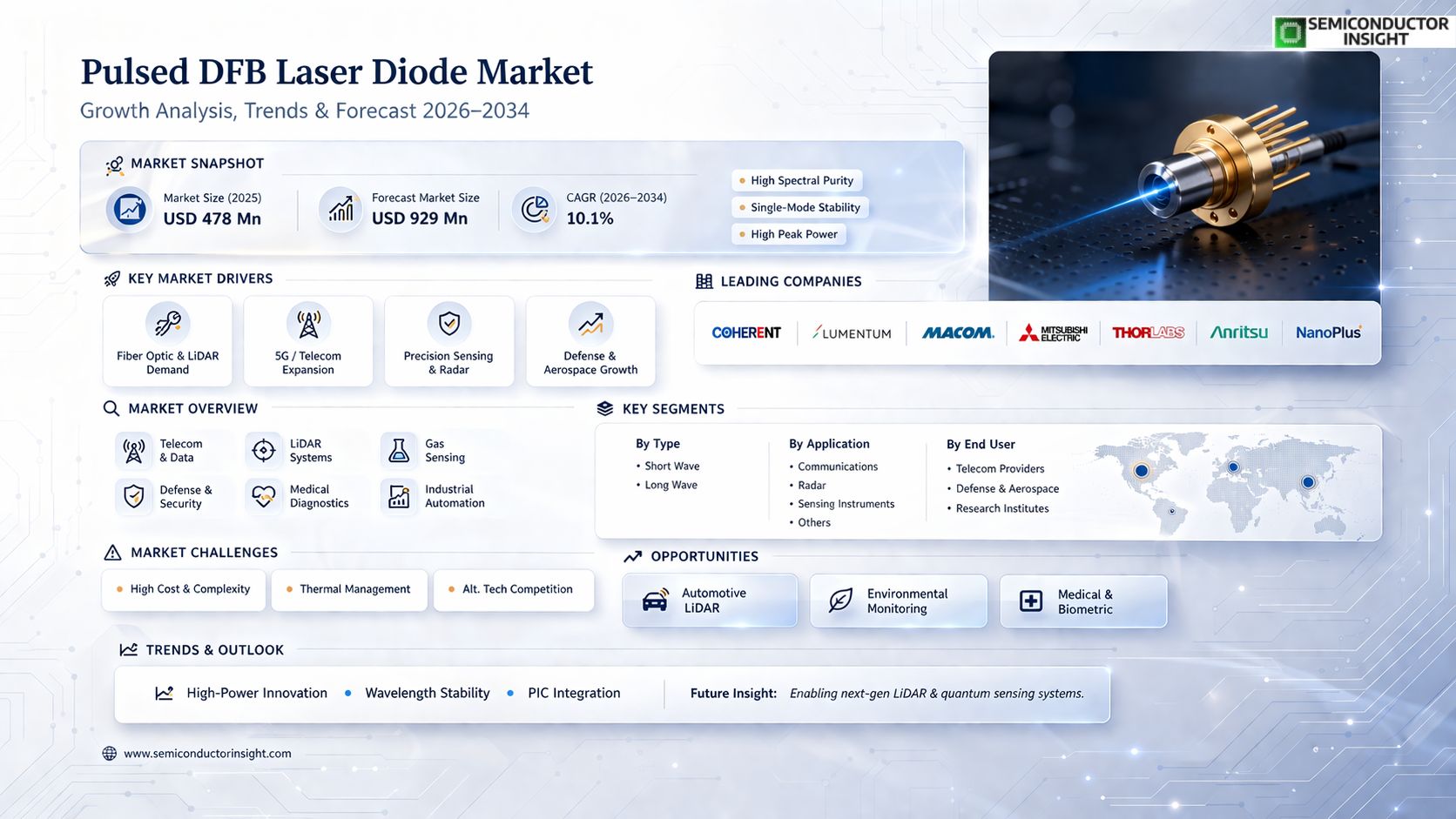
Global Pulsed DFB Laser Diode market size was valued at USD 478 million in 2025. The market is projected to grow from USD 526 million in 2026 to USD 929 million by 2034, exhibiting a CAGR of 10.1% during the forecast period.
A Pulsed Distributed Feedback (DFB) Laser Diode is a specialized semiconductor laser widely used in communication, measurement, and sensing applications. It incorporates a distributed feedback structure directly within its cavity to achieve high-performance laser emission with exceptional spectral purity and stability. While its fundamental working principle is similar to other laser diodes, the DFB design provides superior characteristics such as high frequency stability, stable single-mode output, and excellent linewidth properties. This makes it particularly suitable for high-precision applications where wavelength accuracy and narrow spectral width are critical.
The market is experiencing robust growth driven by several key factors, including escalating demand for high-speed optical communication networks and the proliferation of advanced sensing technologies like LiDAR for autonomous vehicles and environmental monitoring. Furthermore, the expansion of fiber optic networks globally and increasing investments in defense and aerospace systems that utilize precision radar and sensing instruments are significant contributors to market expansion. Initiatives by leading players are also fueling innovation; for instance, companies are continuously developing higher-power and more wavelength-stable pulsed DFB lasers for next-generation applications. Key global manufacturers operating in this competitive landscape with diverse product portfolios include II-VI Incorporated (now Coherent Corp.), Lumentum Holdings Inc., MACOM Technology Solutions, Mitsubishi Electric, and Thorlabs Inc., among others.
MARKET DRIVERS
Expansion in Fiber Optic Sensing and LiDAR Applications
The Pulsed DFB Laser Diode Market is primarily driven by robust demand from fiber optic sensing systems for infrastructure monitoring and the rapid deployment of LiDAR in autonomous vehicles. These diodes provide the necessary narrow linewidth and high peak power in short pulses, which is critical for precise distance measurement and detection. The shift towards Industry 4.0 and smart manufacturing further amplifies the need for reliable sensing solutions, cementing the role of these specialized components. Global push for automotive safety features is projected to be a major catalyst for market growth over the next five years.
Technological Advancements in Telecom and Spectroscopy
Continuous innovation in telecommunications, particularly in next-generation optical networks, and advanced scientific research in gas spectroscopy are creating significant demand. The unique capability of pulsed DFB laser diodes to offer wavelength stability under pulsed operation makes them indispensable for high-speed signal processing and accurate molecular detection. Investments in research and development are leading to diodes with improved efficiency and higher output powers, broadening their application scope. Manufacturers focusing on miniaturization and cost-reduction are unlocking new commercial avenues.
➤ The integration of pulsed DFB laser diodes in medical diagnostic equipment for non-invasive procedures represents a high-growth niche, driven by Global emphasis on advanced healthcare technologies.
Overall, the convergence of demand from industrial automation, environmental monitoring, and defense sectors ensures a diversified and resilient growth trajectory for the Pulsed DFB Laser Diode Market. The increasing adoption of these components in quantum technology research adds a long-term, high-value demand stream that is expected to accelerate market expansion.
MARKET CHALLENGES
High Cost and Complex Manufacturing
A primary challenge for the Pulsed DFB Laser Diode Market is the significant cost associated with design, epitaxial growth, and precise fabrication. The requirement for single-frequency operation and high reliability under pulsed conditions necessitates advanced manufacturing processes and rigorous testing, which elevates the final product price. This cost factor can be a barrier to adoption in price-sensitive, high-volume consumer applications, limiting market penetration. Supply chain complexities for specialized semiconductor materials further exacerbate production challenges and lead times.
Other Challenges
Thermal Management and Reliability Constraints
Managing heat dissipation during high-power pulsed operation is a critical engineering hurdle. Excessive heat can degrade performance, shift the wavelength, and shorten the operational lifespan of the diode, posing reliability concerns for mission-critical systems like aerospace or medical devices.
Intense Competition and Rapid Technological Obsolescence
The market faces intense competition from alternative light sources and continuous-wave DFB lasers for certain applications. Furthermore, the rapid pace of photonic innovation means products can become obsolete quickly, forcing manufacturers to continuously invest in R&D to maintain relevance in the Pulsed DFB Laser Diode Market.
MARKET RESTRAINTS
Economic Sensitivity and Capital Investment Cycles
The growth of the Pulsed DFB Laser Diode Market is sensitive to broader economic conditions that affect capital expenditure in key end-user industries such as telecommunications, automotive, and industrial manufacturing. During economic downturns, investments in new sensing and LiDAR systems can be deferred, directly impacting demand. The market is also restrained by the long design-in cycles and stringent qualification processes required by automotive and aerospace clients, which can delay revenue realization for manufacturers by several years.
MARKET OPPORTUNITIES
Emerging Applications in Environmental Monitoring and Biometrics
The Pulsed DFB Laser Diode Market holds substantial opportunity in emerging sectors such as real-time environmental monitoring for pollution detection and advanced biometric security systems. The need for compact, field-deployable sensors for detecting greenhouse gases aligns perfectly with the capabilities of these laser diodes. Furthermore, the growing demand for secure, spoof-resistant facial recognition and iris scanning in consumer electronics and access control presents a new, high-volume application frontier for manufacturers to explore and develop tailored solutions.
Trends
Advancements in Sensing and Measurement Applications
A dominant trend within the Pulsed DFB Laser Diode Market is its expanding role in high-precision sensing and measurement instruments. The inherent frequency stability and excellent linewidth characteristics of these devices make them exceptionally suitable for demanding applications such as environmental gas sensing, industrial process monitoring, and LiDAR systems. This trend is driven by the need for more accurate, real-time data across sectors, from industrial automation to scientific research. Manufacturers are responding by developing devices with enhanced spectral purity and tailored wavelength options for specific gas absorption lines, directly influencing the growth trajectory of this market segment.
Other Trends
Integration into Advanced Communications Infrastructure
The integration of pulsed DFB laser diodes in next-generation communications equipment, particularly for specialized radar and free-space optical communication systems, represents a significant trend. Their ability to deliver high-power, single-mode pulsed output is critical for applications requiring precise signal timing and long-distance transmission with minimal interference. This positions the technology as a key component in the evolution of secure and high-bandwidth communication networks beyond traditional fiber optics.
Material and Manufacturing Innovations
Continuous innovation in semiconductor materials and epitaxial growth techniques is a fundamental trend shaping the Pulsed DFB Laser Diode Market. Efforts are focused on improving device efficiency, output power, and thermal stability, particularly for long-wave infrared devices. Key global manufacturers are investing in advanced fabrication processes to enhance yield and reduce costs. Furthermore, this trend includes the development of more robust and compact packaging solutions to meet the stringent reliability requirements of defense, aerospace, and telecommunications end-users, strengthening the competitive landscape.
COMPETITIVE LANDSCAPE
Key Industry Players
Market is Consolidated with Leading Players Driving Innovation and Adoption
Global Pulsed DFB Laser Diode market features a moderately consolidated structure dominated by a few major photonics and semiconductor specialists. II-VI Incorporated (now Coherent Corp.) and Lumentum Holdings Inc. are recognized as prominent leaders, leveraging their vertically integrated manufacturing capabilities and extensive R&D investments to secure significant market share. These top players focus on serving high-volume applications in telecommunications and data communications, while also advancing products for precision sensing and measurement. Strategic mergers and acquisitions have been a key trend, enabling these companies to expand their technology portfolios and global reach. The competitive intensity is high, with innovation centered on improving spectral purity, output power, and reliability for critical applications in lidar, gas sensing, and scientific instrumentation.
Beyond the dominant players, a cohort of specialized and niche manufacturers contributes significantly to market diversity and technological advancement. Companies like Nanoplus GmbH and TOPTICA eagleyard are renowned for their expertise in custom and high-performance DFB lasers, particularly in specific wavelength ranges for analytical and industrial sensing. Similarly, players such as Sacher Lasertechnik and Innolume cater to research and development sectors with tunable and ultra-narrow linewidth solutions. Emerging applications in autonomous vehicles and environmental monitoring are creating opportunities for agile manufacturers like QD Laser and Aerodiode to capture growth in newer segments, intensifying competition in specialized, high-value niches.
List of Key Pulsed DFB Laser Diode Companies Profiled
- Coherent Corp. (II-VI Incorporated)
- Lumentum Holdings Inc.
- Anritsu Corporation
- Applied Optoelectronics, Inc.
- EMCORE Corporation
- Innolume GmbH
- MACOM Technology Solutions
- Mitsubishi Electric Corporation
- Thorlabs, Inc.
- Nanoplus GmbH
- QD Laser, Inc.
- TOPTICA eagleyard
- Nolatech Oy
- Sacher Lasertechnik GmbH
- G&H Group
Segment Analysis:
| Segment Category | Sub-Segments | Key Insights |
| By Type |
|
Short Wave DFB laser diodes are the dominant product type, driven by their critical role in modern high-speed fiber optic communication networks and specific sensing applications. This segment’s leadership is underpinned by the relentless global demand for higher bandwidth and data transmission speeds, necessitating components with excellent frequency stability and single-mode output. This technological edge makes them indispensable for next-generation communication infrastructure. Furthermore, their adoption is accelerating due to expansion in data centers and the deployment of 5G networks, which require precise and reliable optical sources. The segment benefits from continuous R&D investments aimed at enhancing performance and reducing power consumption, solidifying its central position in the market’s evolution. |
| By Application |
|
Communications Equipment represents the primary and most expansive application area for pulsed DFB laser diodes. The unparalleled frequency stability and narrow linewidth of these components make them fundamental for encoding and transmitting data in fiber optic systems, supporting everything from long-haul telecommunications to metropolitan and access networks. Market growth is directly tied to global digital infrastructure expansion, including the rollout of 5G and the ongoing upgrade of existing networks to handle exponential data traffic growth. Additionally, their use in data center interconnects for cloud computing and hyperscale operations provides a robust, sustained demand driver, ensuring this segment remains the core engine for the overall market. |
| By End User |
|
Telecommunication Service Providers constitute the most influential end-user segment, acting as the primary volume driver for pulsed DFB laser diode adoption. These entities, including network operators and infrastructure vendors, are engaged in constant capital expenditure to enhance network capacity, reliability, and speed, which directly translates into procurement of advanced optical components. The segment’s demand is characterized by high-volume purchases with stringent requirements for performance consistency and long-term reliability. Furthermore, the competitive landscape among service providers to offer superior bandwidth and low-latency services fosters continuous technological refresh cycles, ensuring a persistent and evolving demand for the latest DFB laser diode innovations. |
| By Wavelength Stability |
|
Ultra-High Stability variants are the leading and most technically sophisticated category, essential for applications where minimal frequency drift is non-negotiable. This includes advanced coherent communication systems, high-precision gas sensing for environmental monitoring, and scientific metrology. The demand for these premium products is driven by the escalating performance thresholds in core end-markets, where even minor wavelength deviations can compromise system integrity. Manufacturers are focusing R&D on improving the design of the distributed feedback structure to achieve this stability, which in turn commands higher value and fosters a competitive focus on technological excellence rather than just cost. |
| By Integration Level |
|
Photonic Integrated Circuits (PICs) represent the forward-looking and high-growth integration segment. The trend towards miniaturization, power efficiency, and system-level cost reduction is propelling the integration of pulsed DFB laser diodes onto silicon or indium phosphide photonic chips. This integration is crucial for the development of compact transceivers in data centers and for enabling complex, multi-function sensing systems. While discrete modules remain prevalent for legacy systems and specific high-power applications, the trajectory of the market strongly favors PICs due to their advantages in scalability, performance consistency, and alignment with the broader industry shift towards more integrated and manufacturable optical solutions. |
Regional Analysis: Global Pulsed DFB Laser Diode Market
North America
North America hosts numerous dedicated photonics research centers and corporate labs driving fundamental advances in pulsed DFB laser technology. These facilities focus on novel waveguide structures and packaging techniques that enhance device reliability and output intensity for demanding scientific and industrial tasks.
The primary consumers in this region are highly sophisticated OEMs in aerospace and telecommunications. They demand specific, advanced specifications, pushing manufacturers in the Pulsed DFB Laser Diode Market to produce highly customized devices for integrated sensing and spectroscopy modules.
A mature ecosystem of standards organizations, test labs, and consultants ensures that pulsed DFB laser diodes meet exacting performance and reliability criteria. This environment creates a high barrier to entry but establishes immense trust for components used in mission-critical applications.
Direct funding and stringent regulatory requirements in healthcare and defense sectors act as powerful market drivers. The need for precise, pulsed laser sources in trace gas detection for environmental monitoring and in rangefinders directly shapes product development priorities.
Europe
Europe possesses a deeply analytical and manufacturing-focused market for the Pulsed DFB Laser Diode Market, with distinct strengths in instrumentation and industrial processing. Germany’s strong heritage in precision engineering and automotive LiDAR is a major catalyst, while the UK, France, and the Netherlands contribute heavily to scientific instrumentation and spaceborne sensing applications. Collaborative pan-European research initiatives foster development of next-generation pulsed DFB lasers for quantum technology and atmospheric monitoring, often emphasizing energy efficiency and ultra-stable operation. The regional supply chain is characterized by specialized medium-sized enterprises that are highly innovative, producing niche, high-value components for complex systems over pure commodity production.
Asia-Pacific
The Asia-Pacific region is characterized by its rapid manufacturing scale-up and aggressive investment in consumer electronics and telecommunications infrastructure, which increasingly extends into photonics. Japan has a long-standing technological leadership in laser diodes and remains a key supplier of high-quality epitaxial wafers essential for pulsed DFB fabrication. Meanwhile, China’s massive government-backed initiatives in photonic integrated circuits and sensing are creating a parallel ecosystem, fostering local supply chains to reduce dependency. South Korea and Taiwan contribute through their advanced semiconductor foundries, which are crucial for hybrid and monolithic integration of pulsed DFB laser diodes. Regional market dynamics focus strongly on cost-optimization and volume manufacturing readiness for emerging applications in consumer 3D sensing and fiber optic sensing networks.
South America
Market development in South America is in a nascent but growing phase, primarily centered on academic research collaborations and specific industrial applications in agriculture and mining. Brazil and Argentina show potential interest, where pulsed DFB laser diodes are explored for environmental sensing related to deforestation monitoring and agricultural health assessment. Adoption is currently limited by access to advanced photonics infrastructure and reliance on imports from North America, Europe, and Asia. However, regional universities are establishing photonics research groups, creating foundational knowledge that may support future specialized applications, particularly in resource management and biomedical diagnostics tailored to local needs.
Middle East & Africa
The Middle East & Africa region presents a diverse landscape where market activity is concentrated in specific high-value sectors. In the Gulf Cooperation Council states, particularly Saudi Arabia and the UAE, investments in smart city projects and oil & gas infrastructure drive interest in fiber optic sensing technologies that utilize pulsed DFB laser diodes. These are deployed for pipeline integrity monitoring and security sensing under harsh environmental conditions. In select regions of Africa and Israel, academic and research institutes are active in developing laser-based sensing for environmental conservation and defense applications. Overall market penetration is selective, focused on turnkey solutions from international providers rather than localized component development or manufacturing.
Report Scope
This market research report provides a comprehensive analysis of the Pulsed DFB Laser Diode Market , covering the forecast period 2026–2034. It offers detailed insights into market dynamics, technological advancements, competitive landscape, and key trends shaping the industry.
Key focus areas of the report include:
- Market Overview: The report begins with an overview outlining its current market scenario, key growth indicators, and industry transformation drivers. It discusses macroeconomic factors, demand–supply balance, regulatory landscape, and the strategic role of semiconductors in powering advancements across industries such as automotive, telecommunications, consumer electronics, and industrial automation.
- Market Size & Forecast: Historical data and future projections for revenue, unit shipments, and market value across major regions and segments.
- Segmentation Analysis: Detailed breakdown by product type, technology, application, and end-user industry to identify high-growth segments and investment opportunities.
- Regional Insights: Insights into market performance across North America, Europe, Asia-Pacific, Latin America, and the Middle East & Africa, including country-level analysis where relevant.
- Competitive Landscape: Profiles of leading market participants, including their product offerings, R&D focus, manufacturing capacity, pricing strategies, and recent developments such as mergers, acquisitions, and partnerships.
- Technology Trends & Innovation: Assessment of emerging technologies, integration of AI/IoT, semiconductor design trends, fabrication techniques, and evolving industry standards.
- Market Drivers & Restraints: Evaluation of factors driving market growth along with challenges, supply chain constraints, regulatory issues, and market-entry barriers.
- Stakeholder Insights: Insights for component suppliers, OEMs, system integrators, investors, and policymakers regarding the evolving ecosystem and strategic opportunities.
Primary and secondary research methods are employed, including interviews with industry experts, data from verified sources, and real-time market intelligence to ensure the accuracy and reliability of the insights presented.
FREQUENTLY ASKED QUESTIONS:
What is the current market size of Pulsed DFB Laser Diode Market?
-> Global Pulsed DFB Laser Diode Market was valued at USD 478 million in 2025 and is projected to reach USD 929 million by 2034, exhibiting a CAGR of 10.1% during the forecast period.
Which key companies operate in Pulsed DFB Laser Diode Market?
-> Key players include II-VI Incorporated, Lumentum, Anritsu, Applied Optoelectronics, EMCORE Corporation, Innolume, MACOM, Mitsubishi Electric, Thorlabs, and Nanoplus, among others.
What are the key growth drivers?
-> Key growth drivers include rising demand for high-precision sensing and measurement, expansion of telecommunications infrastructure, and the superior frequency stability and single-mode output characteristics of DFB laser diodes.
Which region dominates the market?
-> The markets in the United States and China are significant, with the U.S. market size estimated at a substantial value in 2025. The report provides detailed regional analysis across North America, Europe, Asia, South America, and the Middle East & Africa.
What are the emerging trends?
-> Emerging trends include advancements in short-wave and long-wave laser diodes for diverse applications, integration into advanced communications equipment and radar systems, and technological innovations from leading manufacturers to enhance performance and reliability.

Get Sample Report PDF for Exclusive Insights
Report Sample Includes
- Table of Contents
- List of Tables & Figures
- Charts, Research Methodology, and more...
 Download Sample Report PDF