MARKET INSIGHTS
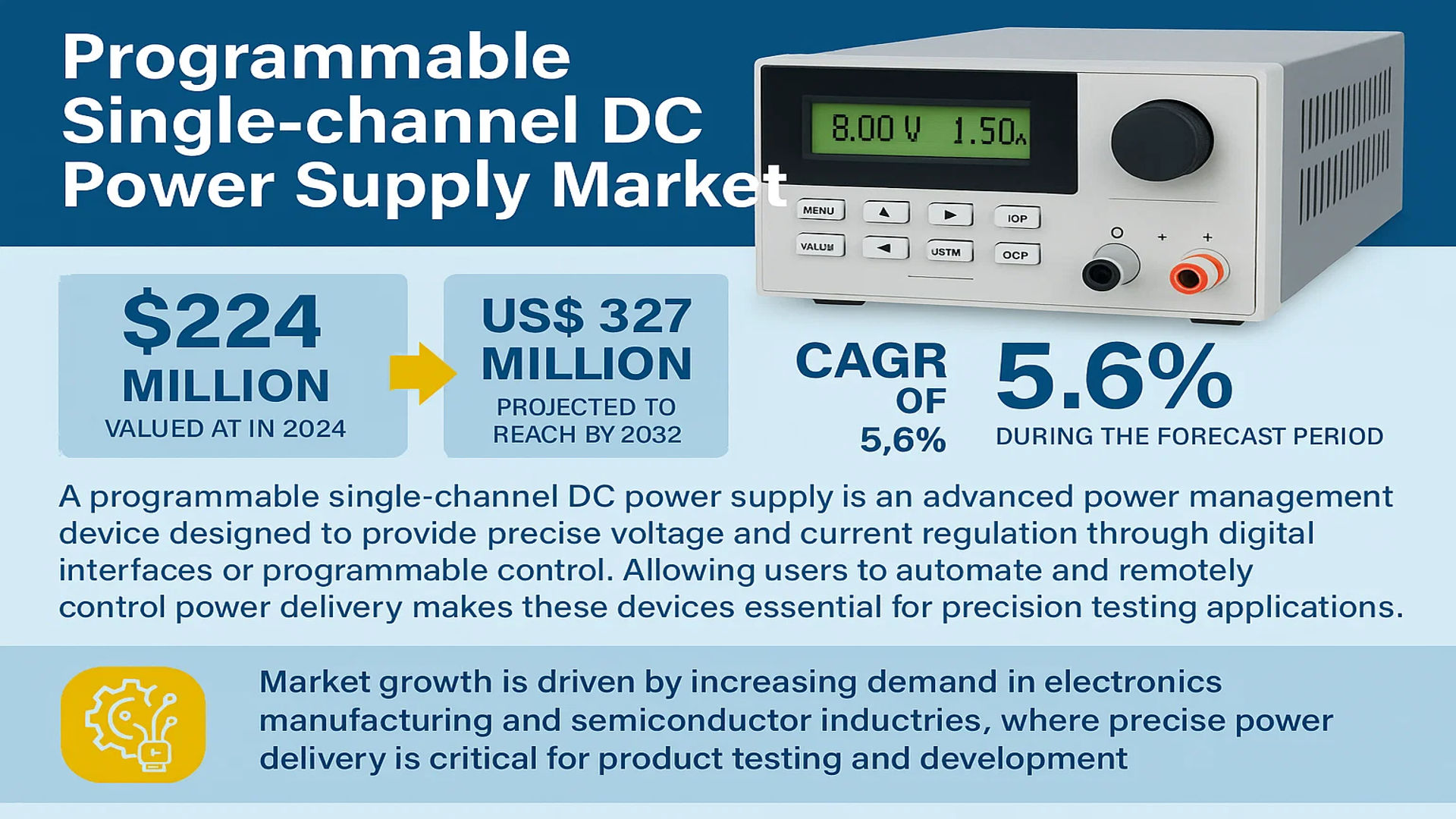
The global Programmable Single-channel DC Power Supply Market was valued at 224 million in 2024 and is projected to reach US$ 327 million by 2032, at a CAGR of 5.6% during the forecast period.
A programmable single-channel DC power supply is an advanced power management device designed to provide precise voltage and current regulation through digital interfaces or programmable control. These systems feature a single output channel, allowing users to independently configure parameters such as voltage levels, current limits, and operational modes using standard communication protocols including GPIB, RS-232, or Ethernet. The ability to automate and remotely control power delivery makes these devices essential for precision testing and industrial applications.
The market growth is driven by increasing demand in electronics manufacturing and semiconductor industries, where precise power delivery is critical for product testing and development. While North America currently dominates market share with advanced R&D infrastructure, Asia-Pacific shows the fastest growth due to expanding electronics production. Major players like Keysight Technologies and AMETEK Programmable Power continue to innovate, introducing smarter power solutions with enhanced programmability and IoT integration to meet evolving industry requirements.
MARKET DYNAMICS
MARKET DRIVERS
Rising Demand for Precision Testing in Electronics Manufacturing to Fuel Market Growth
The global programmable single-channel DC power supply market is experiencing significant growth due to increasing requirements for precision power testing across industries. Electronics manufacturing, which accounts for over 35% of end-use applications, demands highly accurate power solutions to ensure product reliability. Programmable power supplies enable automated testing procedures with precise voltage and current regulation down to millivolt and milliampere levels. This capability is critical for validating components like integrated circuits, sensors, and communication modules where even minor power fluctuations can impact performance. The growing complexity of electronic devices necessitates advanced testing solutions that programmable DC power supplies provide.
Automotive Electrification Trends Creating New Demand Streams
The rapid electrification of automotive systems is creating substantial growth opportunities for programmable DC power supply manufacturers. With electric vehicle production expected to grow at an annual rate of 20% through 2032, testing requirements for battery management systems, charging components, and power electronics are expanding exponentially. Programmable power supplies enable engineers to simulate various operating conditions, including voltage sags, surges, and ripple effects, which are critical for automotive R&D. The ability to automate test sequences through programming interfaces significantly reduces development cycles, making these solutions indispensable for EV manufacturers racing to bring products to market.
➤ The integration of programmable power supplies with automated test equipment has reduced power testing time by up to 40% in automotive applications compared to conventional methods.
Furthermore, the semiconductor industry’s expansion, particularly in Asia-Pacific regions, is driving additional demand. As chip manufacturers increase production capacity to meet global electronics needs, the requirement for precise power testing during wafer fabrication and component validation continues to grow in parallel.
MARKET RESTRAINTS
High Initial Investment Costs Limit Market Penetration
While programmable single-channel DC power supplies offer superior performance, their premium pricing presents a significant barrier to widespread adoption. Advanced models with high precision and wide dynamic ranges can cost three to five times more than basic bench power supplies. This pricing structure makes them prohibitively expensive for small manufacturers, academic institutions, and research labs operating with constrained budgets. The cost sensitivity is particularly pronounced in emerging markets where price often outweighs functionality decisions.
Technical Complexities in Operation and Integration
The sophisticated nature of programmable power supplies creates challenges in workforce adoption. Many units require specialized programming knowledge to fully utilize their capabilities, including scripting languages and communication protocols. This creates a steep learning curve that can delay implementation timelines and increase training costs. Integration with existing test systems also presents challenges, particularly in legacy manufacturing environments where compatibility issues may arise.
MARKET CHALLENGES
Intense Competition from Multi-channel Alternatives
The programmable single-channel DC power supply market faces increasing competition from multi-channel configurations that offer greater testing flexibility. Many R&D applications now require simultaneous testing of multiple power rails, making single-channel solutions less attractive in certain scenarios. While single-channel units maintain advantages in precision and cost-per-channel for specific applications, manufacturers must continually demonstrate their value proposition to maintain market share.
Supply Chain Disruptions Impacting Component Availability
Ongoing semiconductor shortages and logistics challenges have created production bottlenecks for power supply manufacturers. Critical components like high-performance DACs (Digital-to-Analog Converters) and power MOSFETs frequently face extended lead times, delaying product deliveries. These supply chain issues are particularly problematic for programmable power supplies that require specialized components meeting stringent performance specifications.
MARKET OPPORTUNITIES
Expansion of IoT and 5G Networks Creating New Application Areas
The rapid deployment of 5G infrastructure and IoT devices presents significant growth potential for programmable power supply manufacturers. Testing requirements for these technologies demand precise power characterization under varying load conditions. Programmable power supplies are ideally suited for validating power consumption profiles and battery performance in connected devices. With over 25 billion IoT devices expected to be in operation by 2025, this creates a substantial addressable market for power testing solutions.
Advancements in Renewable Energy Systems Driving Innovation
The renewable energy sector is emerging as a key growth area, particularly for testing photovoltaic systems and energy storage solutions. Programmable DC power supplies enable engineers to simulate various solar irradiance conditions and battery charging/discharging cycles. This capability is critical for optimizing system efficiency and reliability as renewable energy adoption accelerates globally. The integration of smart grid technologies further expands testing requirements where programmable power supplies play a vital role in system validation.
PROGRAMMABLE SINGLE-CHANNEL DC POWER SUPPLY MARKET TRENDS
Rising Demand for High-Precision Power Supplies in Advanced Electronics
The increasing complexity of electronic devices and the need for stable, high-precision power sources are driving the demand for programmable single-channel DC power supplies. With the global market valued at $224 million in 2024 and projected to reach $327 million by 2032, growth is fueled by their critical role in testing and development across industries. These power supplies offer advantages such as programmable voltage/current settings, remote monitoring, and low ripple, making them indispensable in semiconductor manufacturing, telecommunications, and automotive testing. Furthermore, advancements in digital control interfaces, including USB, Ethernet, and GPIB, have expanded their integration with automated test equipment (ATE) systems, enhancing efficiency in production lines.
Other Trends
Expansion of Electric Vehicle (EV) and Renewable Energy Applications
Programmable DC power supplies are increasingly utilized in EV battery testing, charge management systems, and renewable energy inverters. As global EV production is expected to exceed 30 million units annually by 2030, manufacturers require precise power sources for validating battery performance under varying loads. Similarly, solar and wind energy systems rely on these devices to simulate different grid conditions for inverter testing. The automotive and renewable sectors are projected to account for over 25% of revenue in the programmable power supply market within the next five years, with continued R&D investments accelerating adoption.
Shift Toward Modular and Compact Designs in Industrial Applications
Industrial automation and miniaturization trends are pushing manufacturers to develop compact, lightweight programmable power supplies without compromising performance. Leading companies such as Keysight Technologies and AMETEK have introduced models with higher power density—delivering up to 1kW in half-rack sizes—to accommodate space-constrained environments. The adoption of gallium nitride (GaN) and silicon carbide (SiC) transistors has also improved efficiency, reducing heat dissipation and energy costs. Meanwhile, industries like medical equipment manufacturing prioritize these solutions for their low electromagnetic interference (EMI) characteristics, critical for sensitive diagnostic devices.
COMPETITIVE LANDSCAPE
Key Industry Players
Market Dominated by Established Players with Strong R&D Capabilities
The global programmable single-channel DC power supply market features a moderately concentrated competitive landscape where leading companies leverage their technical expertise, extensive distribution networks, and continuous product innovation to maintain market position. Keysight Technologies and Tektronix currently lead the segment, together accounting for approximately 35% of the 2024 market share. Their dominance stems from comprehensive product portfolios that serve diverse applications ranging from electronics manufacturing to semiconductor testing.
While North American and European manufacturers traditionally held technological superiority, Asian players like Chroma and GW Instek are gaining traction through competitive pricing and localized support networks. Chroma’s recent expansion in Southeast Asia has enabled 18% YoY growth in regional sales, demonstrating how geographical strategy complements product capabilities.
Recent market shifts show companies emphasizing software integration as much as hardware performance. National Instruments has differentiated itself with LabVIEW-compatible power supplies, while AMETEK Programmable Power focuses on IoT-enabled remote monitoring features. These developments indicate how digital transformation is reshaping competitive advantages beyond traditional specifications like voltage ranges or load regulation.
The market’s technical evolution prompts consolidation, evidenced by TDK’s acquisition of Lambda in 2020 and B&K Precision’s strategic partnership with overseas distributors. Such moves help companies expand their application-specific solutions while optimizing production costs – critical factors as end-users demand higher precision at lower price points.
List of Leading Programmable Single-channel DC Power Supply Manufacturers
- Keysight Technologies (U.S.)
- National Instruments (U.S.)
- Tektronix (U.S.)
- Chroma (Taiwan)
- AMETEK Programmable Power (U.S.)
- Rigol Technologies (China)
- GW Instek (Taiwan)
- B&K Precision (U.S.)
- TDK-Lambda (Japan)
- Magna-Power Electronics (U.S.)
- EA Elektro-Automatik (Germany)
- Qingdao Kangsi Electronic Technology (China)
Segment Analysis:
By Type
Linear Segment Holds Significant Share Due to Precision and Low Noise Characteristics
The market is segmented based on type into:
- Linear
- Subtypes: Bench-top, Rack-mounted, and others
- Switch
By Application
Electronic Manufacturing Industry Leads Owing to High Demand for Testing and Prototyping Equipment
The market is segmented based on application into:
- Electronic Manufacturing Industry
- Communication Industry
- Semiconductor Industry
- Automotive Industry
- Medical Equipment
- Other
Regional Analysis: Programmable Single-channel DC Power Supply Market
Asia-Pacific
The Asia-Pacific region dominates the programmable single-channel DC power supply market, accounting for the largest revenue share in 2024. This leadership position stems from rapid industrialization, particularly in China, Japan, and South Korea, where extensive electronics manufacturing and semiconductor production drive demand for precision power solutions. China alone contributes over 40% of regional demand due to its massive electronics export industry and growing domestic R&D investments. Manufacturers are focusing on cost-competitive yet high-performance models tailored to local industries, with increasing adoption in automotive electronics and renewable energy applications. However, the region faces intense price competition, pushing suppliers to balance affordability with advanced features.
North America
North America represents the second-largest market, characterized by technological sophistication and stringent quality requirements. The U.S. leads regional demand, supported by robust aerospace, defense, and medical equipment industries that require high-reliability power supplies. Key players like Keysight Technologies and AMETEK dominate the premium segment, focusing on IoT integration and smart manufacturing applications. Recent investments in 5G infrastructure and electric vehicle charging systems are creating new growth opportunities. While the market grows steadily at 5.2% CAGR, high product costs and mature end-user industries somewhat limit expansion compared to emerging regions. Regulatory standards like UL certification remain critical purchase considerations.
Europe
Europe maintains a strong position in the programmable power supply market, with Germany and the U.K. contributing significantly to regional revenue. The market benefits from well-established automotive and industrial automation sectors that demand precision voltage control. EU directives on energy efficiency and electromagnetic compatibility shape product development, favoring suppliers offering compliant solutions. Manufacturers emphasize modular designs and network connectivity features to cater to Industry 4.0 applications. Although growth trails Asia-Pacific, niche markets like renewable energy testing and railway electronics present promising opportunities. The presence of research institutions and emphasis on sustainable technologies further drives innovation in power efficiency and reduced footprint designs.
South America
South America shows moderate but steady growth potential, with Brazil and Argentina as primary markets. Economic constraints limit large-scale adoption, but growing electronics assembly operations and automotive manufacturing stimulate demand for basic-to-midrange programmable power supplies. Price sensitivity remains a key market characteristic, with buyers favoring reliable but less sophisticated models. Local distributors play a crucial role in bridging international manufacturers with regional buyers. While political and economic instability occasionally disrupts supply chains, the gradual expansion of telecommunications infrastructure and increasing focus on energy efficiency offer long-term market opportunities.
Middle East & Africa
The MEA region represents an emerging market with growth concentrated in Gulf countries and South Africa. Oil and gas industries drive demand for rugged power solutions in harsh environments, while telecommunications infrastructure projects fuel need for testing equipment. The market is price-conscious but increasingly values product reliability. Limited local manufacturing means most supplies are imported, creating longer lead times. Nevertheless, strategic investments in smart cities and diversification away from oil-based economies are expected to boost demand for programmable power solutions in coming years. Suppliers focus on providing after-sales support and customization services to gain market share in this developing region.
Report Scope
This market research report provides a comprehensive analysis of the global and regional Programmable Single-channel DC Power Supply markets, covering the forecast period 2025–2032. It offers detailed insights into market dynamics, technological advancements, competitive landscape, and key trends shaping the industry.
Key focus areas of the report include:
- Market Size & Forecast: Historical data and future projections for revenue, unit shipments, and market value across major regions and segments.
- Segmentation Analysis: Detailed breakdown by product type (Linear, Switch), technology, application (Electronics Manufacturing, Semiconductor, Automotive, etc.), and end-user industry to identify high-growth segments.
- Regional Outlook: Insights into market performance across North America, Europe, Asia-Pacific, Latin America, and Middle East & Africa, with country-level analysis for key markets.
- Competitive Landscape: Profiles of leading manufacturers including Keysight Technologies, AMETEK, and TDK-Lambda, covering product portfolios, R&D investments, and strategic developments.
- Technology Trends: Assessment of digital integration, precision control advancements, and energy-efficient designs in DC power supplies.
- Market Drivers & Restraints: Analysis of automation demand, semiconductor industry growth, and supply chain challenges impacting the market.
- Stakeholder Analysis: Strategic insights for OEMs, component suppliers, and investors regarding emerging opportunities.
The research combines primary interviews with industry experts and secondary data from verified sources to ensure accuracy and reliability.
FREQUENTLY ASKED QUESTIONS:
What is the current market size of Global Programmable Single-channel DC Power Supply Market?
->Programmable Single-channel DC Power Supply Market was valued at 224 million in 2024 and is projected to reach US$ 327 million by 2032, at a CAGR of 5.6% during the forecast period.
Which key companies operate in this market?
-> Leading players include Keysight Technologies, AMETEK Programmable Power, TDK-Lambda, Chroma, and B&K Precision, with the top five companies holding significant market share.
What are the key growth drivers?
-> Growth is driven by increasing automation in manufacturing, semiconductor industry expansion, and demand for precision power solutions in R&D applications.
Which region dominates the market?
-> Asia-Pacific leads in market growth due to electronics manufacturing expansion, while North America remains strong in high-end applications.
What are the emerging trends?
-> Key trends include integration of IoT capabilities, development of energy-efficient models, and increasing adoption in electric vehicle testing applications.

Get Sample Report PDF for Exclusive Insights
Report Sample Includes
- Table of Contents
- List of Tables & Figures
- Charts, Research Methodology, and more...
 Download Sample Report PDF