
Market Insights
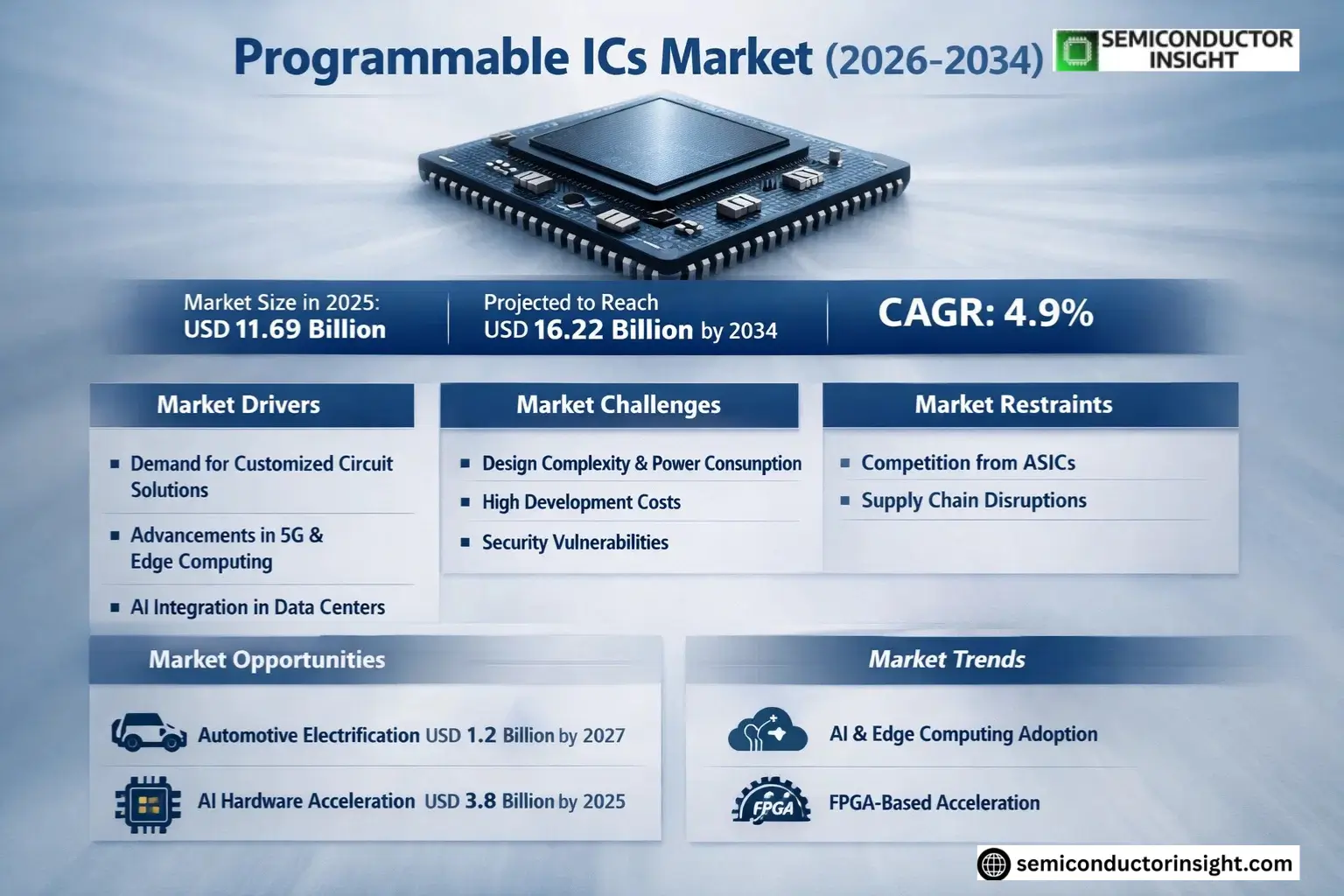
Global Programmable ICs Market size was valued at USD 11.69 billion in 2025. The market is projected to grow from USD 12.24 billion in 2026 to USD 16.22 billion by 2034, exhibiting a CAGR of 4.9% during the forecast period.
Programmable integrated circuits (ICs) are application-specific semiconductors whose internal logic can be reconfigured through software or hardware programming, enabling flexible customization post-manufacturing without requiring physical redesign. These devices combine programmable logic blocks, memory elements, and routing resources to deliver hardware performance with software-like adaptability, making them essential for rapid prototyping, system optimization, and dynamic functionality updates across industries.
Market expansion is driven by accelerating demand for AI acceleration hardware, 5G infrastructure deployment, and automotive electronics innovation. The proliferation of edge computing applications and industrial IoT solutions further amplifies adoption, though design complexity and higher unit costs compared to fixed-function ASICs present adoption barriers. Recent technological advancements include AMD’s acquisition of Xilinx to strengthen FPGA leadership and Intel’s Agilex FPGA series featuring AI-optimized architectures for data center workloads.
MARKET DRIVERS
Growing Demand for Customized Circuit Solutions
Programmable ICs Market is experiencing significant growth due to the increasing need for customized semiconductor solutions across industries. Design flexibility and rapid prototyping capabilities make programmable ICs indispensable in IoT, automotive, and consumer electronics sectors. The market is projected to grow at a CAGR of 8.2% through 2026.
Advancements in 5G and Edge Computing
The rollout of 5G networks and expansion of edge computing infrastructure are creating substantial demand for programmable ICs. These components enable adaptive signal processing and low-latency operations crucial for next-generation networks. Field-programmable gate arrays (FPGAs) account for over 40% of programmable IC deployments in telecom infrastructure.
Growing adoption of AI accelerators in data centers is further propelling market growth, with programmable ICs enabling hardware optimization for machine learning workloads.
MARKET CHALLENGES
Design Complexity and Power Consumption
Despite their advantages, programmable ICs face challenges related to increasing design complexity and power efficiency requirements. Modern FPGAs can consume up to 100W under full load, creating thermal management challenges for compact devices.
Other Challenges
High Development Costs
Initial investment in programmable IC development environments and tools remains prohibitive for small enterprises, with licensing costs for EDA software exceeding USD 100,000 annually in some cases.
Security Vulnerabilities
Configuration bitstream security remains a critical concern, with programmable ICs susceptible to cloning and IP theft through side-channel attacks.
MARKET RESTRAINTS
Competition from ASIC Solutions
Application-specific integrated circuits (ASICs) continue to restrain programmable IC growth in high-volume production scenarios. When production volumes exceed 100,000 units, ASICs typically offer 35-50% lower per-unit costs compared to programmable alternatives.
Supply Chain Disruptions
Programmable ICs Market faces constraints from semiconductor supply chain challenges, with lead times for certain FPGA components extending beyond 40 weeks as of Q2 2023.
MARKET OPPORTUNITIES
Automotive Electrification
The transition to electric vehicles presents a USD 1.2 billion opportunity for programmable ICs by 2027, primarily for battery management systems and autonomous driving functions. Vehicle manufacturers increasingly adopt programmable solutions to accommodate evolving safety standards.
AI Hardware Acceleration
Demand for reconfigurable AI accelerators is creating new market avenues, with programmable IC revenues from AI applications expected to reach USD 3.8 billion by 2025. Emerging architectures combining FPGA and GPU capabilities are gaining traction in hyperscale data centers.
Programmable ICs Market Trends
Acceleration of AI and Edge Computing Adoption
Programmable ICs Market is witnessing significant growth driven by AI and edge computing applications. FPGA-based acceleration continues gaining traction in neural network inferencing, with optimized architectures delivering 5-10x better performance per watt than traditional processors. Major cloud providers are deploying programmable ICs for real-time data processing at the edge, creating strong demand for high-performance, low-latency solutions.
Other Trends
Automotive Electronics Innovation
Automotive applications represent one of the fastest-growing segments for Programmable ICs, particularly in ADAS prototyping and in-vehicle networking. The need for hardware reconfigurability across vehicle lifecycles is driving adoption, with leading semiconductor companies developing automotive-grade programmable solutions that meet stringent reliability requirements.
5G Infrastructure Deployment
Global 5G network expansion continues to fuel demand for Programmable ICs in base stations and network equipment. Programmable solutions enable flexible protocol handling and hardware acceleration for emerging 5G standards, with suppliers reporting 20-30% higher year-over-year shipments for telecommunications applications requiring high-speed signal processing.
Supply Chain Diversification
Geopolitical factors are prompting Programmable IC manufacturers to establish multi-region production and testing capabilities. Industry leaders are qualifying additional foundry partners and packaging facilities to mitigate risks, while maintaining the high quality standards required for mission-critical applications in aerospace and industrial sectors.
Technology Innovation Trends
Programmable ICs Market is experiencing rapid technological advancement, with new 3D architectures combining programmable logic, memory and processing cores on single devices. Suppliers are introducing chips offering 30-50% lower power consumption compared to previous generations, addressing critical needs in battery-powered and thermally-constrained applications.
COMPETITIVE LANDSCAPE
Key Industry Players
AMD and Intel Dominate Programmable IC Market with 60% Revenue Share
Global Programmable ICs Market is highly concentrated, with AMD (through Xilinx acquisition) and Intel (Altera) collectively holding over 60% market share by revenue. These industry leaders dominate high-performance FPGA segments for data center, AI, and 5G applications with their advanced 7nm and 16nm FinFET product portfolios. Both companies benefit from strong ecosystem support including comprehensive toolchains, IP cores, and developer communities that create switching costs for customers.
Niche players like Lattice Semiconductor and Microchip Technology have carved out strong positions in low-power edge computing and industrial automation segments. Achronix Semiconductor has emerged as a formidable competitor in high-speed acceleration, while Chinese firms like GOWIN Semiconductor and Anlogic Infotech are gaining traction in cost-sensitive consumer applications through mature node offerings. The market also sees innovation from FPGA startups like Efinix and QuickLogic bringing architectural breakthroughs.
List of Key Programmable IC Companies Profiled
- AMD (Xilinx)
- Intel (Altera)
- Lattice Semiconductor
- Microchip Technology
- Achronix Semiconductor
- Efinix
- GOWIN Semiconductor
- QuickLogic
- NanoXplore
- Anlogic Infotech
- Pango Microsystems
- S2C
- Cypress Semiconductor
- Silego Technology
- SiliconBlue Technologies
Segment Analysis:
| Segment Category | Sub-Segments | Key Insights |
| By Type |
|
FPGA dominates due to its superior flexibility and parallel processing capabilities.
|
| By Application |
|
Communications & Networks leads as the most demanding application sector.
|
| By End User |
|
Telecom Service Providers represent the most strategic end-user segment.
|
| By Programming Method |
|
Repeated Programmable solutions are driving market growth.
|
| By Integration Level |
|
Heterogeneous SoCs represent the most advanced market segment.
|
Regional Analysis: Asia-Pacific Programmable ICs Market
China leads Asia-Pacific’s programmable IC production with vertically integrated supply chains and aggressive capacity expansions. Domestic consumption of smart devices and EV electronics drives continuous FPGA technology upgrades.
South Korean giants invest heavily in programmable ICs for AI accelerators and memory solutions. Collaboration between fabless designers and foundries creates cutting-edge solutions for global data center applications.
Japanese manufacturers focus on ruggedized programmable ICs for automotive and robotics. Longstanding expertise in reliability engineering creates specialized solutions for harsh environment applications.
India’s growing fabless design startups target power-efficient programmable IC architectures. Government incentives and engineering talent pool position the country as a future innovation center.
North America
North America maintains technological leadership in advanced programmable IC architectures through major Silicon Valley innovators. The region excels in high-end FPGA solutions for aerospace, defense, and cloud computing applications. Strong university-industry collaborations drive breakthroughs in quantum computing interfaces using programmable ICs. Local demand focuses on secure, reconfigurable chips for critical infrastructure and IoT ecosystems.
Europe
European markets emphasize industrial automation and automotive applications of programmable ICs, with Germany and France leading adoption. Strict regulations push development of energy-efficient FPGA solutions for smart manufacturing. The region shows growing FPGA adoption in medical devices and aerospace systems, supported by robust engineering capabilities and precision manufacturing standards.
South America
South America experiences steady Programmable ICs Market growth through telecommunications infrastructure modernization. Brazil and Argentina lead local demand for FPGA-based solutions in industrial IoT and energy management systems. Regional players focus on cost-optimized architectures suitable for developing market requirements and local manufacturing conditions.
Middle East & Africa
The MEA region shows increasing programmable IC adoption in smart city infrastructure and oil/gas automation. Gulf nations invest in FPGA technologies for 5G networks and surveillance systems. Emerging local design capabilities in Israel complement growing assembly and testing facilities across North Africa supporting regional tech development.
Report Scope
This market research report provides a comprehensive analysis of the Programmable ICs Market , covering the forecast period 2025–2034. It offers detailed insights into market dynamics, technological advancements, competitive landscape, and key trends shaping the industry.
Key focus areas of the report include:
- Market Overview: The report begins with an overview outlining its current market scenario, key growth indicators, and industry transformation drivers. It discusses macroeconomic factors, demand–supply balance, regulatory landscape, and the strategic role of semiconductors in powering advancements across industries such as automotive, telecommunications, consumer electronics, and industrial automation.
- Market Size & Forecast: Historical data and future projections for revenue, unit shipments, and market value across major regions and segments.
- Segmentation Analysis: Detailed breakdown by product type, technology, application, and end-user industry to identify high-growth segments and investment opportunities.
- Regional Insights: Insights into market performance across North America, Europe, Asia-Pacific, Latin America, and the Middle East & Africa, including country-level analysis where relevant.
- Competitive Landscape: Profiles of leading market participants, including their product offerings, R&D focus, manufacturing capacity, pricing strategies, and recent developments such as mergers, acquisitions, and partnerships.
- Technology Trends & Innovation: Assessment of emerging technologies, integration of AI/IoT, semiconductor design trends, fabrication techniques, and evolving industry standards.
- Market Drivers & Restraints: Evaluation of factors driving market growth along with challenges, supply chain constraints, regulatory issues, and market-entry barriers.
- Stakeholder Insights: Insights for component suppliers, OEMs, system integrators, investors, and policymakers regarding the evolving ecosystem and strategic opportunities.
Primary and secondary research methods are employed, including interviews with industry experts, data from verified sources, and real-time market intelligence to ensure the accuracy and reliability of the insights presented.
FREQUENTLY ASKED QUESTIONS:
What is the current market size of Programmable ICs Market?
-> Programmable ICs Market size was valued at USD 11.69 billion in 2025. The market is projected to grow from USD 12.24 billion in 2026 to USD 16.22 billion by 2034, exhibiting a CAGR of 4.9% during the forecast period.
What is the growth rate of the Programmable ICs Market?
-> The market is expected to grow at a CAGR of 4.9% during the forecast period 2025-2034.
Which key companies operate in Programmable ICs Market?
-> Key players include AMD, Intel (Altera), Lattice Semiconductor, Microchip Technology, Achronix Semiconductor, Efinix, GOWIN Semiconductor, QuickLogic, NanoXplore, Anlogic Infotech, and Pango Microsystems, among others.
What are the key growth drivers?
-> Key growth drivers include surging compute demand, shorter product cycles, rising customization requirements, and risk reduction through programmability under uncertain demand.
Which region dominates the market?
-> Asia is the dominant market, with significant contributions from China, Japan, and South Korea.
What are the emerging trends?
-> Emerging trends include stronger on-chip heterogeneous integration, improved hardware software co-design, and more application-oriented programmable architectures for AI and high-speed interfaces.
Get Sample Report PDF for Exclusive Insights
Report Sample Includes
- Table of Contents
- List of Tables & Figures
- Charts, Research Methodology, and more...
 Download Sample Report PDF