Programmable AI Accelerator Market Technology Adoption, AI Integration and Industry Outlook (2026-2034)

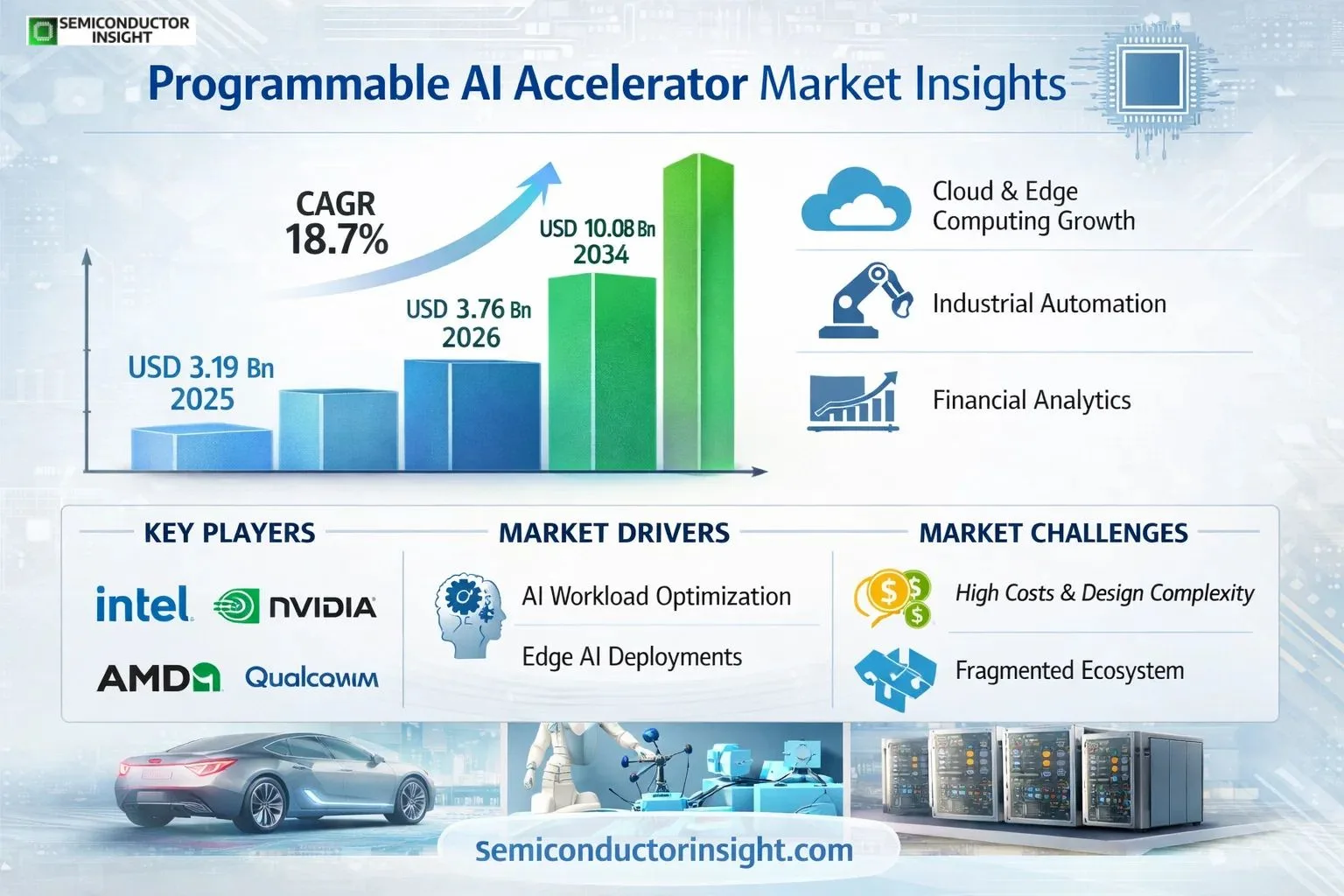
The Programmable AI Accelerator Market was valued at USD 3192 million in 2025 and is projected to reach USD 10475 million by 2034, growing at a CAGR of 18.7% during the forecast period.

PDF Icon Download Sample Report PDF
  • Quick Dispatch

    All Orders

  • Secure Payment

    100% Secure Payment

Price range: $1,500.00 through $4,250.00

Clear

Programmable AI Accelerator Market Insights

Global Programmable AI Accelerator market size was valued at USD 3.19 billion in 2025. The market is projected to grow from USD 3.76 billion in 2026 to USD 10.48 billion by 2034, exhibiting a CAGR of 18.7% during the forecast period.

Programmable AI Accelerators are specialized hardware solutions designed to enhance artificial intelligence computing efficiency while maintaining flexibility for evolving models and workloads. These include FPGA-based accelerators, reconfigurable compute architectures, and hybrid programmable SoCs deployed across servers, edge devices, and networking infrastructure. Unlike fixed-function ASICs, they enable dynamic adaptation to changing inference pipelines and real-time processing requirements in specialized environments such as industrial automation and financial analytics.

The market growth is driven by escalating demand for cloud-based AI services, edge computing deployments in telecommunications (vRAN), and mission-critical applications requiring deterministic performance. In 2025, approximately 920k units were produced globally at an average price of USD 3,800 per unit. Key industry players like NVIDIA (holding ~35% market share), Intel (through its Altera FPGA division), and AMD are investing heavily in software ecosystems to differentiate their offerings amid intensifying competition from custom ASIC solutions.
Programmable AI Accelerator Market Insights

MARKET DRIVERS

Growing Demand for AI Workload Optimization

The Programmable AI Accelerator Market is witnessing significant growth due to the rising demand for efficient AI workload processing across industries. As deep learning models become more complex, programmable accelerators offer the flexibility required for diverse AI applications. Enterprises are prioritizing custom hardware solutions to enhance performance while reducing power consumption.

Advancements in Edge Computing

Programmable AI accelerators are becoming essential for edge devices, where low latency and real-time processing are critical. The market is projected to grow at 28.7% CAGR as industries adopt AI-powered edge solutions for autonomous systems and IoT applications. These accelerators enable efficient deployment of machine learning models in resource-constrained environments.

“The global Programmable AI Accelerator Market is expected to reach $42.6 billion by 2028, driven by increased adoption in cloud and edge computing.”

Cloud service providers are also accelerating demand, deploying programmable accelerators to offer AI-as-a-service with improved cost efficiency and scalability compared to fixed-function hardware.

MARKET CHALLENGES

Complexity in Design and Implementation

Developing programmable AI accelerators requires specialized expertise in both hardware architecture and AI algorithms. The high development costs and lengthy design cycles pose significant barriers for smaller players in the Programmable AI Accelerator Market. Integration with existing infrastructure remains a key technical challenge for many organizations.

Other Challenges

Fragmented Ecosystem

The lack of standardized programming frameworks across different accelerator architectures creates compatibility issues, slowing down widespread adoption.

MARKET RESTRAINTS

High Development and Deployment Costs

The substantial R&D investment required for programmable AI accelerator development limits market entry for many companies. Current solutions often carry premium pricing, making them inaccessible to small and medium enterprises. Additionally, the specialized knowledge required for optimal deployment creates a skills gap that hinders market growth.

MARKET OPPORTUNITIES

Emerging Applications in Autonomous Systems

The Programmable AI Accelerator Market is poised for expansion into autonomous vehicles, drones, and robotics, where flexible acceleration is crucial. These applications require real-time decision-making capabilities that programmable accelerators can efficiently provide. The healthcare sector also presents significant growth potential for AI acceleration in medical imaging and diagnostics.

Programmable AI Accelerator Market Trends
Adoption of Reconfigurable Architectures for AI Workload Diversity

The Programmable AI Accelerator market is experiencing growing demand for FPGA-based solutions and hybrid SoCs that adapt to evolving AI models. Industries ranging from telecom edge deployments to industrial automation require hardware capable of handling diverse inference tasks while maintaining deterministic performance. This trend is driving innovation in runtime reconfiguration and specialized compute architectures optimized for real-time processing.

Other Trends

Cloud-to-Edge Deployment Expansion

Major cloud providers are increasingly deploying programmable accelerators in both data center and edge environments to optimize AI service delivery. Telecom operators leverage these solutions for virtualized RAN workloads, while industrial applications utilize them for adaptive machine vision systems. The flexibility of programmable architectures reduces total cost of ownership by supporting multiple AI pipelines on shared hardware.

Software Ecosystem Development

Vendors are investing heavily in compiler technologies and optimized kernel libraries to improve the usability of programmable AI accelerators. Advanced toolchains that automatically map neural networks to reconfigurable hardware are becoming crucial competitive differentiators. The market is seeing increased integration with mainstream frameworks like TensorFlow and PyTorch to streamline deployment workflows for enterprise customers.

Energy Efficiency Focus

With rising compute demands in AI applications, programmable accelerators are being optimized for power efficiency through architectural innovations like fine-grained clock gating and dynamic voltage scaling. Recent designs demonstrate 30-50% better performance-per-watt compared to previous generations, making them viable for battery-powered edge devices and sustainable data center operations.

COMPETITIVE LANDSCAPE

Key Industry Players

Programmable AI Accelerator Market Leaders Driving Innovation Through Reconfigurable Architectures

The programmable AI accelerator market is dominated by semiconductor giants and specialized AI hardware innovators, with Intel (through its Altera subsidiary) and NVIDIA holding significant shares due to their FPGA and GPU-based solutions respectively. Qualcomm and AMD have strengthened positions through heterogeneous compute architectures optimized for edge AI workloads, while IBM leverages its research expertise in neuromorphic computing. The market exhibits a mix of vertical integration strategies, with cloud providers like Amazon AWS and Meta developing custom accelerators alongside ecosystem partnerships.

Niche players are gaining traction in specific segments – Cerebras Systems and Graphcore lead in wafer-scale and IPU architectures for training acceleration, while Groq and Tenstorrent focus on deterministic latency for inference workloads. SambaNova Systems differentiates through full-stack solutions combining reconfigurable dataflow with memory optimization. Broadcom and Marvell address networking-adjacent acceleration, with Architek emerging in industrial machine vision applications. This diverse landscape reflects the technology’s application across cloud, edge, and specialized vertical deployments.

List of Key Programmable AI Accelerator Companies Profiled

Segment Analysis:

Segment Category Sub-Segments Key Insights
By Type
  • FPGA-based Accelerators
  • Reconfigurable Compute Architectures
  • Hybrid Programmable SoCs
FPGA-based Accelerators dominate due to:

  • Superior flexibility in adapting to evolving AI models
  • Energy efficiency advantages for edge deployments
  • Strong ecosystem support from major chip vendors
By Application
  • Cloud Inference Acceleration
  • Telecom Edge/vRAN
  • Industrial Machine Vision
  • Financial Analytics
Cloud Inference Acceleration leads with:

  • Growing need for real-time processing in AI services
  • Demand for adaptable hardware across diverse workloads
  • Seamless integration with existing cloud infrastructure
By End User
  • Cloud Service Providers
  • Telecom Operators
  • Financial Institutions
Cloud Service Providers are primary adopters because:

  • Need to optimize AI service delivery across diverse customer needs
  • Requirement for hardware that evolves with algorithmic advances
  • Scale advantages in deploying programmable solutions
By Deployment Form
  • PCIe Accelerator Cards
  • Server-attached Modules
  • Embedded Solutions
PCIe Accelerator Cards remain preferred due to:

  • Standardized interface compatibility across data centers
  • Ease of deployment and upgradability
  • High-bandwidth connectivity for AI workloads
By Workload Type
  • Inference Acceleration
  • Training Acceleration
  • Hybrid Workloads
Inference Acceleration dominates because:

  • Wider deployment scenarios across industries
  • Lower power requirements compared to training
  • Greater need for real-time performance optimization

Regional Analysis: North America Programmable AI Accelerator Market

United States

The United States dominates the Programmable AI Accelerator Market with robust adoption across cloud computing and edge AI applications. Major tech hubs like Silicon Valley and Seattle drive innovation through hyperscale data centers implementing FPGA and ASIC-based AI accelerators. The country benefits from strong R&D ecosystems in universities and corporate labs, with NVIDIA, Intel, and AMD leading hardware development. Government initiatives like the National AI Initiative Act further stimulate growth. The military and healthcare sectors show particularly high demand for customizable AI acceleration solutions, with edge deployments growing 35% faster than the national average due to 5G rollout and IoT expansion. Financial services firms are increasingly adopting Programmable AI Accelerators for real-time fraud detection and high-frequency trading applications.

Cloud Infrastructure Dominance

U.S. hyperscalers account for nearly 60% of global Programmable AI Accelerator deployments, with AWS, Google Cloud and Azure driving FPGA adoption for customizable machine learning workloads. Regional data center expansions are prioritizing energy-efficient AI acceleration architectures.

Automotive AI Integration

Detroit and Silicon Valley auto manufacturers are implementing Programmable AI Accelerators in next-gen ADAS systems. The flexibility of FPGA solutions allows for over-the-air updates to accommodate evolving autonomous driving algorithms and sensor fusion requirements.

Defense Applications
Pentagon contracts are accelerating military adoption of radiation-hardened Programmable AI Accelerators for space and battlefield applications. The technology enables real-time sensor processing and EW systems that can be reprogrammed for mission-specific AI workloads.

Healthcare Innovation

Leading medical research institutions are deploying Programmable AI Accelerators for genomics and medical imaging analysis. The reconfigurable nature of these systems allows healthcare providers to adapt AI models for specialized diagnostic applications without hardware replacements.

Canada

Canada’s Programmable AI Accelerator Market benefits from strong government support through the Pan-Canadian AI Strategy, particularly in Toronto-Waterloo and Montreal tech corridors. The country specializes in edge AI applications for smart cities and industrial IoT, with programmable accelerators enabling adaptable solutions for harsh climate conditions. Financial technology firms in Toronto leverage these solutions for AI-powered risk analysis, while oil/gas operations in Alberta deploy ruggedized versions for predictive maintenance. Academic partnerships between universities and chip manufacturers drive innovation in energy-efficient AI acceleration architectures.

Mexico

Mexico’s growing automotive manufacturing sector adopts Programmable AI Accelerators for smart factory applications and quality control systems. The proximity to U.S. tech firms facilitates knowledge transfer, with maquiladoras implementing programmable solutions for flexible production line configurations. Telecommunications companies are deploying edge AI accelerators for 5G network optimization, while financial institutions use them for fraud detection in digital payment systems. Challenges include limited domestic R&D capabilities and reliance on imported semiconductor components.

Western Europe

Germany leads in industrial Programmable AI Accelerator adoption for Industry 4.0 applications, particularly in automotive and precision manufacturing. The UK’s financial sector utilizes these solutions for algorithmic trading, while France focuses on healthcare and defense applications. Nordic countries emphasize energy-efficient designs for datacenters, with Sweden’s climate pledge driving innovations in low-power AI acceleration. The EU Chips Act is boosting regional semiconductor capabilities, though adoption trails North America in cloud deployment scale.

Asia-Pacific

China dominates regional Programmable AI Accelerator deployment through government-backed tech giants and semiconductor initiatives. Japan specializes in edge AI for robotics and automotive applications, while South Korea’s memory chip leaders integrate programmable accelerators. India shows rapid growth in startup-driven AI solutions, particularly for financial inclusion and agriculture. Australia’s mining sector employs ruggedized accelerators for autonomous equipment. Trade restrictions create regional semiconductor ecosystem fragmentation impacting supply chains.

Report Scope

This market research report provides a comprehensive analysis of the Programmable AI Accelerator Market , covering the forecast period 2025–2034. It offers detailed insights into market dynamics, technological advancements, competitive landscape, and key trends shaping the industry.

Key focus areas of the report include:

  • Market Overview: The report begins with an overview outlining its current market scenario, key growth indicators, and industry transformation drivers. It discusses macroeconomic factors, demand–supply balance, regulatory landscape, and the strategic role of programmable AI accelerators in powering advancements across industries such as cloud computing, telecommunications, industrial automation, and financial analytics.
  • Market Size & Forecast: Historical data and future projections for revenue, unit shipments, and market value across major regions and segments.
  • Segmentation Analysis: Detailed breakdown by product type, target workload, deployment form factor, and application to identify high-growth segments and investment opportunities.
  • Regional Insights: Insights into market performance across North America, Europe, Asia-Pacific, Latin America, and the Middle East & Africa, including country-level analysis where relevant.
  • Competitive Landscape: Profiles of leading market participants, including their product offerings, R&D focus, manufacturing capacity, pricing strategies, and recent developments such as mergers, acquisitions, and partnerships.
  • Technology Trends & Innovation: Assessment of emerging technologies, integration of AI/ML, semiconductor design trends, fabrication techniques, and evolving industry standards.
  • Market Drivers & Restraints: Evaluation of factors driving market growth along with challenges, supply chain constraints, regulatory issues, and market-entry barriers.
  • Stakeholder Insights: Insights for component suppliers, OEMs, system integrators, investors, and policymakers regarding the evolving ecosystem and strategic opportunities.

Primary and secondary research methods are employed, including interviews with industry experts, data from verified sources, and real-time market intelligence to ensure the accuracy and reliability of the insights presented.

FREQUENTLY ASKED QUESTIONS:

What is the current market size of Programmable AI Accelerator Market?

-> The Programmable AI Accelerator Market was valued at USD 3192 million in 2025 and is projected to reach USD 10475 million by 2034, growing at a CAGR of 18.7% during the forecast period.

Which key companies operate in Programmable AI Accelerator Market?

-> Key players include Qualcomm, IBM, Nvidia, Intel, AMD, Architek, Broadcom, Marvell, Altera (Intel), Cerebras Systems, Groq, SambaNova Systems, Graphcore, Tenstorrent, Meta, and Amazon AWS, among others.

What are the key growth drivers?

-> Key growth drivers include cloud and enterprise inference acceleration, telecom edge/vRAN deployments, industrial machine vision, cybersecurity inspection, and financial analytics where workload diversity favors programmable hardware.

Which region dominates the market?

-> Asia is the fastest-growing region, particularly in China, Japan, and South Korea, while North America remains a dominant market with strong presence of key players.

What are the emerging trends?

-> Emerging trends include FPGA-based accelerators, reconfigurable compute architectures, hybrid programmable SoCs, and increasing adoption in edge computing applications.
Programmable AI Accelerator Market Technology Adoption, AI Integration and Industry Outlook (2026-2034)

Get Sample Report PDF for Exclusive Insights

Report Sample Includes

  • Table of Contents
  • List of Tables & Figures
  • Charts, Research Methodology, and more...

PDF Icon Download Sample Report PDF
License Type

Corporate License, Excel License, PDF and Excel Databook License

Table of Content

1 Introduction to Research & Analysis Reports
1.1 Programmable AI Accelerator Market Definition
1.2 Market Segments
1.2.1 Segment by Type
1.2.2 Segment by Target Workload
1.2.3 Segment by Deployment Form Factor
1.2.4 Segment by Application
1.3 Global Programmable AI Accelerator Market Overview
1.4 Features & Benefits of This Report
1.5 Methodology & Sources of Information
1.5.1 Research Methodology
1.5.2 Research Process
1.5.3 Base Year
1.5.4 Report Assumptions & Caveats
2 Global Programmable AI Accelerator Overall Market Size
2.1 Global Programmable AI Accelerator Market Size: 2025 VS 2034
2.2 Global Programmable AI Accelerator Market Size, Prospects & Forecasts: 2021-2034
2.3 Global Programmable AI Accelerator Sales: 2021-2034
3 Company Landscape
3.1 Top Programmable AI Accelerator Players in Global Market
3.2 Top Global Programmable AI Accelerator Companies Ranked by Revenue
3.3 Global Programmable AI Accelerator Revenue by Companies
3.4 Global Programmable AI Accelerator Sales by Companies
3.5 Global Programmable AI Accelerator Price by Manufacturer (2021-2026)
3.6 Top 3 and Top 5 Programmable AI Accelerator Companies in Global Market, by Revenue in 2025
3.7 Global Manufacturers Programmable AI Accelerator Product Type
3.8 Tier 1, Tier 2, and Tier 3 Programmable AI Accelerator Players in Global Market
3.8.1 List of Global Tier 1 Programmable AI Accelerator Companies
3.8.2 List of Global Tier 2 and Tier 3 Programmable AI Accelerator Companies
4 Sights by Type
4.1 Overview
4.1.1 Segment by Type – Global Programmable AI Accelerator Market Size Markets, 2025 & 2034
4.1.2 CPU
4.1.3 GPU
4.1.4 Others
4.2 Segment by Type – Global Programmable AI Accelerator Revenue & Forecasts
4.2.1 Segment by Type – Global Programmable AI Accelerator Revenue, 2021-2026
4.2.2 Segment by Type – Global Programmable AI Accelerator Revenue, 2027-2034
4.2.3 Segment by Type – Global Programmable AI Accelerator Revenue Market Share, 2021-2034
4.3 Segment by Type – Global Programmable AI Accelerator Sales & Forecasts
4.3.1 Segment by Type – Global Programmable AI Accelerator Sales, 2021-2026
4.3.2 Segment by Type – Global Programmable AI Accelerator Sales, 2027-2034
4.3.3 Segment by Type – Global Programmable AI Accelerator Sales Market Share, 2021-2034
4.4 Segment by Type – Global Programmable AI Accelerator Price (Manufacturers Selling Prices), 2021-2034
5 Sights by Target Workload
5.1 Overview
5.1.1 Segment by Target Workload – Global Programmable AI Accelerator Market Size Markets, 2025 & 2034
5.1.2 Inference Acceleration
5.1.3 Training Acceleration
5.1.4 Others
5.2 Segment by Target Workload – Global Programmable AI Accelerator Revenue & Forecasts
5.2.1 Segment by Target Workload – Global Programmable AI Accelerator Revenue, 2021-2026
5.2.2 Segment by Target Workload – Global Programmable AI Accelerator Revenue, 2027-2034
5.2.3 Segment by Target Workload – Global Programmable AI Accelerator Revenue Market Share, 2021-2034
5.3 Segment by Target Workload – Global Programmable AI Accelerator Sales & Forecasts
5.3.1 Segment by Target Workload – Global Programmable AI Accelerator Sales, 2021-2026
5.3.2 Segment by Target Workload – Global Programmable AI Accelerator Sales, 2027-2034
5.3.3 Segment by Target Workload – Global Programmable AI Accelerator Sales Market Share, 2021-2034
5.4 Segment by Target Workload – Global Programmable AI Accelerator Price (Manufacturers Selling Prices), 2021-2034
6 Sights by Deployment Form Factor
6.1 Overview
6.1.1 Segment by Deployment Form Factor – Global Programmable AI Accelerator Market Size Markets, 2025 & 2034
6.1.2 PCIe Accelerator Cards
6.1.3 Server-attached Modules
6.1.4 Others
6.2 Segment by Deployment Form Factor – Global Programmable AI Accelerator Revenue & Forecasts
6.2.1 Segment by Deployment Form Factor – Global Programmable AI Accelerator Revenue, 2021-2026
6.2.2 Segment by Deployment Form Factor – Global Programmable AI Accelerator Revenue, 2027-2034
6.2.3 Segment by Deployment Form Factor – Global Programmable AI Accelerator Revenue Market Share, 2021-2034
6.3 Segment by Deployment Form Factor – Global Programmable AI Accelerator Sales & Forecasts
6.3.1 Segment by Deployment Form Factor – Global Programmable AI Accelerator Sales, 2021-2026
6.3.2 Segment by Deployment Form Factor – Global Programmable AI Accelerator Sales, 2027-2034
6.3.3 Segment by Deployment Form Factor – Global Programmable AI Accelerator Sales Market Share, 2021-2034
6.4 Segment by Deployment Form Factor – Global Programmable AI Accelerator Price (Manufacturers Selling Prices), 2021-2034
7 Sights by Application
7.1 Overview
7.1.1 Segment by Application – Global Programmable AI Accelerator Market Size, 2025 & 2034
7.1.2 Machine Learning
7.1.3 Edge Computing
7.1.4 Natural Language Processing
7.1.5 Others
7.2 Segment by Application – Global Programmable AI Accelerator Revenue & Forecasts
7.2.1 Segment by Application – Global Programmable AI Accelerator Revenue, 2021-2026
7.2.2 Segment by Application – Global Programmable AI Accelerator Revenue, 2027-2034
7.2.3 Segment by Application – Global Programmable AI Accelerator Revenue Market Share, 2021-2034
7.3 Segment by Application – Global Programmable AI Accelerator Sales & Forecasts
7.3.1 Segment by Application – Global Programmable AI Accelerator Sales, 2021-2026
7.3.2 Segment by Application – Global Programmable AI Accelerator Sales, 2027-2034
7.3.3 Segment by Application – Global Programmable AI Accelerator Sales Market Share, 2021-2034
7.4 Segment by Application – Global Programmable AI Accelerator Price (Manufacturers Selling Prices), 2021-2034
8 Sights Region
8.1 By Region – Global Programmable AI Accelerator Market Size, 2025 & 2034
8.2 By Region – Global Programmable AI Accelerator Revenue & Forecasts
8.2.1 By Region – Global Programmable AI Accelerator Revenue, 2021-2026
8.2.2 By Region – Global Programmable AI Accelerator Revenue, 2027-2034
8.2.3 By Region – Global Programmable AI Accelerator Revenue Market Share, 2021-2034
8.3 By Region – Global Programmable AI Accelerator Sales & Forecasts
8.3.1 By Region – Global Programmable AI Accelerator Sales, 2021-2026
8.3.2 By Region – Global Programmable AI Accelerator Sales, 2027-2034
8.3.3 By Region – Global Programmable AI Accelerator Sales Market Share, 2021-2034
8.4 North America
8.4.1 By Country – North America Programmable AI Accelerator Revenue, 2021-2034
8.4.2 By Country – North America Programmable AI Accelerator Sales, 2021-2034
8.4.3 United States Programmable AI Accelerator Market Size, 2021-2034
8.4.4 Canada Programmable AI Accelerator Market Size, 2021-2034
8.4.5 Mexico Programmable AI Accelerator Market Size, 2021-2034
8.5 Europe
8.5.1 By Country – Europe Programmable AI Accelerator Revenue, 2021-2034
8.5.2 By Country – Europe Programmable AI Accelerator Sales, 2021-2034
8.5.3 Germany Programmable AI Accelerator Market Size, 2021-2034
8.5.4 France Programmable AI Accelerator Market Size, 2021-2034
8.5.5 U.K. Programmable AI Accelerator Market Size, 2021-2034
8.5.6 Italy Programmable AI Accelerator Market Size, 2021-2034
8.5.7 Russia Programmable AI Accelerator Market Size, 2021-2034
8.5.8 Nordic Countries Programmable AI Accelerator Market Size, 2021-2034
8.5.9 Benelux Programmable AI Accelerator Market Size, 2021-2034
8.6 Asia
8.6.1 By Region – Asia Programmable AI Accelerator Revenue, 2021-2034
8.6.2 By Region – Asia Programmable AI Accelerator Sales, 2021-2034
8.6.3 China Programmable AI Accelerator Market Size, 2021-2034
8.6.4 Japan Programmable AI Accelerator Market Size, 2021-2034
8.6.5 South Korea Programmable AI Accelerator Market Size, 2021-2034
8.6.6 Southeast Asia Programmable AI Accelerator Market Size, 2021-2034
8.6.7 India Programmable AI Accelerator Market Size, 2021-2034
8.7 South America
8.7.1 By Country – South America Programmable AI Accelerator Revenue, 2021-2034
8.7.2 By Country – South America Programmable AI Accelerator Sales, 2021-2034
8.7.3 Brazil Programmable AI Accelerator Market Size, 2021-2034
8.7.4 Argentina Programmable AI Accelerator Market Size, 2021-2034
8.8 Middle East & Africa
8.8.1 By Country – Middle East & Africa Programmable AI Accelerator Revenue, 2021-2034
8.8.2 By Country – Middle East & Africa Programmable AI Accelerator Sales, 2021-2034
8.8.3 Turkey Programmable AI Accelerator Market Size, 2021-2034
8.8.4 Israel Programmable AI Accelerator Market Size, 2021-2034
8.8.5 Saudi Arabia Programmable AI Accelerator Market Size, 2021-2034
8.8.6 UAE Programmable AI Accelerator Market Size, 2021-2034
9 Manufacturers & Brands Profiles
9.1 Qualcomm
9.1.1 Qualcomm Company Summary
9.1.2 Qualcomm Business Overview
9.1.3 Qualcomm Programmable AI Accelerator Major Product Offerings
9.1.4 Qualcomm Programmable AI Accelerator Sales and Revenue in Global (2021-2026)
9.1.5 Qualcomm Key News & Latest Developments
9.2 IBM
9.2.1 IBM Company Summary
9.2.2 IBM Business Overview
9.2.3 IBM Programmable AI Accelerator Major Product Offerings
9.2.4 IBM Programmable AI Accelerator Sales and Revenue in Global (2021-2026)
9.2.5 IBM Key News & Latest Developments
9.3 Nvidia
9.3.1 Nvidia Company Summary
9.3.2 Nvidia Business Overview
9.3.3 Nvidia Programmable AI Accelerator Major Product Offerings
9.3.4 Nvidia Programmable AI Accelerator Sales and Revenue in Global (2021-2026)
9.3.5 Nvidia Key News & Latest Developments
9.4 Intel
9.4.1 Intel Company Summary
9.4.2 Intel Business Overview
9.4.3 Intel Programmable AI Accelerator Major Product Offerings
9.4.4 Intel Programmable AI Accelerator Sales and Revenue in Global (2021-2026)
9.4.5 Intel Key News & Latest Developments
9.5 AMD
9.5.1 AMD Company Summary
9.5.2 AMD Business Overview
9.5.3 AMD Programmable AI Accelerator Major Product Offerings
9.5.4 AMD Programmable AI Accelerator Sales and Revenue in Global (2021-2026)
9.5.5 AMD Key News & Latest Developments
9.6 Architek
9.6.1 Architek Company Summary
9.6.2 Architek Business Overview
9.6.3 Architek Programmable AI Accelerator Major Product Offerings
9.6.4 Architek Programmable AI Accelerator Sales and Revenue in Global (2021-2026)
9.6.5 Architek Key News & Latest Developments
9.7 Broadcom
9.7.1 Broadcom Company Summary
9.7.2 Broadcom Business Overview
9.7.3 Broadcom Programmable AI Accelerator Major Product Offerings
9.7.4 Broadcom Programmable AI Accelerator Sales and Revenue in Global (2021-2026)
9.7.5 Broadcom Key News & Latest Developments
9.8 Marvell
9.8.1 Marvell Company Summary
9.8.2 Marvell Business Overview
9.8.3 Marvell Programmable AI Accelerator Major Product Offerings
9.8.4 Marvell Programmable AI Accelerator Sales and Revenue in Global (2021-2026)
9.8.5 Marvell Key News & Latest Developments
9.9 Altera (Intel)
9.9.1 Altera (Intel) Company Summary
9.9.2 Altera (Intel) Business Overview
9.9.3 Altera (Intel) Programmable AI Accelerator Major Product Offerings
9.9.4 Altera (Intel) Programmable AI Accelerator Sales and Revenue in Global (2021-2026)
9.9.5 Altera (Intel) Key News & Latest Developments
9.10 Cerebras Systems
9.10.1 Cerebras Systems Company Summary
9.10.2 Cerebras Systems Business Overview
9.10.3 Cerebras Systems Programmable AI Accelerator Major Product Offerings
9.10.4 Cerebras Systems Programmable AI Accelerator Sales and Revenue in Global (2021-2026)
9.10.5 Cerebras Systems Key News & Latest Developments
9.11 Groq
9.11.1 Groq Company Summary
9.11.2 Groq Business Overview
9.11.3 Groq Programmable AI Accelerator Major Product Offerings
9.11.4 Groq Programmable AI Accelerator Sales and Revenue in Global (2021-2026)
9.11.5 Groq Key News & Latest Developments
9.12 SambaNova Systems
9.12.1 SambaNova Systems Company Summary
9.12.2 SambaNova Systems Business Overview
9.12.3 SambaNova Systems Programmable AI Accelerator Major Product Offerings
9.12.4 SambaNova Systems Programmable AI Accelerator Sales and Revenue in Global (2021-2026)
9.12.5 SambaNova Systems Key News & Latest Developments
9.13 Graphcore
9.13.1 Graphcore Company Summary
9.13.2 Graphcore Business Overview
9.13.3 Graphcore Programmable AI Accelerator Major Product Offerings
9.13.4 Graphcore Programmable AI Accelerator Sales and Revenue in Global (2021-2026)
9.13.5 Graphcore Key News & Latest Developments
9.14 Tenstorrent
9.14.1 Tenstorrent Company Summary
9.14.2 Tenstorrent Business Overview
9.14.3 Tenstorrent Programmable AI Accelerator Major Product Offerings
9.14.4 Tenstorrent Programmable AI Accelerator Sales and Revenue in Global (2021-2026)
9.14.5 Tenstorrent Key News & Latest Developments
9.15 Meta
9.15.1 Meta Company Summary
9.15.2 Meta Business Overview
9.15.3 Meta Programmable AI Accelerator Major Product Offerings
9.15.4 Meta Programmable AI Accelerator Sales and Revenue in Global (2021-2026)
9.15.5 Meta Key News & Latest Developments
9.16 Amazon AWS
9.16.1 Amazon AWS Company Summary
9.16.2 Amazon AWS Business Overview
9.16.3 Amazon AWS Programmable AI Accelerator Major Product Offerings
9.16.4 Amazon AWS Programmable AI Accelerator Sales and Revenue in Global (2021-2026)
9.16.5 Amazon AWS Key News & Latest Developments
10 Global Programmable AI Accelerator Production Capacity, Analysis
10.1 Global Programmable AI Accelerator Production Capacity, 2021-2034
10.2 Programmable AI Accelerator Production Capacity of Key Manufacturers in Global Market
10.3 Global Programmable AI Accelerator Production by Region
11 Key Market Trends, Opportunity, Drivers and Restraints
11.1 Market Opportunities & Trends
11.2 Market Drivers
11.3 Market Restraints
12 Programmable AI Accelerator Supply Chain Analysis
12.1 Programmable AI Accelerator Industry Value Chain
12.2 Programmable AI Accelerator Upstream Market
12.3 Programmable AI Accelerator Downstream and Clients
12.4 Marketing Channels Analysis
12.4.1 Marketing Channels
12.4.2 Programmable AI Accelerator Distributors and Sales Agents in Global
13 Conclusion
14 Appendix
14.1 Note
14.2 Examples of Clients
14.3 DisclaimerList of Tables
Table 1. Key Players of Programmable AI Accelerator in Global Market
Table 2. Top Programmable AI Accelerator Players in Global Market, Ranking by Revenue (2025)
Table 3. Global Programmable AI Accelerator Revenue by Companies, (US$, Mn), 2021-2026
Table 4. Global Programmable AI Accelerator Revenue Share by Companies, 2021-2026
Table 5. Global Programmable AI Accelerator Sales by Companies, (K Units), 2021-2026
Table 6. Global Programmable AI Accelerator Sales Share by Companies, 2021-2026
Table 7. Key Manufacturers Programmable AI Accelerator Price (2021-2026) & (US$/Unit)
Table 8. Global Manufacturers Programmable AI Accelerator Product Type
Table 9. List of Global Tier 1 Programmable AI Accelerator Companies, Revenue (US$, Mn) in 2025 and Market Share
Table 10. List of Global Tier 2 and Tier 3 Programmable AI Accelerator Companies, Revenue (US$, Mn) in 2025 and Market Share
Table 11. Segment by Type – Global Programmable AI Accelerator Revenue, (US$, Mn), 2025 & 2034
Table 12. Segment by Type – Global Programmable AI Accelerator Revenue (US$, Mn), 2021-2026
Table 13. Segment by Type – Global Programmable AI Accelerator Revenue (US$, Mn), 2027-2034
Table 14. Segment by Type – Global Programmable AI Accelerator Sales (K Units), 2021-2026
Table 15. Segment by Type – Global Programmable AI Accelerator Sales (K Units), 2027-2034
Table 16. Segment by Target Workload – Global Programmable AI Accelerator Revenue, (US$, Mn), 2025 & 2034
Table 17. Segment by Target Workload – Global Programmable AI Accelerator Revenue (US$, Mn), 2021-2026
Table 18. Segment by Target Workload – Global Programmable AI Accelerator Revenue (US$, Mn), 2027-2034
Table 19. Segment by Target Workload – Global Programmable AI Accelerator Sales (K Units), 2021-2026
Table 20. Segment by Target Workload – Global Programmable AI Accelerator Sales (K Units), 2027-2034
Table 21. Segment by Deployment Form Factor – Global Programmable AI Accelerator Revenue, (US$, Mn), 2025 & 2034
Table 22. Segment by Deployment Form Factor – Global Programmable AI Accelerator Revenue (US$, Mn), 2021-2026
Table 23. Segment by Deployment Form Factor – Global Programmable AI Accelerator Revenue (US$, Mn), 2027-2034
Table 24. Segment by Deployment Form Factor – Global Programmable AI Accelerator Sales (K Units), 2021-2026
Table 25. Segment by Deployment Form Factor – Global Programmable AI Accelerator Sales (K Units), 2027-2034
Table 26. Segment by Application – Global Programmable AI Accelerator Revenue, (US$, Mn), 2025 & 2034
Table 27. Segment by Application – Global Programmable AI Accelerator Revenue, (US$, Mn), 2021-2026
Table 28. Segment by Application – Global Programmable AI Accelerator Revenue, (US$, Mn), 2027-2034
Table 29. Segment by Application – Global Programmable AI Accelerator Sales, (K Units), 2021-2026
Table 30. Segment by Application – Global Programmable AI Accelerator Sales, (K Units), 2027-2034
Table 31. By Region – Global Programmable AI Accelerator Revenue, (US$, Mn), 2025 & 2034
Table 32. By Region – Global Programmable AI Accelerator Revenue, (US$, Mn), 2021-2026
Table 33. By Region – Global Programmable AI Accelerator Revenue, (US$, Mn), 2027-2034
Table 34. By Region – Global Programmable AI Accelerator Sales, (K Units), 2021-2026
Table 35. By Region – Global Programmable AI Accelerator Sales, (K Units), 2027-2034
Table 36. By Country – North America Programmable AI Accelerator Revenue, (US$, Mn), 2021-2026
Table 37. By Country – North America Programmable AI Accelerator Revenue, (US$, Mn), 2027-2034
Table 38. By Country – North America Programmable AI Accelerator Sales, (K Units), 2021-2026
Table 39. By Country – North America Programmable AI Accelerator Sales, (K Units), 2027-2034
Table 40. By Country – Europe Programmable AI Accelerator Revenue, (US$, Mn), 2021-2026
Table 41. By Country – Europe Programmable AI Accelerator Revenue, (US$, Mn), 2027-2034
Table 42. By Country – Europe Programmable AI Accelerator Sales, (K Units), 2021-2026
Table 43. By Country – Europe Programmable AI Accelerator Sales, (K Units), 2027-2034
Table 44. By Region – Asia Programmable AI Accelerator Revenue, (US$, Mn), 2021-2026
Table 45. By Region – Asia Programmable AI Accelerator Revenue, (US$, Mn), 2027-2034
Table 46. By Region – Asia Programmable AI Accelerator Sales, (K Units), 2021-2026
Table 47. By Region – Asia Programmable AI Accelerator Sales, (K Units), 2027-2034
Table 48. By Country – South America Programmable AI Accelerator Revenue, (US$, Mn), 2021-2026
Table 49. By Country – South America Programmable AI Accelerator Revenue, (US$, Mn), 2027-2034
Table 50. By Country – South America Programmable AI Accelerator Sales, (K Units), 2021-2026
Table 51. By Country – South America Programmable AI Accelerator Sales, (K Units), 2027-2034
Table 52. By Country – Middle East & Africa Programmable AI Accelerator Revenue, (US$, Mn), 2021-2026
Table 53. By Country – Middle East & Africa Programmable AI Accelerator Revenue, (US$, Mn), 2027-2034
Table 54. By Country – Middle East & Africa Programmable AI Accelerator Sales, (K Units), 2021-2026
Table 55. By Country – Middle East & Africa Programmable AI Accelerator Sales, (K Units), 2027-2034
Table 56. Qualcomm Company Summary
Table 57. Qualcomm Programmable AI Accelerator Product Offerings
Table 58. Qualcomm Programmable AI Accelerator Sales (K Units), Revenue (US$, Mn) and Average Price (US$/Unit) & (2021-2026)
Table 59. Qualcomm Key News & Latest Developments
Table 60. IBM Company Summary
Table 61. IBM Programmable AI Accelerator Product Offerings
Table 62. IBM Programmable AI Accelerator Sales (K Units), Revenue (US$, Mn) and Average Price (US$/Unit) & (2021-2026)
Table 63. IBM Key News & Latest Developments
Table 64. Nvidia Company Summary
Table 65. Nvidia Programmable AI Accelerator Product Offerings
Table 66. Nvidia Programmable AI Accelerator Sales (K Units), Revenue (US$, Mn) and Average Price (US$/Unit) & (2021-2026)
Table 67. Nvidia Key News & Latest Developments
Table 68. Intel Company Summary
Table 69. Intel Programmable AI Accelerator Product Offerings
Table 70. Intel Programmable AI Accelerator Sales (K Units), Revenue (US$, Mn) and Average Price (US$/Unit) & (2021-2026)
Table 71. Intel Key News & Latest Developments
Table 72. AMD Company Summary
Table 73. AMD Programmable AI Accelerator Product Offerings
Table 74. AMD Programmable AI Accelerator Sales (K Units), Revenue (US$, Mn) and Average Price (US$/Unit) & (2021-2026)
Table 75. AMD Key News & Latest Developments
Table 76. Architek Company Summary
Table 77. Architek Programmable AI Accelerator Product Offerings
Table 78. Architek Programmable AI Accelerator Sales (K Units), Revenue (US$, Mn) and Average Price (US$/Unit) & (2021-2026)
Table 79. Architek Key News & Latest Developments
Table 80. Broadcom Company Summary
Table 81. Broadcom Programmable AI Accelerator Product Offerings
Table 82. Broadcom Programmable AI Accelerator Sales (K Units), Revenue (US$, Mn) and Average Price (US$/Unit) & (2021-2026)
Table 83. Broadcom Key News & Latest Developments
Table 84. Marvell Company Summary
Table 85. Marvell Programmable AI Accelerator Product Offerings
Table 86. Marvell Programmable AI Accelerator Sales (K Units), Revenue (US$, Mn) and Average Price (US$/Unit) & (2021-2026)
Table 87. Marvell Key News & Latest Developments
Table 88. Altera (Intel) Company Summary
Table 89. Altera (Intel) Programmable AI Accelerator Product Offerings
Table 90. Altera (Intel) Programmable AI Accelerator Sales (K Units), Revenue (US$, Mn) and Average Price (US$/Unit) & (2021-2026)
Table 91. Altera (Intel) Key News & Latest Developments
Table 92. Cerebras Systems Company Summary
Table 93. Cerebras Systems Programmable AI Accelerator Product Offerings
Table 94. Cerebras Systems Programmable AI Accelerator Sales (K Units), Revenue (US$, Mn) and Average Price (US$/Unit) & (2021-2026)
Table 95. Cerebras Systems Key News & Latest Developments
Table 96. Groq Company Summary
Table 97. Groq Programmable AI Accelerator Product Offerings
Table 98. Groq Programmable AI Accelerator Sales (K Units), Revenue (US$, Mn) and Average Price (US$/Unit) & (2021-2026)
Table 99. Groq Key News & Latest Developments
Table 100. SambaNova Systems Company Summary
Table 101. SambaNova Systems Programmable AI Accelerator Product Offerings
Table 102. SambaNova Systems Programmable AI Accelerator Sales (K Units), Revenue (US$, Mn) and Average Price (US$/Unit) & (2021-2026)
Table 103. SambaNova Systems Key News & Latest Developments
Table 104. Graphcore Company Summary
Table 105. Graphcore Programmable AI Accelerator Product Offerings
Table 106. Graphcore Programmable AI Accelerator Sales (K Units), Revenue (US$, Mn) and Average Price (US$/Unit) & (2021-2026)
Table 107. Graphcore Key News & Latest Developments
Table 108. Tenstorrent Company Summary
Table 109. Tenstorrent Programmable AI Accelerator Product Offerings
Table 110. Tenstorrent Programmable AI Accelerator Sales (K Units), Revenue (US$, Mn) and Average Price (US$/Unit) & (2021-2026)
Table 111. Tenstorrent Key News & Latest Developments
Table 112. Meta Company Summary
Table 113. Meta Programmable AI Accelerator Product Offerings
Table 114. Meta Programmable AI Accelerator Sales (K Units), Revenue (US$, Mn) and Average Price (US$/Unit) & (2021-2026)
Table 115. Meta Key News & Latest Developments
Table 116. Amazon AWS Company Summary
Table 117. Amazon AWS Programmable AI Accelerator Product Offerings
Table 118. Amazon AWS Programmable AI Accelerator Sales (K Units), Revenue (US$, Mn) and Average Price (US$/Unit) & (2021-2026)
Table 119. Amazon AWS Key News & Latest Developments
Table 120. Programmable AI Accelerator Capacity of Key Manufacturers in Global Market, 2024-2026 (K Units)
Table 121. Global Programmable AI Accelerator Capacity Market Share of Key Manufacturers, 2024-2026
Table 122. Global Programmable AI Accelerator Production by Region, 2021-2026 (K Units)
Table 123. Global Programmable AI Accelerator Production by Region, 2027-2034 (K Units)
Table 124. Programmable AI Accelerator Market Opportunities & Trends in Global Market
Table 125. Programmable AI Accelerator Market Drivers in Global Market
Table 126. Programmable AI Accelerator Market Restraints in Global Market
Table 127. Programmable AI Accelerator Raw Materials
Table 128. Programmable AI Accelerator Raw Materials Suppliers in Global Market
Table 129. Typical Programmable AI Accelerator Downstream
Table 130. Programmable AI Accelerator Downstream Clients in Global Market
Table 131. Programmable AI Accelerator Distributors and Sales Agents in Global Market

List of Figures
Figure 1. Programmable AI Accelerator Product Picture
Figure 2. Programmable AI Accelerator Segment by Type in 2025
Figure 3. Programmable AI Accelerator Segment by Target Workload in 2025
Figure 4. Programmable AI Accelerator Segment by Deployment Form Factor in 2025
Figure 5. Programmable AI Accelerator Segment by Application in 2025
Figure 6. Global Programmable AI Accelerator Market Overview: 2025
Figure 7. Key Caveats
Figure 8. Global Programmable AI Accelerator Market Size: 2025 VS 2034 (US$, Mn)
Figure 9. Global Programmable AI Accelerator Revenue: 2021-2034 (US$, Mn)
Figure 10. Programmable AI Accelerator Sales in Global Market: 2021-2034 (K Units)
Figure 11. The Top 3 and 5 Players Market Share by Programmable AI Accelerator Revenue in 2025
Figure 12. Segment by Type – Global Programmable AI Accelerator Revenue, (US$, Mn), 2025 & 2034
Figure 13. Segment by Type – Global Programmable AI Accelerator Revenue Market Share, 2021-2034
Figure 14. Segment by Type – Global Programmable AI Accelerator Sales Market Share, 2021-2034
Figure 15. Segment by Type – Global Programmable AI Accelerator Price (US$/Unit), 2021-2034
Figure 16. Segment by Target Workload – Global Programmable AI Accelerator Revenue, (US$, Mn), 2025 & 2034
Figure 17. Segment by Target Workload – Global Programmable AI Accelerator Revenue Market Share, 2021-2034
Figure 18. Segment by Target Workload – Global Programmable AI Accelerator Sales Market Share, 2021-2034
Figure 19. Segment by Target Workload – Global Programmable AI Accelerator Price (US$/Unit), 2021-2034
Figure 20. Segment by Deployment Form Factor – Global Programmable AI Accelerator Revenue, (US$, Mn), 2025 & 2034
Figure 21. Segment by Deployment Form Factor – Global Programmable AI Accelerator Revenue Market Share, 2021-2034
Figure 22. Segment by Deployment Form Factor – Global Programmable AI Accelerator Sales Market Share, 2021-2034
Figure 23. Segment by Deployment Form Factor – Global Programmable AI Accelerator Price (US$/Unit), 2021-2034
Figure 24. Segment by Application – Global Programmable AI Accelerator Revenue, (US$, Mn), 2025 & 2034
Figure 25. Segment by Application – Global Programmable AI Accelerator Revenue Market Share, 2021-2034
Figure 26. Segment by Application – Global Programmable AI Accelerator Sales Market Share, 2021-2034
Figure 27. Segment by Application -Global Programmable AI Accelerator Price (US$/Unit), 2021-2034
Figure 28. By Region – Global Programmable AI Accelerator Revenue, (US$, Mn), 2025 & 2034
Figure 29. By Region – Global Programmable AI Accelerator Revenue Market Share, 2021 VS 2025 VS 2034
Figure 30. By Region – Global Programmable AI Accelerator Revenue Market Share, 2021-2034
Figure 31. By Region – Global Programmable AI Accelerator Sales Market Share, 2021-2034
Figure 32. By Country – North America Programmable AI Accelerator Revenue Market Share, 2021-2034
Figure 33. By Country – North America Programmable AI Accelerator Sales Market Share, 2021-2034
Figure 34. United States Programmable AI Accelerator Revenue, (US$, Mn), 2021-2034
Figure 35. Canada Programmable AI Accelerator Revenue, (US$, Mn), 2021-2034
Figure 36. Mexico Programmable AI Accelerator Revenue, (US$, Mn), 2021-2034
Figure 37. By Country – Europe Programmable AI Accelerator Revenue Market Share, 2021-2034
Figure 38. By Country – Europe Programmable AI Accelerator Sales Market Share, 2021-2034
Figure 39. Germany Programmable AI Accelerator Revenue, (US$, Mn), 2021-2034
Figure 40. France Programmable AI Accelerator Revenue, (US$, Mn), 2021-2034
Figure 41. U.K. Programmable AI Accelerator Revenue, (US$, Mn), 2021-2034
Figure 42. Italy Programmable AI Accelerator Revenue, (US$, Mn), 2021-2034
Figure 43. Russia Programmable AI Accelerator Revenue, (US$, Mn), 2021-2034
Figure 44. Nordic Countries Programmable AI Accelerator Revenue, (US$, Mn), 2021-2034
Figure 45. Benelux Programmable AI Accelerator Revenue, (US$, Mn), 2021-2034
Figure 46. By Region – Asia Programmable AI Accelerator Revenue Market Share, 2021-2034
Figure 47. By Region – Asia Programmable AI Accelerator Sales Market Share, 2021-2034
Figure 48. China Programmable AI Accelerator Revenue, (US$, Mn), 2021-2034
Figure 49. Japan Programmable AI Accelerator Revenue, (US$, Mn), 2021-2034
Figure 50. South Korea Programmable AI Accelerator Revenue, (US$, Mn), 2021-2034
Figure 51. Southeast Asia Programmable AI Accelerator Revenue, (US$, Mn), 2021-2034
Figure 52. India Programmable AI Accelerator Revenue, (US$, Mn), 2021-2034
Figure 53. By Country – South America Programmable AI Accelerator Revenue Market Share, 2021-2034
Figure 54. By Country – South America Programmable AI Accelerator Sales, Market Share, 2021-2034
Figure 55. Brazil Programmable AI Accelerator Revenue, (US$, Mn), 2021-2034
Figure 56. Argentina Programmable AI Accelerator Revenue, (US$, Mn), 2021-2034
Figure 57. By Country – Middle East & Africa Programmable AI Accelerator Revenue, Market Share, 2021-2034
Figure 58. By Country – Middle East & Africa Programmable AI Accelerator Sales, Market Share, 2021-2034
Figure 59. Turkey Programmable AI Accelerator Revenue, (US$, Mn), 2021-2034
Figure 60. Israel Programmable AI Accelerator Revenue, (US$, Mn), 2021-2034
Figure 61. Saudi Arabia Programmable AI Accelerator Revenue, (US$, Mn), 2021-2034
Figure 62. UAE Programmable AI Accelerator Revenue, (US$, Mn), 2021-2034
Figure 63. Global Programmable AI Accelerator Production Capacity (K Units), 2021-2034
Figure 64. The Percentage of Production Programmable AI Accelerator by Region, 2025 VS 2034
Figure 65. Programmable AI Accelerator Industry Value Chain
Figure 66. Marketing Channels