MARKET INSIGHTS
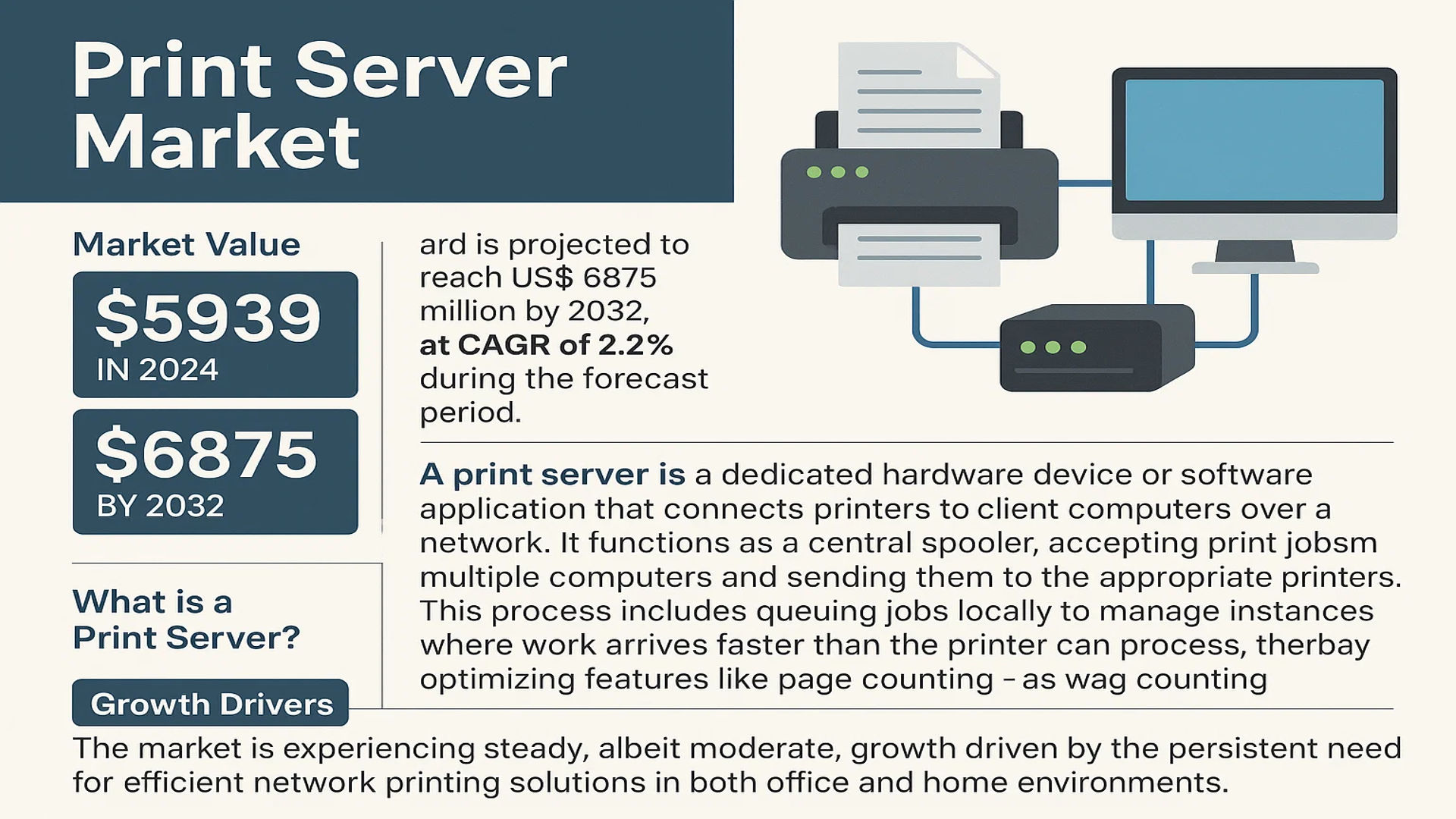
The global Print Server Market was valued at 5939 million in 2024 and is projected to reach US$ 6875 million by 2032, at a CAGR of 2.2% during the forecast period.
A print server is a dedicated hardware device or software application that connects printers to client computers over a network. It functions as a central spooler, accepting print jobs from multiple computers and sending them to the appropriate printers. This process includes queuing jobs locally to manage instances where work arrives faster than the printer can process, thereby optimizing workflow and preventing data bottlenecks. Ancillary functions often include the ability to inspect, reorder, or delete jobs in the queue, as well as providing accounting features like page counting, which may involve reading data generated by the printers themselves.
The market is experiencing steady, albeit moderate, growth driven by the persistent need for efficient network printing solutions in both office and home environments. However, growth is tempered by the increasing adoption of cloud-based printing solutions and wireless direct printing technologies. The market remains highly concentrated, with the top three players—D-Link, HP, and Startech—collectively holding a significant 32% market share. Other key players operating in this space with extensive portfolios include Brother International, Canon, Xerox, NETGear, and TRENDnet.
MARKET DYNAMICS
MARKET DRIVERS
Enterprise Digital Transformation Initiatives to Accelerate Print Server Adoption
The ongoing digital transformation across enterprises globally is driving significant demand for print servers as organizations modernize their IT infrastructure. With over 65% of businesses actively investing in network optimization and centralized print management solutions, print servers have become essential components for managing multi-vendor printer fleets efficiently. These devices enable seamless integration of legacy printing equipment with modern cloud-based workflows, reducing operational costs by up to 30% through centralized administration and monitoring. The transition to hybrid work models has further emphasized the need for reliable network printing solutions that can support both on-premise and remote printing requirements, creating sustained demand across various industry verticals.
Growing Small and Medium Business Sector to Fuel Market Expansion
The rapid expansion of the small and medium business sector worldwide represents a substantial growth opportunity for the print server market. With approximately 400 million SMEs globally accounting for nearly 90% of businesses and more than 50% of employment worldwide, this segment has demonstrated increasing adoption of professional printing solutions. Print servers provide cost-effective network printing capabilities that allow multiple users to share printers without requiring individual connections, reducing hardware costs by up to 40% compared to traditional setups. The proliferation of home offices and small professional workspaces has further accelerated demand, with the segment expected to maintain a growth rate exceeding 3.5% annually through the forecast period.
Enhanced Security Features Driving Enterprise Adoption
Increasing concerns about print security and data protection are compelling organizations to invest in advanced print server solutions with robust security features. Network printing has emerged as a significant vulnerability point, with studies indicating that unsecured printers contribute to approximately 60% of data breaches in office environments. Modern print servers address these concerns through advanced encryption protocols, user authentication mechanisms, and secure job release technologies that prevent unauthorized access to sensitive documents. The implementation of these security features has become particularly crucial in regulated industries such as healthcare and finance, where compliance requirements mandate stringent document handling procedures.
MARKET CHALLENGES
Increasing Shift Toward Digitalization and Paperless Workflows to Challenge Market Growth
The global movement toward digital transformation and paperless office environments presents a significant challenge to the print server market. Organizations are increasingly adopting digital document management systems, cloud storage solutions, and electronic workflow platforms that reduce reliance on physical printing. Recent surveys indicate that enterprises have reduced their printing volumes by approximately 25-30% over the past five years, with further reductions expected as digital adoption accelerates. This trend is particularly pronounced in knowledge-intensive industries where document collaboration and electronic signatures have become standard practice, diminishing the need for traditional printing infrastructure and consequently affecting print server demand.
Other Challenges
Compatibility Issues with Modern Operating Systems
The rapid evolution of operating systems and network protocols creates persistent compatibility challenges for print server manufacturers. With major technology companies frequently updating their software ecosystems, print server providers must continuously develop new drivers and firmware updates to maintain functionality. This ongoing requirement for compatibility testing and software development increases operational costs and can lead to temporary market disruptions when new operating system versions are released.
Intense Price Competition from Integrated Solutions
The market faces increasing pressure from all-in-one network printers and multifunction devices that incorporate built-in print server capabilities. These integrated solutions often provide comparable functionality at lower total cost of ownership, particularly for small to medium-sized installations. The competitive landscape has intensified as manufacturers of network-enabled printers incorporate advanced management features directly into their devices, reducing the need for standalone print server solutions in many deployment scenarios.
MARKET RESTRAINTS
Technical Complexity and Integration Challenges to Hinder Market Penetration
The technical complexity associated with print server implementation and maintenance acts as a significant restraint on market growth. Many organizations, particularly smaller businesses with limited IT resources, struggle with the configuration, deployment, and ongoing management of print server solutions. The integration process often requires specialized networking knowledge and can involve compatibility issues with existing infrastructure, creating implementation barriers. Additionally, the need for regular firmware updates and security patches adds to the operational burden, leading some organizations to opt for simpler though less efficient printing solutions. These technical challenges are particularly pronounced in heterogeneous network environments where multiple printer brands and models must be supported simultaneously.
Economic Uncertainties and Budget Constraints to Limit Investments
Global economic fluctuations and organizational budget constraints significantly impact the print server market. During periods of economic uncertainty, businesses often defer IT infrastructure upgrades and extend the lifecycle of existing equipment, directly affecting replacement cycles for print servers. The perception of print servers as non-essential infrastructure components makes them vulnerable to budget cuts, with many organizations prioritizing investments in core business systems over printing infrastructure. This financial pressure is particularly evident in price-sensitive markets and among small businesses operating with limited capital expenditure budgets.
MARKET OPPORTUNITIES
Cloud Integration and IoT Connectivity to Create New Growth Pathways
The integration of cloud computing capabilities and Internet of Things connectivity presents substantial growth opportunities for the print server market. Modern print servers are evolving into intelligent network devices that offer cloud-based management, remote monitoring, and predictive maintenance features. This transformation enables organizations to manage distributed printing infrastructure centrally while reducing on-site IT support requirements. The adoption of cloud-connected print servers has grown by approximately 40% annually as businesses seek more flexible and scalable printing solutions. These advanced systems provide real-time analytics on printing patterns, consumable usage, and maintenance requirements, creating additional value beyond basic print job management.
Emerging Markets Infrastructure Development to Drive Future Demand
The ongoing infrastructure development and digitalization initiatives in emerging economies represent a significant opportunity for market expansion. As businesses in these regions modernize their operations and invest in network infrastructure, the demand for efficient printing solutions is expected to increase substantially. Government initiatives promoting digital literacy and small business development are creating favorable conditions for print server adoption, particularly in sectors such as education, healthcare, and public administration. The growing middle class and increasing disposable income in these markets are further driving office automation investments, including advanced printing solutions that require robust print server support.
Advanced Analytics and Managed Print Services Integration to Enhance Value Proposition
The integration of advanced analytics capabilities and support for managed print services creates new revenue streams and market opportunities. Modern print servers are increasingly incorporating data collection and analysis features that provide insights into printing behaviors, cost allocation, and environmental impact. These capabilities enable organizations to optimize their printing infrastructure, reduce waste, and improve cost efficiency. The partnership between print server manufacturers and managed print service providers has created synergistic business models where hardware sales are complemented by ongoing service contracts, enhancing customer retention and creating more predictable revenue patterns.
PRINT SERVER MARKET TRENDS
Integration with Cloud and IoT Ecosystems Emerges as a Dominant Trend
The global Print Server market is undergoing a significant transformation, driven by the pervasive integration with cloud computing and Internet of Things (IoT) ecosystems. This trend is fundamentally reshaping how businesses manage their printing infrastructure, moving away from traditional, localized setups to more flexible, centralized, and remotely accessible solutions. The adoption of cloud-based print management software, which often relies on dedicated print servers, has seen a notable uptick, with the cloud services market itself projected to grow substantially. This shift is largely fueled by the post-pandemic acceleration of hybrid work models, where employees require seamless access to office resources from any location. Consequently, modern print servers are increasingly designed with robust security protocols to protect network integrity and sensitive documents, addressing one of the primary concerns in digital workflows. Furthermore, the ability of these devices to provide detailed usage analytics and automate supplies replenishment is adding a layer of operational intelligence that was previously unavailable, making them a critical component of the modern smart office.
Other Trends
Rising Demand for Wireless and Mobile Printing Solutions
The proliferation of mobile devices in both professional and personal environments is creating a sustained demand for print servers that support wireless connectivity and mobile printing protocols. Standards like Apple AirPrint, Google Cloud Print, and Mopria have become essential features, as users expect the ability to print directly from smartphones and tablets without the need for complex driver installations. This trend is particularly strong in the home and small office segments, where convenience and ease of use are paramount purchasing factors. The market has responded with a wave of compact, user-friendly external print servers that can be easily added to existing printer hardware, effectively modernizing older devices and extending their operational lifespan. This not only caters to the demand for mobile compatibility but also aligns with broader sustainability goals by reducing electronic waste.
Consolidation and Specialization in a Mature Market
While the market exhibits steady growth, it is also characterized by a high degree of consolidation and increasing product specialization. The top three manufacturers collectively hold a significant portion of the global market share, leveraging their extensive distribution networks and brand recognition. However, this concentration fosters intense competition, pushing companies to differentiate their offerings beyond basic connectivity. We are now seeing a clear segmentation where products are tailored for specific environments: high-volume, enterprise-grade servers with advanced queue management and accounting features for large offices, and simpler, plug-and-play units for home users. This specialization is a direct response to the diverse needs of the market’s application segments. Additionally, the technical barriers, though not insurmountable, ensure that innovation remains a key competitive differentiator, with leading players investing in enhanced security features, energy efficiency, and compatibility with a wider range of printer models and multifunction devices.
COMPETITIVE LANDSCAPE
Key Industry Players
Companies Strive to Strengthen their Product Portfolio to Sustain Competition
The competitive landscape of the global print server market is semi-consolidated, characterized by a mix of large multinational corporations and specialized medium to small-sized players. This structure is largely due to the relatively high technical barriers and the significant advantage held by companies with established R&D capabilities and robust distribution networks. D-Link Corporation emerges as a dominant force, leveraging its extensive portfolio of networking hardware and strong brand recognition across both consumer and commercial segments. Their market leadership is further solidified by a comprehensive global presence, particularly in North America, Europe, and Asia-Pacific regions.
HP Inc. and Startech.com also command significant market shares, collectively accounting for a substantial portion of global revenues. HP’s strength is deeply rooted in its vast ecosystem of printers and enterprise solutions, creating a natural demand for its compatible print servers. Meanwhile, Startech.com has carved out a strong position by focusing on specialized connectivity solutions, including a wide array of external and internal print server models that cater to diverse and legacy hardware requirements. The sustained growth of these top players is attributed to continuous product innovation, strategic pricing, and deep penetration in key end-markets such as corporate offices and large enterprises.
Furthermore, these leading companies are actively pursuing growth through strategic initiatives, including geographical expansion into emerging markets and the launch of advanced products featuring enhanced security protocols and cloud integration capabilities. Such moves are critical for maintaining competitiveness in an evolving digital landscape where network security and remote management are becoming paramount.
Meanwhile, other notable players like Brother International and Canon Inc. are strengthening their market positions. They are achieving this through significant investments in research and development to create more seamless integration between their printers and network infrastructure. Additionally, companies such as NETGear and TRENDnet are competing aggressively by offering cost-effective and reliable solutions, often focusing on the small office/home office (SOHO) segment, ensuring dynamic and continued evolution within the competitive landscape.
List of Key Print Server Companies Profiled
- D-Link Corporation (Taiwan)
- HP Inc. (U.S.)
- Brother International Corporation (U.S.)
- Startech.com Ltd. (Canada)
- Dymo (U.S.)
- Linksys (U.S.)
- Canon Inc. (Japan)
- Edimax Technology Co., Ltd. (Taiwan)
- Xerox Corporation (U.S.)
- IOGEAR (U.S.)
- NETGEAR, Inc. (U.S.)
- TRENDnet (U.S.)
Segment Analysis:
By Type
External Print Server Segment Commands Significant Market Share Due to Superior Flexibility and Ease of Deployment
The market is segmented based on type into:
- Internal Print Server
- Typically a card installed inside a printer, offering a dedicated network connection.
- External Print Server
- A standalone hardware device that connects one or more printers directly to a network, providing greater flexibility for older printers and multi-printer setups.
By Application
Office Application Segment Leads the Market Owing to High Demand for Centralized Network Printing Solutions
The market is segmented based on application into:
- Office
- Home
- Others
- Includes educational institutions, public printing kiosks, and industrial environments.
By Connectivity
Wired Ethernet Connectivity Remains Prevalent for its Reliability and Security in Corporate Environments
The market is segmented based on connectivity into:
- Wired
- Primarily Ethernet (RJ-45) connections.
- Wireless
- Wi-Fi connectivity, catering to modern, cable-free office and home setups.
By End-User
Large Enterprises Dominate Consumption Due to Complex Printing Infrastructure and High-Volume Needs
The market is segmented based on end-user into:
- Small and Medium Enterprises (SMEs)
- Large Enterprises
- Individual Consumers / Home Office
Regional Analysis: Print Server Market
Asia-Pacific
The Asia-Pacific region dominates the global print server market, accounting for over 40% of total revenue share. This leadership position is driven by rapid digitalization across small and medium enterprises, extensive manufacturing of networking hardware, and the widespread adoption of multi-function printers in countries like China, Japan, and India. China, as the world’s manufacturing hub, produces a significant portion of global print server units, with companies like D-Link and Edimax maintaining strong production facilities. The region benefits from cost-competitive manufacturing and high domestic demand from both the corporate and public sectors. However, increasing integration of print management software into operating systems presents a long-term challenge to dedicated hardware sales.
North America
North America represents the second-largest market for print servers, characterized by high adoption of advanced networking solutions and strong presence of market leaders like HP, NETGear, and Linksys. The region’s mature IT infrastructure and high security requirements in corporate environments drive demand for specialized print servers with enhanced management features and compliance capabilities. The market is transitioning toward cloud-integrated print solutions and IoT-enabled devices, though traditional print servers remain relevant for organizations with specific security protocols or legacy system compatibility needs. The United States accounts for approximately 85% of the regional market value.
Europe
Europe maintains a stable print server market with emphasis on security, energy efficiency, and compliance with data protection regulations such as GDPR. Germany, France, and the UK are the primary markets, driven by robust manufacturing and corporate sectors. European customers show strong preference for brands like Brother International and Canon that offer reliable performance and local support networks. The market faces pressure from software-based print management solutions but continues to see demand from industries requiring isolated network printing and specialized accounting features. Environmental regulations regarding electronic waste and energy consumption are influencing product development toward more efficient designs.
South America
The South American print server market is emerging, with Brazil and Argentina representing the primary growth areas. Market expansion is driven by increasing computerization of businesses and infrastructure development. However, economic volatility and currency fluctuations affect consistent adoption of networking hardware. Price sensitivity leads to strong competition among entry-level products, with consumers often prioritizing cost over advanced features. The market shows potential for growth as digital transformation initiatives gain traction, particularly in the education and government sectors.
Middle East & Africa
This region represents a developing market for print servers, with growth concentrated in urban centers and economic hubs like UAE, Saudi Arabia, and South Africa. Market development is driven by infrastructure investments and business modernization efforts. The region shows particular interest in robust external print servers capable of operating in high-temperature environments. While the market remains relatively small compared to other regions, it presents opportunities for vendors offering durable products with simple deployment features. Political and economic instability in some areas continues to constrain broader market development.
Report Scope
This market research report provides a comprehensive analysis of the global Print Server market, covering the forecast period 2025–2032. It offers detailed insights into market dynamics, technological advancements, competitive landscape, and key trends shaping the industry.
Key focus areas of the report include:
- Market Size & Forecast: Historical data and future projections for revenue, unit shipments, and market value across major regions and segments.
- Segmentation Analysis: Detailed breakdown by product type, technology, application, and end-user industry to identify high-growth segments and investment opportunities.
- Regional Outlook: Insights into market performance across North America, Europe, Asia-Pacific, Latin America, and the Middle East & Africa, including country-level analysis where relevant.
- Competitive Landscape: Profiles of leading market participants, including their product offerings, R&D focus, manufacturing capacity, pricing strategies, and recent developments such as mergers, acquisitions, and partnerships.
- Technology Trends & Innovation: Assessment of emerging technologies, integration of cloud-based solutions, IoT connectivity, evolving network protocols, and enhanced security features.
- Market Drivers & Restraints: Evaluation of factors driving market growth along with challenges, supply chain constraints, regulatory issues, and market-entry barriers.
- Stakeholder Analysis: Insights for component suppliers, OEMs, system integrators, investors, and policymakers regarding the evolving ecosystem and strategic opportunities.
Primary and secondary research methods are employed, including interviews with industry experts, data from verified sources, and real-time market intelligence to ensure the accuracy and reliability of the insights presented.
FREQUENTLY ASKED QUESTIONS:
What is the current market size of Global Print Server Market?
-> Print Server Market was valued at 5939 million in 2024 and is projected to reach US$ 6875 million by 2032, at a CAGR of 2.2% during the forecast period.
Which key companies operate in Global Print Server Market?
-> Key players include D-Link, HP, Brother International, Startech, Dymo, Linksys, Canon, Edimax, Xerox, IOGEAR, NETGear, and TRENDnet, among others.
What are the key growth drivers?
-> Key growth drivers include increasing demand for network printing solutions in offices, growth in SMBs requiring shared printing resources, and technological advancements in print server capabilities.
Which region dominates the market?
-> Asia-Pacific is the fastest-growing region, while North America remains a dominant market due to high technology adoption rates.
What are the emerging trends?
-> Emerging trends include integration with cloud-based printing solutions, enhanced security features for network printing, and the development of wireless print servers.

Get Sample Report PDF for Exclusive Insights
Report Sample Includes
- Table of Contents
- List of Tables & Figures
- Charts, Research Methodology, and more...
 Download Sample Report PDF