
MARKET INSIGHTS
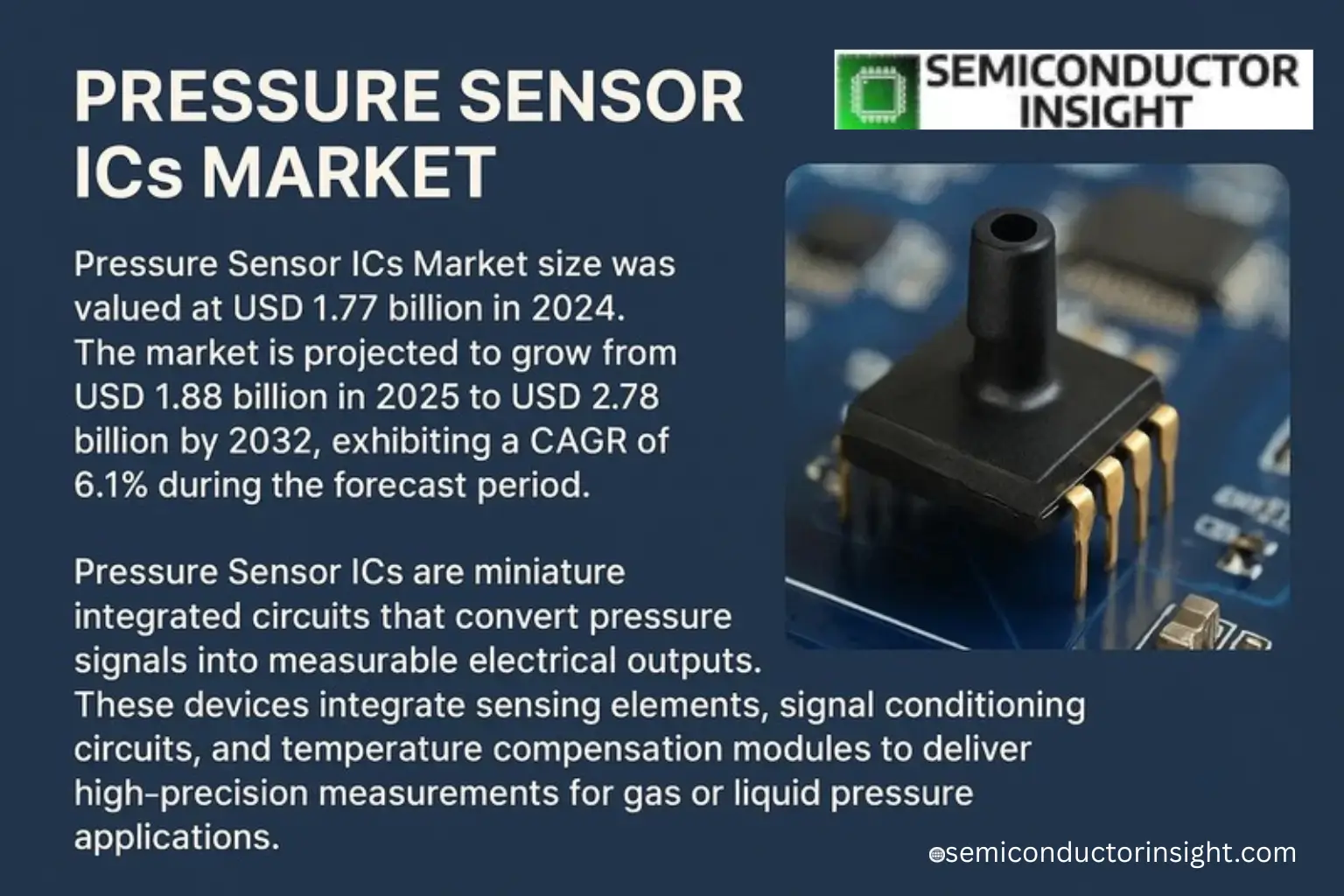
Global Pressure Sensor ICs Market size was valued at USD 1.77 billion in 2024. The market is projected to grow from USD 1.88 billion in 2025 to USD 2.78 billion by 2032, exhibiting a CAGR of 6.1% during the forecast period.
Pressure Sensor ICs are miniature integrated circuits that convert pressure signals into measurable electrical outputs. These devices integrate sensing elements, signal conditioning circuits, and temperature compensation modules to deliver high-precision measurements for gas or liquid pressure applications. They are widely used in automotive systems (tire pressure monitoring, engine management), industrial automation, medical equipment (blood pressure monitors, ventilators), and consumer electronics.
The market growth is driven by increasing demand for smart sensors in automotive electrification and Industry 4.0 applications, alongside advancements in MEMS technology enabling smaller form factors and lower power consumption. However, high R&D costs and technical complexities in extreme-environment applications remain challenges. Key players like Bosch, Infineon, and TE Connectivity dominate the market through continuous innovation for instance, Bosch’s latest MEMS-based sensors achieved a 15% reduction in power consumption while improving accuracy to ±0.25% full-scale output.
MARKET DRIVERS
Proliferation of Smart and Connected Devices
The escalating demand for intelligent systems across consumer electronics, industrial automation, and automotive sectors is a primary driver for the Pressure Sensor ICs Market. These integrated circuits are essential for monitoring and controlling pressure in applications like smartphones, wearables, and IoT-enabled industrial equipment. The push towards miniaturization and enhanced functionality requires compact, reliable, and energy-efficient pressure sensing solutions, directly fueling market expansion.
Stringent Regulatory Standards and Safety Requirements
Regulatory mandates concerning safety, emissions, and efficiency, particularly in the automotive and healthcare industries, are accelerating the adoption of high-precision pressure sensor ICs. Government policies worldwide are enforcing stricter norms for vehicle safety systems, including tire pressure monitoring systems (TPMS) and engine management, creating a sustained demand for robust sensor technology.
Furthermore, the industrial sector’s focus on predictive maintenance and operational safety underscores the critical role of these components, ensuring reliable performance in harsh environments.
MARKET CHALLENGES
High Development Costs and Technical Complexity
Designing and manufacturing advanced Pressure Sensor ICs involves significant R&D investment and sophisticated fabrication processes, particularly for MEMS technology. Achieving high accuracy, stability, and miniaturization while managing costs presents a major challenge for market players, potentially limiting their ability to scale production for cost-sensitive applications.
Other Challenges
Intense Price Competition
The market is characterized by strong competition, leading to price pressures that can erode profit margins, especially for standardized sensor ICs.
Supply Chain Vulnerabilities
Dependence on specialized raw materials and semiconductor fabrication facilities makes the supply chain susceptible to disruptions, as evidenced by recent global chip shortages.
MARKET RESTRAINTS
Saturation in Mature Application Segments
Growth in certain established markets, such as automotive TPMS and consumer electronics, is slowing as these segments reach high penetration rates. This maturity limits the volume-based growth potential for standard pressure sensor ICs, compelling manufacturers to innovate and target emerging applications to maintain momentum.
Performance Limitations in Extreme Conditions
The operational efficacy of some pressure sensor ICs can be compromised under extreme temperatures, high vibrations, or corrosive environments. This restraint is particularly relevant for applications in aerospace, oil & gas, and heavy industry, where sensor failure can have critical consequences, demanding more robust and expensive solutions.
MARKET OPPORTUNITIES
Expansion in Electric and Autonomous Vehicles
The rapid transition to electric vehicles (EVs) and the development of autonomous driving systems represent a significant growth avenue for the Pressure Sensor ICs Market. These advanced vehicles require numerous sensors for battery management, brake systems, cabin air quality, and advanced driver-assistance systems (ADAS), creating substantial demand for high-performance, reliable pressure sensing solutions.
Growth of Industrial IoT and Smart Infrastructure
The ongoing Industrial IoT (IIoT) revolution and investments in smart city infrastructure offer prolific opportunities. Pressure sensor ICs are integral for monitoring pipelines, HVAC systems, water management, and manufacturing processes, enabling real-time data collection and predictive analytics for improved efficiency and resource management.
Pressure Sensor ICs Market Trends
Broadening Application Scope Driving Expansion
The Pressure Sensor ICs Market is experiencing a significant expansion beyond its traditional strongholds in the automotive and industrial control sectors. These miniature integrated circuits are now indispensable core sensing units in medical equipment, consumer electronics, and smart home devices. This diversification is a primary driver of market growth. Global market, valued at USD 1766 million in 2024, is projected to reach USD 2782 million by 2032, reflecting a steady compound annual growth rate (CAGR) of 6.1%. The maturity and cost reduction of MEMS (Micro-Electro-Mechanical Systems) technology have been instrumental, enabling the development of smaller, lower-power, and more highly integrated sensor ICs that are ideal for modern, compact devices.
Other Trends
Automotive Sector Evolution
Within the automotive industry, the transition towards intelligent driving and new energy vehicles is creating robust demand for high-precision Pressure Sensor ICs. Applications are expanding from tire pressure monitoring and engine management to critical roles in battery thermal management systems for electric vehicles. This shift necessitates pressure sensors with enhanced performance metrics, including higher accuracy, faster response times, and the ability to operate reliably across wider temperature ranges.
Technological Integration and Market Challenges
The next wave of growth for the Pressure Sensor ICs Market is linked to integration with advanced technologies like AI and edge computing. This is fostering the evolution of “smart sensors” capable of on-device data processing and intelligent decision-making, which is particularly valuable for real-time applications. However, the market faces significant barriers, including a high technological threshold for producing sensors that meet demanding specifications for high stability in extreme environments. This has resulted in a competitive landscape where a few global leaders, such as Bosch, Infineon, and TE Connectivity, dominate the high-end segment. Furthermore, high initial investments for MEMS manufacturing and intense price competition due to product homogeneity compress profit margins for many participants.
COMPETITIVE LANDSCAPE
Key Industry Players
Technology Leadership and Market Consolidation Define the Pressure Sensor IC Market
Global Pressure Sensor ICs Market is characterized by a high degree of technological intensity and is consolidated among a few international giants that dominate the high-performance segments. Companies like Bosch, Infineon, and TE Connectivity lead the market, leveraging their extensive expertise in MEMS fabrication, sophisticated signal conditioning algorithms, and robust global supply chains. Their leadership is particularly pronounced in the highly demanding automotive sector, where requirements for long-term reliability, high accuracy, and operation under extreme temperatures create significant entry barriers. These players have established deep relationships with major automotive OEMs and Tier-1 suppliers, securing their positions in critical applications such as tire pressure monitoring systems (TPMS), manifold absolute pressure (MAP) sensors, and battery pack pressure monitoring for electric vehicles.
Beyond the dominant leaders, a tier of specialized and significant players competes effectively in niche applications and specific regional markets. Companies such as Sensirion, STMicroelectronics, and NXP offer strong portfolios with a focus on consumer electronics, industrial automation, and medical devices. Furthermore, established component suppliers like Honeywell, Amphenol, and Omron apply their broad sensing expertise to the pressure IC segment, often differentiating through application-specific integration and reliability. The competitive landscape also includes agile innovators like Superior Sensor Technology, which focuses on high-performance differential pressure sensing, and regional players such as Melexis and ROHM, who are strengthening their market presence. This diverse ecosystem fosters competition, driving advancements in miniaturization, power efficiency, and smart sensor capabilities.
List of Key Pressure Sensor IC Companies Profiled
- Amphenol
- Honeywell
- Bosch
- Infineon
- Wurth Elektronik
- Adafruit
- Alps Alpine
- ROHM Co., Ltd.
- Bourns
- NXP
- Sensirion
- STMicroelectronics
- TE Connectivity
- Melexis
- Omron
- TDK
- Superior Sensor Technology
- Metrodyne Microsystem
- Shenzhen HOPERF
Segment Analysis:
| Segment Category | Sub-Segments | Key Insights |
| By Type |
|
Absolute Pressure Sensor ICs
|
| By Application |
|
Automotive
|
| By End User |
|
OEMs
|
| By Technology |
|
MEMS-based
|
| By Pressure Range |
|
Medium Pressure
|
Regional Analysis: Global Pressure Sensor ICs Market
Asia-Pacific leads in pressure sensor IC integration for tire pressure monitoring and fuel injection systems, driven by regional automotive manufacturing hubs. Japanese firms pioneer miniature pressure sensors for hybrid vehicle battery packs.
Smart factory initiatives in China and Taiwan incorporate pressure sensor ICs for pneumatic system monitoring. Sensor fusion solutions combine pressure data with temperature readings for predictive maintenance applications.
South Korean manufacturers embed pressure sensor ICs in smartphones for altitude measurement and waterproofing detection. Wearable health devices utilize differential pressure sensors for advanced fitness tracking capabilities.
Singaporean medtech firms develop disposable pressure sensor ICs for portable diagnostic equipment. Continuous blood pressure monitoring patches leverage ultra-low power sensor IC designs from regional semiconductor leaders.
North America
The North American Pressure Sensor ICs Market thrives on aerospace and defense applications, with stringent requirements for high-reliability pressure measurement. Silicon Valley startups innovate MEMS-based pressure sensors for industrial IoT platforms, while Canadian firms specialize in harsh environment sensing solutions. Automotive tier-1 suppliers integrate smart pressure sensor ICs for advanced driver assistance systems. The region sees growing adoption in building automation for HVAC optimization and water management systems.
Europe
European manufacturers lead in precision pressure sensor ICs for industrial process control and medical ventilators. German automotive suppliers develop contactless pressure sensing technologies for brake systems. The region’s emphasis on energy efficiency drives demand for pressure sensor ICs in smart home appliances and renewable energy systems. Scandinavian countries pioneer frost-resistant pressure sensor designs for offshore and Arctic applications.
Middle East & Africa
The Pressure Sensor ICs Market expands through oil & gas monitoring applications and smart city infrastructure projects. UAE-based companies adopt differential pressure sensors for building management systems in extreme climates. South African mining operations implement ruggedized pressure sensor ICs for equipment condition monitoring. Water scarcity concerns drive innovation in irrigation system pressure optimization solutions.
South America
Brazilian automotive manufacturers increase pressure sensor IC adoption for ethanol fuel system monitoring. Agricultural equipment modernization in Argentina incorporates pressure sensors for precision spraying systems. Chilean mining operations deploy explosion-proof pressure sensor ICs for underground gas detection. Regional growth is constrained by semiconductor supply chain challenges despite growing industrial automation needs.
Report Scope
This market research report provides a comprehensive analysis of the Pressure Sensor ICs Market , covering the forecast period 2025–2032. It offers detailed insights into market dynamics, technological advancements, competitive landscape, and key trends shaping the industry.
Key focus areas of the report include:
- Market Overview: The report begins with an overview outlining its current market scenario, key growth indicators, and industry transformation drivers. It discusses macroeconomic factors, demand–supply balance, regulatory landscape, and the strategic role of semiconductors in powering advancements across industries such as automotive, medical, consumer electronics, and industrial automation.
- Market Size & Forecast: Historical data and future projections for revenue, unit shipments, and market value across major regions and segments.
- Segmentation Analysis: Detailed breakdown by product type, technology, application, and end-user industry to identify high-growth segments and investment opportunities.
- Regional Insights: Insights into market performance across North America, Europe, Asia, South America, and Middle East & Africa, including country-level analysis where relevant.
- Competitive Landscape: Profiles of leading market participants, including their product offerings, R&D focus, manufacturing capacity, pricing strategies, and recent developments such as mergers, acquisitions, and partnerships.
- Technology Trends & Innovation: Assessment of emerging technologies, integration of AI/IoT, MEMS technology advancements, and evolving industry standards.
- Market Drivers & Restraints: Evaluation of factors driving market growth along with challenges, supply chain constraints, regulatory issues, and market-entry barriers.
- Stakeholder Insights: Insights for component suppliers, OEMs, system integrators, investors, and policymakers regarding the evolving ecosystem and strategic opportunities.
Primary and secondary research methods are employed, including interviews with industry experts, data from verified sources, and real-time market intelligence to ensure the accuracy and reliability of the insights presented.
FREQUENTLY ASKED QUESTIONS:
What is the current market size of Pressure Sensor ICs Market?
-> Pressure Sensor ICs Market size was valued at USD 1.77 billion in 2024. The market is projected to grow from USD 1.88 billion in 2025 to USD 2.78 billion by 2032, exhibiting a CAGR of 6.1% during the forecast period.
What is the growth rate of Pressure Sensor ICs Market?
-> The market is projected to grow at a CAGR of 6.1% during 2025-2032.
Which key companies operate in Pressure Sensor ICs Market?
-> Key players include Bosch, Infineon, TE Connectivity, Honeywell, STMicroelectronics, NXP, Sensirion, and Omron, among others.
What are the key applications of Pressure Sensor ICs?
-> Key applications include automotive systems, medical equipment, industrial automation, consumer electronics, and process measurement.
What are the emerging trends in Pressure Sensor ICs Market?
-> Emerging trends include integration with AI/edge computing, development of smart sensors, and increasing adoption in electric vehicles and wearable medical devices.

Get Sample Report PDF for Exclusive Insights
Report Sample Includes
- Table of Contents
- List of Tables & Figures
- Charts, Research Methodology, and more...
 Download Sample Report PDF



