Precision Analog IC Market Insights
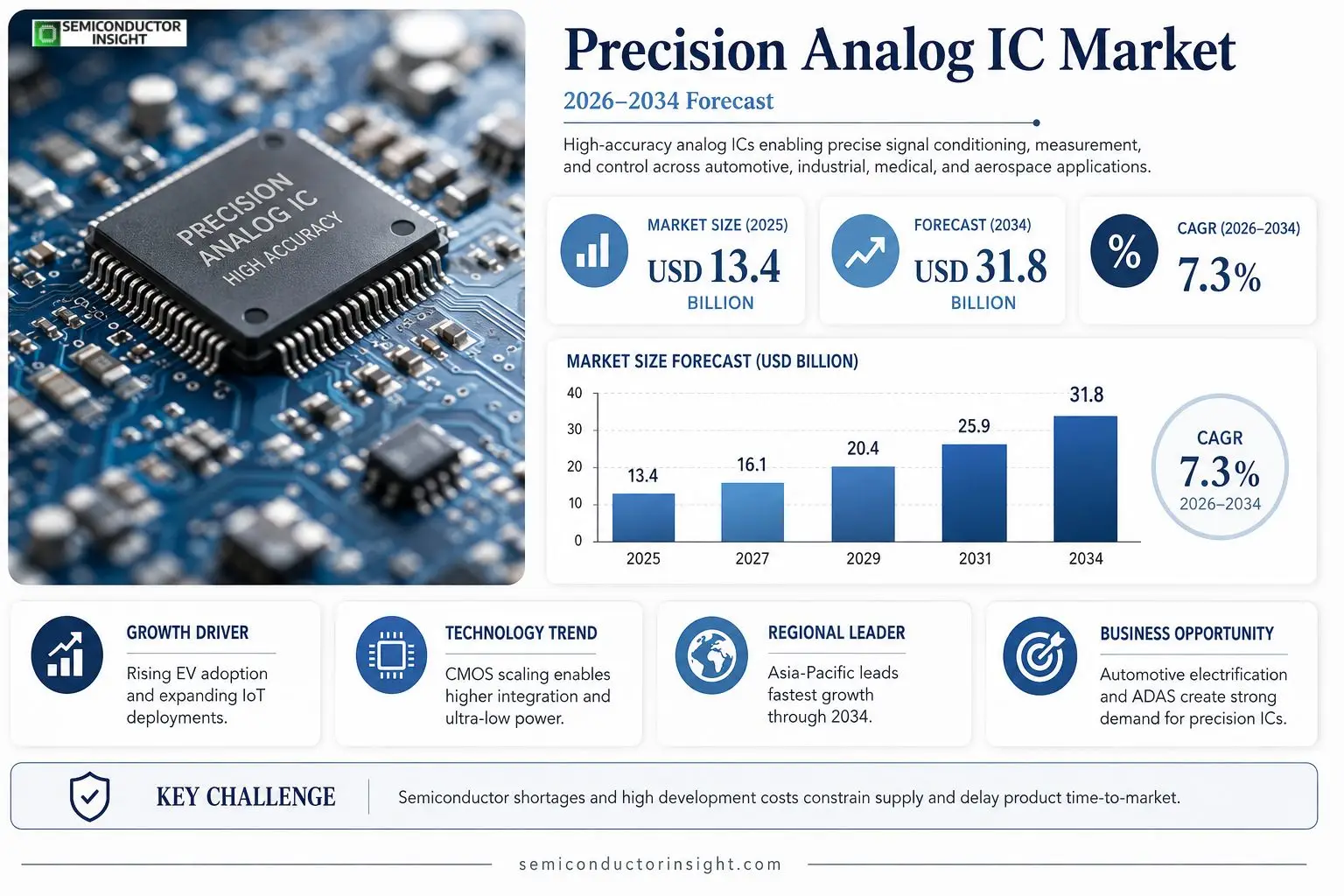
Global precision analog integrated circuits market size was valued at USD 13.4 billion in 2025. The market is projected to grow from USD 14.1 billion in 2025 to USD 31.8 billion by 2034, exhibiting a CAGR of 7.3% during the forecast period.
Precision analog ICs are high‑performance semiconductor components designed for accurate signal conditioning, measurement, and control in applications such as automotive ADAS, industrial automation, medical instrumentation, and aerospace. These devices include low‑noise amplifiers, high‑resolution data converters, voltage references, and temperature sensors that require tight tolerance and stability.The market is experiencing rapid growth because of rising electric‑vehicle adoption, expanding IoT deployments, and stricter safety regulations for critical systems. Furthermore, advances in CMOS scaling enable higher integration while keeping power consumption low. Key players,including Texas Instruments, Analog Devices, Infineon Technologies, and STMicroelectronics,are broadening their portfolios through strategic acquisitions and intensive R&D efforts.
MARKET DRIVERS
Rising Adoption of IoT and Edge Devices
Precision Analog IC Market is being propelled by the exponential growth of Internet‑of‑Things (IoT) deployments, where accurate signal conditioning is critical for sensor reliability. Manufacturers are integrating high‑resolution analog front‑ends to support real‑time data analytics, thereby creating a robust demand pipeline.
Energy‑Efficient Design Trends
Low‑power analog architectures are gaining traction as devices strive for longer battery life. Advances in sub‑micron processes enable ultra‑low quiescent current, allowing edge nodes to operate for years without maintenance. This efficiency push directly fuels Precision Analog IC Market expansion.
➤ “Analog precision is the bridge between digital intelligence and real‑world interaction.”
Finally, regulatory standards for medical and industrial equipment are tightening, mandating higher accuracy and stability. Companies that can deliver compliant, high‑performance analog solutions are positioned to capture significant market share.
MARKET CHALLENGES
Supply Chain Constraints
Global semiconductor shortages have disrupted the availability of specialty substrates required for precision analog devices. Lead times have extended, increasing inventory costs for OEMs and slowing time‑to‑market for new product introductions.
Other Challenges
Manufacturing Yield
Achieving high yield on complex analog geometries remains difficult, as small process variations can cause performance drift, raising overall production expenses.
MARKET RESTRAINTS
High Development Costs
Designing precision analog circuitry demands extensive simulation, silicon validation, and specialized engineering talent, inflating R&D budgets. Smaller players often lack the capital to invest in such intensive programs, limiting market participation.Furthermore, the need for rigorous testing under varied temperature and voltage conditions adds to the overall cost structure, deterring entry from cost‑sensitive segments.
MARKET OPPORTUNITIES
Emerging Automotive Electrification
Electrified powertrains and advanced driver‑assistance systems (ADAS) require ultra‑precise signal conversion for sensor fusion and battery management. The shift toward 48 V architectures creates a sizable opportunity for high‑accuracy analog ICs that can operate across wide voltage ranges.Additionally, the rollout of vehicle‑to‑everything (V2X) communication standards will need robust analog front‑ends capable of handling high‑frequency RF signals with minimal distortion, positioning Precision Analog IC Market as a critical enabler of next‑generation automotive technology.
Precision Analog IC Market Trends
Growth Driven by Automotive and IoT
Precision Analog IC Market is experiencing a pronounced upswing as vehicle manufacturers integrate advanced driver‑assistance systems (ADAS) that rely on low‑noise amplifiers and high‑resolution converters. Concurrently, the proliferation of Internet‑of‑Things devices creates demand for stable voltage references and temperature sensors that maintain accuracy across diverse operating environments. These dual forces are reshaping product roadmaps and prompting designers to prioritize components that deliver both precision and low power consumption.
Other Trends
Integration and Power Efficiency
Recent advances in CMOS scaling enable higher functional integration within a single die, allowing analog signal‑conditioning blocks to coexist with digital logic while preserving tight tolerance. This integration reduces board space, cuts bill‑of‑materials costs, and minimizes overall power draw,a critical consideration for battery‑operated equipment in both automotive and industrial sectors. As a result, manufacturers are launching families of mixed‑signal ICs that combine analog front‑ends with embedded calibration engines, delivering superior performance without sacrificing efficiency.
Competitive Landscape
Key players such as Texas Instruments, Analog Devices, Infineon Technologies, and STMicroelectronics are expanding their portfolios through targeted acquisitions and accelerated research programs. These companies focus on enhancing device robustness to meet stricter safety standards, especially in aerospace and medical instrumentation where failure tolerance is non‑negotiable. Product launches now often emphasize built‑in self‑test capabilities and extended temperature ranges, reflecting a market preference for solutions that simplify system validation.In addition to established vendors, emerging startups are leveraging niche specializations in ultra‑low‑noise designs for quantum‑sensor applications. Their innovations are prompting larger firms to adopt collaborative development models, fostering an ecosystem where bespoke analog performance can be integrated into mainstream production lines. This dynamic encourages continual refinement of design methodologies and drives the overall maturity of Precision Analog IC Market.
COMPETITIVE LANDSCAPEKey Industry Players
Precision Analog IC Market Competitive Outlook
Precision Analog IC Market is dominated by a handful of large semiconductor firms that leverage extensive R&D budgets and broad product portfolios to address high‑performance automotive, industrial and medical applications. Texas Instruments leads the segment with its ultra‑low‑noise amplifiers and high‑resolution data converters, capitalising on a global sales network that spans more than 150 countries. Analog Devices follows closely, offering a deep line of precision references, instrumentation amplifiers and mixed‑signal converters that benefit from its strong presence in aerospace and defense. Infineon Technologies and STMicroelectronics round out the top tier‑one players, each delivering specialized voltage‑reference families and sensor interfaces that align with the rapid growth of electric‑vehicle and IoT deployments. These incumbents benefit from economies of scale, robust supply chains and strategic acquisitions that broaden their analog‑centric portfolios, establishing a market structure where a few tier‑one players capture the majority of revenue while maintaining collaborative relationships with foundry partners for advanced CMOS scaling. The dominance of these companies is reinforced by their ability to integrate precision analog blocks into system‑on‑chip solutions, thereby meeting automotive functional‑safety standards such as ISO 26262 and supporting the increasing demand for sensor‑fusion architectures in advanced driver‑assistance systems.Beyond the tier‑one giants, a diverse set of niche players contributes critical innovation and specialized product lines that enrich the competitive landscape. NXP Semiconductors focuses on automotive sensor interfaces and high‑precision voltage regulators, while Maxim Integrated (now part of Analog Devices) continues to supply low‑power reference designs for portable medical devices. ON Semiconductor offers a portfolio of low‑noise amplifiers and temperature sensors tailored for industrial automation, and Microchip Technology provides precision DACs that cater to aerospace telemetry. Renesas Electronics and Rohm Semiconductor add depth with mixed‑signal converters optimized for automotive power‑train control. Skyworks Solutions and Qorvo leverage their RF expertise to deliver high‑linearity varactors and front‑end modules that incorporate precision analog functions. Cypress Semiconductor, now merged with Infineon, contributes advanced timing‑reference ICs, and Texas Instruments’ strategic partner Maxim supplies niche reference architectures. This ecosystem of specialized firms fosters differentiation, drives technology‑node advancements, and ensures that customers have access to best‑in‑class components across the full spectrum of precision analog requirements.
List of Key Precision Analog IC Companies Profiled
- Texas Instruments
- Analog Devices
- Infineon Technologies
- STMicroelectronics
- NXP Semiconductors
- Maxim Integrated (part of Analog Devices)
- ON Semiconductor
- Microchip Technology
- Renesas Electronics
- Rohm Semiconductor
- Skyworks Solutions
- Qorvo
- Cypress Semiconductor (now Infineon)
- Murata Manufacturing
- Melexis
Segment Analysis:
| Segment Category | Sub-Segments | Key Insights |
| By Type |
|
Low‑Noise Amplifiers
|
| By Application |
|
Automotive ADAS
|
| By End User |
|
Automotive OEMs & Tier‑1 Suppliers
|
| By Technology |
|
CMOS Scaling
|
| By Market Driver |
|
Stringent Safety Regulations
|
Regional Analysis: North America
United States
The automotive sector is a significant driver for precision analog ICs, particularly in areas such as sensor interfaces, motor control, and battery management systems. The increasing complexity of electric vehicles necessitates high-performance analog components for power conversion and thermal management. Focus on safety and reliability standards also dictate the types of precision analog ICs utilized in this market.
Precision analog ICs are essential for industrial automation systems, enabling accurate control and monitoring of processes. Applications include motor drives, instrumentation, and programmable logic controllers. The demand for robust and reliable analog solutions is paramount in harsh industrial environments, often requiring specialized components.
The aerospace and defense industry relies heavily on high-reliability precision analog ICs for critical systems such as navigation, communication, and radar. Stringent performance and safety requirements drive the demand for specialized and often custom-designed analog components.
The burgeoning field of high-performance computing demands advanced precision analog ICs for data acquisition, signal conditioning, and power management in servers and data centers. The need for low-noise and high-accuracy analog front-ends is critical for optimal system performance.
Europe
Europe presents a substantial market for Precision Analog ICs, with key growth areas in automotive, industrial, and medical applications. The region is focused on energy efficiency and sustainable technologies, influencing demand for power management and sensor ICs. Stringent data privacy regulations also shape the development of analog solutions for IoT devices. The European Union’s emphasis on innovation and research further supports advancements in Precision Analog IC Market. A strong emphasis on security and reliability in critical infrastructure drives demand for highly dependable components.
Asia-Pacific
Asia-Pacific is experiencing rapid growth in Precision Analog IC Market, driven by strong demand from China, India, and Southeast Asian countries. The expanding automotive and consumer electronics industries are key contributors to this growth. The increasing adoption of 5G technology and the growth of IoT devices are also fueling demand for precision analog components. Government initiatives promoting semiconductor manufacturing further bolster the region’s prospects. The region continues to be a primary manufacturing hub for a wide range of electronic devices.
South America
South America represents a smaller but growing market for Precision Analog ICs, primarily driven by the industrial and automotive sectors. The increasing adoption of automation and the growing demand for connected devices are contributing to market expansion. Economic stability and infrastructure development play crucial roles in sustained market growth. The region is witnessing increased investment in manufacturing capabilities to cater to regional demand.
Middle East & Africa
The Middle East & Africa market for Precision Analog ICs is characterized by moderate growth, driven by investments in infrastructure, telecommunications, and industrial projects. The increasing adoption of smart city initiatives and the growing demand for energy-efficient solutions are key market drivers. Government initiatives focused on technological advancement are also fostering market development. The region’s focus on renewable energy also creates demand for specialized analog components.
Report Scope
This market research report provides a comprehensive analysis of the Precision Analog IC Market , covering the forecast period 2026–2034. It offers detailed insights into market dynamics, technological advancements, competitive landscape, and key trends shaping the industry.
Key focus areas of the report include:
- Market Overview: The report begins with an overview outlining its current market scenario, key growth indicators, and industry transformation drivers. It discusses macroeconomic factors, demand–supply balance, regulatory landscape, and the strategic role of semiconductors in powering advancements across industries such as automotive, telecommunications, consumer electronics, and industrial automation.
- Market Size & Forecast: Historical data and future projections for revenue, unit shipments, and market value across major regions and segments.
- Segmentation Analysis: Detailed breakdown by product type, technology, application, and end-user industry to identify high-growth segments and investment opportunities.
- Regional Insights: Insights into market performance across North America, Europe, Asia-Pacific, Latin America, and the Middle East & Africa, including country-level analysis where relevant.
- Competitive Landscape: Profiles of leading market participants, including their product offerings, R&D focus, manufacturing capacity, pricing strategies, and recent developments such as mergers, acquisitions, and partnerships.
- Technology Trends & Innovation: Assessment of emerging technologies, integration of AI/IoT, semiconductor design trends, fabrication techniques, and evolving industry standards.
- Market Drivers & Restraints: Evaluation of factors driving market growth along with challenges, supply chain constraints, regulatory issues, and market-entry barriers.
- Stakeholder Insights: Insights for component suppliers, OEMs, system integrators, investors, and policymakers regarding the evolving ecosystem and strategic opportunities.
Primary and secondary research methods are employed, including interviews with industry experts, data from verified sources, and real-time market intelligence to ensure the accuracy and reliability of the insights presented.
FREQUENTLY ASKED QUESTIONS:
What is the current market size of Precision Analog IC Market?
-> Precision Analog IC Market was valued at USD 13.4 billion in 2025 and is expected to reach USD 31.8 billion by 2034, exhibiting a CAGR of 7.3% during the forecast period.
Which key companies operate in Precision Analog IC Market?
-> Key players include Texas Instruments, Analog Devices, Infineon Technologies, and STMicroelectronics, among others.
What are the key growth drivers?
-> Key growth drivers include rising electric‑vehicle adoption, expanding IoT deployments, and stricter safety regulations for critical systems.
Which region dominates the market?
-> Asia-Pacific is the fastest‑growing region, while Europe remains a dominant market.
What are the emerging trends?
-> Emerging trends include advances in CMOS scaling for higher integration, low‑power designs, and AI‑enabled analog processing.

Get Sample Report PDF for Exclusive Insights
Report Sample Includes
- Table of Contents
- List of Tables & Figures
- Charts, Research Methodology, and more...
 Download Sample Report PDF