
MARKET INSIGHTS
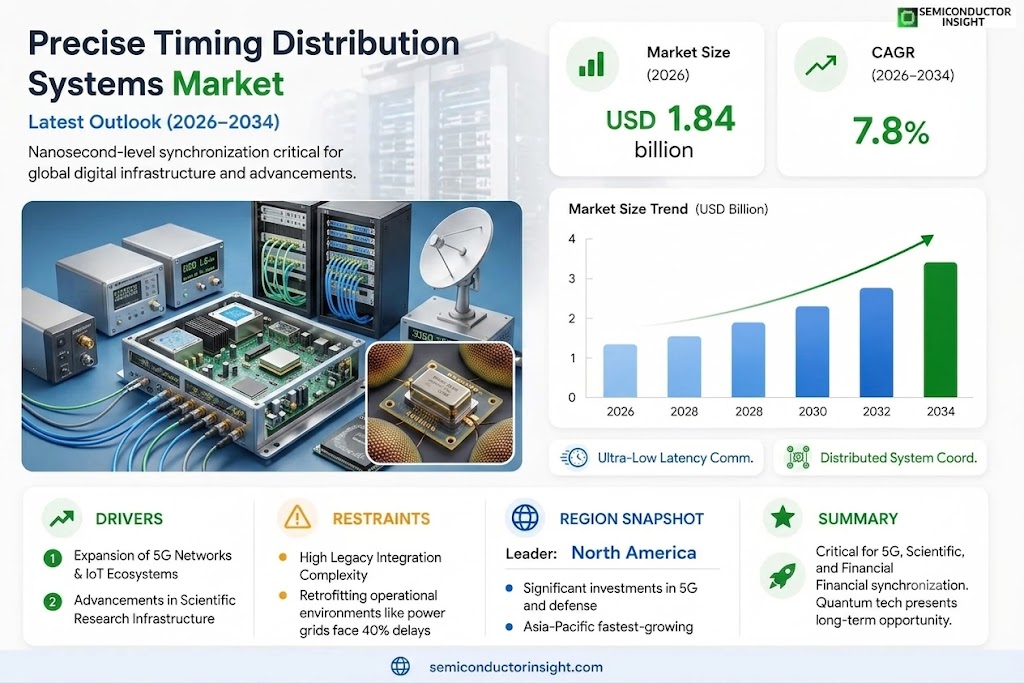
The global Precise Timing Distribution Systems Market was valued at 1628 million in 2024 and is projected to reach US$ 2719 million by 2032, at a CAGR of 7.8% during the forecast period. While the U.S. dominates current market share, China is emerging as a high-growth region with accelerating infrastructure investments.
Precise Timing Distribution Systems (PTDS) are specialized synchronization solutions that deliver ultra-accurate timing signals across networks and devices. These systems utilize technologies like GPS, atomic clocks, and optical fiber distribution to achieve nanosecond-level precision, which is critical for applications ranging from financial trading networks to 5G telecommunications.
The market growth is driven by increasing demand for network synchronization in telecom infrastructure, particularly with 5G rollouts requiring microsecond-level timing accuracy. Furthermore, sectors like aerospace, defense, and scientific research are adopting PTDS solutions to enhance system reliability. Key players including Microsemi Corporation, Spectracom, and Oscilloquartz are expanding their product portfolios through strategic collaborations and technological advancements in optical timing distribution.
MARKET DYNAMICS
MARKET DRIVERS
Expansion of 5G Networks and IoT Ecosystems Accelerates Demand
The rapid global deployment of 5G infrastructure represents a fundamental driver for precise timing distribution systems. These networks require nanosecond-level synchronization accuracy to maintain ultra-low latency communications. With over 300 million 5G base stations expected to be operational worldwide by 2025, telecom operators are investing heavily in precision timing solutions to meet stringent 3GPP standards. The proliferation of IoT devices, projected to exceed 30 billion connected units globally by 2030, further amplifies this demand as distributed sensor networks require coordinated timing references.
Advancements in Scientific Research Infrastructure Fuel Adoption
Large-scale scientific facilities are increasingly adopting atomic clock distribution systems to synchronize critical experiments. Particle accelerators like CERN’s Large Hadron Collider require timing accuracy below 100 picoseconds to coordinate particle detection across multiple kilometers. Similarly, next-generation radio telescope arrays such as the Square Kilometre Array demand femtosecond-level synchronization across thousands of antennas. The global scientific research equipment market, valued at over $12 billion annually, continues to drive innovation in ultra-precise timing solutions.
Financial Sector Modernization Creates New Requirements
Electronic trading platforms and high-frequency trading operations rely on microsecond-accurate timestamping to maintain market integrity. Regulatory mandates like MiFID II in Europe require timestamp accuracy within 100 microseconds, pushing financial institutions to upgrade their timing infrastructure. With global electronic trading volumes surpassing $20 trillion daily, the demand for precise timing references in financial data centers shows no signs of slowing.
MARKET RESTRAINTS
Integration Complexities with Legacy Systems Pose Implementation Challenges
The transition to precise timing distribution often encounters compatibility issues with existing infrastructure. Many industrial facilities operate timing systems with millisecond-level accuracy that cannot easily interface with modern nanosecond-precise solutions. Retrofitting synchronization networks in operational environments like power grids or manufacturing plants frequently requires costly system overhauls. Industry surveys indicate that nearly 40% of timing system upgrades face delays due to integration difficulties with legacy equipment.
Other Restraints
Vulnerability to Cyber Threats
The increasing network connectivity of timing systems exposes them to potential cyberattacks that could disrupt critical synchronization. Timing distribution networks providing services to financial markets or telecom operators represent high-value targets for malicious actors.
Signal Degradation Over Distance
Maintaining timing precision across distributed networks presents technical hurdles, particularly for fiber optic distribution over long distances. Environmental factors can introduce phase noise and jitter that degrade signal integrity.
MARKET OPPORTUNITIES
Emergence of Quantum Technologies Opens New Application Frontiers
Quantum computing and quantum communication systems require unprecedented timing accuracy to maintain coherence between qubits. The quantum technology market, projected to grow at 30% CAGR through 2030, presents significant opportunities for atomic clock and precision timing solutions. Quantum key distribution networks particularly demand femtosecond-level synchronization to ensure secure communication channels.
Smart City Initiatives Drive Demand for Synchronized Infrastructure
Urban digital transformation projects increasingly incorporate precise timing for traffic management systems, smart grids, and public safety networks. With over 1,000 smart city projects currently underway globally, municipal governments represent a growing customer base for timing distribution solutions that can coordinate distributed sensor networks and IoT devices.
MARKET CHALLENGES
High Initial Costs and ROI Concerns Limit Adoption Pace
Precision timing systems often require substantial capital investment, with some atomic clock solutions costing over $100,000 per unit. While the long-term operational benefits are clear, many organizations face budgetary constraints that slow adoption. The specialized nature of these systems also creates extended evaluation cycles, with procurement decisions frequently taking 12-18 months for thorough technical validation.
Other Challenges
Technical Expertise Shortage
The specialized knowledge required to implement and maintain precise timing networks creates a talent gap. Industry reports indicate a 25% shortage of qualified synchronization engineers globally, particularly affecting emerging markets.
GNSS Vulnerability Concerns
Overreliance on GPS and other global navigation satellite systems for timing references creates systemic risks. Jamming and spoofing incidents have increased awareness of the need for resilient backup timing solutions.
PRECISE TIMING DISTRIBUTION SYSTEMS MARKET TRENDS
5G Network Expansion Driving Adoption of Precision Timing Solutions
The global rollout of 5G networks has become a significant growth driver for precise timing distribution systems, with the market valued at $1.628 billion in 2024 and projected to reach $2.719 billion by 2032. This 7.8% CAGR growth stems from 5G’s strict synchronization requirements, where even nanosecond-level timing discrepancies can impact network performance. Leading manufacturers like Microsemi Corporation and Oscilloquartz are developing advanced solutions to meet the stringent phase synchronization needs of 5G base stations, particularly for applications requiring ultra-low latency such as industrial IoT and autonomous vehicles.
Other Trends
Financial Sector Modernization
High-frequency trading platforms are increasingly adopting atomic clock distribution systems to maintain sub-microsecond synchronization across global trading networks. This trend reflects the financial industry’s growing reliance on timestamp accuracy for algorithmic trading, where a 1-millisecond advantage can yield $100 million annually for major trading firms. Recent product innovations from companies like Spectracom and Meinberg specifically target financial applications with compact, GNSS-disciplined oscillators that maintain precision even during GPS outages.
Scientific Research Pushing Technical Boundaries
Cutting-edge research facilities are driving demand for ultra-precise timing solutions, particularly in particle accelerators and radio telescope arrays. The Square Kilometre Array project, involving over 130,000 antennas across two continents, requires timing accuracy below 2 nanoseconds for coherent signal processing – a technical challenge addressed by specialized distribution systems from Menlo Systems and Trimble. Similarly, quantum computing research facilities are adopting optical timing distribution networks capable of femtosecond-level synchronization to coordinate qubit operations.
Cybersecurity Concerns Reshaping Timing Architecture
Growing vulnerabilities in GNSS-dependent timing infrastructure have accelerated the development of hybrid timing solutions combining satellite signals with terrestrial references. Recent incidents of GPS spoofing affecting power grids have led to 32% growth in secure timing distribution systems that incorporate atomic clocks and fiber-optic networks. Manufacturers like Brandywine Communications now offer encrypted timing distribution with built-in anomaly detection, particularly for critical infrastructure applications where timing accuracy directly impacts operational safety.
COMPETITIVE LANDSCAPE
Key Industry Players
Leading Providers Focus on Innovation and Strategic Collaborations to Maintain Market Share
The global precise timing distribution systems market exhibits a moderately fragmented competitive landscape, characterized by a mix of established players and emerging competitors. Microsemi Corporation (now part of Microchip Technology) has maintained a dominant position, leveraging its comprehensive portfolio of atomic clocks, synchronization solutions, and strong penetration in telecommunications and aerospace applications. The company accounted for approximately 18% revenue share in 2024, owing to its advanced IEEE 1588 Precision Time Protocol solutions.
ADVA Optical Networking has emerged as another key contender, securing 12% market share last year through its specialized optical synchronization products for 5G networks. Their Oscilloquartz synchronization solutions have seen particularly strong adoption in European network infrastructure projects. Meanwhile, Spectracom (an Orolia company) continues to gain traction in defense and government applications with its ruggedized GPS-disciplined oscillators and time servers.
The competitive intensity is increasing as companies invest heavily in R&D to develop next-generation solutions. Menlo Systems recently launched its optical frequency comb technology for scientific applications, while Meinberg expanded its industrial synchronization offerings with new PTP grandmaster clocks. These innovation-focused strategies are reshaping market dynamics, particularly in emerging sectors like quantum computing and advanced radio astronomy.
Strategic partnerships are becoming increasingly crucial for market expansion. Trimble enhanced its market position through collaborations with telecommunications providers in Asia-Pacific, while Bodet strengthened its European foothold via distribution agreements with industrial automation suppliers. Such moves help companies address the growing demand for nanosecond-level timing accuracy across diverse applications.
List of Key Precise Timing Distribution System Companies Profiled
- Microsemi Corporation/Microchip Technology (U.S.)
- Arbiter Systems (U.S.)
- Menlo Systems (Germany)
- MENHIR PHOTONICS (Switzerland)
- Bodet (France)
- Meinberg (Germany)
- Testech (China)
- ION (U.S.)
- Perle (Canada)
- Time and Frequency Solutions (Australia)
- ADVA Optical Networking (Germany)
- hopf Elektronik (Germany)
- Spectracom (U.S.)
- Oscilloquartz (Switzerland)
- Brandywine Communications (U.S.)
- Trimble (U.S.)
Segment Analysis:
By Type
Centralized Systems Lead the Market with Enhanced Synchronization for Critical Infrastructure
The market is segmented based on type into:
- Centralized
- Distributed
By Application
GPS Distribution Segment Dominates Due to Widespread Use in Navigation and Telecommunications
The market is segmented based on application into:
- Clock or RF Signal Transfer Over Long Distances
- GPS Distribution
- Maser Distribution
- Atomic Clock Distribution
- Particle Accelerators
- Radio Telescope Arrays
By End User
Telecommunications Sector Holds Largest Share Owing to 5G Network Expansion
The market is segmented based on end user into:
- Telecommunications
- Finance and Banking
- Government and Defense
- Transportation
- Energy and Utilities
Regional Analysis: Precise Timing Distribution Systems Market
North America
The North American market for Precise Timing Distribution Systems is driven by stringent technological requirements across industries such as telecommunications, financial services, and critical infrastructure. The U.S., in particular, accounts for the majority of regional demand due to large-scale 5G deployments and the modernization of power grids requiring nanosecond-level synchronization. Financial trading networks and data centers are also key adopters of these systems, as precise timing is essential for high-frequency trading and distributed computing applications. The presence of major players like Microsemi Corporation and Spectracom further strengthens the regional ecosystem. However, high implementation costs and complex integration processes pose challenges for smaller enterprises.
Europe
Europe maintains a technologically advanced market for Precise Timing Distribution Systems, with Germany and the U.K. leading adoption. The region’s strong telecom sector, coupled with increasing smart grid deployments, fuels demand for synchronization solutions. EU directives on critical infrastructure resilience and the push for autonomous vehicle networks are creating new opportunities. While research institutions and particle accelerator facilities have traditionally been primary users, commercial applications are now growing faster with 5G rollouts. Challenges include fragmentation across national standards and the need for multi-vendor compatibility in timing architectures.
Asia-Pacific
As the fastest-growing regional market, Asia-Pacific benefits from massive telecommunications infrastructure projects and governmental digitalization initiatives. China’s BeiDou satellite navigation system integration and Japan’s precision manufacturing requirements create substantial demand. India’s expanding financial sector and smart city projects are emerging as significant growth drivers. While cost sensitivity remains an issue in developing markets, the need for telecom synchronization and industrial automation is overcoming budget constraints. Local manufacturers are gaining market share by offering competitive pricing, though quality differentials persist compared to Western solutions.
South America
The South American market shows gradual growth, primarily concentrated in Brazil’s financial sector and Chile’s mining operations where timing precision improves operational efficiency. Infrastructure limitations and economic instability have slowed broader adoption, though modernization of national timekeeping systems creates opportunities. Regional players face challenges in competing with imported solutions due to currency fluctuations and complex customs processes. Nevertheless, selective investments in telecom upgrades and energy grid improvements are supporting measured market expansion across the region.
Middle East & Africa
This emerging market displays potential driven by smart city projects in the Gulf states and financial hub development in places like Dubai and Riyadh. Oil and gas operations increasingly require precise timing for distributed control systems, while telecom operators are upgrading synchronization capabilities for 5G readiness. Sub-Saharan Africa shows pockets of demand from mobile network operators, though affordability remains a constraint. The lack of local manufacturing and reliance on imports creates supply chain challenges, but regional partnerships with global suppliers are helping bridge this gap for critical infrastructure projects.
Report Scope
This market research report provides a comprehensive analysis of the global and regional Precise Timing Distribution Systems markets, covering the forecast period 2024–2032. It offers detailed insights into market dynamics, technological advancements, competitive landscape, and key trends shaping the industry.
Key focus areas of the report include:
- Market Size & Forecast: Historical data and future projections for revenue, unit shipments, and market value across major regions and segments. The global Precise Timing Distribution Systems market was valued at USD 1,628 million in 2024 and is projected to reach USD 2,719 million by 2032, growing at a CAGR of 7.8%.
- Segmentation Analysis: Detailed breakdown by product type (Centralized, Distributed), application (Clock/RF Signal Transfer, GPS Distribution, Atomic Clock Distribution, etc.), and end-user industry to identify high-growth segments.
- Regional Outlook: Insights into market performance across North America, Europe, Asia-Pacific, Latin America, and Middle East & Africa, including country-level analysis. The U.S. and China are key growth markets.
- Competitive Landscape: Profiles of leading market participants including Microsemi Corporation, Menlo Systems, Meinberg, Spectracom, and Trimble, covering their product portfolios, market share (top 5 players held approximately 45% share in 2024), and strategic developments.
- Technology Trends & Innovation: Assessment of emerging technologies in precise timing synchronization, including advancements in atomic clock integration and fiber-optic distribution networks.
- Market Drivers & Restraints: Evaluation of growth drivers like 5G network expansion and scientific research needs, along with challenges such as high implementation costs and technical complexity.
- Stakeholder Analysis: Insights for telecommunications providers, research institutions, system integrators, and investors regarding the evolving ecosystem and strategic opportunities.
Primary and secondary research methods are employed, including interviews with industry experts, manufacturer surveys, and data from verified sources to ensure the accuracy and reliability of the insights presented.
FREQUENTLY ASKED QUESTIONS:
What is the current market size of Global Precise Timing Distribution Systems Market?
->Precise Timing Distribution Systems Market was valued at 1628 million in 2024 and is projected to reach US$ 2719 million by 2032, at a CAGR of 7.8% during the forecast period.
Which key companies operate in this market?
-> Key players include Microsemi Corporation, Menlo Systems, Meinberg, Spectracom, Trimble, Arbiter Systems, and Oscilloquartz, among others.
What are the key growth drivers?
-> Key growth drivers include 5G network deployment, increasing demand for high-precision timing in financial markets, and expansion of scientific research facilities.
Which region dominates the market?
-> North America currently leads the market, while Asia-Pacific is expected to show the highest growth rate during the forecast period.
What are the emerging trends?
-> Emerging trends include integration with quantum technologies, development of compact atomic clocks, and adoption in satellite navigation systems.
Get Sample Report PDF for Exclusive Insights
Report Sample Includes
- Table of Contents
- List of Tables & Figures
- Charts, Research Methodology, and more...
 Download Sample Report PDF

