
Power Sequencers Market Insights
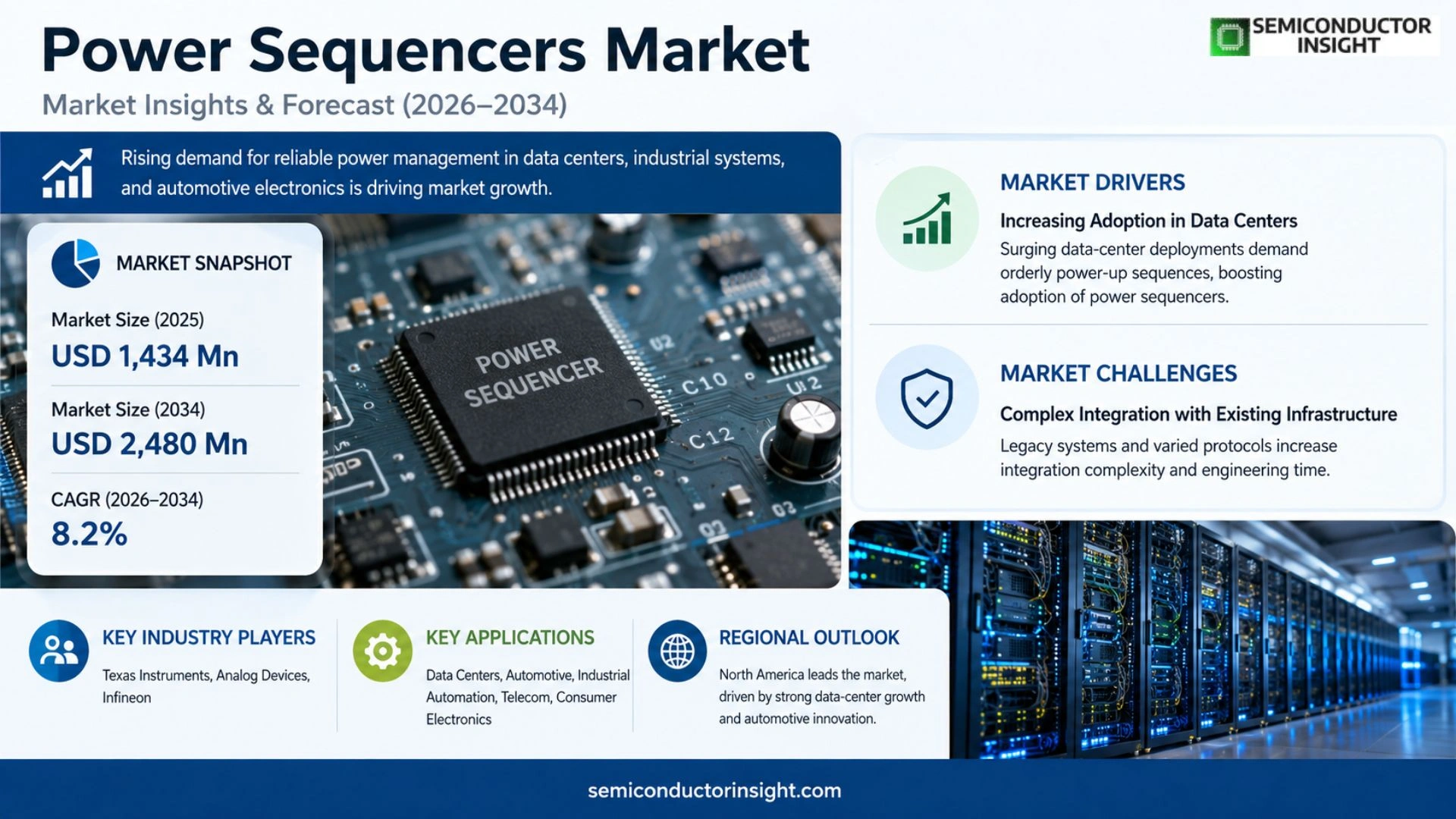
Power Sequencers market was valued at USD 1,434 million in 2025 and is projected to reach USD 2,480 million by 2034, exhibiting a CAGR of 8.2% during the forecast period.
A power sequencer is a critical power‑management component for multi‑rail architectures. It orchestrates enable signals, timing delays, voltage thresholds and status monitoring across multiple regulators and load switches during power‑up, power‑down and fault recovery sequences. By enforcing a predefined ordering it prevents latch‑up, false reset or surge stress in processors, FPGAs, storage controllers, automotive camera modules, display assemblies and industrial control boards caused by improper rail timing. Modern offerings have evolved from standalone devices toward integrated sequencing PMICs and digital system managers that combine multi‑rail sequencing, soft‑start control, voltage monitoring, fault response, watchdog timers and I²C/PMBus configuration within a single silicon solution.
MARKET DRIVERS
Increasing Adoption in Data Centers
The surge in hyperscale data‑center footprints has forced operators to prioritize orderly power‑up sequences. Power Sequencers mitigate the risk of inrush currents that can trip breakers, preserving uptime for mission‑critical workloads. As server densities climb, designers are embedding sequencers directly into rack‑level power distribution units, a move that reduces installation time and elevates reliability.
Regulatory Push for Energy Efficiency
Stricter efficiency standards across North America and Europe compel manufacturers to demonstrate controlled start‑up behavior. By staggering load activation, sequencers lower peak demand, helping facilities meet mandated Power Usage Effectiveness (PUE) targets. This compliance pressure fuels demand for smarter, programmable sequencing solutions that can be remotely monitored.
➤ “Sequencing technology is becoming the silent backbone of resilient power architectures, especially where every millisecond of downtime translates into substantial revenue loss.”
Beyond compliance, the ability to integrate sequencing logic with building‑management systems creates a value‑added service layer. Operators can now generate predictive maintenance alerts, turning what was once a protective device into a data source for continuous improvement initiatives.
MARKET CHALLENGES
Complex Integration with Existing Infrastructure
Legacy power‑distribution frameworks often lack standardized communication protocols, forcing engineers to develop custom adapters for each sequencer model. This heterogeneity inflates engineering cycles and raises the likelihood of configuration errors, which can erode the very reliability sequencers are meant to protect.
Other Challenges
Supply Chain Volatility
Global semiconductor shortages have constrained the availability of high‑precision timing chips essential for advanced sequencing. Even modest lead‑time extensions can delay large‑scale rollout projects, prompting buyers to adopt a cautious procurement stance.
MARKET RESTRAINTS
High Initial Capital Outlay
Deploying fully programmable sequencers entails upfront investment in both hardware and configuration services. For smaller facilities, the cost‑benefit calculus often tilts toward simpler, albeit less flexible, protection devices, limiting broader market penetration until economies of scale lower pricing.
MARKET OPPORTUNITIES
Emerging Edge Computing Deployments
Edge sites,ranging from autonomous‑vehicle charging stations to remote manufacturing cells,require compact, robust power‑sequencing solutions that can operate with minimal human oversight. The convergence of IoT connectivity and AI‑driven diagnostics opens a niche for sequencers that not only protect assets but also feed real‑time performance metrics into centralized control platforms.
Power Sequencers Market Trends
Integration of Sequencing Functions into PMICs
The most visible shift in Power Sequencers Market is the migration from discrete sequencing chips toward power‑management‑ICs that embed full‑featured sequencing logic. Designers now favor integrated devices because they collapse multiple footprints into a single package, reduce bill‑of‑materials, and simplify board bring‑up. This trend is reinforced by the growing need to orchestrate five to ten rails on modern compute boards, where timing tolerances are measured in nanoseconds. By embedding soft‑start, voltage monitoring, and watchdog capabilities, PMIC‑based sequencers eliminate the latency associated with external resistor‑capacitor timing networks. The resulting architecture not only shortens development cycles but also opens avenues for telemetry‑driven health monitoring, a feature that many high‑reliability customers now regard as mandatory rather than optional.
Other Trends
Automotive Power Management Complexity
Automotive electronics are adding a new layer of urgency to Power Sequencers Market. Advanced driver‑assistance systems, camera arrays, and domain controllers each bring a distinct rail hierarchy, and functional‑safety standards such as ISO 26262 demand deterministic sequencing and fault isolation. Consequently, automotive‑focused vendors are shipping sequencers with built‑in ASIL‑qualified watchdogs, programmable delay ladders, and I²C/PMBus interfaces that enable real‑time diagnostics. The pressure to meet stringent EMC limits also pushes manufacturers toward low‑noise, soft‑start architectures that mitigate surge currents during vehicle ignition. For tier‑one suppliers, the ability to provide a single sequencer package that satisfies both power‑efficiency and safety requirements translates directly into reduced validation effort and faster platform qualification.
Emerging Competitive Landscape in Asia‑Pacific
While legacy players in the United States, Japan, and Europe retain a foothold in high‑reliability segments, firms headquartered in South Korea, China, and Taiwan are rapidly expanding their portfolios with highly integrated sequencing PMICs aimed at consumer and display markets. These newcomers leverage advanced silicon‑on‑insulator processes to achieve higher channel density and integrate telemetry blocks without inflating die size. Their aggressive pricing strategies force established manufacturers to revisit cost structures and accelerate the rollout of next‑generation programmable sequencers. The geographic diffusion of design wins,spanning data‑center modules, smart‑home hubs, and industrial edge gateways,means that Power Sequencers Market will increasingly respond to global supply‑chain dynamics rather than isolated regional demand.
COMPETITIVE LANDSCAPE
Key Industry Players
Power Sequencers Market: Competitive Overview
Texas Instruments, Analog Devices, and Infineon dominate the higher‑volume segment, leveraging deep analog portfolios and extensive automotive qualification to supply integrated PMICs that embed sequencing logic. Their breadth of process technologies enables customers to replace discrete sequencers with single‑chip solutions, shrinking board area and simplifying design validation. NXP and Renesas have carved out strong positions in automotive and industrial control, where functional‑safety certifications such as ASIL‑B are mandatory. The market structure reflects a split between traditional standalone sequencers,still favored in high‑reliability aerospace and server back‑ends,and increasingly sophisticated system‑level managers that combine power‑up ordering, telemetry, and watchdog functions. Over the forecast horizon, we see incremental consolidation as larger analog firms acquire niche IP providers to broaden their digital power‑management portfolios.
Beyond the headline names, a cadre of specialized players reinforces the competitive fabric. Monolithic Power Systems offers ultra‑compact sequencer families tailored for edge‑compute modules, while ABLIC and Richtek provide cost‑effective parts that target consumer‑grade display and camera applications in East Asian OEMs. SG Micro and Silicon Mitus differentiate through aggressive roadmap timing, introducing PMBus‑compatible devices that meet emerging AEC‑Q100 guidelines. Silergy and STMicroelectronics focus on high‑channel‑count solutions for data‑center platforms, delivering programmable delay trees that align with server‑scale power‑budget constraints. Microchip’s portfolio bridges the gap between legacy discrete parts and its newer integrated controllers, catering to OEMs that require a phased migration path. Collectively, these firms sustain a vibrant ecosystem where regional design preferences and application‑specific requirements drive a steady stream of product introductions.
List of Key Power Sequencers Companies Profiled
- Texas Instruments
- Analog Devices
- Infineon Technologies AG
- NXP Semiconductors
- Renesas Electronics Corporation
- STMicroelectronics
- Monolithic Power Systems
- ABLIC Inc.
- Silicon Mitus
- SG Micro Corp
- Richtek Technology Corporation
- Silergy Corp.
- Microchip Technology Inc.
Segment Analysis:
| Segment Category | Sub-Segments | Key Insights |
| By Type |
|
Analog vs Digital
|
| By Application |
|
Cross‑Domain Drivers
|
| By End User |
|
Engineer Priorities
|
| By Technology |
|
Evolutionary Trend
|
| By Configuration Method |
|
Methodology Impact
|
Regional Analysis: Power Sequencers Market
North America
The regulatory environment in North America emphasises UL and IEC safety standards, prompting manufacturers to certify sequencers for fault‑tolerant operation. Recent revisions to the Energy Independence Act encourage energy‑management features, nudging vendors toward smarter sequencing capabilities. Compliance costs remain manageable, but firms must stay agile to incorporate evolving test protocols that affect product road‑maps.
Advanced micro‑controller families enable higher resolution timing and integrated diagnostics, allowing clients to monitor sequencing events in real time. Hybrid analog‑digital designs are gaining traction as they balance legacy equipment compatibility with modern communication protocols such as MQTT. Vendors that bundle edge‑computing modules with sequencers position themselves to capture emerging industrial‑IoT projects.
North American sequencer producers benefit from a dense supplier network for silicon, passive components, and enclosure materials, reducing lead times compared with offshore alternatives. However, recent semiconductor shortages have prompted a shift toward dual‑sourcing strategies, with manufacturers establishing secondary contracts in Canada and Mexico. This approach mitigates risk while preserving cost competitiveness.
End‑users across automotive, data centre, and renewable sectors increasingly specify sequencers with built‑in redundancy and diagnostic logging to reduce downtime. Preference for modular architectures enables straightforward scaling as facilities expand. Service providers also request remote firmware update capabilities, aligning with broader trends toward predictive maintenance and lifecycle cost optimisation.
Europe
European manufacturers prioritize compliance with the Machinery Directive and IEC 62061, shaping the design of power sequencers that must demonstrate functional safety. The region’s strong focus on energy efficiency drives demand for sequencers that can interface with Building Management Systems, enabling coordinated start‑up of HVAC, lighting and backup generators. Countries such as Germany and France are investing in offshore wind farms, where sequencers play a pivotal role in synchronising turbine converters. Competitive pressure from local players encourages rapid iteration of firmware, adding features like predictive fault detection. As sustainability targets tighten, OEMs are likely to embed sequencer functionality directly into motor‑drive packages, reducing component count and simplifying system integration.
Asia-Pacific
Asia‑Pacific’s rapid industrialisation fuels a burgeoning need for reliable power sequencing across a diverse set of sectors. In China, high‑speed rail projects and large‑scale data‑centre builds require sequencers that can guarantee precise voltage ramping to protect sensitive electronics. Japan’s focus on robotics has led to bespoke sequencer solutions that integrate with real‑time control loops, minimizing cycle time for assembly lines. Meanwhile, India’s expanding renewable‑energy footprint, particularly solar farms, creates opportunities for sequencers that manage inverter start‑up sequences under variable grid conditions. Local suppliers are increasingly partnering with multinational firms to acquire advanced firmware capabilities, a move that shortens development cycles and improves after‑sale support. The region’s cost‑sensitivities push vendors to adopt modular designs that can be customized without extensive re‑engineering.
South America
South America presents a fragmented market where power sequencer adoption is closely tied to the pace of infrastructure upgrades. Brazil’s growing petrochemical complex demands sequencers that can orchestrate start‑up of large‑scale compressors while maintaining strict emissions monitoring. In Argentina, government incentives for smart‑grid pilots have spurred interest in sequencers capable of remote configuration, enabling utilities to adjust load‑shedding strategies on the fly. Local engineering firms often act as system integrators, adding value through site‑specific tuning of sequencing parameters. Budget constraints encourage the selection of compact, cost‑effective units that still meet international safety standards. As regional trade agreements lower tariff barriers, cross‑border component sourcing is expected to increase, offering manufacturers broader market access.
Middle East & Africa
The Middle East & Africa region is witnessing a shift from oil‑centric power systems toward diversified energy portfolios, creating new uses for power sequencers. In the United Arab Emirates, large‑scale data‑centre projects incorporate sequencers to manage uninterrupted power supplies, aligning with the nation’s ambition to become a digital hub. South‑African mining operations rely on sequencers to coordinate the start‑up of heavy‑duty motor drives, where abrupt voltage changes could jeopardise equipment longevity. Growing interest in solar‑plus‑storage installations across the Gulf states demands sequencers that can handle bidirectional power flows and frequent cycling. Local value‑added resellers increasingly provide firmware customization services, allowing end‑users to tailor sequencing logic to site‑specific safety protocols. The region’s infrastructural investments suggest a steady rise in sequencer demand over the next decade.
Report Scope
This market research report provides a comprehensive analysis of the Power Sequencers Market , covering the forecast period 2026–2034. It offers detailed insights into market dynamics, technological advancements, competitive landscape, and key trends shaping the industry.
Key focus areas of the report include:
- Market Overview: The report begins with an overview outlining its current market scenario, key growth indicators, and industry transformation drivers. It discusses macroeconomic factors, demand–supply balance, regulatory landscape, and the strategic role of semiconductors in powering advancements across industries such as automotive, telecommunications, consumer electronics, and industrial automation.
- Market Size & Forecast: Historical data and future projections for revenue, unit shipments, and market value across major regions and segments.
- Segmentation Analysis: Detailed breakdown by product type, technology, application, and end-user industry to identify high-growth segments and investment opportunities.
- Regional Insights: Insights into market performance across North America, Europe, Asia-Pacific, Latin America, and the Middle East & Africa, including country-level analysis where relevant.
- Competitive Landscape: Profiles of leading market participants, including their product offerings, R&D focus, manufacturing capacity, pricing strategies, and recent developments such as mergers, acquisitions, and partnerships.
- Technology Trends & Innovation: Assessment of emerging technologies, integration of AI/IoT, semiconductor design trends, fabrication techniques, and evolving industry standards.
- Market Drivers & Restraints: Evaluation of factors driving market growth along with challenges, supply chain constraints, regulatory issues, and market-entry barriers.
- Stakeholder Insights: Insights for component suppliers, OEMs, system integrators, investors, and policymakers regarding the evolving ecosystem and strategic opportunities.
Primary and secondary research methods are employed, including interviews with industry experts, data from verified sources, and real-time market intelligence to ensure the accuracy and reliability of the insights presented.
FREQUENTLY ASKED QUESTIONS:
What is the current market size of Power Sequencers Market?
-> Power Sequencers market was valued at USD 1,434 million in 2025 and is projected to reach USD 2,480 million by 2034, exhibiting a CAGR of 8.2%
Which key companies operate in Power Sequencers Market?
-> Key players include Texas Instruments, Analog Devices, Inc., Renesas Electronics Corporation, STMicroelectronics N.V., Infineon Technologies AG, NXP Semiconductors N.V., Microchip Technology Incorporated, Monolithic Power Systems, Inc., ABLIC Inc., Silicon Mitus, Inc., SG Micro Corp, Richtek Technology Corporation, Silergy Corp..
What are the key growth drivers?
-> Key growth drivers include automotive electronics, compute and storage platforms, and industrial automation demanding multi‑rail power management, functional safety, and tighter voltage coordination.
Which region dominates the market?
-> Asia-Pacific shows the fastest growth, while North America and Europe remain dominant in terms of revenue share.
What are the emerging trends?
-> Emerging trends include integration of sequencing functions into PMICs, digital system managers, enhanced telemetry, functional safety compliance (ASIL, AEC‑Q100), and increased use of PMBus‑managed digital sequencing.

Get Sample Report PDF for Exclusive Insights
Report Sample Includes
- Table of Contents
- List of Tables & Figures
- Charts, Research Methodology, and more...
 Download Sample Report PDF