MARKET INSIGHTS
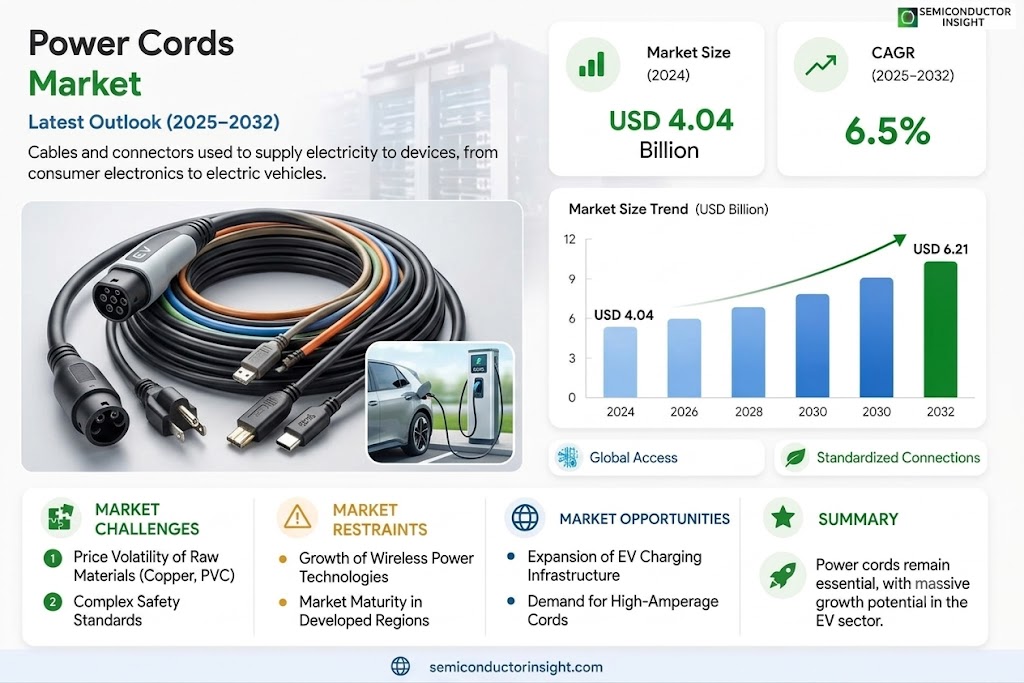
Global Power Cords Market size was valued at USD 4.04 billion in 2024 to USD 6.21 billion by 2032, exhibiting a CAGR of 6.5% during the forecast period.
Power cords are detachable means of supplying electricity from a main power source to electrical equipment or appliances. These essential components consist of a flexible electrical cable with connectors at each end one male plug that inserts into an electrical outlet and one female connector that attaches to the device.
The market is experiencing steady growth driven by several factors, including the rising global demand for consumer electronics, increased industrial automation, and the expansion of data centers and telecommunications infrastructure. However, this growth faces challenges from intense price competition and raw material cost volatility. Geographically, China dominates as the largest market, holding approximately 37% of the global share, while North America follows as a significant regional market accounting for about 17%. The competitive landscape is fragmented, with key players such as Volex, Longwell, and Electri-Cord leading the industry; the top three companies collectively occupy around 22% of the total market share.
MARKET DRIVERS
Proliferation of Electronic Devices
The exponential growth in the adoption of consumer electronics, IT equipment, and home appliances is a primary driver for the Power Cords Market. Global demand for devices such as smartphones, laptops, smart TVs, and gaming consoles continues to rise, necessitating reliable power connectivity solutions. This trend is further amplified by the increasing number of devices per household and the expansion of the middle class in emerging economies.
Infrastructure Development and Industrialization
Global investments in construction, manufacturing facilities, and data centers are creating substantial demand for industrial-grade power cords. The rapid pace of urbanization and the establishment of new industrial parks require extensive electrical infrastructure, including heavy-duty cords for machinery, servers, and operational equipment. The push for smart city initiatives also contributes to this growth.
Furthermore, the ongoing global electrification efforts, particularly in rural and underserved regions, are expanding the addressable market for power cords, linking more consumers and businesses to the electrical grid.
MARKET CHALLENGES
Price Volatility of Raw Materials
The power cord manufacturing industry is highly sensitive to fluctuations in the prices of key raw materials like copper, PVC, and other petroleum-based polymers. These commodities are subject to global market dynamics, including supply chain disruptions, trade policies, and geopolitical tensions, which can squeeze profit margins and create pricing instability for manufacturers and consumers.
Other Challenges
Intense Market Competition and Price Pressure
The market is characterized by a large number of regional and global players, leading to fierce competition. This often results in price wars, forcing manufacturers to operate on thin margins and potentially compromising on quality to remain cost-competitive.
Complex and Evolving Safety Standards
Power cords must comply with a myriad of international safety standards and certifications (e.g., UL, CE, IEC). Navigating these requirements, which often vary by region and are subject to frequent updates, adds significant complexity and cost to product development and market entry.
MARKET RESTRAINTS
Growth of Wireless Power Technologies
The advancement and increasing adoption of wireless charging technology pose a significant long-term restraint on the traditional wired power cord market. As wireless charging becomes more efficient and standardized for a wider range of devices, from smartphones to electric vehicles, the dependency on physical cords for power delivery is expected to gradually decrease in certain consumer segments.
Market Maturity in Developed Regions
In mature markets such as North America and Western Europe, the power cord market is largely replacement-driven rather than driven by new demand. The growth rate in these regions is subdued compared to emerging markets, as the penetration of electronic devices is already high and product lifecycles are long, limiting the frequency of new purchases.
MARKET OPPORTUNITIES
Expansion of Electric Vehicle (EV) Infrastructure
Global push for electric mobility presents a massive opportunity for specialized power cords, particularly EV charging cables. The construction of public and private charging stations worldwide requires robust, high-amperage cords capable of fast charging, creating a new and rapidly growing segment within the market.
Demand for Smart and Specialized Cords
There is a growing opportunity in developing advanced power cords with integrated features such as surge protection, smart energy monitoring, and USB-C/USB-PD compatibility. The demand for cords that support higher power delivery for modern laptops, monitors, and other devices is increasing, allowing manufacturers to capture higher value.
Renewable Energy Integration
The expansion of renewable energy systems, including residential and commercial solar power installations, requires specialized cabling and interconnection solutions. Power cords used in these applications must meet specific durability and safety standards for outdoor and high-voltage use, opening a niche but growing market segment.
Power Cords Market Trends
Sustained Global Growth Driven by Electronics Demand
Global Power Cords market, valued at approximately USD 4,041 million in 2024, is projected to reach USD 6,213 million by 2032, exhibiting a steady compound annual growth rate (CAGR) of 6.5%. This growth is fundamentally driven by the expanding global demand for a wide array of electronic devices. Power cords are essential detachable components that supply electricity from a main source to equipment or appliances, featuring a flexible cord with a male plug for the electrical outlet and a female plug for the appliance. The proliferation of computers, consumer electronics, and telecommunications infrastructure worldwide continues to fuel the need for reliable power connectivity solutions, underpinning the market’s positive trajectory.
Other Trends
Geographic Market Concentration and Supply Chain Dynamics
The market exhibits significant geographic concentration, with China holding the largest share at approximately 37%. This dominance is attributed to the country’s extensive manufacturing base for electronics. North America follows as the second-largest market, accounting for about 17% of the global share. The competitive landscape is fragmented, featuring numerous key players such as Volex, Longwell, and Electri-Cord. The top three companies collectively occupy around 22% of the market share, indicating a competitive environment with a long tail of suppliers. This structure influences global supply chain dynamics and pricing strategies.
Segmentation Trends by Application and Type
Market segmentation reveals distinct trends across different applications and product types. The market is segmented by application into computers, telecommunications, consumer electronics, power tools, medical equipment, and others, with consumer electronics representing a consistently high-demand segment. In terms of product type, the market is divided between ordinary power cords and shielded insulated power cords. The latter is gaining traction in applications requiring enhanced safety and protection from electromagnetic interference, particularly in medical and high-precision industrial equipment. This diversification allows manufacturers to target specific, high-growth niche markets within the broader industry.
COMPETITIVE LANDSCAPE
Key Industry Players
Global Market Characterized by Fragmented Competition and Regional Dominance
Global Power Cords Market is fragmented, with the top three manufacturers Volex, Longwell, and Electri-Cord collectively holding approximately 22% of the market share. This indicates a competitive environment with no single player exerting dominant control. Volex, a leading global provider, is recognized for its extensive product portfolio catering to industries such as consumer electronics, medical equipment, and data centers. The market structure is further influenced by significant regional production hubs, most notably China, which accounts for the largest market share of about 37%. North America follows as a significant market, representing approximately 17% of the global share, driven by demand from sectors like telecommunications and power tools.
Beyond the leading players, a multitude of other significant companies operate, often specializing in niche applications or specific geographic markets. These players, such as Feller, Quail Electronics, and HL TECHNOLOGY, contribute to a diverse competitive landscape by offering specialized products for applications ranging from industrial power tools to medical devices and consumer electronics. Companies like Tripplite and Coleman Cable have established strong brand recognition in the North American market, particularly for retail and commercial power accessory solutions. Meanwhile, numerous Asia-based manufacturers like HUASHENG ELECTRICAL, Yung Li, and Ningbo Chenglong leverage regional manufacturing advantages to compete on a global scale, contributing to the overall fragmentation and competitiveness of the market.
List of Key Power Cords Companies Profiled
- Volex
- Longwell
- Electri-Cord
- Feller
- Quail Electronics
- HL TECHNOLOGY
- Hongchang Electronics
- Americord
- CHING CHENG
- Prime Wire & Cable
- AURICH
- I-SHENG
- Queenpuo
- CEP
- Yunhuan Electronics
Segment Analysis:
| Segment Category | Sub-Segments | Key Insights |
| By Type |
|
Shielded Insulated Power Cords are experiencing robust demand growth due to increasingly stringent global safety regulations and the critical need for reliable power delivery in sensitive electronic environments. This segment’s dominance is underpinned by its superior performance in mitigating electromagnetic interference, which is essential for the stable operation of high-end computing equipment, medical devices, and industrial machinery. Manufacturers are focusing on developing advanced shielding materials and robust insulation to meet the evolving requirements for durability and safety across various applications. |
| By Application |
|
Consumer Electronics represents the most substantial and consistently expanding application segment, driven by the perpetual cycle of product innovation and the global proliferation of smart devices. The demand is fueled by new product launches, replacement cycles for items like smartphones and laptops, and the growing integration of electronics into daily life. This segment requires power cords that are not only reliable but also increasingly compact, flexible, and designed with user-friendly features, pushing manufacturers towards miniaturization and the use of advanced, durable materials. |
| By End User |
|
Commercial end users are the leading segment, encompassing a vast range of applications from office buildings and retail spaces to data centers and hospitality sectors. Growth is propelled by global digitalization efforts, the expansion of IT infrastructure, and the ongoing development of commercial real estate. This segment demands high-volume purchases of standardized, safe, and reliable power cords, often requiring specific certifications and the ability to integrate seamlessly into complex building management and power distribution systems. |
| By Voltage Rating |
|
Low Voltage power cords dominate the market, as they are the standard for the vast majority of consumer electronics, computers, and small appliances globally. The universality of low-voltage applications in both residential and commercial settings ensures sustained high demand. This segment’s leadership is reinforced by the continuous innovation in connector designs and international safety standards that govern their production, ensuring compatibility and safety for everyday electronic devices used by millions worldwide. |
| By Plug Standard |
|
IEC standards are the leading category due to their widespread international adoption and recognition, which facilitates global trade and compatibility for a vast array of electronic equipment. The versatility and standardization offered by IEC connectors make them the preferred choice for manufacturers producing goods for multiple regions. This segment’s prominence is driven by the need for interoperability in a globalized market, where electronic devices manufactured in one country are destined for consumers and businesses across the world, necessitating a common and reliable connectivity solution. |
Regional Analysis: Power Cords Market
Asia-Pacific
The sheer volume of consumer electronics, appliances, and IT equipment manufactured in the Asia-Pacific region creates an unparalleled, captive demand for power cords. Local manufacturers benefit from proximity to their end-product customers, enabling just-in-time delivery and collaborative design of custom cord solutions tailored to specific device requirements, from simple appliance cords to complex multi-conductor cables for servers.
A mature and deeply integrated supply chain for raw materials like copper, plastic polymers, and connectors provides significant cost and logistical advantages. This ecosystem allows for highly efficient production, shorter lead times, and the ability to scale manufacturing operations up or down quickly in response to fluctuating global demand, making the region exceptionally resilient and competitive.
While regional plug standards vary, leading countries have established robust safety certification frameworks. Manufacturers are adept at producing cords compliant with various international standards (UL, CE, CCC, PSE), which is crucial for export-oriented production. Continuous innovation focuses on developing cords for high-speed data transfer, higher power ratings for electric vehicles, and improved durability for industrial applications.
Massive government-led investments in national infrastructure, including 5G networks, data centers, renewable energy projects, and urban development, are fueling domestic demand for specialized power distribution components. This internal growth, alongside export strength, provides a dual-engine for the power cord market, insulating it from potential downturns in other global economies.
North America
The North American Power Cords Market is characterized by its maturity, stringent safety regulations, and a strong focus on replacement and upgrade cycles. The region features a well-established electrical infrastructure and high consumer purchasing power, driving demand for high-quality, safety-certified cords for a wide range of applications, from residential appliances to sophisticated data center equipment. The market is heavily influenced by standards set by organizations like UL and CSA, which mandate rigorous testing and certification. Demand is stable, driven by the need for replacements, the growth of the IT and telecommunications sector, and the gradual adoption of smart home devices and electric vehicles, which require specialized charging cords. The market is consolidated with a focus on value-added features like enhanced durability, aesthetic design, and connectivity solutions rather than just cost competitiveness.
Europe
Europe represents a sophisticated and diverse market for power cords, defined by a complex regulatory landscape and a push towards energy efficiency and sustainability. The region’s harmonized standards, yet varying national plug types, create a need for manufacturers to produce a wide variety of compliant cords. The market is driven by strong industrial and manufacturing sectors, particularly in Germany, Italy, and France, which demand robust cords for machinery. Furthermore, the European Union’s focus on the circular economy is encouraging the development of more durable, repairable, and recyclable power cords. The rapid growth of renewable energy installations and the electric vehicle industry are also key growth drivers, requiring specialized high-amperage and weather-resistant cord solutions, pushing innovation in the region.
South America
The South American Power Cords Market is emerging, with growth largely tied to economic stability and industrial development within major economies like Brazil and Argentina. The market is primarily driven by the increasing electrification of rural areas, urbanization, and the expansion of the construction sector. Demand is focused on essential power cords for consumer electronics, household appliances, and basic industrial equipment. While the market is price-sensitive, there is a growing awareness of safety standards. The region presents significant growth potential, but it is susceptible to economic fluctuations and infrastructure challenges. Local manufacturing exists but competes with imports, particularly from Asia, making cost a primary competitive factor alongside the ability to meet local certification requirements.
Middle East & Africa
The Middle East & Africa region exhibits a dualistic market for power cords. The Gulf Cooperation Council (GCC) countries, with their vast infrastructure projects, burgeoning construction sectors, and high per capita income, drive demand for high-quality power cords in commercial, residential, and industrial applications, including for major projects like smart cities and tourism developments. In contrast, other parts of Africa are characterized by a focus on basic electrification and affordable solutions, with demand driven by population growth and gradual urban expansion. The entire region shows potential for growth linked to economic diversification efforts and infrastructure investment, but the market remains fragmented with varying standards and a mix of local assembly and significant imports.
Report Scope
This market research report provides a comprehensive analysis of the Power Cords Market, covering the forecast period 2025–2032. It offers detailed insights into market dynamics, technological advancements, competitive landscape, and key trends shaping the industry.
Key focus areas of the report include:
- Market Overview: The report begins with an overview outlining its current market scenario, key growth indicators, and industry transformation drivers. It discusses macroeconomic factors, demand–supply balance, regulatory landscape, and the strategic role of power cords in powering a wide range of industries such as computers, telecommunications, consumer electronics, power tools, medical equipment, and others.
- Market Size & Forecast: Historical data and future projections for revenue, unit shipments (in Millions of Pcs), and market value across major regions and segments.
- Segmentation Analysis: Detailed breakdown by product type (Ordinary Power Cord, Shielded Insulated Power Cord), application (Computers, Telecommunications, Consumer Electronics, Power Tools, Medical Equipments, Others), and end-user industry to identify high-growth segments and investment opportunities.
- Regional Insights: Insights into market performance across Asia, North America, Europe, South America, and the Middle East & Africa, including country-level analysis for major markets.
- Competitive Landscape: Profiles of leading market participants, including their product offerings, manufacturing capacity, pricing strategies, and recent developments such as mergers, acquisitions, and partnerships.
- Technology Trends & Innovation: Assessment of emerging technologies, material science advancements, safety standards, and evolving industry requirements for power transmission.
- Market Drivers & Restraints: Evaluation of factors driving market growth along with challenges, supply chain constraints, raw material price volatility, and regulatory compliances.
- Stakeholder Insights: Insights for manufacturers, suppliers, distributors, OEMs, investors, and policymakers regarding the evolving ecosystem and strategic opportunities.
Primary and secondary research methods are employed, including interviews with industry experts, data from verified sources, and real-time market intelligence to ensure the accuracy and reliability of the insights presented.
FREQUENTLY ASKED QUESTIONS:
What is the current market size of Power Cords Market?
-> Power Cords Market size was valued at USD 4.04 billion in 2024 to USD 6.21 billion by 2032, exhibiting a CAGR of 6.5% during the forecast period.
Which key companies operate in Power Cords Market?
-> Key players include Volex, Longwell, Electri-Cord, Feller, Quail Electronics, HL TECHNOLOGY, Hongchang Electronics, Americord, CHING CHENG, Prime Wire & Cable, AURICH, I-SHENG, Queenpuo, CEP, Yunhuan Electronics, Coleman Cable, HUASHENG ELECTRICAL, StayOnline, Yung Li, MEGA, ShangYu Jintao, Kord King, GoGreen Power, Tripplite, QIAOPU, Weitien, Ningbo Chenglong, among others. The top 3 companies occupied about 22% market share.
What are the key growth drivers?
-> Key growth drivers include rising demand from consumer electronics, expansion of telecommunications infrastructure, increasing adoption of power tools, and growth in medical equipment manufacturing.
Which region dominates the market?
-> China is the largest Power Cords market with about 37% market share, followed by North America which accounts for about 17% market share.
What are the emerging trends?
-> Emerging trends include development of shielded insulated power cords for enhanced safety, customization for specific applications, and increasing focus on durable and high-performance materials.

Get Sample Report PDF for Exclusive Insights
Report Sample Includes
- Table of Contents
- List of Tables & Figures
- Charts, Research Methodology, and more...
 Download Sample Report PDF