
Portable Monitors Market Insights
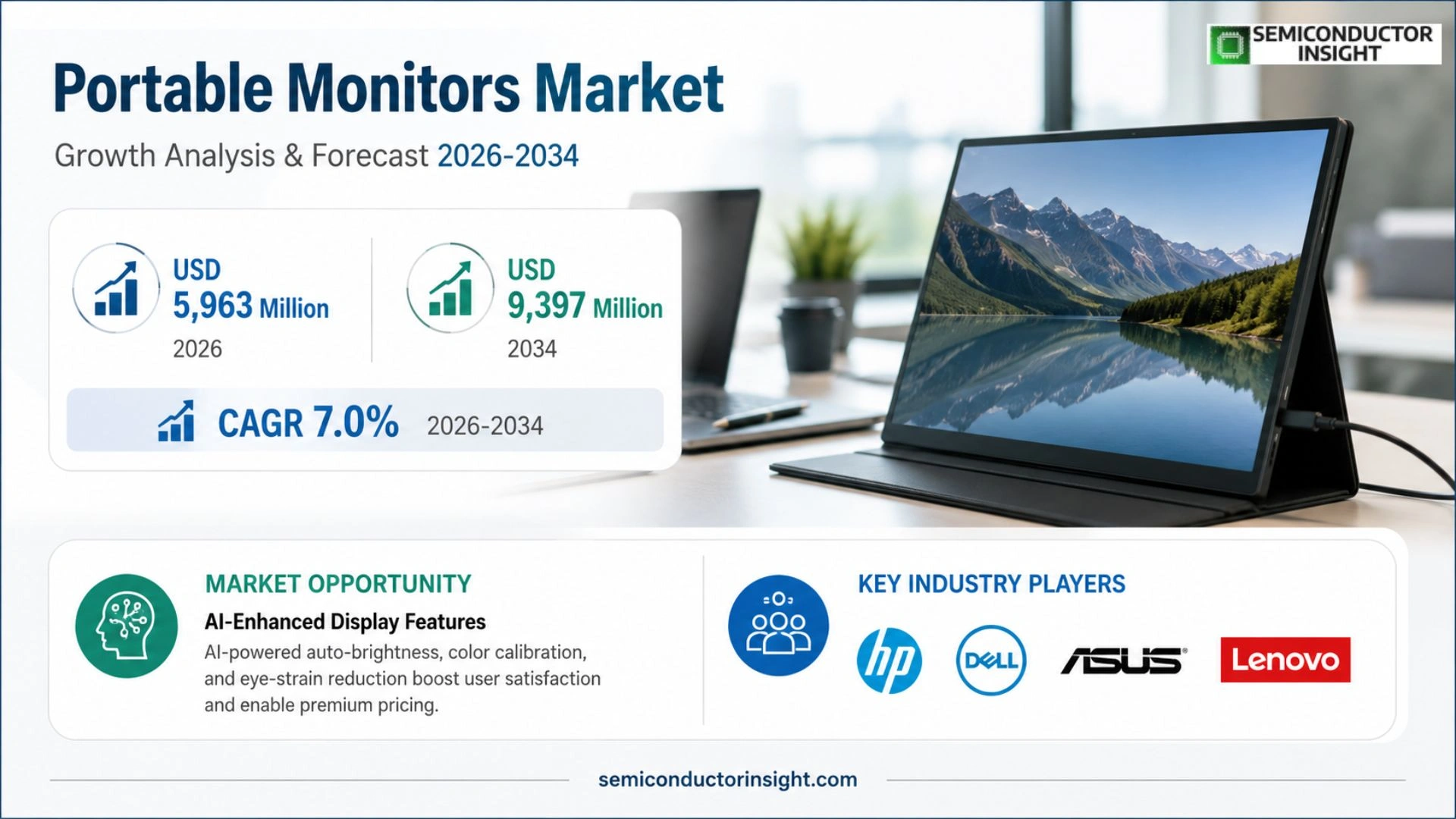
Portable Monitors market is projected to grow from USD 5,963 million in 2026 to USD 9,397 million by 2034, exhibiting a CAGR of 7.0% during the forecast period.
A portable monitor is a lightweight external display designed to be easily carried and quickly connected to a laptop, a tablet, a smartphone, a game console or a mini PC to add a second (or larger) screen without the bulk of a traditional desktop monitor. They are engineered for mobile productivity,extending spreadsheets, Coding space, collaboration views and presentations,while also serving entertainment and gaming use cases when paired with consoles or handheld devices. Key design priorities include low weight, thin profiles, enduring housings for travel, flexible orientation (landscape/portrait), broad ergonomics such as stable stands, glare control, enduring brightness across varied environments.
The market is experiencing growth because remote‑work adoption has heightened demand for multi‑screen setups on the move,and advances in USB‑C power delivery now enable single‑cable operation. Initiatives by leading manufacturers reinforce this trend; for example in March 2024 HP announced an OLED portable monitor line featuring built‑in battery packs aimed at creative professionals. Other notable players,including ASUS, Lenovo, Dell tagged ViewSonic>,continue expanding portfolios with higher refresh rates and integrated touch functionality.
MARKET DRIVERS
Remote‑Work Adoption Accelerates Demand
Portable Monitors market has been buoyed by the rapid shift toward remote and hybrid work models. Companies are equipping mobile employees with secondary displays that attach to laptops, enabling dual‑screen productivity without a fixed office desk. In 2023, corporate procurement of lightweight screens grew by roughly 14% year‑over‑year, reflecting managers’ focus on ergonomics and efficiency.
Advancements in Connectivity Standards
USB‑C Alt‑Mode and Thunderbolt 4 have become mainstream, eliminating the need for bulky adapters and simplifying plug‑and‑play setups. These standards deliver power, video, and data over a single cable, which cuts down on desk clutter and improves user experience. As a result, OEMs are launching higher‑resolution, 4K‑capable models at price points previously reserved for larger monitors.
➤ Enterprises that prioritize flexible workstations are markedly increasing their spend on portable screens, creating a steady revenue pipeline for manufacturers.
Moreover, the rise of content‑creation platforms has spurred freelancers to adopt mobile dual‑screen solutions. A recent survey showed that 38% of gig‑economy workers plan to add a portable monitor to their toolkit within the next twelve months, citing better workflow management as the primary motive.
MARKET CHALLENGES
Price Sensitivity Among Small‑Business Buyers
While demand is rising, many small‑business owners remain cautious about allocating budget to auxiliary hardware. Unit prices for premium 15‑inch models hover around $250, which can strain limited capital expenditures, especially in emerging economies.
Other Challenges
Supply Chain Volatility
Component shortages,especially for high‑performance LCD panels,have led to intermittent stockouts. Manufacturers are forced to prioritize larger contracts, leaving discretionary purchases delayed.
MARKET RESTRAINTS
Limited Battery Life for Integrated Devices
Some portable monitors incorporate built‑in batteries to support true on‑the‑go usage. However, current battery technologies provide only 3–4 hours of operation, which fails to meet the expectations of field technicians who need all‑day reliability. This limitation nudges buyers toward wired solutions, dampening the growth of fully untethered segments.
Regulatory Hurdles in Key Regions
In certain jurisdictions, electromagnetic emission standards for display devices are tightening. Compliance testing adds cost and time to product launches, causing some manufacturers to defer entry into those markets despite strong demand signals.
MARKET OPPORTUNITIES
AI‑Enhanced Display Features
Integrating on‑board AI for auto‑brightness, color calibration, and eye‑strain reduction creates a differentiated value proposition. Early adopters report a 12% boost in user satisfaction scores, suggesting that intelligent displays could command premium pricing and unlock new revenue streams for players willing to invest in firmware development.
Expansion into Education and Training
Educational institutions are modernizing classrooms with portable screens that support interactive lessons and remote tutoring. Pilot programs across North America indicate that a single 13‑inch monitor can replace a traditional desktop setup, halving space requirements while maintaining functional parity. This creates a sizable niche where volume sales can offset lower average transaction values.
Portable Monitors Market Trends
Shift Toward Mobile Multitasking
Portable Monitors market is being reshaped by a surge in hybrid work environments that demand an extra screen without the encumbrance of a traditional desk set‑up. In 2025, manufacturers produced roughly 23,300 units, each priced around US$280, generating gross margins that typically range from 20 % to 40 %. These figures underscore a business model that balances modest unit volumes with healthy profitability, driven by the appeal of lightweight, thin designs and plug‑and‑play connectivity. Buyers increasingly value ergonomics,stable stands, glare‑reduction coatings, and brightness levels suited for cafés, airports, and co‑working spaces,over raw display breakthroughs. Consequently, firms that fine‑tune the ergonomics‑technology trade‑off are capturing the highest share of revenue, while the broader ecosystem of accessories (USB‑C hubs, power banks) reinforces the value proposition of a truly portable second display.
Other Trends
Segment Differentiation by User Type
Within Portable Monitors market, three user clusters are emerging as distinct drivers of product evolution. Business travelers and remote employees prioritize durability, compactness, and reliable glare control, often opting for IPS panels that deliver consistent color across varied lighting. Creative professionals seek higher color fidelity and resolution,4K or high‑Gamut IPS,to support design work, and many demand touch or pen support for sketching on the go. Gamers, by contrast, focus on refresh rates of 120 Hz or higher, low latency, and HDMI compatibility for console connections, pushing manufacturers toward OLED or fast‑panel technologies. Brands that tailor feature bundles to each segment,offering rugged chassis for travelers, color‑calibrated screens for creators, and high‑refresh models for gamers,are differentiating themselves in a crowded shelf, while niche specialists are also leveraging rapid product cycles to stay relevant.
Integration and Ecosystem Alignment
Integration is the next frontier for Portable Monitors market, as consumers gravitate toward devices that mesh seamlessly with existing laptops, tablets, and docking stations. Single‑cable USB‑C solutions that combine video, data, and power,often with passthrough charging,are becoming a baseline expectation, reducing cable clutter and simplifying the setup process. Companies that embed firmware profiles compatible with major operating systems enhance plug‑and‑play reliability, a factor that sways corporate procurement decisions. Distribution channels reflect this shift: e‑commerce platforms highlight spec‑driven comparisons, while brick‑and‑mortar retailers emphasize warranty coverage and in‑store demonstrations of ergonomic features. Looking ahead, tighter coupling with mobile docks, wireless display standards, and AI‑assisted brightness adaptation will likely decide which manufacturers capture the most sustainable share of the evolving portable display landscape.
COMPETITIVE LANDSCAPE
Key Industry Players
Portable Monitors Market Competitive Overview
The portable‑monitor segment is now dominated by a handful of global OEMs that leverage extensive display supply chains and established after‑sales networks. HP and Dell, for instance, integrate portable screens into their broader workstation ecosystems, offering USB‑C single‑cable solutions that sync seamlessly with enterprise laptops. Lenovo’s ThinkVision line targets corporate travelers, emphasizing lightweight chassis and an anti‑glare coating suited for airport terminals. Meanwhile, Asus and Acer differentiate through high‑refresh gaming models, bundling adaptive sync technology and detachable stands that appeal to esports enthusiasts. This concentration of capabilities creates a tiered market structure where the top three firms capture roughly one‑third of global shipments, while mid‑size players compete on niche specifications such as OLED panels or built‑in batteries to carve out loyal user segments.
Beyond the headline brands, a diverse set of specialist manufacturers fuels product variety and pushes functional boundaries. ViewSonic and LG focus on color‑accurate IPS displays for creative professionals, often coupling their monitors with color‑calibration software. AOC and MSI target the budget‑to‑mid range, balancing acceptable brightness with competitive pricing. Smaller innovators such as Mobile Pixels (with its “Drop” hinge system), Gechic, NexiGo, and Espresso Displays excel in ultra‑thin form factors and versatile mounting options, attracting remote‑work freelancers who prize convenience. Companies like ARZOPA and EHOMEWEI enrich the ecosystem with rugged, travel‑grade housings, while InnoView and Intehill experiment with integrated power‑bank modules that reduce dependence on laptop chargers. This fragmentation encourages rapid feature iteration, forcing larger players to incorporate emerging functionalities to retain relevance.
List of Key Portable Monitors Companies Profiled
- HP
- Dell
- Lenovo
- ASUS
- Acer
- ViewSonic
- LG
- MSI
- Gechic
- Mobile Pixels
- Espresso Displays
- ARZOPA
- EHOMEWEI
- InnoView
- Intehill
Segment Analysis:
| Segment Category | Sub-Segments | Key Insights |
| By Type |
|
Non‑touch Monitor continues to dominate because it fulfills the core need for a lightweight, plug‑and‑play second screen. – Business travelers and remote workers value the reduced weight, thin profile and durable housing, which align with the mobile‑centric workflow. – Simpler panel technology keeps costs modest while delivering sufficient brightness and color fidelity for most productivity tasks, reinforcing its appeal in corporate procurement. – The absence of touch components also reduces power draw, extending battery life for laptops that rely on USB‑C power‑through. Overall, the non‑touch segment is the reference point for portability and cost‑effectiveness. |
| By Application |
|
Remote Collaboration & Productivity is the leading application because modern work styles demand an extra screen that can travel. – Users extend spreadsheets, coding environments, and video‑conferencing windows onto a portable display, reducing the need to toggle between tabs. – Integrated stands and glare‑control coatings enable comfortable usage in cafés, airports, or co‑working spaces. – Seamless USB‑C connectivity ensures a single‑cable experience, which is a decisive factor for time‑pressed professionals. – The application’s emphasis on reliability and ease‑of‑setup drives manufacturers to prioritize plug‑and‑play firmware across operating systems. |
| By End User |
|
Remote Workers emerge as the dominant end‑user segment as the hybrid‑work model solidifies. – They prioritize ultra‑light builds, robust hinges, and anti‑glare screens to accommodate diverse lighting conditions. – Battery‑pass‑through capability is critical, allowing the monitor to draw power from the host laptop without draining its own battery. – Integration with productivity suites (e.g., Microsoft Teams, Zoom) through automatic detection enhances the user experience. – The segment’s feedback loops drive rapid iteration on ergonomics, stand flexibility, and software driver stability. |
| By Feature Set |
|
Touchscreen with Pen Support leads this feature‑oriented category because it bridges productivity and creativity on the go. – Artists and designers appreciate pressure‑sensitive stylus input for sketching directly on the display, eliminating the need for separate tablets. – The added tactile feedback supports annotation of documents during meetings, aligning with the collaborative workflow of remote professionals. – Manufacturers emphasize low latency and calibrated color profiles to meet the expectations of creative users while maintaining portability. |
| By Connectivity |
|
USB‑C Single‑Cable Solution dominates because it consolidates power delivery, video, and data into one connector, dramatically simplifying the user experience. – The universality of USB‑C across laptops, tablets, and smartphones aligns with the ecosystem‑centric purchasing decisions of corporate IT departments. – Reliable plug‑and‑play behavior across Windows, macOS, and Chrome OS platforms reduces support overhead and fosters brand loyalty. – The trend pushes OEMs to integrate DP‑Alt Mode and Power Delivery compliance, making this connectivity option the benchmark for future portable monitor designs. |
Regional Analysis: Portable Monitors Market
North America
Large enterprises are redefining desk configurations by pairing laptops with portable monitors, citing enhanced multitasking and reduced ergonomic strain. Procurement departments view the devices as cost‑effective alternatives to full‑scale desktop upgrades, accelerating adoption cycles across finance and engineering units.
Tech‑savvy consumers gravitate toward monitors that blend aesthetics with battery efficiency. The premium market segment benefits from design narratives that emphasize travel‑ready durability, driving brand loyalty among digital nomads and creative freelancers.
Manufacturers have diversified component sourcing across North America and Asia, mitigating disruption risks. Near‑shoring initiatives expand capacity in Mexico, allowing quicker response to fluctuating order volumes without sacrificing product quality.
Environmental compliance standards encourage recyclable materials and energy‑efficient designs. Companies that embed these criteria into product development gain a competitive edge and smoother market entry in environmentally conscious jurisdictions.
Europe
European firms exhibit a pragmatic stance toward portable monitors, emphasizing interoperable standards and data security. Financial services and public sector units integrate dual‑screen solutions to streamline analytics workflows while adhering to strict GDPR‑aligned data handling protocols. Manufacturers respond with modular accessories that cater to varied connectivity preferences across the continent. Market momentum is further buoyed by a growing freelance ecosystem in major cities, where compact displays support on‑the‑go client engagements. The region’s regulatory emphasis on energy efficiency propels innovation in low‑power display technologies, aligning product roadmaps with sustainability commitments.
Asia‑Pacific
The Asia‑Pacific landscape is shaped by a rapid expansion of mobile work cultures, especially in China, India, and Southeast Asia. Enterprises adopt portable monitors to equip field engineers and sales forces with real‑time data visibility, fostering agile decision‑making. Consumer demand is amplified by a youthful demographic that values sleek, tech‑forward gadgets for both study and entertainment. Local manufacturers leverage cost‑competitive production capabilities to introduce feature‑rich models at attractive price points, intensifying competition. Meanwhile, governments promote digital infrastructure upgrades, indirectly stimulating demand for supplementary display solutions that enhance productivity in emerging urban centers.
South America
In South America, Portable Monitors market gains traction through targeted initiatives in Brazil and Argentina, where remote work adoption outpaces traditional office models. Companies in the logistics and agribusiness sectors seek lightweight screens to improve on‑site data analysis, reducing reliance on bulky desktop setups. Consumer awareness is rising as influencers showcase the convenience of dual‑screen setups for gaming and streaming. Import tariffs remain a consideration, prompting distributors to favor regional assembly partners that can navigate customs efficiently. The market’s evolution reflects a blend of cost sensitivity and an appetite for technology that bridges connectivity gaps in diverse operating environments.
Middle East & Africa
The Middle East & Africa region presents a mosaic of opportunities, with the Gulf states investing heavily in digital transformation across government and private enterprises. Portable monitors support mobile command centers and remote consultancy services, aligning with national visions for smart economies. In Africa, the rise of mobile broadband and entrepreneurial tech hubs drives demand for affordable, rugged displays that can endure variable power conditions. Partnerships between multinational OEMs and local distributors facilitate market entry, while training programs highlight productivity gains from multi‑screen workflows. Overall, the region’s heterogeneous needs encourage manufacturers to diversify product portfolios to meet both premium and entry‑level expectations.
Report Scope
This market research report provides a comprehensive analysis of the Portable Monitors Market , covering the forecast period 2026–2034. It offers detailed insights into market dynamics, technological advancements, competitive landscape, and key trends shaping the industry.
Key focus areas of the report include:
- Market Overview: The report begins with an overview outlining its current market scenario, key growth indicators, and industry transformation drivers. It discusses macroeconomic factors, demand–supply balance, regulatory landscape, and the strategic role of semiconductors in powering advancements across industries such as automotive, telecommunications, consumer electronics, and industrial automation.
- Market Size & Forecast: Historical data and future projections for revenue, unit shipments, and market value across major regions and segments.
- Segmentation Analysis: Detailed breakdown by product type, technology, application, and end-user industry to identify high-growth segments and investment opportunities.
- Regional Insights: Insights into market performance across North America, Europe, Asia-Pacific, Latin America, and the Middle East & Africa, including country-level analysis where relevant.
- Competitive Landscape: Profiles of leading market participants, including their product offerings, R&D focus, manufacturing capacity, pricing strategies, and recent developments such as mergers, acquisitions, and partnerships.
- Technology Trends & Innovation: Assessment of emerging technologies, integration of AI/IoT, semiconductor design trends, fabrication techniques, and evolving industry standards.
- Market Drivers & Restraints: Evaluation of factors driving market growth along with challenges, supply chain constraints, regulatory issues, and market-entry barriers.
- Stakeholder Insights: Insights for component suppliers, OEMs, system integrators, investors, and policymakers regarding the evolving ecosystem and strategic opportunities.
Primary and secondary research methods are employed, including interviews with industry experts, data from verified sources, and real-time market intelligence to ensure the accuracy and reliability of the insights presented.
FREQUENTLY ASKED QUESTIONS:
What is the current market size of Portable Monitors Market?
-> Portable Monitors market is projected to grow from USD 5,963 million in 2026 to USD 9,397 million by 2034, exhibiting a CAGR of 7.0%
Which key companies operate in Portable Monitors Market?
-> Key players include HP, ViewSonic, ASUS, Lenovo, AOC International, Dell, LG, Acer, MSI, ARZOPA, espresso Displays, INNOCN, Sculptor, Mobile Pixels, EHOMEWEI, Intehill, InnoView, Magedok, Verbatim, NexiGo, Gechic, among others.
What are the key growth drivers?
-> Key growth drivers include rise of remote and hybrid work, growing demand for additional screen real‑estate on the go, increased mobile productivity needs, expansion of gaming and entertainment use cases, and advances in lightweight, durable design and USB‑C integration.
Which region dominates the market?
-> Asia exhibits the strongest growth momentum, driven by large consumer bases and rapid adoption of mobile computing, while North America and Europe also hold significant market shares.
What are the emerging trends?
-> Emerging trends include enhanced ergonomics with lighter materials, higher brightness for varied environments, tighter integration with docking stations and tablets, and the development of multi‑function displays offering touch, pen support, and built‑in batteries.

Get Sample Report PDF for Exclusive Insights
Report Sample Includes
- Table of Contents
- List of Tables & Figures
- Charts, Research Methodology, and more...
 Download Sample Report PDF


