
MARKET INSIGHTS
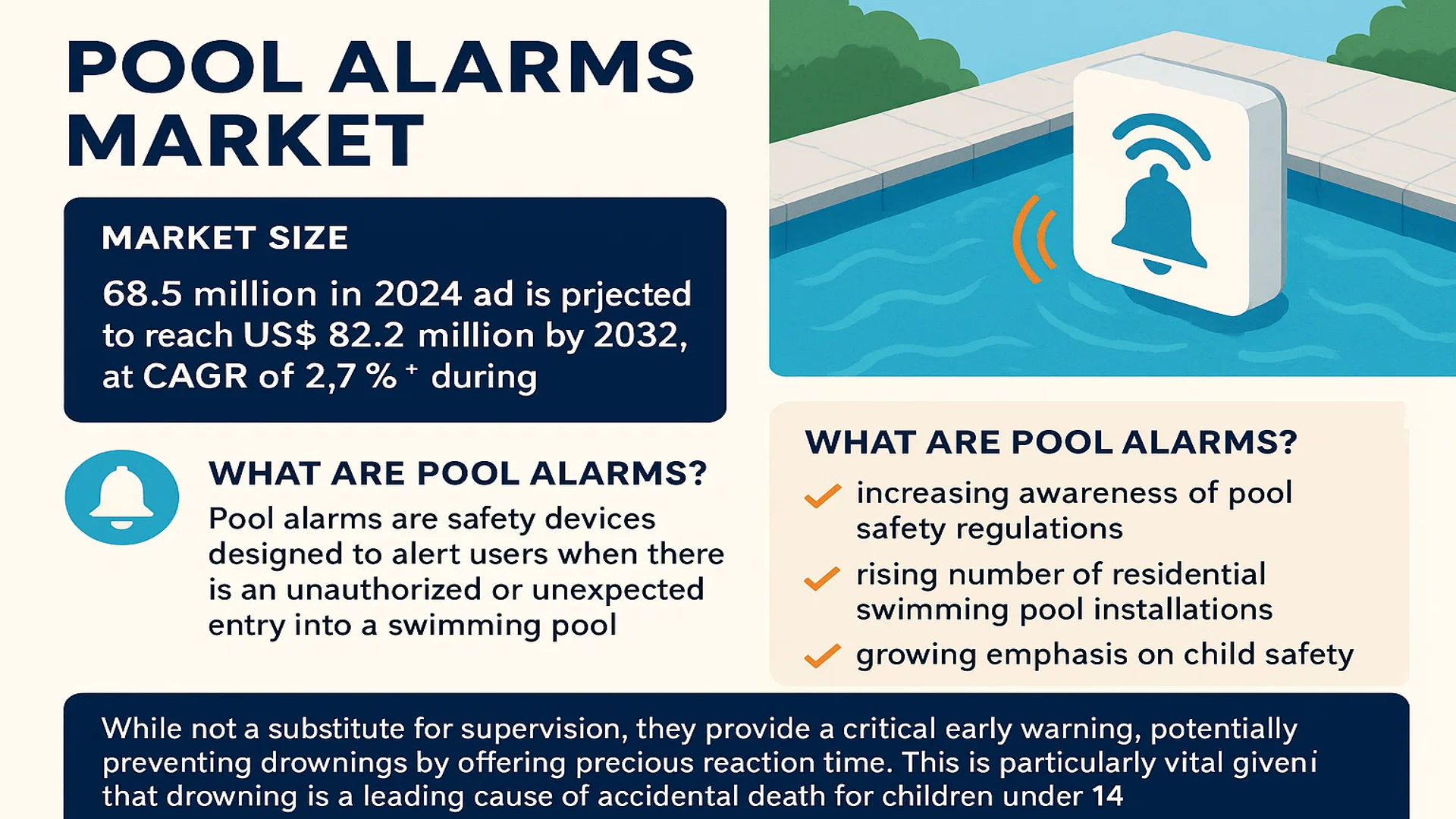
The global Pool Alarms Market was valued at 68.5 million in 2024 and is projected to reach US$ 82.2 million by 2032, at a CAGR of 2.7% during the forecast period.
Pool alarms are safety devices designed to alert users when there is an unauthorized or unexpected entry into a swimming pool. These systems function by detecting disturbances on the water’s surface, the opening of a pool gate, or the removal of a pool cover. While not a substitute for supervision, they provide a critical early warning, potentially preventing drownings by offering precious reaction time. This is particularly vital given that drowning is a leading cause of accidental death for children under 14.
The market’s steady growth is primarily driven by increasing awareness of pool safety regulations, a rising number of residential swimming pool installations, and a growing emphasis on child safety. The industry structure is moderately concentrated, with the top five manufacturers holding a combined 63% of the sales revenue market share. Sensor Espio leads the market with a 23% share, followed by Aquaguard (20%) and Pool Patrol (10%). Key product types include Fence/Wall Mounted Pool Alarms, Pool Mounted Infrared Detectors, Underwater Motion Alarms, and others, catering to both commercial and residential pool segments.
MARKET DYNAMICS
MARKET DRIVERS
Rising Drowning Incidents and Safety Regulations to Drive Market Growth
Drowning remains a significant public health concern globally, with statistics indicating it is the third leading cause of unintentional injury death worldwide. Approximately 236,000 people die from drowning annually, and for every drowning death, there are an estimated 5 to 10 non-fatal drowning incidents requiring emergency care. This alarming prevalence has heightened awareness and regulatory focus on pool safety measures. Many regions have implemented or strengthened legislation mandating pool safety equipment, including alarms, particularly for residential pools. For instance, several U.S. states have adopted legislation inspired by the Virginia Graeme Baker Pool & Spa Safety Act, which emphasizes layers of protection, often including alarms. This regulatory push, combined with growing parental and homeowner awareness, is a primary driver for the pool alarms market, compelling compliance and adoption to enhance safety and prevent tragic accidents.
Increasing Pool Construction and Smart Home Integration to Boost Demand
The global expansion of residential and commercial swimming pools is significantly contributing to market growth. The swimming pool construction industry has seen steady growth, with the residential segment particularly strong in North America, Europe, and increasingly in Asia-Pacific. This expansion is complemented by the rising integration of pool alarms into broader smart home security and automation systems. Modern pool alarms are evolving beyond standalone devices to become interconnected components of home ecosystems, offering remote alerts via smartphones and integration with other safety and monitoring systems. This technological advancement enhances their appeal, offering homeowners not just safety but also convenience and modern functionality. The trend towards smarter, connected homes is thus acting as a catalyst, driving replacement demand for older alarm models and attracting new customers seeking integrated safety solutions.
Growing Awareness and Insurance Incentives to Fuel Market Expansion
Heightened awareness campaigns by safety organizations and government bodies have been instrumental in educating the public about drowning risks and preventive measures. These initiatives effectively communicate the role of pool alarms as a critical layer of protection. Furthermore, the insurance industry is increasingly recognizing their value. Many home insurance providers offer premium discounts for properties equipped with certified pool safety devices, including alarms. This financial incentive lowers the total cost of ownership for consumers and encourages adoption. The combination of public education highlighting the stark reality of drowning statistics and tangible economic benefits from insurers creates a powerful driver for market growth, making pool alarms a more attractive and financially sensible investment for a broader range of pool owners.
MARKET CHALLENGES
High False Alarm Rates and Consumer Complacency to Challenge Market Penetration
A significant challenge facing the pool alarm market is the prevalence of false alarms triggered by environmental factors like wind, rain, falling debris, or even pets. These frequent false alerts can lead to user frustration, causing them to disable the alarm entirely, thereby negating its safety purpose. This issue of reliability undermines consumer confidence and can deter potential buyers who question the product’s effectiveness. Additionally, a sense of complacency among pool owners presents a formidable obstacle. Many individuals perceive drowning as a remote risk that happens to others, not within their own households. This underestimation of danger leads to procrastination in investing in safety equipment like alarms, as it is often not viewed as an immediate necessity, thereby limiting market penetration despite clear risks.
Other Challenges
Technical Limitations and Installation Complexities
Certain types of pool alarms, particularly some underwater motion sensors, face technical limitations in very large or irregularly shaped pools, potentially leaving blind spots. Furthermore, installation can be perceived as complex or intrusive for some models, such as those requiring hardwiring or permanent mounting, which may discourage DIY-minded consumers or those hesitant to modify their pool area, impacting adoption rates.
Price Sensitivity and Competitive Alternatives
The cost of a quality pool alarm system can be a barrier, especially in price-sensitive markets and for budget-conscious consumers. This challenge is compounded by the availability of alternative, and sometimes perceived as more comprehensive, safety measures like four-sided isolation fencing or automatic pool covers. Consumers often weigh the cost of an alarm against these other options, which can restrain market growth for alarms specifically.
MARKET RESTRAINTS
Lack of Stringent Universal Regulations and Standardization to Deter Market Growth
While some regions have enacted strict pool safety laws, the absence of consistent, mandatory regulations on a global scale acts as a major restraint. In many countries, the installation of pool alarms remains a recommendation rather than a legal requirement, which significantly dampens market demand. Without the force of law, adoption is largely left to consumer discretion, which varies widely. Furthermore, the market suffers from a lack of universal performance and quality standards. This variability can lead to consumer confusion and hesitation, as it is difficult to compare products and be assured of a minimum level of reliability and effectiveness. The resulting uncertainty regarding product performance and the optional nature of installation in numerous markets collectively restrain more robust and widespread market expansion.
Economic Fluctuations and Disposable Income Constraints to Limit Market Expansion
The pool alarm market is sensitive to broader economic conditions. As a non-essential safety product for many consumers, its purchase is often tied to discretionary spending. During periods of economic downturn, inflation, or reduced consumer confidence, spending on such safety enhancements is often deferred or eliminated from household budgets. This sensitivity makes the market vulnerable to economic cycles, restraining steady growth. Consumers prioritize essential expenditures, and investments in pool safety, while important, can be perceived as deferrable, especially if the pool is not used by young children. This economic dependency places a inherent limitation on the market’s potential, particularly in developing regions where disposable income levels are lower and economic volatility is more pronounced.
Seasonal Sales Nature and Replacement Cycle to Restrain Consistent Demand
The market for pool alarms is highly seasonal, with the majority of sales occurring in the spring and early summer as homeowners prepare their pools for the season. This seasonality creates challenges for manufacturers and retailers in terms of inventory management, cash flow, and year-round operational stability. Additionally, pool alarms are durable goods with a long replacement cycle. Once a consumer purchases an alarm, they are unlikely to need a new one for many years unless they move or the unit fails. This infrequent purchase pattern results in a market that relies heavily on new pool construction and first-time buyers rather than a steady stream of repeat customers, which inherently restrains the pace of market growth and volume consistency.
MARKET OPPORTUNITIES
Technological Innovation in AI and IoT to Unlock New Growth Avenues
The integration of advanced technologies such as artificial intelligence (AI) and the Internet of Things (IoT) presents a substantial opportunity for the pool alarm market. Next-generation alarms can leverage AI algorithms to better distinguish between a human fall and environmental disturbances, drastically reducing false alarms and enhancing reliability. Furthermore, IoT connectivity allows for seamless integration with smart home systems, enabling remote monitoring, real-time alerts sent directly to smartphones, and data logging of pool activity. This evolution from a simple alarm to an intelligent, connected safety hub increases the product’s value proposition, allowing manufacturers to command premium prices and tap into the growing smart home market segment, which is expanding rapidly globally.
Expansion in Emerging Markets and Untapped Regions to Offer Lucrative Potential
Significant growth opportunity lies in the penetration of emerging markets, particularly in Asia-Pacific, Latin America, and the Middle East, where the number of residential pools is rising steadily alongside economic development and urbanization. In these regions, awareness of pool safety is still developing, representing a vast untapped customer base. Strategic market education campaigns coupled with the introduction of products tailored to local needs and price points can unlock enormous potential. Furthermore, as the middle class expands in these economies, disposable income for home improvements and safety products increases, creating a favorable environment for market entry and expansion that is not yet saturated with competition.
Product Diversification and Bundling Strategies to Create New Revenue Streams
There is a considerable opportunity for companies to diversify their product offerings beyond traditional alarms. Developing multi-sensor systems that combine surface wave detection with gate sensors, cover monitors, and wearable immersion tags for children creates a comprehensive safety ecosystem. Bundling these products together can provide a more complete solution for concerned parents and pool owners, increasing the average transaction value. Additionally, offering subscription-based services for cloud storage of activity logs, professional monitoring, or extended warranties can create recurring revenue models, transforming the market from a one-time product sale to an ongoing service relationship, thereby enhancing customer lifetime value and opening new, sustainable growth channels.
POOL ALARMS MARKET TRENDS
Integration of Smart Home Technology and IoT Connectivity Emerges as a Dominant Trend
The global pool alarms market is undergoing a significant transformation, driven by the widespread integration of smart home technology and Internet of Things (IoT) connectivity. This trend is fundamentally shifting consumer expectations from basic alert systems to comprehensive, connected safety solutions. Modern pool alarms now frequently feature Wi-Fi and Bluetooth capabilities, allowing them to send instant notifications directly to a homeowner’s smartphone or integrate seamlessly with broader smart home ecosystems like Amazon Alexa or Google Home. This connectivity provides remote monitoring capabilities, a feature that is increasingly considered a standard requirement rather than a luxury. Furthermore, the adoption of these advanced systems is supported by the growing penetration of smart home devices, which exceeded 15% of households in key markets like North America and Europe. This technological evolution enhances user convenience and provides a more robust safety net by ensuring alerts are received instantly, regardless of the user’s location, thereby addressing a critical gap in traditional, standalone alarm systems.
Other Trends
Stringent Safety Regulations and Legislation
A powerful driver of market growth is the increasing implementation of stringent pool safety regulations and legislation by local and national governments worldwide. These mandates are a direct response to sobering statistics surrounding drownings, particularly for children under the age of five, for whom drowning remains a leading cause of accidental death. In the United States, for instance, several states have enacted legislation requiring certified pool alarms on all residential pools, a move that has directly catalyzed market demand. The International Code Council’s pool and spa code, which is adopted by numerous jurisdictions, often includes provisions for layers of protection, with alarms being a key component. This regulatory push compels both new pool construction and retrofitting of existing pools to comply with safety standards, creating a sustained and legally enforced demand for certified products and ensuring that safety remains a non-negotiable aspect of pool ownership.
Product Innovation and Diversification of Alarm Types
Manufacturers are actively engaged in product innovation to cater to diverse consumer needs and pool configurations, leading to a more segmented and sophisticated market. While surface wave sensors remain prevalent, there is notable growth and development in other alarm types. Underwater motion alarms, which detect disturbances beneath the water’s surface, are gaining traction for their ability to trigger an alert even if a entry into the pool is silent. Similarly, wearable alarms, such as wristbands that alert when submerged, offer personalized protection for young children and pets. The market has also seen advancements in gate alarm technology, with models featuring magnetic contacts and loud, weather-resistant sirens. This diversification allows consumers to select a system—or a combination of systems—that best fits their specific pool environment and safety concerns, moving the market beyond one-size-fits-all solutions towards tailored, multi-layered safety approaches.
COMPETITIVE LANDSCAPE
Key Industry Players
Companies Strive to Strengthen their Product Portfolio to Sustain Competition
The competitive landscape of the global pool alarms market is fragmented, characterized by a mix of established brands and specialized niche players. While the market is not dominated by a single entity, the top five manufacturers collectively command a significant portion of the revenue, holding approximately 63% of the total sales share in 2024. This indicates a competitive environment where product innovation, reliability, and market reach are paramount for success.
Sensor Espio is the unequivocal market leader, holding a dominant 23% revenue share globally. Its leadership position is largely attributed to its comprehensive range of reliable and technologically advanced alarms, including sophisticated underwater motion sensors and surface wave detection systems. The company’s strong brand recognition and extensive distribution network, particularly across North America and Europe, have solidified its top status.
Following closely are Aquaguard and Pool Patrol, which hold market shares of approximately 20% and 10%, respectively. Aquaguard has carved out a significant presence through its focus on user-friendly and highly sensitive alarm systems, often marketed directly to safety-conscious residential pool owners. Pool Patrol, meanwhile, is recognized for its durable and affordable product lines, making it a popular choice for both residential and commercial applications. The growth of these companies is driven by continuous product development and effective marketing strategies that highlight compliance with international safety standards.
Additionally, these leading companies are aggressively pursuing growth through strategic initiatives. Geographic expansion into emerging markets in Asia-Pacific and Latin America, coupled with frequent new product launches featuring enhanced connectivity like smart home integration, are expected to be key drivers for increasing their market share over the forecast period.
Meanwhile, other notable players like Poolguard and Safety Turtle are strengthening their positions through targeted innovations. Poolguard is investing heavily in R&D for solar-powered and wireless alarm options, reducing installation complexity. Safety Turtle is focusing on its unique wearable technology for children and pets, creating a specialized niche within the broader market. These focused strategies ensure a dynamic and evolving competitive landscape where companies continually adapt to meet consumer demands for safety and convenience.
List of Key Pool Alarms Companies Profiled
- Sensor Espio (France)
- Aquaguard (U.S.)
- Pool Patrol (U.S.)
- Poolguard (U.S.)
- Techko (U.S.)
- Safety Turtle (Canada)
- SmartPool (U.S.)
- Blue Wave Products (U.S.)
- Magiline (France)
Segment Analysis:
By Type
Fence/Wall Mounted Pool Alarms Lead the Market Due to Their Ease of Installation and Compliance with Safety Regulations
The market is segmented based on type into:
- Fence/Wall Mounted Pool Alarms
- Pool Mounted Infrared Detectors
- Underwater Motion Alarms
- Others
By Application
Residential Pool Segment Dominates Owing to High Consumer Awareness and Increasing Safety Concerns for Families
The market is segmented based on application into:
- Commercial Pool
- Residential Pool
By Technology
Surface Wave Detection Technology Holds Significant Share Due to Its Effectiveness in Detecting Unauthorized Pool Entry
The market is segmented based on technology into:
- Surface Wave Detection
- Infrared Beam Detection
- Subsurface Detection
- Multi-Technology Systems
By Sales Channel
Online Retail Channels Show Rapid Growth Fueled by E-commerce Expansion and Consumer Preference for Convenient Shopping
The market is segmented based on sales channel into:
- Specialty Retail Stores
- Home Improvement Centers
- Online Retail
- Direct Sales
Regional Analysis: Pool Alarms Market
North America
The North American market, led by the United States, is the most mature and technologically advanced region for pool alarms globally. This dominance is driven by stringent state-level safety regulations, such as the Virginia Graeme Baker Pool and Spa Safety Act, which mandates specific safety measures including alarms for many public and residential pools. High consumer awareness about drowning prevention, particularly for children under 14 where it remains a leading cause of accidental death, fuels demand. The market is characterized by a preference for sophisticated, multi-sensor systems that integrate with smart home ecosystems. Key players like Pool Patrol and Safety Turtle have a strong foothold here, with innovation focused on reducing false alarms and enhancing wireless connectivity. However, market growth faces headwinds from market saturation in certain affluent areas and the high initial cost of advanced systems.
Europe
Europe represents a significant and steadily growing market, largely propelled by a combination of regulatory pressure and a rising culture of domestic safety. The EU’s General Product Safety Directive encourages the adoption of safety devices like pool alarms, though specific mandates vary by member state. Countries like France and Germany, with high rates of private pool ownership, show particularly strong demand. The European consumer tends to prioritize reliability, durability, and products with clear CE marking conformity. There is a noticeable trend towards aesthetically discreet designs, such as sleek fence-mounted or underwater motion sensors, that blend with garden landscapes. While the market is advanced, growth is somewhat moderated by the prevalence of older, existing pools that may not be retrofitted with new safety technology immediately.
Asia-Pacific
The Asia-Pacific region is the fastest-growing market for pool alarms, albeit from a smaller base, driven by rapid urbanization, rising disposable incomes, and a boom in residential and hospitality construction. Markets in Australia, with its strong pool culture, and China, with its expanding middle class, are particularly dynamic. However, the market landscape is bifurcated. In developed economies like Australia and Japan, there is demand for high-end, feature-rich alarms often required by local building codes. In contrast, emerging economies are more price-sensitive, with growth primarily fueled by increasing safety awareness rather than strict regulation. This presents a substantial opportunity for manufacturers offering reliable, cost-effective solutions. The region’s vast potential is its greatest asset, though navigating diverse regulatory environments and consumer preferences remains a key challenge.
South America
The South American market for pool alarms is nascent but shows promising long-term potential. Growth is primarily concentrated in countries with developing economies and growing urban middle classes, such as Brazil and Argentina. The market is currently driven almost exclusively by consumer awareness campaigns and a growing recognition of child safety risks, as formal regulatory frameworks mandating pool alarms are limited or weakly enforced. Economic volatility in the region often makes pool alarms a discretionary purchase rather than a necessity, which can suppress market growth during downturns. The prevailing consumer preference is for basic, affordable models, making it a volume-driven market for entry-level products. As infrastructure and economic conditions stabilize, the market is expected to gradually mature.
Middle East & Africa
The market in the Middle East & Africa is highly emergent and unevenly developed. Demand is concentrated in wealthier Gulf Cooperation Council (GCC) nations like the UAE and Saudi Arabia, driven by extensive luxury residential and hotel construction featuring private pools. In these markets, pool alarms are often included as a standard safety feature in high-end properties. Conversely, across most of Africa, the market is virtually untapped, hindered by limited pool ownership outside of commercial hotels and significant economic constraints. The region’s growth is intrinsically linked to urban development projects and the tourism industry. While overall penetration is low, the high-value projects in the Middle East offer lucrative niches for premium alarm manufacturers.
Report Scope
This market research report provides a comprehensive analysis of the global and regional Pool Alarms markets, covering the forecast period 2025–2032. It offers detailed insights into market dynamics, technological advancements, competitive landscape, and key trends shaping the industry.
Key focus areas of the report include:
- Market Size & Forecast: Historical data and future projections for revenue, unit shipments, and market value across major regions and segments.
- Segmentation Analysis: Detailed breakdown by product type, technology, application, and end-user industry to identify high-growth segments and investment opportunities.
- Regional Outlook: Insights into market performance across North America, Europe, Asia-Pacific, Latin America, and the Middle East & Africa, including country-level analysis where relevant.
- Competitive Landscape: Profiles of leading market participants, including their product offerings, R&D focus, manufacturing capacity, pricing strategies, and recent developments such as mergers, acquisitions, and partnerships.
- Technology Trends & Innovation: Assessment of emerging technologies, integration of AI/IoT, semiconductor design trends, fabrication techniques, and evolving industry standards.
- Market Drivers & Restraints: Evaluation of factors driving market growth along with challenges, supply chain constraints, regulatory issues, and market-entry barriers.
- Stakeholder Analysis: Insights for component suppliers, OEMs, system integrators, investors, and policymakers regarding the evolving ecosystem and strategic opportunities.
Primary and secondary research methods are employed, including interviews with industry experts, data from verified sources, and real-time market intelligence to ensure the accuracy and reliability of the insights presented.
FREQUENTLY ASKED QUESTIONS:
What is the current market size of Global Pool Alarms Market?
-> Pool Alarms Market was valued at 68.5 million in 2024 and is projected to reach US$ 82.2 million by 2032, at a CAGR of 2.7% during the forecast period.
Which key companies operate in Global Pool Alarms Market?
-> Key players include Sensor Espio, Aquaguard, Pool Patrol, Poolguard, Techko, Safety Turtle, SmartPool, Blue Wave, and Magiline, among others.
What are the key growth drivers?
-> Key growth drivers include increasing safety regulations for residential pools, rising awareness about drowning prevention, and growing adoption of smart home safety devices.
Which region dominates the market?
-> North America is the dominant market, while Asia-Pacific is the fastest-growing region.
What are the emerging trends?
-> Emerging trends include integration with smart home systems, wireless connectivity features, and advanced sensor technologies for improved detection accuracy.

Get Sample Report PDF for Exclusive Insights
Report Sample Includes
- Table of Contents
- List of Tables & Figures
- Charts, Research Methodology, and more...
 Download Sample Report PDF



