Polymeric Positive Temperature Coefficient Thermistors Market Insights
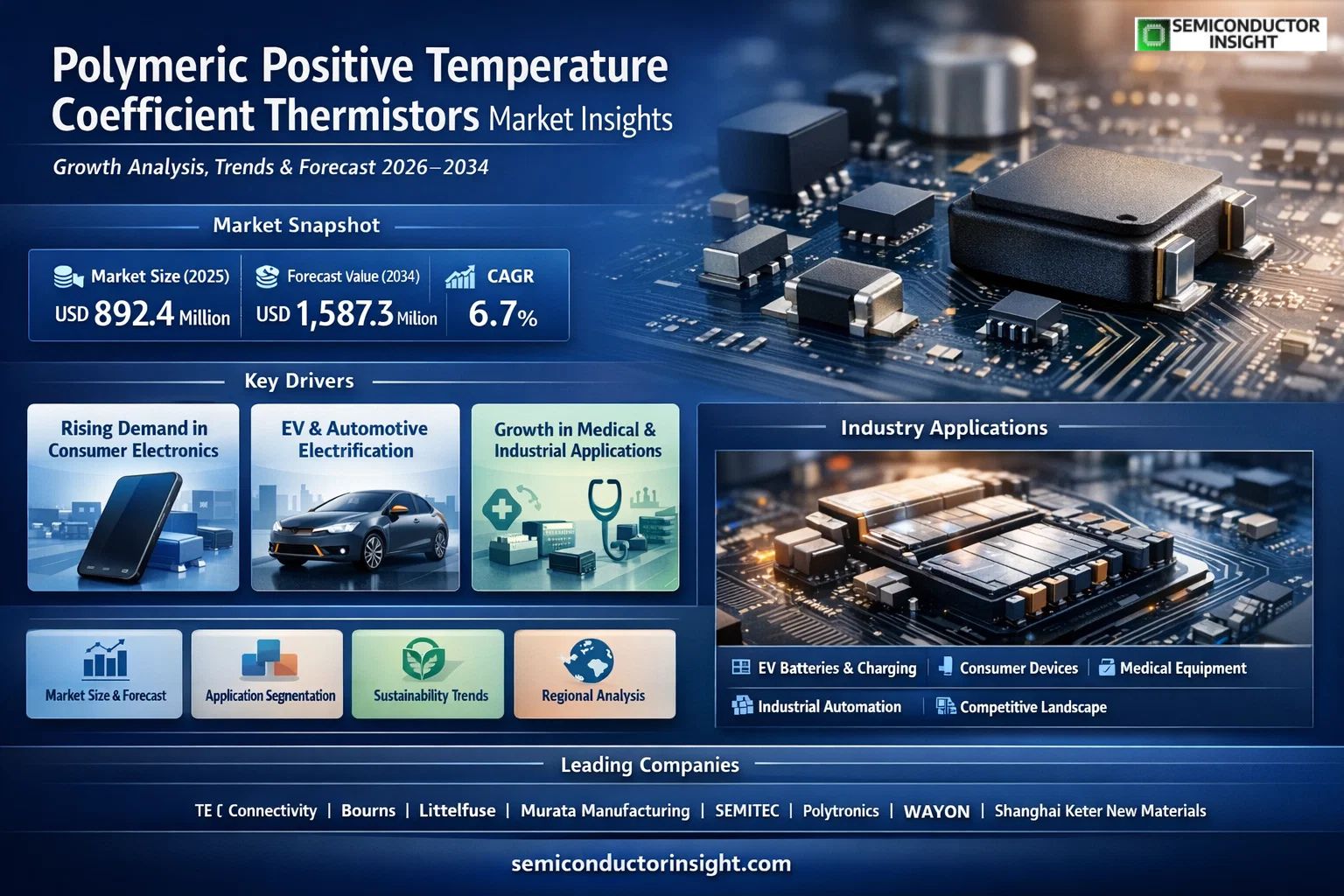
Global Polymeric Positive Temperature Coefficient Thermistors market size was valued at USD 892.4 million in 2025. The market is projected to grow from USD 941.6 million in 2026 to USD 1,587.3 million by 2034, exhibiting a CAGR of 6.7% during the forecast period.
Polymeric Positive Temperature Coefficient (PPTC) Thermistors, also commonly referred to as resettable fuses, are specialized electronic components engineered from polymer-based materials such as polyethylene and polyamide. These components function by leveraging the intrinsic relationship between temperature and electrical resistance , as temperature rises beyond a critical threshold, the polymer matrix expands, disrupting the conductive pathways and causing a sharp increase in resistance that effectively limits current flow. Once the overcurrent condition is resolved and the device cools, resistance returns to its original low state, making the component self-resetting and reusable.
The market is witnessing steady growth driven by the expanding adoption of PPTC thermistors across automotive electronics, consumer devices, medical equipment, and industrial applications. The rapid proliferation of electric vehicles (EVs) and the increasing complexity of battery management systems have significantly elevated demand for reliable overcurrent protection components. Furthermore, the surge in consumer electronics production , particularly portable devices, laptops, and wearables , continues to reinforce the need for compact, reliable circuit protection. Key manufacturers operating in Global market include TE Connectivity, Bourns, Littelfuse, Murata Manufacturing, SEMITEC, OMEGA, Polytronics, Tang Electronics, WAYON, and Shanghai Keter New Materials, among others, collectively shaping the competitive landscape through continuous product innovation and strategic global expansion.
MARKET DRIVERS
Rising Demand for Overcurrent Protection in Consumer Electronics
Polymeric Positive Temperature Coefficient Thermistors Market is experiencing robust growth driven by the accelerating adoption of compact electronic devices that require reliable circuit protection. As consumer electronics such as smartphones, laptops, tablets, and wearables become increasingly sophisticated, the need for passive protection components that can reset automatically without manual replacement has intensified. Polymeric PTC thermistors offer a self-resetting overcurrent protection mechanism that reduces product failure rates and extends device lifecycles, making them an attractive solution for electronics manufacturers operating under tight cost and design constraints.
Electrification of Automotive Systems Fueling Adoption
Global transition toward electric vehicles (EVs) and hybrid electric vehicles (HEVs) has emerged as one of the most significant drivers for Polymeric Positive Temperature Coefficient Thermistors Market. Modern EV battery management systems, charging modules, and onboard electronics demand high-performance overcurrent and thermal protection components. Polymeric PTC thermistors are increasingly integrated into battery protection circuits, motor control units, and USB charging ports across automotive platforms. As automakers accelerate EV production targets and regulatory mandates tighten around vehicle electrical safety, demand for PPTC components within the automotive vertical is projected to remain strong through the coming years.
➤ The expanding deployment of EV charging infrastructure globally is creating sustained upstream demand for Polymeric PTC thermistors used in both onboard vehicle protection systems and stationary charging equipment, reinforcing long-term market growth prospects.
Industrial automation and the proliferation of Internet of Things (IoT) connected devices are further amplifying demand within Polymeric Positive Temperature Coefficient Thermistors Market. As smart factory deployments expand and edge computing devices become more prevalent, circuit protection requirements across distributed network nodes have grown considerably. PPTC thermistors provide dependable resettable protection in these environments, reducing maintenance interventions and system downtime. Their compatibility with automated surface-mount technology (SMT) assembly processes also supports broader integration across high-volume PCB manufacturing lines.
MARKET CHALLENGES
Performance Limitations at Elevated Temperatures and Voltages
Despite their widespread utility, Polymeric Positive Temperature Coefficient Thermistors face inherent technical challenges that can constrain their application in certain environments. Standard PPTC devices exhibit reduced hold current ratings and longer trip times at higher ambient temperatures, which can limit their suitability in high-power industrial or automotive applications where thermal conditions are demanding. Engineers must carefully account for derating factors during circuit design, adding complexity to product development processes and occasionally requiring the use of alternative or complementary protection technologies to meet performance specifications.
Competitive Pressure from Alternative Circuit Protection Technologies
Polymeric Positive Temperature Coefficient Thermistors Market faces meaningful competition from alternative overcurrent protection solutions including ceramic PTC thermistors, metal oxide varistors (MOVs), and traditional fuses. In applications requiring faster response times or tighter protection tolerances, some design engineers may favor non-polymeric solutions. Additionally, ongoing miniaturization trends in electronics are pushing component suppliers to deliver ever-smaller packages, challenging manufacturers to maintain PPTC performance characteristics while reducing physical footprint , a technically demanding objective that requires continued R&D investment.
Other Challenges
Supply Chain Vulnerabilities
Polymeric Positive Temperature Coefficient Thermistors Market, like many electronic components sectors, is exposed to supply chain disruptions affecting specialty polymer materials and conductive carbon black compounds used in PPTC manufacturing. Fluctuations in raw material availability and pricing can compress margins for component manufacturers and create lead time uncertainty for downstream OEM customers, particularly during periods of heightened global demand.
Standardization and Qualification Complexity
End-market qualification requirements , especially in automotive (AEC-Q200) and medical electronics segments , impose rigorous testing and certification burdens on PPTC thermistor suppliers. Meeting these standards demands significant time and resource investment, which can slow the commercialization of new product variants and limit market entry for smaller manufacturers seeking to compete in regulated application segments.
MARKET RESTRAINTS
Technical Constraints in High-Power and High-Frequency Applications
A notable restraint on Polymeric Positive Temperature Coefficient Thermistors Market is the limited applicability of standard PPTC devices in high-power or high-frequency circuit environments. The relatively higher resistance of polymeric PTC components in their tripped state, combined with their thermal recovery time following a fault event, can introduce operational delays in sensitive systems. Applications requiring instantaneous protection responses or continuous high-current throughput may necessitate complementary or substitute protection architectures, thereby narrowing the addressable market for PPTC thermistors in certain advanced electronics segments.
Price Sensitivity in Cost-Driven End Markets
In highly cost-competitive end markets such as mass-market consumer electronics and white goods, procurement teams exert persistent downward pressure on component pricing. While Polymeric PTC thermistors offer a favorable total cost of ownership due to their resettable nature, their unit cost at the bill-of-materials level can face scrutiny compared to conventional one-time fuses in budget-constrained designs. This pricing dynamic can restrain revenue growth for PPTC thermistor suppliers serving the lower tiers of the consumer electronics supply chain, where design-in decisions are heavily influenced by component cost differentials rather than long-term reliability advantages.
Miniaturization Challenges Impacting Product Development Timelines
The relentless trend toward device miniaturization across end-use industries places considerable engineering pressure on Polymeric Positive Temperature Coefficient Thermistors manufacturers. Scaling PPTC components to progressively smaller form factors while preserving their thermal switching precision and current-handling characteristics requires advanced materials science capabilities and precision manufacturing processes. These development challenges can extend product introduction timelines and increase R&D expenditures, acting as a structural restraint on the pace of new product launches within the Polymeric PTC thermistors segment.
MARKET OPPORTUNITIES
Expansion in EV Battery Protection and Fast-Charging Infrastructure
The accelerating global rollout of electric vehicle platforms and associated fast-charging networks presents a substantial growth opportunity for Polymeric Positive Temperature Coefficient Thermistors Market. Battery protection modules, USB Power Delivery circuits, and DC fast chargers all require dependable resettable overcurrent protection components capable of operating reliably across variable thermal and load conditions. PPTC thermistor manufacturers that develop automotive-grade and charging-infrastructure-optimized product lines are well positioned to capture incremental design wins as electrification infrastructure investment continues to scale across North America, Europe, and Asia-Pacific.
Growth in Medical Electronics and Wearable Health Devices
The medical electronics segment represents an emerging and high-value opportunity for Polymeric Positive Temperature Coefficient Thermistors Market. Wearable health monitoring devices, portable diagnostic equipment, and implantable device support systems all require miniaturized, reliable circuit protection that meets stringent safety standards. As global healthcare systems increase investment in digital health infrastructure and remote patient monitoring technologies, demand for precision PPTC protection components in medically compliant designs is expected to expand. Suppliers capable of achieving medical-grade qualifications and offering application engineering support stand to benefit from this structural growth trend.
Industrial IoT and Smart Infrastructure Deployments
The ongoing global buildout of Industrial IoT networks, smart grid infrastructure, and 5G telecommunications equipment creates broad-based demand for compact, reliable circuit protection components. Polymeric PTC thermistors are well suited to protect the distributed sensor nodes, edge computing modules, and communications hardware that underpin these deployments. As enterprise and government investment in connected industrial infrastructure intensifies across both mature and emerging economies, Polymeric Positive Temperature Coefficient Thermistors Market stands to benefit from increased design-in activity across a diversified set of industrial end-use applications, supporting sustained long-term market expansion.
Trends
Rising Adoption of Resettable Fuse Technology Across Safety-Critical Applications
Polymeric Positive Temperature Coefficient Thermistors Market is witnessing significant momentum as industries increasingly prioritize overcurrent protection and thermal management in electronic systems. PPTC thermistors, often referred to as resettable fuses, are gaining traction due to their ability to automatically reset after a fault condition is removed, eliminating the need for manual fuse replacement. This self-resetting characteristic makes them particularly valuable in applications where reliability and minimal maintenance are critical. The growing complexity of modern electronic systems, combined with stricter international safety standards, is reinforcing the demand for PPTC components across multiple end-use sectors.
Other Trends
Automotive Sector Driving Consistent Demand
The automotive industry represents one of the most influential application segments for Polymeric Positive Temperature Coefficient Thermistors Market. As vehicles incorporate a greater number of electronic control units, battery management systems, and advanced driver-assistance systems, the need for dependable circuit protection components has intensified. Electric vehicles, in particular, require robust thermal and overcurrent protection solutions to safeguard lithium-ion battery packs, making PPTC thermistors an integral part of EV power management architecture. Leading manufacturers such as Littelfuse, Bourns, and TE are actively developing automotive-grade PPTC solutions compliant with AEC-Q200 standards to meet this growing requirement.
Surface Mount Technology Gaining Design Preference
Within Polymeric Positive Temperature Coefficient Thermistors Market, the Surface Mount Type segment is experiencing accelerated adoption driven by the miniaturization trend in consumer electronics and industrial PCB designs. Surface mount PPTC devices offer compact form factors compatible with automated assembly processes, making them a preferred choice among electronics manufacturers seeking to optimize board space and production efficiency. This segment’s growth is further supported by the expanding wearable technology, smart home device, and portable medical equipment categories.
Asia-Pacific Emerging as a Key Production and Consumption Hub
The Asia-Pacific region, led by China, Japan, and South Korea, is consolidating its position as both a major manufacturing base and a high-growth consumption market within Polymeric Positive Temperature Coefficient Thermistors Market. Prominent regional players including Murata Manufacturing, SEMITEC, Polytronics, WAYON, and Shanghai Keter New Materials are expanding production capacities to serve growing domestic and export demand. The region’s thriving consumer electronics ecosystem, combined with rapid industrialization and increasing medical device manufacturing, positions Asia-Pacific as a central driver of global PPTC thermistor market dynamics through the forecast period.
COMPETITIVE LANDSCAPE
Key Industry Players
Polymeric Positive Temperature Coefficient Thermistors Market , Competitive Dynamics and Leading Manufacturer Profiles
Global Polymeric Positive Temperature Coefficient (PPTC) Thermistors market is characterized by a moderately consolidated competitive landscape, with a handful of established multinational corporations commanding a significant portion of total revenues. Littelfuse and TE Connectivity stand out as dominant forces, leveraging decades of expertise in circuit protection and passive electronic components to maintain strong positions across key end-use segments including automotive, industrial, and consumer electronics. These industry leaders benefit from extensive global distribution networks, robust R&D investment, and diversified product portfolios that span both Surface Mount Type and Lead Encapsulated Type PPTC thermistors. Murata Manufacturing further reinforces the competitive intensity at the top tier, drawing on its formidable capabilities in advanced materials and miniaturized electronic components to serve high-growth markets such as medical equipment and electric vehicles. The top five global players collectively accounted for a substantial share of global PPTC thermistor revenues in 2025, underscoring the degree of market concentration at the leadership level.
Beyond the dominant players, Polymeric Positive Temperature Coefficient Thermistors Market features a dynamic tier of specialized and regional manufacturers that compete on the basis of customization, pricing agility, and application-specific engineering. Companies such as Bourns, SEMITEC, and Polytronics have carved out meaningful niches by offering tailored resettable fuse solutions for industrial automation, telecommunications infrastructure, and consumer electronics OEMs. Asian manufacturers, including WAYON, Tang Electronics, and Shanghai Keter New Materials, have been steadily expanding their global footprint, capitalizing on cost-competitive manufacturing and growing domestic demand across China and Southeast Asia. This expanding competitive base is intensifying price competition in standard product categories while simultaneously driving innovation in high-performance, high-temperature, and compact form-factor PPTC devices. Strategic investments in new materials research , particularly next-generation conductive polymer composites , are increasingly differentiating forward-looking manufacturers from commodity suppliers in this evolving market.
List of Key Polymeric Positive Temperature Coefficient Thermistors Companies Profiled
- TE Connectivity
- OMEGA Engineering
- Bourns
- Littelfuse
- SEMITEC
- Murata Manufacturing
- Polytronics Technology Corporation
- Tang Electronics
- WAYON Electronics
- Shanghai Keter New Materials
- Bel Fuse Inc.
- Eaton Corporation
- Thinking Electronic Industrial
- TDK Corporation
- Vishay Intertechnology
Segment Analysis:
| Segment Category | Sub-Segments | Key Insights |
| By Type |
|
Surface Mount Type holds the dominant position in the Polymeric Positive Temperature Coefficient (PPTC) Thermistors market by product type, driven by its inherent compatibility with modern automated assembly processes.
|
| By Application |
|
Automotive represents one of the most strategically significant application segments for PPTC thermistors, driven by the accelerating transition toward electric vehicles and advanced driver-assistance systems (ADAS).
|
| By End User |
|
OEMs (Original Equipment Manufacturers) constitute the leading end-user segment, as they integrate PPTC thermistors directly into product designs at the earliest stage of development.
|
| By Polymer Material |
|
Polyethylene-Based PPTC thermistors lead this segment owing to the material’s well-established processing characteristics, wide operating temperature range, and cost efficiency in large-scale manufacturing.
|
| By Voltage Rating |
|
Low Voltage PPTC Thermistors dominate this segmentation category, reflecting the widespread deployment of these components in battery-operated and USB-powered consumer electronic devices that operate within low-voltage parameters.
|
Regional Analysis: Polymeric Positive Temperature Coefficient Thermistors Market
Asia-Pacific
China remains the cornerstone of Asia-Pacific’s leadership in Polymeric Positive Temperature Coefficient Thermistors Market. The country’s highly integrated electronics supply chain, low-cost production environment, and massive domestic consumption market create a self-reinforcing growth dynamic. Chinese manufacturers are increasingly investing in advanced PTC thermistor technologies to meet stringent international quality standards and capture higher-value export segments, particularly in automotive and industrial applications.
The rapid proliferation of electric vehicles across Japan, South Korea, and China is a pivotal growth driver for the regional Polymeric Positive Temperature Coefficient Thermistors Market. Automotive-grade polymeric PTC thermistors are increasingly deployed in battery management systems, motor protection circuits, and onboard charging units. As EV production targets across Asia-Pacific become more ambitious, demand for high-reliability thermal protection components is expected to escalate significantly over the forecast period.
The aggressive rollout of 5G telecommunications networks across Asia-Pacific is generating robust ancillary demand for polymeric PTC thermistors used in base stations, network switching equipment, and consumer devices. South Korea and Japan, recognized as early 5G adopters, are leading this transition, while China’s large-scale infrastructure investment further amplifies market opportunities. These developments position the region as a strategic growth frontier for thermistor suppliers targeting next-generation connectivity hardware.
Asia-Pacific’s accelerating shift toward smart manufacturing and industrial IoT is creating new application avenues for Polymeric Positive Temperature Coefficient Thermistors. Automated production lines, robotics systems, and connected industrial sensors require reliable overcurrent and thermal protection components. Countries such as Japan and South Korea, with their advanced robotics industries, and emerging manufacturing economies like Vietnam and India, are contributing to broadening the regional demand landscape for polymeric PTC thermistor solutions.
North America
North America represents a highly mature and innovation-driven segment of Global Polymeric Positive Temperature Coefficient Thermistors Market. The United States, in particular, is home to a concentration of advanced technology firms, aerospace and defense contractors, and automotive manufacturers that require high-performance thermal management components. The growing domestic electric vehicle ecosystem, supported by significant federal incentives and investment in EV infrastructure, is creating sustained demand for polymeric PTC thermistors in battery protection and thermal regulation applications. Canada and Mexico also contribute meaningfully, with Mexico’s expanding automotive manufacturing corridor integrating thermistor components into vehicle assembly processes. North American market participants are increasingly focused on developing next-generation polymeric PTC materials with enhanced stability and miniaturization capabilities to meet the evolving requirements of compact, high-power electronic devices. Regulatory frameworks emphasizing product safety and energy efficiency further support the adoption of polymeric PTC thermistors across consumer and industrial end-use sectors throughout the region.
Europe
Europe occupies a significant position in Polymeric Positive Temperature Coefficient Thermistors Market, underpinned by its strong automotive engineering heritage, rigorous safety standards, and proactive transition toward sustainable electromobility. Germany, as the hub of European automotive excellence, drives substantial demand for polymeric PTC thermistors integrated into hybrid and fully electric vehicle platforms. The European Union’s firm commitments to carbon neutrality and phasing out internal combustion engines are accelerating EV adoption timelines, directly benefiting the thermistor market. Beyond automotive, European industrial machinery, renewable energy systems, and precision medical equipment sectors represent growing application areas for polymeric PTC technology. The region’s emphasis on quality compliance, material safety regulations, and environmental standards encourages manufacturers to innovate with cleaner, more efficient polymeric PTC formulations. Countries including France, Italy, Sweden, and the Netherlands are emerging as complementary growth contributors within the broader European Polymeric Positive Temperature Coefficient Thermistors Market landscape.
South America
South America presents a gradually evolving opportunity within Global Polymeric Positive Temperature Coefficient Thermistors Market. Brazil, as the region’s largest economy, anchors demand through its consumer electronics retail sector and expanding automotive production industry. Argentina and Chile are witnessing increasing awareness of energy-efficient electronic components driven by broader industrial modernization initiatives. While the region currently lags behind Asia-Pacific and North America in terms of thermistor adoption rates, growing foreign direct investment in manufacturing infrastructure and improving access to advanced electronic components are expected to stimulate market development over the coming years. The ongoing electrification of public transportation networks in major South American urban centers represents a notable emerging application channel. Regional economic volatility and infrastructure constraints remain challenges, but long-term structural growth trends support a positive outlook for Polymeric Positive Temperature Coefficient Thermistors Market across South America through the forecast period.
Middle East & Africa
The Middle East and Africa region represents an emerging frontier for Polymeric Positive Temperature Coefficient Thermistors Market, characterized by nascent but increasingly promising growth dynamics. Gulf Cooperation Council countries, particularly the United Arab Emirates and Saudi Arabia, are investing substantially in smart city infrastructure, renewable energy projects, and industrial diversification programs under national development visions. These initiatives drive demand for sophisticated electronic control and protection components, including polymeric PTC thermistors. In Africa, the gradual expansion of telecommunications infrastructure and off-grid solar energy systems is creating baseline demand for thermal protection components in remote and urban deployment scenarios. While the region’s contribution to Global Polymeric Positive Temperature Coefficient Thermistors Market remains modest in the near term, strategic infrastructure investments, increasing technology adoption rates, and a young and growing consumer base collectively position the Middle East and Africa as a region of interest for forward-looking thermistor market participants over the long-term horizon.
Report Scope
This market research report provides a comprehensive analysis of Polymeric Positive Temperature Coefficient Thermistors Market, covering the forecast period 2026–2034. It offers detailed insights into market dynamics, technological advancements, competitive landscape, and key trends shaping the industry.
Key focus areas of the report include:
- Market Overview: The report begins with an overview outlining its current market scenario, key growth indicators, and industry transformation drivers. It discusses macroeconomic factors, demand–supply balance, regulatory landscape, and the strategic role of semiconductors in powering advancements across industries such as automotive, telecommunications, consumer electronics, and industrial automation.
- Market Size & Forecast: Historical data and future projections for revenue, unit shipments, and market value across major regions and segments.
- Segmentation Analysis: Detailed breakdown by product type, technology, application, and end-user industry to identify high-growth segments and investment opportunities.
- Regional Insights: Insights into market performance across North America, Europe, Asia-Pacific, Latin America, and the Middle East & Africa, including country-level analysis where relevant.
- Competitive Landscape: Profiles of leading market participants, including their product offerings, R&D focus, manufacturing capacity, pricing strategies, and recent developments such as mergers, acquisitions, and partnerships.
- Technology Trends & Innovation: Assessment of emerging technologies, integration of AI/IoT, semiconductor design trends, fabrication techniques, and evolving industry standards.
- Market Drivers & Restraints: Evaluation of factors driving market growth along with challenges, supply chain constraints, regulatory issues, and market-entry barriers.
- Stakeholder Insights: Insights for component suppliers, OEMs, system integrators, investors, and policymakers regarding the evolving ecosystem and strategic opportunities.
Primary and secondary research methods are employed, including interviews with industry experts, data from verified sources, and real-time market intelligence to ensure the accuracy and reliability of the insights presented.
FREQUENTLY ASKED QUESTIONS:
What is the current market size of Polymeric Positive Temperature Coefficient Thermistors Market?
-> Global Polymeric Positive Temperature Coefficient Thermistors Market was valued at USD 892.4 million in 2025 and is expected to reach USD 1,587.3 million by 2034, growing at a CAGR of 6.7% during the forecast period 2026–2034.
Which key companies operate in Polymeric Positive Temperature Coefficient Thermistors Market?
-> Key players include TE, OMEGA, Bourns, Littelfuse, SEMITEC, Murata Manufacturing, Polytronics, Tang Electronics, WAYON, and Shanghai Keter New Materials, among others. In 2025, Global top five players held approximately % of the market in terms of revenue.
What are the key growth drivers?
-> Key growth drivers include rising demand for overcurrent protection in automotive and consumer electronics, growing adoption of resettable fuses in medical equipment and industrial applications, increasing miniaturization trends driving Surface Mount Type PPTC adoption, and expanding EV and smart device markets globally.
Which region dominates the market?
-> Asia is a dominant and fast-growing region in Global Polymeric Positive Temperature Coefficient Thermistors Market, with China projected to reach USD million by 2034. North America, led by the U.S. market estimated at USD million in 2025, also represents a significant share of global demand.
What are the emerging trends?
-> Emerging trends include increased use of Surface Mount Type PPTC thermistors, growing integration of resettable fuses in EV battery management systems, rising demand for miniaturized and high-precision overcurrent protection components, and expanding applications in medical equipment and industrial automation sectors.

Get Sample Report PDF for Exclusive Insights
Report Sample Includes
- Table of Contents
- List of Tables & Figures
- Charts, Research Methodology, and more...
 Download Sample Report PDF