MARKET INSIGHTS
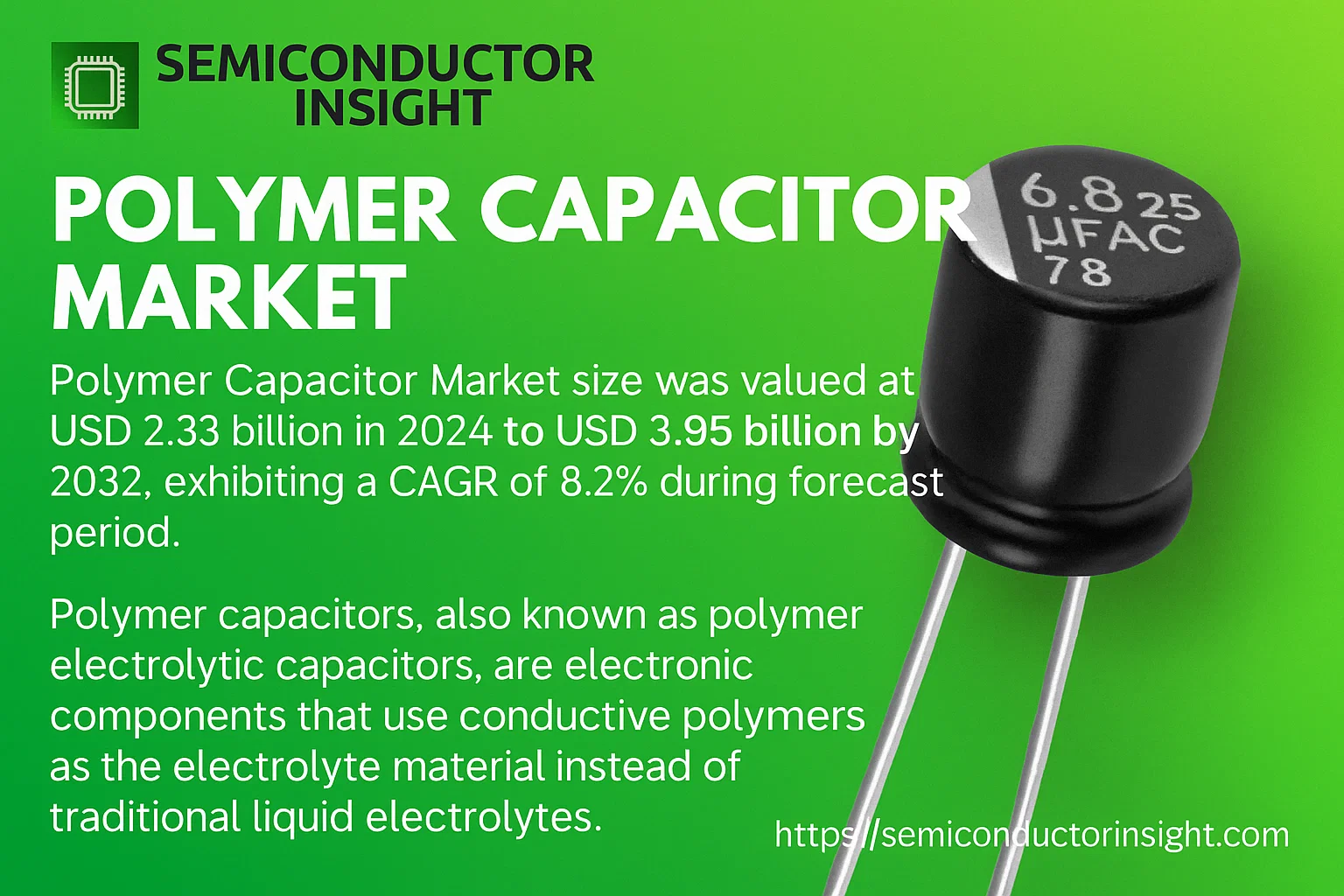
Global Polymer Capacitor Market size was valued at USD 2.33 billion in 2024 to USD 3.95 billion by 2032, exhibiting a CAGR of 8.2% during the forecast period.
Polymer capacitors, also known as polymer electrolytic capacitors, are electronic components that use conductive polymers as the electrolyte material instead of traditional liquid electrolytes. These capacitors are characterized by their excellent frequency characteristics, low equivalent series resistance (ESR), high ripple current capability, and stable performance across temperature variations.
The market is experiencing steady growth driven by increasing demand from consumer electronics, automotive electrification, and industrial automation sectors. The miniaturization trend in electronics favors polymer capacitors due to their smaller footprint and superior performance characteristics compared to traditional alternatives. Furthermore, the expansion of electric vehicle production and renewable energy infrastructure creates additional demand for reliable power management components. Key manufacturers including Murata Manufacturing Co., Ltd., Panasonic Corporation, and TDK Corporation continue to innovate with new product developments focused on higher capacitance density and improved reliability.
 30
30
MARKET DRIVERS
Surging Demand in Consumer Electronics and Automotive Sectors
Polymer Capacitor Market is primarily driven by the robust growth of the consumer electronics industry, where these components are essential for smartphones, laptops, and gaming consoles due to their high capacitance, low equivalent series resistance (ESR), and reliability. The expansion of the automotive industry, particularly the shift towards electric vehicles (EVs) and advanced driver-assistance systems (ADAS), further propels demand. Polymer capacitors are critical in power management units, infotainment systems, and battery management systems, where stability and performance under high temperatures are paramount.
Technological Advancements and Miniaturization Trend
Continuous innovation in materials science and manufacturing processes has led to the development of polymer capacitors with higher voltage ratings, improved thermal stability, and smaller form factors. This trend towards miniaturization aligns with the needs of compact, high-performance electronic devices. The adoption of conductive polymer materials offers a longer operational lifespan and greater reliability compared to traditional electrolytic capacitors, making them the preferred choice for mission-critical applications.
Furthermore, the increasing investment in telecommunications infrastructure, including the rollout of 5G networks, requires high-frequency and high-stability capacitors, a niche where polymer capacitors excel. The renewable energy sector also contributes to growth, utilizing these components in solar inverters and wind power systems for efficient energy conversion and storage.
MARKET CHALLENGES
Supply Chain Volatility and Raw Material Constraints
The market faces significant challenges related to the volatility of raw material prices and supply chain disruptions. Key materials, including conductive polymers and specialized metals, are subject to price fluctuations influenced by geopolitical factors and global demand. Recent events have highlighted the fragility of the electronics component supply chain, leading to extended lead times and potential production bottlenecks for capacitor manufacturers.
Other Challenges
Technical Limitations in High-Voltage Applications
While excellent for many uses, polymer capacitors currently face limitations in very high-voltage applications compared to some alternative technologies like tantalum or multilayer ceramic capacitors. This restricts their adoption in certain industrial and power electronics segments.
Intense Price Competition
The market is highly competitive, with numerous global and regional players. This creates intense price pressure, squeezing profit margins and potentially impacting investment in further research and development for some manufacturers.
MARKET RESTRAINTS
High Initial Cost and Competition from Alternative Technologies
The relatively higher cost of polymer capacitors compared to traditional aluminum electrolytic capacitors remains a significant restraint, particularly in cost-sensitive consumer applications. While their lifetime cost of ownership is often lower due to longevity and reliability, the initial purchase price can be a barrier. Additionally, ongoing advancements in multilayer ceramic capacitor (MLCC) technology, which offers its own advantages in miniaturization and high-frequency performance, present strong competition and limit market share growth for polymer capacitors in certain segments.
Technical Complexity and Manufacturing Hurdles
The manufacturing process for polymer capacitors is complex and requires precise control over material synthesis and assembly. This complexity can lead to higher production costs and pose challenges for achieving consistent quality at scale. Furthermore, the need for specialized equipment and expertise acts as an entry barrier for new players, potentially slowing the pace of innovation and market expansion.
MARKET OPPORTUNITIES
Expansion in Electric Vehicles and Renewable Energy Infrastructure
The rapid global transition to electric mobility and the bolstering of renewable energy infrastructure represent substantial growth opportunities. Polymer capacitors are indispensable in EV powertrains, onboard chargers, and fast-charging stations due to their high ripple current handling and temperature resilience. Similarly, their use in solar inverters and wind turbine converters for grid stability is expected to see significant uptake as investments in clean energy accelerate.
Growth in 5G, IoT, and Advanced Computing
The deployment of 5G networks, the proliferation of Internet of Things (IoT) devices, and the advancement of data centers and high-performance computing create a fertile ground for polymer capacitor adoption. These applications demand components that can operate efficiently at high frequencies, withstand demanding environments, and offer high reliability—all key strengths of polymer capacitor technology. This trend is expected to open new, high-value market segments.
Polymer Capacitor Market Trends
Market Expansion Driven by Miniaturization
Global Polymer Capacitor market is projected to grow from USD 2325 million in 2024 to USD 3948 million by 2032, exhibiting a compound annual growth rate (CAGR) of 8.2%. This sustained expansion is fundamentally driven by the relentless trend of miniaturization in the electronics industry. As consumers demand smaller, more powerful devices, manufacturers require electronic components with a smaller physical footprint and higher performance. Polymer capacitors, known for their stability, low impedance, and excellent high-frequency performance, are uniquely positioned to meet this demand. Their increasing integration into smartphones, laptops, and the vast ecosystem of IoT devices is a primary catalyst for market growth.
Other Trends
Performance and Material Advancements
Concurrent with the push for smaller sizes is the trend toward improved performance. Advances in conductive polymer materials and sophisticated manufacturing processes are yielding capacitors with significantly lower equivalent series resistance (ESR) and higher ripple current handling capabilities. This enhances the efficiency and reliability of power management circuits in their target applications. Furthermore, an increasing focus on sustainability is prompting manufacturers to explore and adopt more environmentally friendly materials and production methods.
Automotive and Energy Sectors as Key Growth Areas
The automotive industry represents a significant growth vector for the Polymer Capacitor Market. The proliferation of electronic control units (ECUs), the transition to electric and hybrid vehicles, and the need for robust components capable of withstanding harsh operating conditions have led to a surge in demand. Similarly, the renewable energy and advanced energy storage sectors are creating new opportunities. Polymer capacitors are increasingly utilized in these applications due to their high energy density and long operational lifespan, which are critical for efficient power conversion and storage systems. Despite this positive outlook, the market faces challenges, including relatively high production costs and intense competition from alternative capacitor technologies like multilayer ceramic capacitors (MLCCs), which manufacturers must navigate to maintain growth momentum.
COMPETITIVE LANDSCAPE
Key Industry Players
A Market Characterized by Established Giants and Specialized Innovators
Global Polymer Capacitor Market is highly competitive, dominated by well-established multinational corporations with extensive R&D capabilities and global distribution networks. Japanese giants Murata Manufacturing Co., Ltd., Nichicon Corporation, and Panasonic Corporation are recognized as leaders, holding significant market share. They are joined by other major players such as KEMET (a subsidiary of Yageo Corporation), Rubycon Corporation, and Nippon Chemi-Con (NCC), which have a strong foothold in the high-reliability segments. Companies like Vishay Intertechnology, Inc. and AVX Corporation (a Kyocera Group company) also play a pivotal role, leveraging their broad electronic components portfolios. Competition is intense and primarily based on product performance, quality, reliability, and the ability to innovate towards miniaturization and higher capacitance values, catering to the demanding needs of consumer electronics and the automotive industry.
The competitive landscape includes several other significant players that hold important positions in specialized or regional markets. These companies, such as TDK Corporation, Apaq Technology Co., Ltd., and Lelon Electronics Corp., compete by offering cost-effective solutions and focusing on specific applications like industrial electronics and power supplies. Chinese manufacturers like Jianghai Capacitor, Aihua Group, and Shenzhen Shunhai Technology are increasingly influential, particularly in the value-oriented segment, contributing to the market’s dynamism. Furthermore, companies like Illinois Capacitor and Guangdong Fennon Electronics provide niche offerings, often competing on specific technical specifications or serving local supply chains. This tier of the market highlights the importance of strategic positioning and the ability to adapt to regional demand fluctuations and technological trends.
List of Key Polymer Capacitor Companies Profiled
- Murata Manufacturing Co., Ltd.
- Nippon Chemi-Con (NCC)
- Nichicon Corporation
- Panasonic Corporation
- KEMET (Yageo Corporation)
- Rubycon Corporation
- AVX Corporation (Kyocera Group)
- Vishay Intertechnology, Inc.
- Apaq Technology Co., Ltd.
- Lelon Electronics Corp.
- Jianghai Capacitor
- Aihua Group
- Illinois Capacitor, Inc.
- TDK Corporation
- Shenzhen Maxking Electronics Co., Ltd.
Segment Analysis:
| Segment Category | Sub-Segments | Key Insights |
| By Type |
|
Polymer Aluminum Electrolytic Capacitor is the foundational segment, widely adopted for its optimal balance of performance and cost-effectiveness, making it suitable for a vast range of general-purpose electronics. Its leading position is reinforced by robust manufacturing processes and extensive availability, catering to the high-volume demands of consumer and industrial markets. The segment’s maturity and versatility ensure its continued dominance, though technological advancements in tantalum and hybrid types pose a compelling future challenge. |
| By Application |
|
Consumer Electronics is the dominant application segment, driven by the relentless demand for smartphones, laptops, and wearable devices that require stable power management and high-frequency performance in compact form factors. This segment benefits immensely from the global miniaturization trend, where polymer capacitors’ low impedance and high reliability are critical. The segment’s strength is further amplified by continuous product innovation and the rapid replacement cycles characteristic of consumer technology, ensuring sustained market pull. |
| By End User |
|
Original Equipment Manufacturers (OEMs) represent the most significant end-user segment, as they integrate polymer capacitors directly into their final products, such as consumer electronics and automotive systems. This segment’s leadership is anchored in large-scale procurement, long-term supply agreements, and stringent quality requirements that drive specifications and innovation from capacitor suppliers. The close collaboration between major OEMs and manufacturers fosters advancements tailored to specific application needs, solidifying this channel’s paramount importance in the market ecosystem. |
| By Performance Characteristic |
|
High-Frequency/Low ESR capacitors are the leading segment by performance characteristic, as their ability to efficiently filter noise and provide stable power is essential for modern digital circuits, telecommunications infrastructure, and computing hardware. The critical nature of signal integrity and power delivery in high-speed applications makes low equivalent series resistance a paramount design criterion. This segment’s prominence is directly linked to the overarching industry trends towards higher processing speeds and greater power efficiency across virtually all electronic applications. |
| By Sales Channel |
|
Direct Sales is the predominant channel for the Polymer Capacitor Market, particularly for large-volume transactions with major OEMs and industrial clients. This channel facilitates close technical collaboration, customized solutions, and streamlined supply chain management, which are crucial for meeting the specific and often demanding requirements of high-end applications. The strength of direct relationships allows manufacturers to provide dedicated support and ensure consistent quality, making it the backbone of the market’s commercial structure despite the important role of distributors for smaller buyers and prototyping needs. |
Regional Analysis: Polymer Capacitor Market
Asia-Pacific’s unmatched manufacturing capabilities for end-products like smartphones, laptops, and televisions create a massive, captive demand for polymer capacitors. The region’s dense network of capacitor manufacturers ensures a reliable and cost-effective supply chain, enabling just-in-time production for global electronics brands and giving it a significant competitive advantage over other regions in terms of scale and responsiveness.
Leading Japanese and South Korean companies are at the forefront of polymer capacitor technology, continuously pushing the boundaries for higher capacitance, lower ESR, and improved thermal stability. This strong focus on research and development ensures a pipeline of advanced products tailored for next-generation applications, from high-frequency power supplies to advanced driver-assistance systems in vehicles.
The aggressive deployment of 5G infrastructure across China, Japan, and other key countries is a major growth driver. Polymer capacitors are critical components in 5G base stations and networking equipment due to their high ripple current handling and long-life reliability, fueling significant and sustained demand from this burgeoning sector within the region.
The rapid electrification of the automotive industry in Asia, particularly in China, is creating a new wave of demand. Polymer capacitors are essential for power management, infotainment systems, and advanced safety features in electric and hybrid vehicles, positioning the region for continued growth as its automotive sector evolves.
North America
The North American market for polymer capacitors is characterized by high-value, specialized demand primarily from the aerospace, defense, medical, and automotive sectors. The region’s strength lies in its advanced technological landscape and stringent quality requirements, leading to a focus on high-reliability and high-performance capacitor solutions. While overall volume may be lower than Asia-Pacific, the demand is driven by innovation in areas like electric vehicles from major manufacturers, next-generation data centers, and sophisticated telecommunications equipment. The presence of leading technology firms and a strong emphasis on research institutions fosters a market environment that values cutting-edge specifications and long-term reliability over pure cost-competitiveness.
Europe
Europe maintains a significant and mature market for polymer capacitors, anchored by its strong automotive industry, industrial automation sector, and renewable energy initiatives. German and French automotive manufacturers, in particular, are major consumers, utilizing these components in engine control units, battery management systems for electric vehicles, and advanced safety features. The region’s push towards green energy, including wind and solar power installations, also drives demand for robust capacitors used in power conversion and conditioning equipment. European market dynamics are shaped by high quality standards and a focus on sustainability and energy efficiency, influencing the types of polymer capacitors favored by OEMs.
South America
The Polymer Capacitor Market in South America is a developing market, with growth primarily linked to the gradual modernization of industrial infrastructure and the consumer electronics sector. Brazil is the largest market within the region, driven by its industrial base and growing automotive production. Demand is fuelled by the need for replacement components in industrial machinery, the expansion of telecommunications networks, and increasing sales of consumer electronic devices. However, market growth can be inconsistent, often influenced by regional economic volatility and political factors, leading to a more cautious adoption rate compared to more established markets.
Middle East & Africa
This region represents an emerging market with potential for future growth, though current demand for polymer capacitors is relatively limited. The primary drivers are infrastructure development projects, particularly in the Gulf Cooperation Council (GCC) countries, including telecommunications network expansions and investments in smart city technologies. The industrial sector and increasing consumer electronics penetration also contribute to demand. However, the market is still nascent, with growth hindered by a less developed local manufacturing base for electronics, leading to a higher reliance on imports and making the market more susceptible to supply chain fluctuations.
Report Scope
This market research report provides a comprehensive analysis of the Polymer Capacitor Market, covering the forecast period 2025–2032. It offers detailed insights into market dynamics, technological advancements, competitive landscape, and key trends shaping the industry.
Key focus areas of the report include:
- Market Overview: The report begins with an overview outlining its current market scenario, key growth indicators, and industry transformation drivers. It discusses macroeconomic factors, demand–supply balance, regulatory landscape, and the strategic role of semiconductors in powering advancements across industries such as automotive, telecommunications, consumer electronics, and industrial automation.
- Market Size & Forecast: Historical data and future projections for revenue, unit shipments, and market value across major regions and segments.
- Segmentation Analysis: Detailed breakdown by product type, technology, application, and end-user industry to identify high-growth segments and investment opportunities.
- Regional Insights: Insights into market performance across North America, Europe, Asia-Pacific, Latin America, and the Middle East & Africa, including country-level analysis where relevant.
- Competitive Landscape: Profiles of leading market participants, including their product offerings, R&D focus, manufacturing capacity, pricing strategies, and recent developments such as mergers, acquisitions, and partnerships.
- Technology Trends & Innovation: Assessment of emerging technologies, integration of AI/IoT, semiconductor design trends, fabrication techniques, and evolving industry standards.
- Market Drivers & Restraints: Evaluation of factors driving market growth along with challenges, supply chain constraints, regulatory issues, and market-entry barriers.
- Stakeholder Insights: Insights for component suppliers, OEMs, system integrators, investors, and policymakers regarding the evolving ecosystem and strategic opportunities.
Primary and secondary research methods are employed, including interviews with industry experts, data from verified sources, and real-time market intelligence to ensure the accuracy and reliability of the insights presented.
FREQUENTLY ASKED QUESTIONS:
What is the current market size of Polymer Capacitor Market?
-> Polymer Capacitor Market size was valued at USD 2.33 billion in 2024 to USD 3.95 billion by 2032, exhibiting a CAGR of 8.2% during the forecast period.
Which key companies operate in Polymer Capacitor Market?
-> Key players include Murata, NCC (Chemi-con), Nichicon, Panasonic Corporation, Kemet, Rubycon Corporation, AVX, Vishay, Apaq Technology Co, Lelon, Jianghai, Aihua Group, Illinois Capacitor, TDK, Shenzhen Maxking Electronics, Guangdong FOLLON Electronics, and Shenzhen Shunhai Technology, among others.
What are the key growth drivers?
-> Key growth drivers include the miniaturization trend in electronics, growing demand in consumer electronics and IoT devices, increased use in automotive applications, and development of advanced energy storage and renewable energy systems.
Which region dominates the market?
-> Asia is a key market, with significant contributions from countries such as China, Japan, and South Korea.
What are the emerging trends?
-> Emerging trends include miniaturization and high density, improved performance with lower ESR, sustainability in manufacturing, a focus on automotive and electric vehicle applications, and use in energy storage solutions.

Get Sample Report PDF for Exclusive Insights
Report Sample Includes
- Table of Contents
- List of Tables & Figures
- Charts, Research Methodology, and more...
 Download Sample Report PDF