Polarizer for 3D Glasses Market Insights
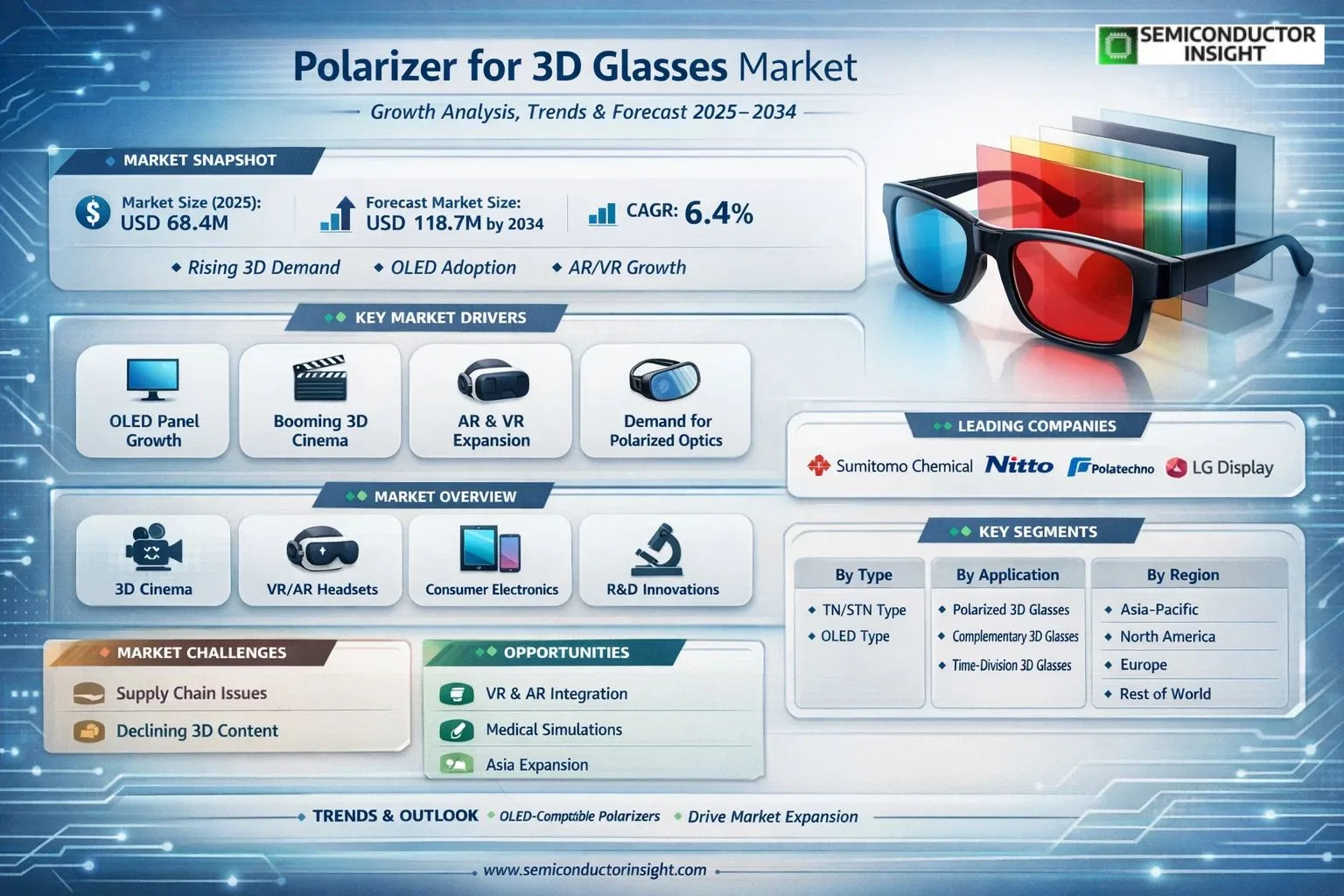
Global Polarizer for 3D Glasses market size was valued at USD 68.4 million in 2025. The market is projected to grow from USD 72.1 million in 2026 to USD 118.7 million by 2034, exhibiting a CAGR of 6.4% during the forecast period.
Polarizers for 3D glasses are specialized polarizing films essential for passive stereoscopic displays. These films selectively transmit light waves in specific directions, with left and right lenses featuring orthogonal polarizations—typically horizontal for the left eye and vertical for the right—to create a 3D effect when viewing polarized images. Products are categorized into TN/STN type and OLED type, primarily applied in polarized 3D glasses, complementary color 3D glasses, and time-division 3D glasses.
The market sees steady expansion fueled by renewed interest in 3D cinema, growth in AR/VR applications, and demand for high-quality polarized optics in consumer electronics. Advancements in OLED technology further boost efficiency and viewing angles. Key initiatives by industry leaders drive innovation; for example, major manufacturers continue to optimize film thickness to around 1mm for seamless integration. Sumitomo Chemical, Nitto Denko, Polatechno, BenQ Materials (BQM), Shanjin Optoelectronics (LG), and Hengmei Optoelectronics (Samsung) are prominent players offering diverse portfolios in this competitive landscape.
MARKET DRIVERS
Advancements in Display Technologies
Polarizer for 3D Glasses Market is propelled by innovations in LCD and OLED displays, which demand high-quality polarizers for superior image separation and brightness. These advancements enable crisper 3D visuals, boosting adoption in cinemas and home entertainment systems. Market projections indicate a steady CAGR of around 4.5% through 2028, driven by enhanced polarization efficiency.
Growing Immersive Entertainment Demand
Rising popularity of 3D content in theaters and streaming platforms fuels the need for reliable polarizers. Passive 3D systems, reliant on these components, offer cost-effective solutions over active alternatives, supporting market expansion in emerging entertainment hubs.
➤ Global cinema screen installations with 3D capability reached over 150,000 units in 2023, intensifying demand for durable polarizers.
Furthermore, integration with gaming consoles and projection systems underscores the resilient growth trajectory of Polarizer for 3D Glasses Market amid evolving consumer preferences for immersive experiences.
MARKET CHALLENGES
Supply Chain Vulnerabilities
Disruptions in raw material sourcing, particularly rare earth elements used in polarizer films, pose significant hurdles for Polarizer for 3D Glasses Market. Geopolitical tensions have led to price volatility exceeding 15% annually, impacting production scalability.
Other Challenges
Declining 3D Content Production
Post-2010s hype, major studios have reduced 3D film outputs by nearly 40%, diminishing glasses demand and straining polarizer inventories. This shift toward 2D and 4K content challenges market sustainability.Technological transitions to glasses-free displays further complicate inventory management, requiring manufacturers to pivot strategies swiftly.
MARKET RESTRAINTS
High Production Costs
Elevated expenses in precision manufacturing and quality control limit accessibility in Polarizer for 3D Glasses Market. Advanced thin-film deposition processes contribute to costs 20-30% higher than standard optical films, deterring small-scale producers.Regulatory compliance for optical clarity and durability adds layers of expense, particularly in stringent markets like Europe and North America.Competition from cheaper alternatives in active shutter technologies restrains passive polarizer dominance, capping overall market penetration.
MARKET OPPORTUNITIES
Expansion in VR/AR Applications
Polarizer for 3D Glasses Market holds promise through VR/AR headset integrations, where lightweight polarizers enhance stereoscopic effects. With VR shipments projected to surpass 20 million units by 2025, this segment offers substantial growth avenues.Emerging uses in medical simulations and educational tools further diversify demand, leveraging polarizers for precise depth perception.Strategic partnerships in Asia-Pacific regions, focusing on affordable 3D projection, position the market for renewed vigor amid digital transformation trends.
Polarizer for 3D Glasses Market Trends
Shift Towards OLED-Compatible Polarizers
Polarizer for 3D Glasses Market continues to evolve with the transition from traditional LCD technologies to advanced OLED panels. Polarizing films remain essential, as they enable the distinct polarization directions—typically horizontal for the left eye and vertical for the right—required to create the stereoscopic 3D effect in glasses. While TFT-LCD series dominate color displays, black and white series, including TN/STN and OLED types, are critical for 3D goggles. As OLED panels penetrate larger applications like televisions, demand for high-performance OLED polarizers grows, driving innovation in film thickness reduction to around 1mm while maintaining optical clarity and wide viewing angles.
Other Trends
Competitive Landscape Among Key Manufacturers
Major players such as Sumitomo Chemical, Nitto Denko, and Polatechno lead Polarizer for 3D Glasses Market, with the top five firms holding substantial revenue shares. These companies focus on enhancing product efficiency for TN/STN types used in monochrome displays and polarized sunglasses, alongside developing routes for AMOLED polarizers. Ongoing mergers, acquisitions, and R&D efforts address challenges like price fluctuations and supply chain dynamics, ensuring steady advancement in polarizer quality for global 3D applications.
Growth in Application Segments
Segments like Polarized 3D Glasses and Time-Division 3D Glasses see increased utilization, alongside Complementary Color variants. The market benefits from these applications in cinemas and home entertainment, where polarizers mitigate glare and UV exposure. Regionally, Asia-Pacific, particularly China, Japan, and South Korea, drives expansion due to robust manufacturing capacities for both TN/STN and OLED types, while North America and Europe focus on premium 3D viewing solutions. This diversification supports sustainable growth amid shifting display trends.
COMPETITIVE LANDSCAPE
Key Industry Players
Leading Manufacturers and Innovators in Polarizer for 3D Glasses Market
Polarizer for 3D Glasses Market exhibits a concentrated competitive structure dominated by established Japanese and Taiwanese giants, with Sumitomo Chemical and Nitto Denko leading as the top global players. These frontrunners command a substantial revenue share, with the top five manufacturers collectively accounting for the majority of the market in 2025. Their dominance stems from proprietary technologies in producing high-transmittance polarizing films critical for passive 3D systems, where orthogonal polarization directions enable stereoscopic viewing. Advanced manufacturing capabilities support both TN/STN and emerging OLED types, catering to polarized 3D glasses and complementary color variants amid steady demand in entertainment and professional applications.
Complementing the leaders are niche specialists and regional powerhouses, including Polatechno, BenQ Materials (BQM), and affiliates like Shanjin Optoelectronics (LG) and Hengmei Optoelectronics (Samsung), which focus on customized solutions for time-division and polarized 3D glasses. Chinese entrants such as CMMT, Optimax, Shenzhen Sunnypol Optoelectronics, Shenzhen SAPO Photoelectric, and WINDA Optoelectronics are rapidly expanding through cost advantages and localized supply chains, targeting Asia-Pacific growth. This tier of players intensifies competition by innovating in black-and-white series polarizers for 3D goggles, while navigating challenges like OLED penetration and raw material volatility, fostering a dynamic landscape poised for strategic consolidations.
List of Key Polarizer for 3D Glasses Companies Profiled
- Sumitomo Chemical
- Nitto Denko
- Polatechno
- BenQ Materials (BQM)
- Shanjin Optoelectronics (LG)
- Hengmei Optoelectronics (Samsung)
- CMMT
- Optimax
- Shenzhen Sunnypol Optoelectronics
- Shenzhen SAPO Photoelectric
- WINDA Optoelectronics
- LG Chem
Segment Analysis:
| Segment Category | Sub-Segments | Key Insights |
| By Type |
|
TN/STN Type dominates as the foundational technology for polarizers in 3D glasses, offering reliable performance in various display setups.
|
| By Application |
|
Polarized 3D Glasses lead the application segment by enabling seamless stereoscopic imaging in immersive viewing experiences.
|
| By End User |
|
Cinemas represent the core end-user group, fueling demand for advanced polarizers in professional-grade 3D deployments.
|
| By Polarization Mode |
|
Linear Polarization prevails as the preferred mode for most 3D glasses polarizers, leveraging orthogonal orientations for image separation.
|
| By Surface Treatment |
|
Frosted surface treatment leads by addressing key user experience challenges in 3D viewing.
|
Regional Analysis: Polarizer for 3D Glasses Market
Asia-Pacific
Asia-Pacific excels in scalable production of polarizers, leveraging advanced thin-film deposition techniques. Proximity to raw material sources reduces costs, while automated facilities ensure precision for 3D glasses applications. This infrastructure supports export-oriented strategies, meeting stringent quality standards for global cinema chains and consumer electronics brands.
Innovations in circular polarizers and anti-reflective coatings originate here, improving 3D image depth and viewer comfort. Japanese firms pioneer hybrid materials blending performance with affordability, influencing trends toward sustainable manufacturing. These developments drive adoption in professional and home settings alike.
Rising entertainment infrastructure, including multiplex expansions and VR arcades, propels demand. Urbanization and tech-savvy populations favor premium 3D experiences, prompting tailored business strategies. Integration with smartphones and wearables further amplifies opportunities through the forecast period.
Intense rivalry among key players fosters continuous improvement, with mergers enhancing vertical integration. Local brands dominate supply to international markets, while export policies strengthen positioning. Strategic alliances with Hollywood studios secure long-term contracts, solidifying market leadership.
North America
North America exhibits strong potential in Polarizer for 3D Glasses Market, fueled by advanced cinema networks and a tech-forward consumer base. Hollywood’s influence drives demand for high-fidelity polarizers in premium theaters, where immersive storytelling demands superior optics. Innovations in passive 3D systems align with preferences for comfortable, glasses-based viewing. Business strategies emphasize partnerships with content creators to bundle polarizers with projection tech. Emerging AR/VR integrations in entertainment venues signal future growth, though reliance on imports tempers pace. Investments in custom solutions for theme parks and events bolster resilience, positioning the region for expanded influence through 2034.
Europe
Europe’s polarizer for 3D glasses market thrives on cultural affinity for cinematic arts and technological sophistication. Key markets like Germany and France prioritize eco-friendly materials, spurring R&D into recyclable polarizers. Diverse applications span museums, live events, and home setups, supported by regulatory pushes for sustainable optics. Strategic initiatives focus on localization to counter supply disruptions, enhancing self-sufficiency. Collaborative frameworks across the EU facilitate knowledge sharing, driving refinements in polarization efficiency. As digital entertainment evolves, Europe’s emphasis on quality over volume ensures steady traction in niche high-end segments by 2034.
South America
South America is gradually advancing in Polarizer for 3D Glasses Market amid rising multiplex investments in Brazil and Mexico. Urban entertainment hubs adopt 3D tech to attract younger demographics, creating demand for affordable, durable polarizers. Challenges like economic volatility prompt adaptive strategies, including bulk imports and local assembly. Growing middle-class aspirations fuel home theater adoption, while educational events leverage 3D for engagement. Regional players explore value-added coatings to compete, fostering gradual market maturation. By 2034, infrastructure expansions could elevate South America’s role in broader Latin dynamics.
Middle East & Africa
The Middle East & Africa region shows nascent but promising dynamics in Polarizer for 3D Glasses Market, driven by luxury cinema developments in the Gulf and tourism-focused entertainment in South Africa. High-profile venues prioritize premium polarizers for flagship experiences, aligning with diversification strategies. Arid climates demand robust, heat-resistant variants, spurring specialized imports. Digital inclusion initiatives introduce 3D in education and public screenings, broadening applications. Business approaches emphasize scalable distribution networks, with potential for assembly hubs. As urbanization accelerates, this region may emerge as a growth pocket through 2034.
Report Scope
This market research report provides a comprehensive analysis of Polarizer for 3D Glasses Market, covering the forecast period 2025–2032. It offers detailed insights into market dynamics, technological advancements, competitive landscape, and key trends shaping the industry.
Key focus areas of the report include:
- Market Overview: The report begins with an overview outlining its current market scenario, key growth indicators, and industry transformation drivers. It discusses macroeconomic factors, demand–supply balance, regulatory landscape, and the strategic role of polarizers in powering advancements across industries such as consumer electronics, 3D entertainment, display technologies, and eyewear.
- Market Size & Forecast: Historical data and future projections for revenue, unit shipments, and market value across major regions and segments.
- Segmentation Analysis: Detailed breakdown by product type, technology, application, and end-user industry to identify high-growth segments and investment opportunities.
- Regional Insights: Insights into market performance across North America, Europe, Asia-Pacific, Latin America, and the Middle East & Africa, including country-level analysis where relevant.
- Competitive Landscape: Profiles of leading market participants, including their product offerings, R&D focus, manufacturing capacity, pricing strategies, and recent developments such as mergers, acquisitions, and partnerships.
- Technology Trends & Innovation: Assessment of emerging technologies, integration of AI/IoT, semiconductor design trends, fabrication techniques, and evolving industry standards.
- Market Drivers & Restraints: Evaluation of factors driving market growth along with challenges, supply chain constraints, regulatory issues, and market-entry barriers.
- Stakeholder Insights: Insights for component suppliers, OEMs, system integrators, investors, and policymakers regarding the evolving ecosystem and strategic opportunities.
Primary and secondary research methods are employed, including interviews with industry experts, data from verified sources, and real-time market intelligence to ensure the accuracy and reliability of the insights presented.
FREQUENTLY ASKED QUESTIONS:
What is the current market size of Polarizer for 3D Glasses Market?
-> Global Polarizer for 3D Glasses Market was valued at grow from USD 72.1 million in 2026 to USD 118.7 million by 2034, exhibiting a CAGR of 6.4% during the forecast period.
Which key companies operate in Polarizer for 3D Glasses Market?
-> Key players include Sumitomo Chemical, Nitto Denko, Polatechno, BenQ Materials(BQM), Shanjin Optoelectronics (LG), Hengmei Optoelectronics (Samsung), among others. In 2025, the global top five players had a share approximately % in terms of revenue.
What are the key growth drivers?
-> Key growth drivers include OLED panel penetration into large-sized products, demand for polarizing films in LCD and 3D glasses, and applications in polarized sunglasses.
Which region dominates the market?
-> Asia is the fastest-growing region, while North America holds significant market share.
What are the emerging trends?
-> Emerging trends include OLED as the main development trend, advancements in TN/STN and OLED types, and polarization techniques for 3D viewing experiences.
Get Sample Report PDF for Exclusive Insights
Report Sample Includes
- Table of Contents
- List of Tables & Figures
- Charts, Research Methodology, and more...
 Download Sample Report PDF