
MARKET INSIGHTS
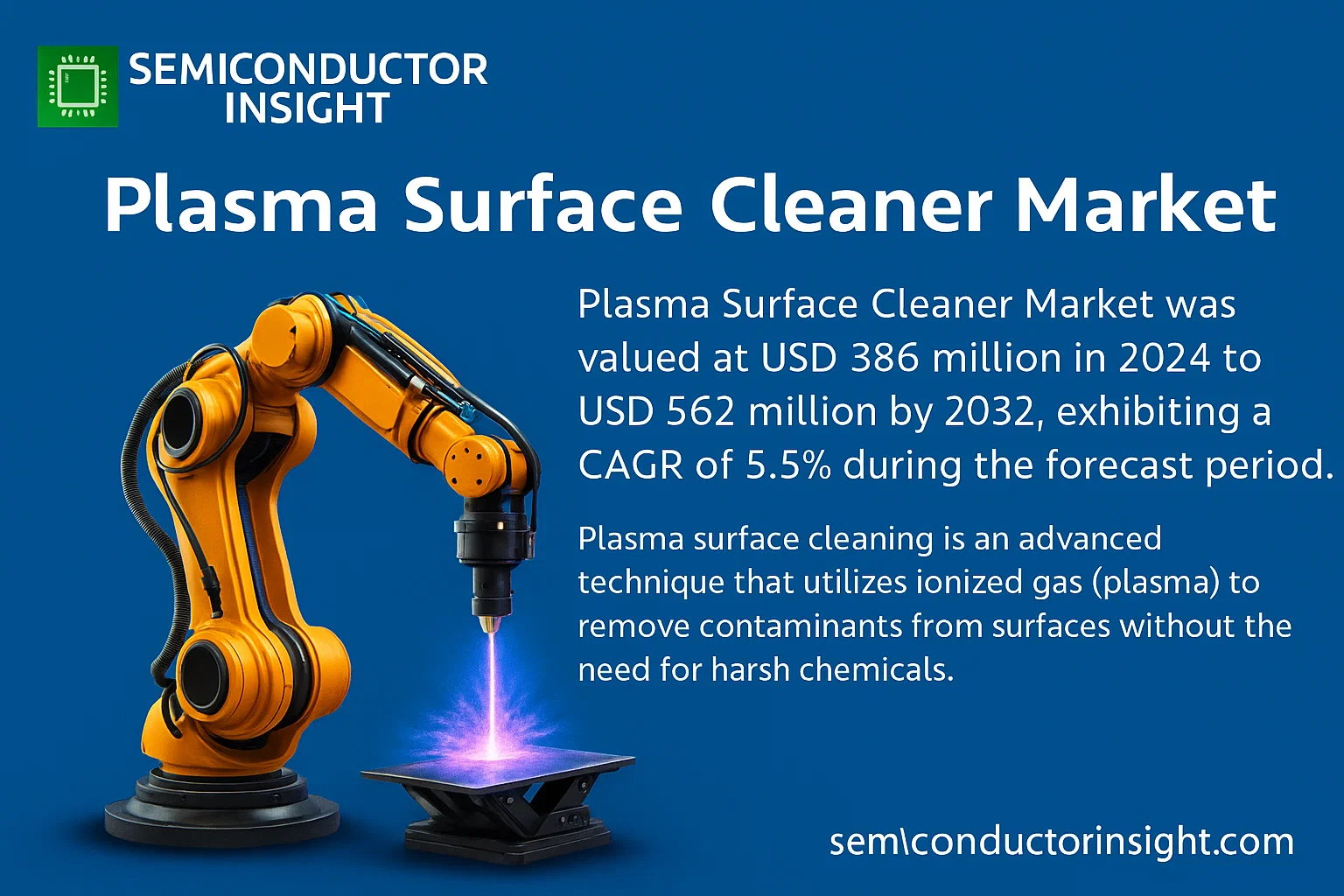
Global Plasma Surface Cleaner Market was valued at USD 386 million in 2024 to USD 562 million by 2032, exhibiting a CAGR of 5.5% during the forecast period.
Plasma surface cleaning is an advanced technique that utilizes ionized gas (plasma) to remove contaminants from surfaces without the need for harsh chemicals. This process is highly effective for removing organic residues, oxides, and other contaminants from a wide range of materials, including metals, ceramics, and polymers. The technology is widely adopted in industries requiring high levels of cleanliness and precision, such as semiconductor manufacturing, medical device production, and aerospace engineering. Its ability to clean complex geometries and delicate surfaces without causing damage makes it a preferred choice over traditional methods like ultrasonic cleaning or solvent washing.
The market growth is primarily driven by the increasing demand for precision cleaning in the electronics and semiconductor industries, where even microscopic contaminants can lead to product failure. The adoption of plasma cleaning is also growing in the automotive and aerospace sectors for cleaning critical components and ensuring reliability. Furthermore, stringent regulations regarding the use of hazardous chemicals are pushing industries towards eco-friendly alternatives like plasma cleaning. Technological advancements, such as the development of atmospheric plasma systems that operate at atmospheric pressure, are making the technology more accessible and cost-effective, further propelling market growth. The Asia-Pacific region, led by China, Japan, and South Korea, is expected to be the fastest-growing market due to its large electronics manufacturing base.
MARKET DRIVERS
Increasing Demand in Electronics Manufacturing
The global plasma surface cleaner market is primarily driven by the booming electronics and semiconductor industry. The miniaturization of electronic components and the need for high-reliability microchips demand flawless surface preparation to ensure strong adhesion and prevent device failure. Plasma cleaning is a critical step for removing organic contaminants and microscopic residues from substrates, wafers, and lead frames, making it indispensable for advanced packaging and PCB assembly. The proliferation of 5G technology, IoT devices, and electric vehicles is further accelerating this demand.
Stringent Regulatory Standards and Quality Requirements
Industries such as medical devices and aerospace are subject to rigorous regulatory standards that mandate superior surface quality. Plasma surface treatment is a dry, solvent-free process that effectively sterilizes and activates surfaces for bonding, coating, and printing, ensuring compliance with standards from agencies like the FDA and FAA. The move towards more biocompatible implants and lightweight aerospace composites has made plasma cleaning a preferred method for achieving the necessary surface energy and cleanliness.
➤ The medical device segment is projected to witness a CAGR of over 8.5% as plasma cleaning ensures optimal adhesion for coatings on stents and catheters.
Furthermore, the automotive sector’s shift towards lightweight materials like composites and engineering plastics requires effective surface activation for bonding and painting. Plasma treatment provides an eco-friendly alternative to chemical primers, supporting the industry’s sustainability goals while enhancing manufacturing efficiency.
MARKET CHALLENGES
High Initial Investment and Operational Costs
The adoption of plasma surface cleaning technology is hampered by the significant capital expenditure required for equipment acquisition and installation. Advanced atmospheric and low-pressure plasma systems can be cost-prohibitive for small and medium-sized enterprises (SMEs). Additionally, operational costs related to specialized gases, maintenance, and skilled labor can be substantial, creating a barrier to entry for many potential users, particularly in price-sensitive markets.
Other Challenges
Technical Complexity and Process Integration
Integrating plasma cleaning into existing production lines poses technical challenges, as the process requires precise control of parameters like power, gas composition, and exposure time. A lack of standardization across different materials and applications can lead to process variability, requiring extensive validation and expertise to ensure consistent results without damaging sensitive substrates.
Limited Awareness in Traditional Industries
While established in high-tech sectors, plasma cleaning is less known in traditional manufacturing industries such as textiles and packaging. Convincing these industries to transition from conventional chemical or mechanical cleaning methods to plasma technology requires significant educational efforts and demonstrable ROI, slowing down market penetration.
MARKET RESTRAINTS
Economic Volatility and Supply Chain Disruptions
Global economic uncertainties and fluctuations in industrial output can negatively impact capital investment in new manufacturing technologies like plasma cleaners. Industries may delay or cancel equipment purchases during economic downturns. Furthermore, disruptions in the supply chain for critical components, such as RF generators and vacuum pumps, can lead to increased lead times and costs, restraining market growth.
Competition from Alternative Technologies
The plasma surface cleaner market faces competition from well-established alternative surface treatment methods. Techniques such as flame treatment, corona treatment, and chemical etching are deeply embedded in certain manufacturing processes due to their lower upfront cost and operational simplicity. For applications where ultra-high cleanliness is not critical, these alternatives present a cost-effective restraint on the adoption of plasma technology.
MARKET OPPORTUNITIES
Expansion into Emerging Applications
Significant growth opportunities exist in emerging applications such as renewable energy and flexible electronics. The manufacturing of solar panels, fuel cells, and printed electronics requires pristine surfaces for efficient performance and longevity. Plasma cleaning is ideal for treating delicate materials like polymer films and transparent conductive oxides, opening new revenue streams for market players.
Development of Compact and Affordable Systems
There is a substantial untapped market opportunity in developing compact, benchtop, and more affordable plasma cleaning systems tailored for SMEs and research laboratories. By reducing the system footprint and cost without compromising performance, manufacturers can democratize access to this technology, fostering adoption in academia, prototyping, and small-batch production environments. The market for tabletop systems is expected to grow rapidly as a result.
Advancements in Atmospheric Plasma Technology
Ongoing R&D in atmospheric plasma systems that operate at ambient pressure presents a major opportunity. These systems eliminate the need for expensive vacuum chambers, reducing both initial investment and processing time. This innovation makes in-line, continuous plasma treatment feasible for high-volume manufacturing processes like web coating and automotive assembly, significantly expanding the technology’s applicability.
Plasma Surface Cleaner Market Trends
Steady Market Expansion Driven by Technological and Environmental Factors
The global plasma surface cleaner market is on a clear growth trajectory, valued at approximately $386 million in 2024 and projected to reach $562 million by 2032, representing a compound annual growth rate (CAGR) of 5.5%. This expansion is driven by the superior efficiency and environmental benefits of plasma cleaning, which provides a uniform and secure method for removing contaminants without altering the underlying material’s properties. The technology is particularly dominant in the electronics and circuit industries for cleaning PCB boards and lead frames during manufacturing and packaging processes. The method is eco-friendly, as it eliminates the need for hazardous chemical solvents, thereby saving costs associated with environmental hazard disposal.
Other Trends
Application Diversification Across Key Industries
The market is witnessing significant diversification in applications. The semiconductor industry remains a primary user, but adoption is rapidly increasing in automotive, medical devices, and aerospace sectors. This is due to the growing demand for high-quality products with precise surface finishes and enhanced functional properties. Plasma cleaning is also finding new applications in emerging fields such as nanotechnology, energy storage, and biotechnology, creating additional avenues for market growth. The process is highly valued in medical and manufacturing for sterilization, as it effectively destroys microbial contaminants, oils, and organic compounds more effectively than traditional solvents.
Regional Market Dynamics and Competitive Landscape
The market is geographically diverse, with strong sales across Asia, Europe, and North America. Key markets include China, Japan, South Korea, Germany, France, and the United States, with growing interest from Latin America, the Middle East, and Africa. The competitive landscape features established players like Nordson MARCH, Plasmatreat, and Panasonic, who are focused on innovation in plasma generation and equipment design. Ongoing technological advancements are enhancing the efficiency, versatility, and reliability of plasma surface cleaners, ensuring the market’s continued growth as manufacturers cater to evolving industry demands for sustainable and precise surface treatment solutions.
COMPETITIVE LANDSCAPE
Key Industry Players
A diverse market led by established technology providers and specialized equipment manufacturers.
The global plasma surface cleaner market is moderately concentrated, featuring a mix of large multinational corporations with diversified product portfolios and smaller, specialized manufacturers. Nordson MARCH is widely recognized as a leading global player, leveraging its extensive experience and global distribution network to serve diverse industries from electronics to medical devices. Companies like Plasmatreat and PVA TePla also hold significant market shares, offering advanced atmospheric pressure and low-pressure plasma systems, respectively. The competitive environment is characterized by a strong focus on technological innovation to enhance cleaning efficiency, process control, and equipment reliability, with key players actively investing in R&D to expand applications into high-growth sectors such as semiconductors and electric vehicles.
Beyond these dominant players, the market includes several significant niche competitors that have carved out strong positions. Companies such as Diener Electronic, Samco Inc., and Tantec are recognized for their deep expertise in specific plasma technologies, catering to research institutions and specialized manufacturing processes. Bdtronic and Vision Semicon provide targeted solutions for the semiconductor and microelectronics industries. Firms like Plasma Etch and PINK GmbH Thermosysteme focus on specific applications and regional markets. Additionally, players such as Panasonic and SCI Automation bring their industrial automation prowess to the plasma cleaning space. This secondary tier of companies competes effectively by offering specialized technical support, customized solutions, and competitive pricing, particularly for small to medium-sized enterprises.
List of Key Plasma Surface Cleaner Companies Profiled
- Nordson MARCH
- Plasmatreat
- Bdtronic
- Panasonic
- PVA TePla
- Diener Electronic
- Vision Semicon
- Samco Inc.
- Tantec
- SCI Automation
- PINK GmbH Thermosysteme
- Plasma Etch
- Harrick Plasma
- Yamato Scientific Co., Ltd.
Segment Analysis:
| Segment Category | Sub-Segments | Key Insights |
| By Type |
|
Tabletop Type plasma surface cleaners represent a dominant force in the market, driven by their accessibility and versatility for research laboratories, small-scale manufacturing, and prototyping applications. Their compact footprint and relative affordability make them an ideal entry point for organizations adopting plasma cleaning technology. Conversely, Large Chamber Type systems are critical for high-volume industrial production lines, offering the necessary throughput for sectors like automotive and consumer electronics. The choice between these types is fundamentally dictated by the required processing capacity and the scale of operations, with innovation focusing on enhancing the automation and process control capabilities of both categories to meet evolving industry standards. |
| By Application |
|
Semiconductor manufacturing stands as the cornerstone application for plasma surface cleaners, where absolute surface purity is non-negotiable for ensuring high device yields and performance. The technology is indispensable for cleaning wafers and critical components without introducing mechanical stress or chemical residues. The Electronics application segment closely follows, leveraging plasma cleaning for printed circuit boards (PCBs) and lead frames to ensure superior adhesion for coatings and encapsulants. The Automotive industry utilizes plasma for activating plastic components prior to bonding and painting, while the growing “Others” category encompasses promising frontiers in medical device sterilization, aerospace component preparation, and advanced materials research, indicating a broadening scope of adoption across high-tech sectors. |
| By End User |
|
Original Equipment Manufacturers (OEMs) in sectors like electronics, automotive, and medical devices constitute the primary end-user segment, integrating plasma cleaning directly into their production lines to guarantee the quality and reliability of their final products. Research & Academic Institutions form a vital segment for driving innovation, utilizing plasma cleaners for R&D in material science, nanotechnology, and biotechnology, often serving as early adopters of new plasma processes. Contract Manufacturing Organizations represent a growing segment, as more brands outsource production, creating demand for advanced surface treatment services to meet stringent client specifications, thereby expanding the market’s reach through specialized service offerings. |
| By Process Environment |
|
Low Pressure (Vacuum) Plasma remains the established and dominant process environment, renowned for its ability to deliver uniform and highly effective cleaning, especially for complex geometries and sensitive substrates common in semiconductor and medical device manufacturing. The controlled environment allows for precise process parameters. Atmospheric Pressure Plasma systems are gaining significant traction for inline processing, eliminating the need for vacuum chambers and thereby reducing cycle times for applications in automotive and packaging industries. The emergence of Hybrid Systems, which combine the benefits of both environments, represents an innovative trend aimed at maximizing flexibility and efficiency for manufacturers dealing with diverse product portfolios and processing requirements. |
| By Technology |
|
Remote Plasma technology is increasingly favored for applications involving sensitive materials, as it generates the plasma away from the substrate, minimizing the risk of surface damage from ion bombardment while effectively delivering reactive species for cleaning. Direct Plasma technology, where the substrate is placed directly within the plasma discharge, offers high energy transfer and is often used for robust materials requiring aggressive contaminant removal. Arc or Jet Plasma systems provide a highly focused and localized treatment, ideal for targeted cleaning or surface activation on specific areas of a component. The selection of technology is a critical decision point, balancing cleaning efficacy with the thermal and physical sensitivity of the workpiece. |
Regional Analysis: Plasma Surface Cleaner Market
This segment is the primary driver, with a relentless focus on yield improvement and contamination control for integrated circuits and advanced display panels. The need for ultraclean surfaces at the nanoscale is paramount, making plasma cleaning an essential step in fabrication processes across the region.
The stringent regulatory requirements for biocompatibility and sterilization in medical devices fuel the adoption of plasma cleaning. It is widely used to activate polymer surfaces for improved bonding and to remove organic residues from surgical instruments and implants, ensuring high safety standards.
The region’s growing automotive industry, especially in electric vehicles, utilizes plasma cleaning for adhesive bonding preparation and coating adhesion on composite materials and electronic components. The aerospace sector leverages the technology for critical surface treatment of lightweight alloys.
Asia-Pacific hosts world-class research institutions and corporate R&D centers that are pioneering new plasma applications. This intense focus on innovation ensures the continuous development of more efficient, environmentally friendly, and specialized plasma cleaning systems tailored to emerging industry needs.
North America
The North American market is characterized by a strong emphasis on high-value, specialized applications and stringent quality control standards. The United States, in particular, is a significant hub for aerospace, defense, and medical technology, where plasma cleaning is critical for ensuring the reliability of sophisticated components. The region benefits from a mature technological landscape, with a high adoption rate of automation and advanced manufacturing processes. The presence of leading semiconductor fabricators and a robust life sciences industry sustains consistent demand. Innovation is driven by collaborative efforts between academic research centers and industry players, focusing on developing plasma technologies for next-generation materials and nanoscale devices.
Europe
Europe maintains a strong position in the Plasma Surface Cleaner market, supported by its advanced automotive industry, high-quality medical device manufacturing, and a focus on sustainable technologies. Germany, as a manufacturing powerhouse, leads demand for precision cleaning in automotive and industrial applications. The region’s stringent environmental regulations promote the adoption of dry, solvent-free plasma cleaning processes over traditional wet chemical methods. There is a notable emphasis on research for applications in renewable energy technologies, such as solar panel manufacturing and fuel cells. The market is mature, with a focus on process optimization, reliability, and integrating plasma systems into sophisticated automated production lines.
South America
The South American market for Plasma Surface Cleaners is in a developing phase, with growth primarily driven by the medical device and automotive sectors in countries like Brazil and Argentina. The adoption rate is gradually increasing as local manufacturers seek to meet international quality standards for exports. The market is characterized by a focus on cost-effective solutions and the modernization of industrial bases. While the technological infrastructure is less dense compared to leading regions, there is growing awareness of the benefits of plasma surface treatment for improving product quality and competitiveness in global markets, indicating potential for future expansion.
Middle East & Africa
This region represents an emerging market with growth potential linked to economic diversification efforts, particularly in the Gulf Cooperation Council countries. Investments in healthcare infrastructure and a budding electronics assembly industry are creating initial demand for plasma cleaning technology. The market is currently small and reliant on imports of equipment. Growth is expected to be gradual, driven by the need for high-quality manufacturing processes in specialized industrial zones and the medical sector. The focus is primarily on entry-level and mid-range systems suitable for specific localized applications rather than large-scale semiconductor fabrication.
Report Scope
This market research report provides a comprehensive analysis of the Plasma Surface Cleaner Market, covering the forecast period 2025–2032. It offers detailed insights into market dynamics, technological advancements, competitive landscape, and key trends shaping the industry.
Key focus areas of the report include:
- Market Overview: The report begins with an overview outlining the current market scenario, key growth indicators, and industry transformation drivers. It discusses macroeconomic factors, demand–supply balance, regulatory landscape, and the strategic role of Plasma Surface Cleaners in enabling advancements across industries such as electronics, medical devices, automotive, and aerospace.
- Market Size & Forecast: Historical data and future projections for revenue, unit shipments, and market value across major regions and segments.
- Segmentation Analysis: Detailed breakdown by product type (Tabletop, Large Chamber), application (Semiconductor, Automotive, Electronics, Others), and end-user industry to identify high-growth segments and investment opportunities.
- Regional Insights: Insights into market performance across North America, Europe, Asia, South America, and the Middle East & Africa, including country-level analysis for key markets.
- Competitive Landscape: Profiles of leading market participants, including their product offerings, R&D focus, manufacturing capacity, pricing strategies, and recent developments such as mergers, acquisitions, and partnerships.
- Technology Trends & Innovation: Assessment of emerging technologies, innovations in plasma generation and process control, and evolving industry standards.
- Market Drivers & Restraints: Evaluation of factors driving market growth along with challenges, supply chain constraints, regulatory issues, and market-entry barriers.
- Stakeholder Insights: Insights for component suppliers, OEMs, system integrators, investors, and policymakers regarding the evolving ecosystem and strategic opportunities.
Primary and secondary research methods are employed, including interviews with industry experts, data from verified sources, and real-time market intelligence to ensure the accuracy and reliability of the insights presented.
FREQUENTLY ASKED QUESTIONS:
What is the current market size of Plasma Surface Cleaner Market?
->Plasma Surface Cleaner Market was valued at USD 386 million in 2024 to USD 562 million by 2032, exhibiting a CAGR of 5.5% during the forecast period.
Which key companies operate in Plasma Surface Cleaner Market?
-> Key players include Nordson MARCH, Plasmatreat, Bdtronic, Panasonic, PVA TePla, Diener Electronic, Vision Semicon, Samco Inc., Tantec, SCI Automation, PINK GmbH Thermosysteme, and Plasma Etch, among others.
What are the key growth drivers?
-> Key growth drivers include technological advancements, increasing demand for precision cleaning and surface modification, and the growing focus on environmental sustainability.
Which region dominates the market?
-> The global market for plasma surface cleaners is diverse, with significant sales distributed across Asia, Europe, and North America. Key country markets include China, Japan, South Korea, Germany, France, and the United States.
What are the emerging trends?
-> Emerging trends include innovations in plasma generation and equipment design, expansion into new applications in nanotechnology and biotechnology, and the adoption of eco-friendly cleaning processes.

Get Sample Report PDF for Exclusive Insights
Report Sample Includes
- Table of Contents
- List of Tables & Figures
- Charts, Research Methodology, and more...
 Download Sample Report PDF
