
MARKET INSIGHTS
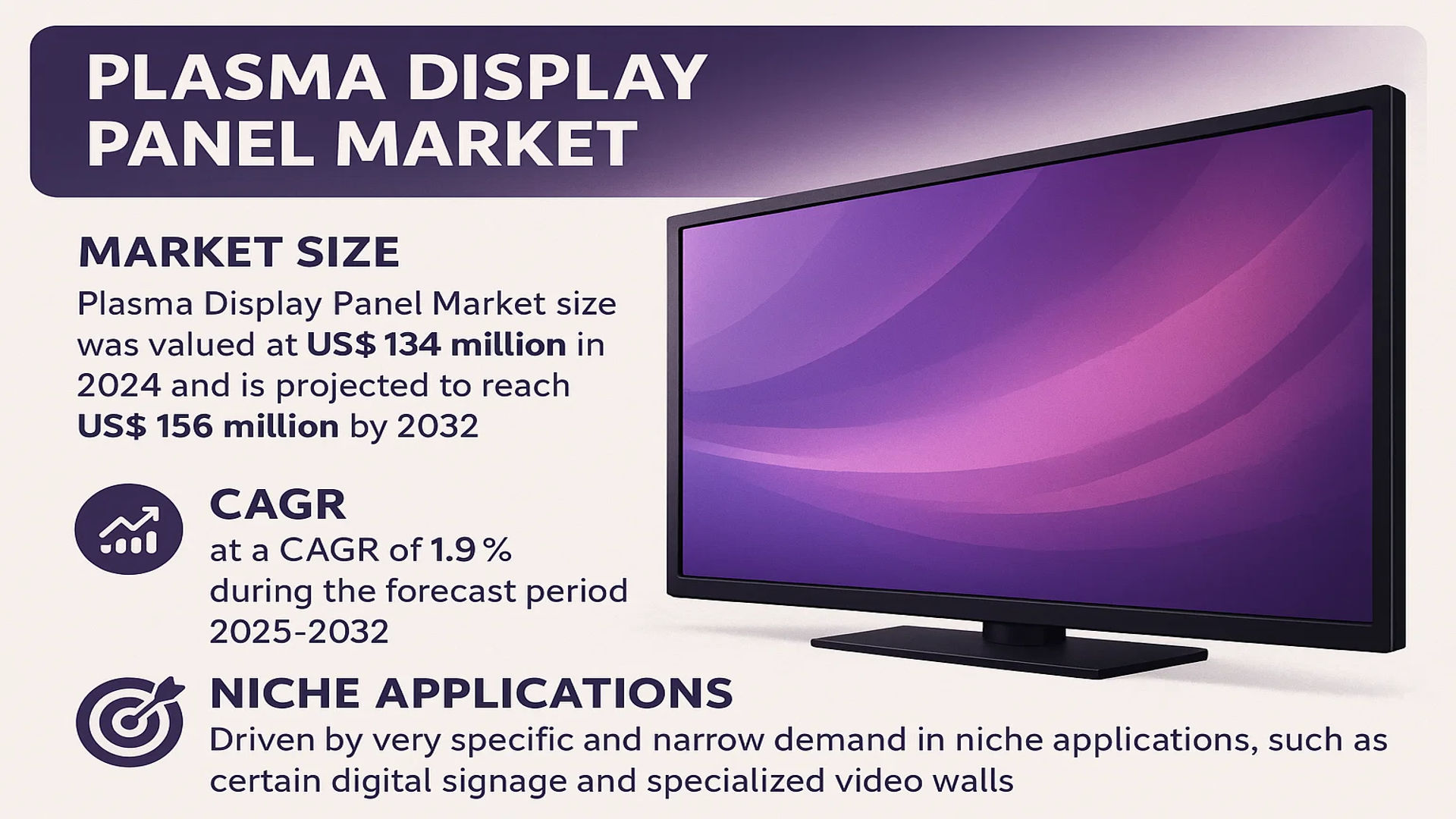
The global Plasma Display Panel Market size was valued at US$ 134 million in 2024 and is projected to reach US$ 156 million by 2032, at a CAGR of 1.9% during the forecast period 2025-2032.
Plasma Display Panels (PDP) are a flat panel display technology that uses small cells containing electrically charged ionized gases, or plasmas, to produce an image. A plasma display consists of millions of tiny gas-filled compartments, or cells, sandwiched between two panels of glass. This technology was commercialized in the 1990s and was once a dominant force in the large-screen television market.
The market’s minimal growth is primarily driven by a very specific and narrow demand in niche applications, such as certain digital signage and specialized video walls, where its historical advantages in wide viewing angles and superior contrast ratios are still valued. However, this limited expansion is severely constrained because major manufacturers, including Samsung and Panasonic, ceased mass production of these panels by 2014. The market is now largely sustained by remaining inventory and very limited specialized production, facing immense pressure from advanced and more efficient technologies like OLED and MicroLED.
MARKET DYNAMICS
MARKET DRIVERS
Niche Demand in Commercial Display Applications Sustains Market Presence
Despite the widespread phase-out of plasma display panels in consumer television markets, specialized commercial applications continue to drive residual demand. Plasma technology maintains advantages in large-format displays where superior contrast ratios, wider viewing angles, and reduced motion blur remain critical performance factors. The commercial display segment, particularly in high-end hospitality, corporate boardrooms, and control rooms, values plasma’s ability to deliver deeper black levels and consistent image quality across wide viewing angles. This sustained demand in professional environments has created a stable niche market, with current revenue generation primarily coming from replacement panels and maintenance services for existing installations. The market demonstrates remarkable resilience in these specialized segments where display performance often outweighs energy efficiency concerns.
Legacy System Maintenance Requirements Support Aftermarket Services
The extensive installed base of plasma displays from the technology’s commercial peak continues to generate substantial aftermarket revenue. With an estimated several million units still operational worldwide, maintenance and replacement part requirements create consistent market activity. Many organizations with significant investments in plasma display infrastructure continue to prioritize maintenance over complete system replacements due to cost considerations and compatibility requirements. This creates ongoing demand for replacement panels, power supply units, and control boards. The specialized nature of these repairs requires specific technical expertise, creating a professional services market that supplements panel sales. This maintenance-driven ecosystem provides stability to market participants who have adapted to serve this specialized segment.
Furthermore, the unique visual characteristics of plasma technology continue to be preferred in certain professional applications where color accuracy and motion handling are paramount. This preference sustains demand among specific user groups who have not transitioned to newer display technologies.
➤ For instance, air traffic control systems and emergency response centers that implemented plasma displays during the technology’s peak adoption period often maintain these systems due to the significant costs associated with complete infrastructure overhaul.
Additionally, the limited manufacturing capacity has created a scenario where remaining inventory commands premium pricing, particularly for larger panel sizes that were less commonly produced during the technology’s commercial lifespan.
MARKET CHALLENGES
Manufacturing Discontinuation Creates Supply Chain Constraints
The market faces severe challenges due to the complete cessation of mass production by all major manufacturers. Since 2014, when the last major producers halted manufacturing, the entire supply chain has been operating on remaining inventory and reclaimed components. This production halt has created significant supply constraints, particularly for larger panel sizes and specific models that were produced in smaller quantities. The limited availability of new panels has driven prices upward and created long lead times for replacement units. Organizations maintaining plasma-based systems must now contend with shrinking inventory pools and increasing component scarcity, making system maintenance progressively more challenging and costly.
Other Challenges
Technical Obsolescence
The advancing age of existing plasma displays presents increasing technical challenges. Many units still in operation have exceeded their intended lifespan, leading to higher failure rates and more frequent maintenance requirements. The natural degradation of phosphors and other components affects color accuracy and brightness over time, creating performance issues that cannot be fully resolved through maintenance. This technical obsolescence forces users to eventually consider technology transitions, despite the significant investment required for system replacements.
Energy Efficiency Regulations
Increasingly stringent energy efficiency regulations worldwide disadvantage plasma technology compared to newer display solutions. Plasma displays typically consume significantly more power than equivalent-sized LED or OLED displays, making them less compliant with modern energy standards. This regulatory pressure encourages organizations to replace existing plasma installations with more energy-efficient alternatives, particularly in regions with strict energy consumption requirements for commercial installations.
MARKET RESTRAINTS
Superior Competing Technologies Limit Market Expansion
The rapid advancement and cost reduction of competing display technologies present significant restraints on plasma display market recovery. Modern LED and OLED technologies now match or exceed plasma’s historical advantages in contrast ratio and viewing angles while offering substantial improvements in energy efficiency, thickness, weight, and resolution. The average power consumption for contemporary 55-inch LED displays is approximately 50-60% lower than equivalent plasma models, creating compelling economic incentives for technology transition. Additionally, manufacturing scales for modern display technologies have driven production costs down dramatically, making new installations more affordable than maintaining aging plasma systems in many cases.
Furthermore, the resolution capabilities of newer technologies far surpass what plasma technology achieved commercially. While plasma displays typically maxed out at 1080p resolution, modern displays routinely offer 4K and 8K resolutions, providing significantly higher pixel density and image clarity. This technological gap makes plasma displays increasingly unsuitable for applications requiring high-resolution content display.
MARKET OPPORTUNITIES
Specialized Retrofit and Maintenance Services Create Niche Opportunities
The contracted plasma display market has created specialized opportunities in refurbishment and component-level repair services. With new panel production ceased, businesses that can expertly refurbish existing panels and repair control electronics have established valuable market positions. This includes developing techniques for panel reconditioning, sourcing rare components, and recreating obsolete circuit boards. The specialized knowledge required for these services creates high barriers to entry but also allows for premium pricing structures. Organizations that invested heavily in plasma-based systems often prefer paying for expert maintenance rather than undertaking complete system replacements, particularly when the existing installations are integrated with other specialized equipment.
Additionally, the collector and enthusiast market represents another opportunity segment. Certain audiovisual enthusiasts continue to seek out high-quality plasma displays for home theater applications, valuing the technology’s particular visual characteristics. This niche demand supports a secondary market for well-preserved units and creates opportunities for businesses that can source, refurbish, and certify displays for this discerning customer base.
Moreover, the gradual increase in rarity of functioning plasma displays has created a market among technology preservationists and museums seeking to maintain examples of significant display technologies. This archival and preservation demand, while small, provides additional opportunities for businesses that can properly store and maintain display units for long-term preservation.
PLASMA DISPLAY PANEL MARKET TRENDS
Niche Commercial Applications Sustain Market Viability Despite Overall Decline
While the consumer television market has largely abandoned plasma display panel (PDP) technology in favor of LCD and OLED alternatives, PDP maintains a specialized presence in commercial applications where its inherent advantages remain valuable. The technology’s superior contrast ratios, wider viewing angles, and reduced motion blur continue to make it suitable for high-end video walls in control rooms, broadcasting studios, and large-format public displays. The market has stabilized around these specialized applications, with manufacturers focusing production exclusively on commercial-grade panels rather than consumer televisions. This strategic shift has allowed the remaining PDP manufacturers to maintain profitability despite the overall market contraction. The global market, valued at approximately $134 million in 2024, reflects this transition to higher-value, lower-volume specialized applications rather than mass-market consumer products.
Other Trends
Regional Market Divergence
Significant regional variations characterize the current PDP market landscape. While North American and European markets have seen near-complete phase-out of PDP technology, certain Asian markets continue to demonstrate sustained demand. Countries with established manufacturing infrastructure and technical expertise in plasma technology maintain production capabilities primarily for domestic commercial markets and specialized export applications. This regional divergence creates a fragmented global market where supply chains are concentrated in specific geographical areas, creating both challenges and opportunities for remaining market participants who must navigate these complex regional dynamics.
Technological Legacy and Maintenance Demand
The extensive installed base of plasma displays from the technology’s peak period continues to generate substantial aftermarket and maintenance demand. With millions of units still operational worldwide, particularly in commercial and institutional settings, there exists a persistent need for replacement panels, components, and specialized repair services. This creates a secondary market that supplements new panel sales and provides ongoing revenue streams for manufacturers and service providers. The specialized nature of plasma display maintenance requires specific technical expertise that has become increasingly rare as the technology has declined, creating premium pricing opportunities for those who retain these skills. This maintenance ecosystem represents a significant aspect of the current market structure that extends beyond simple panel sales.
COMPETITIVE LANDSCAPE
Key Industry Players
Legacy Manufacturers Maintain Niche Presence in a Declining Market
The global plasma display panel market is highly consolidated, dominated by a handful of legacy manufacturers who pioneered the technology. The competitive landscape is unique because it is a sunset industry; most major players ceased production nearly a decade ago. Consequently, the market is now primarily sustained by the after-sales service, replacement parts, and niche commercial applications for existing installations. Panasonic historically held the lion’s share of the market and remains a key player due to its extensive installed base, particularly of its high-end professional Viera series panels used in commercial settings.
LG Electronics and Samsung also commanded significant portions of the market prior to their exit from PDP manufacturing in 2014. Their market presence persists through their vast global service networks, which continue to support the millions of plasma TVs still in use. The longevity of these panels has created a long-tail aftermarket.
While the market is in a state of managed decline, these companies continue to leverage their strong brand recognition and deep technical expertise in display technologies to serve remaining customers. Their focus has shifted from innovation and new product development to supply chain management for spare parts and maintaining service-level agreements for high-value commercial clients, such as those using large-format seamless video walls in control rooms and broadcast studios.
Meanwhile, companies like Pioneer (whose PDP business was acquired by Panasonic) and Hitachi (Fujitsu) are remembered for their technological contributions, particularly in developing high-contrast, deep-black levels that were the hallmark of premium plasma displays. Their historical innovations continue to influence display standards today.
List of Key Plasma Display Panel Companies Profiled
- Panasonic Corporation (Japan)
- Samsung Electronics (South Korea)
- LG Electronics (South Korea)
- Pioneer Corporation (Japan)
- Hitachi, Ltd. (Fujitsu legacy assets) (Japan)
- Sichuan Changhong Electric Co., Ltd. (China)
Segment Analysis:
By Size
Large Size Display Above 51 Inch Segment Dominates Due to Sustained Niche Demand in High-End Commercial Applications
The market is segmented based on size into:
- Small Size Display Below 42 Inch
- Middle Size Display 42-51 Inch
- Large Size Display Above 51 Inch
By Application
Seamless Video Wall Segment Leads Due to Superior Performance in Public Information and Control Room Environments
The market is segmented based on application into:
- Plasma TV
- Seamless Video Wall
- Others
By End User
Commercial and Industrial Sector is the Primary End User Leveraging PDPs for Large Format Displays
The market is segmented based on end user into:
- Commercial and Industrial
- Consumer Electronics
- Others
By Region
Asia-Pacific Holds a Significant Share Driven by Legacy Manufacturing Bases and Regional Demand
The market is segmented based on region into:
- North America
- Europe
- Asia-Pacific
- South America
- Middle East & Africa
Regional Analysis: Plasma Display Panel Market
Asia-Pacific
The Asia-Pacific region is the dominant force in the Plasma Display Panel market, primarily driven by its historical role as the manufacturing hub for this technology before its commercial decline. While the market is now a niche segment, the region still accounts for the largest volume of remaining sales and aftermarket support. This is largely due to the presence of legacy manufacturing infrastructure and a significant installed base of existing plasma displays, particularly in countries like China, Japan, and South Korea. The region’s key players, including Panasonic, Samsung, LG, and Hitachi (Fujitsu), were headquartered here, and their continued, albeit limited, support for specialized applications sustains a small but steady demand. The market is now almost exclusively focused on the replacement and servicing of existing large-format displays in commercial settings, such as control rooms and high-end public viewing areas, where the superior contrast and viewing angles of PDPs are still valued over newer technologies.
North America
The North American market for Plasma Display Panels is characterized by a very specialized and residual demand. Following the cessation of mass production by major manufacturers over a decade ago, the market has transitioned entirely to servicing a niche clientele. The primary demand stems from commercial and industrial sectors that have significant investments in existing plasma display infrastructure and for whom a wholesale switch to alternative technologies like LED or OLED is cost-prohibitive or technically unsuitable. This includes applications in aviation control towers, security command centers, and certain high-end home theater enthusiasts who maintain older systems. The market is supported by a network of specialized distributors and service providers who source remaining panel inventories or refurbished units, primarily from Asian suppliers. The focus is on longevity and reliability, with virtually no new product development occurring.
Europe
Similar to North America, the European Plasma Display Panel market is a legacy sector operating on the periphery of the mainstream display industry. Demand is almost entirely driven by the need for replacement parts and panels for existing installations in professional environments. These include broadcast studios, medical imaging centers (though largely supplanted), and transportation hubs that installed large-scale plasma video walls in the early 2000s. The market is constrained by the lack of new products and the dwindling global inventory of panels. European regulations concerning energy efficiency and hazardous materials in electronics have further accelerated the phase-out of PDP technology in favor of more efficient LCD and OLED solutions. Consequently, the market is highly fragmented, relying on third-party service companies and a limited supply chain for maintenance and repair.
South America
The Plasma Display Panel market in South America is minimal and faces significant challenges. The region’s adoption of PDP technology was always limited compared to other display types, even during its commercial peak, due to higher costs and import duties. Today, the market is virtually nonexistent for new sales. Any residual activity is confined to very specific, localized efforts to maintain aging displays in premium commercial or hospitality settings. Economic volatility and currency fluctuations make sourcing replacement panels or parts from international suppliers expensive and logistically complex. There is no local manufacturing or meaningful distribution network for PDPs, forcing end-users to eventually transition to more readily available and supported display technologies.
Middle East & Africa
The market for Plasma Display Panels in the Middle East & Africa is the most underdeveloped among all regions. Initial penetration was low, and the rapid global decline of the technology meant it never gained a significant foothold. Any existing installations are extremely rare and are typically found in older, high-budget projects from the late 2000s, such as in luxury hotels or corporate headquarters. The challenging operating environment, with high ambient temperatures and dust, is also poorly suited to the heat generation and ventilation requirements of plasma displays, leading to higher failure rates. With no local support infrastructure and immense difficulty in procuring parts, the market is essentially inactive. Growth potential is nonexistent, as all new investments are directed toward modern, efficient, and widely supported display solutions.
Report Scope
This market research report provides a comprehensive analysis of the global Plasma Display Panel market, covering the forecast period 2025–2032. It offers detailed insights into market dynamics, technological advancements, competitive landscape, and key trends shaping the industry.
Key focus areas of the report include:
- Market Size & Forecast: Historical data and future projections for revenue, unit shipments, and market value across major regions and segments.
- Segmentation Analysis: Detailed breakdown by product type, technology, application, and end-user industry to identify high-growth segments and investment opportunities.
- Regional Outlook: Insights into market performance across North America, Europe, Asia-Pacific, Latin America, and the Middle East & Africa, including country-level analysis where relevant.
- Competitive Landscape: Profiles of leading market participants, including their product offerings, R&D focus, manufacturing capacity, pricing strategies, and recent developments such as mergers, acquisitions, and partnerships.
- Technology Trends & Innovation: Assessment of emerging technologies, integration of AI/IoT, semiconductor design trends, fabrication techniques, and evolving industry standards.
- Market Drivers & Restraints: Evaluation of factors driving market growth along with challenges, supply chain constraints, regulatory issues, and market-entry barriers.
- Stakeholder Analysis: Insights for component suppliers, OEMs, system integrators, investors, and policymakers regarding the evolving ecosystem and strategic opportunities.
Primary and secondary research methods are employed, including interviews with industry experts, data from verified sources, and real-time market intelligence to ensure the accuracy and reliability of the insights presented.
FREQUENTLY ASKED QUESTIONS:
What is the current market size of Global Plasma Display Panel Market?
-> Plasma Display Panel Market size was valued at US$ 134 million in 2024 and is projected to reach US$ 156 million by 2032, at a CAGR of 1.9% during the forecast period 2025-2032.
Which key companies operate in Global Plasma Display Panel Market?
-> Key players include Panasonic, Samsung, LG, Pioneer, Hitachi (Fujitsu), and Changhong, among others.
What are the key growth drivers?
-> Key growth drivers include demand for large-format displays, niche applications in seamless video walls, and superior contrast ratio capabilities.
Which region dominates the market?
-> Asia-Pacific is the dominant market, driven by manufacturing hubs and consumer demand, while North America remains a significant market.
What are the emerging trends?
-> Emerging trends include specialized applications in commercial displays, refurbishment markets, and limited production for high-end niche segments.

Get Sample Report PDF for Exclusive Insights
Report Sample Includes
- Table of Contents
- List of Tables & Figures
- Charts, Research Methodology, and more...
 Download Sample Report PDF


