
MARKET INSIGHTS
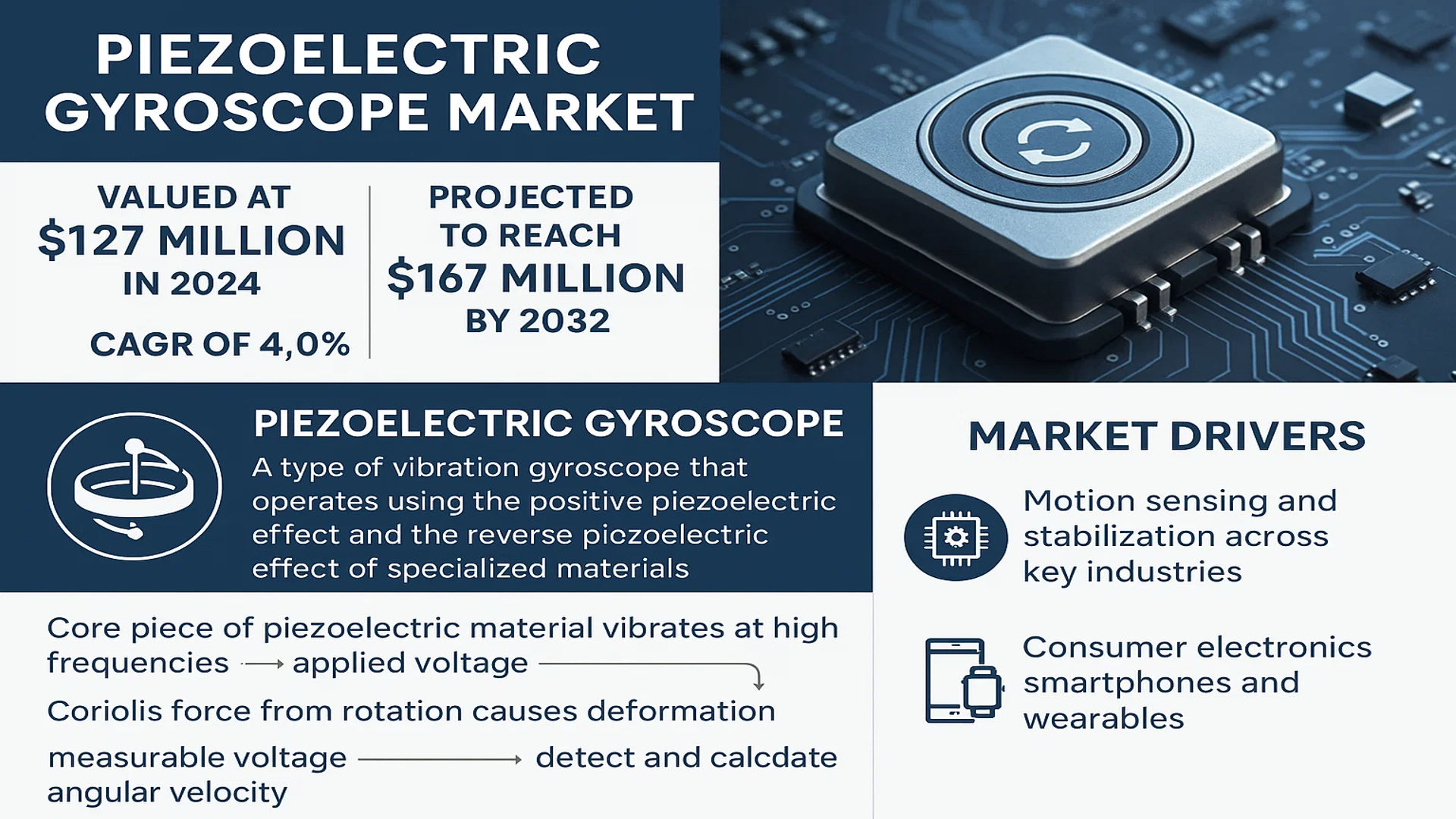
The global Piezoelectric Gyroscope Market was valued at 127 million in 2024 and is projected to reach US$ 167 million by 2032, at a CAGR of 4.0% during the forecast period.
A piezoelectric gyroscope is a type of vibration gyroscope that operates using the positive piezoelectric effect and the reverse piezoelectric effect of specialized materials. Its core principle hinges on the pressure-electric properties of piezoelectric materials, where a core piece of this material is made to vibrate at high frequencies via an applied high-frequency voltage. When subjected to external rotation, the Coriolis force is generated perpendicular to the vibration direction, causing a deformation in the material. This deformation subsequently generates a measurable voltage, and by detecting this voltage, the magnitude of the angular velocity can be precisely calculated.
The market’s steady growth is primarily driven by the escalating demand for motion sensing and stabilization across key industries. The consumer electronics sector, particularly smartphones and wearable devices, remains a dominant application area. Furthermore, the expansion of the automotive industry, with its increasing integration of advanced driver-assistance systems (ADAS) and electronic stability control, is a significant growth driver. The aerospace and defense sector also contributes substantially to demand, utilizing these gyroscopes for navigation and guidance systems. Key players such as Murata Manufacturing, TDK Corporation, and Bosch Sensortec lead the market with continuous innovation and a wide portfolio of products.
MARKET DYNAMICS
MARKET DRIVERS
Expanding Consumer Electronics Sector to Drive Piezoelectric Gyroscope Adoption
The consumer electronics industry continues to be the primary growth driver for piezoelectric gyroscopes, with global smartphone shipments exceeding 1.2 billion units annually. These components are essential for motion sensing, image stabilization, and augmented reality applications in modern devices. The increasing integration of advanced features in smartphones, tablets, and wearable devices has created sustained demand for high-performance gyroscopes. The piezoelectric gyroscope market benefits particularly from the growing adoption of 5G-enabled devices and the expansion of IoT ecosystems, where precise motion detection is crucial. With consumer electronics manufacturers constantly innovating to enhance user experience, the requirement for reliable and compact motion sensors continues to rise, positioning piezoelectric gyroscopes as critical components in next-generation electronic devices.
Automotive Safety and Navigation Systems to Accelerate Market Growth
The automotive industry’s rapid transition toward advanced driver assistance systems (ADAS) and autonomous vehicles represents a significant growth opportunity for piezoelectric gyroscopes. These sensors are integral to electronic stability control, navigation systems, and platform stabilization applications. The global ADAS market is projected to grow at approximately 12% annually, driven by increasing safety regulations and consumer demand for enhanced vehicle safety features. Piezoelectric gyroscopes provide critical angular rate sensing capabilities that enable precise vehicle positioning and motion detection, making them indispensable components in modern automotive electronics. The expansion of electric vehicle production, which typically incorporates more advanced electronic systems than conventional vehicles, further amplifies this demand across global automotive markets.
Aerospace and Defense Applications to Fuel Market Expansion
The aerospace and defense sector represents a high-value application area for piezoelectric gyroscopes, where these sensors are used in aircraft navigation, missile guidance, and unmanned aerial vehicle stabilization systems. The global defense spending has reached unprecedented levels, with several nations increasing their investments in advanced navigation and guidance technologies. Piezoelectric gyroscopes offer advantages in harsh environments due to their solid-state construction and resistance to shock and vibration, making them suitable for demanding aerospace applications. The growing deployment of commercial satellites and space exploration initiatives further drives demand for reliable motion sensing solutions, creating sustained growth opportunities for manufacturers specializing in high-performance piezoelectric gyroscopes.
MARKET CHALLENGES
Intense Competition from MEMS Technology to Challenge Market Position
The piezoelectric gyroscope market faces significant challenges from the rapid advancement and adoption of Micro-Electro-Mechanical Systems (MEMS) gyroscopes, which offer smaller form factors, lower power consumption, and reduced manufacturing costs. MEMS gyroscopes have captured substantial market share in consumer electronics applications, where cost sensitivity is particularly high. While piezoelectric gyroscopes maintain advantages in certain high-performance applications, the continuous improvement in MEMS technology performance presents an ongoing competitive challenge. The research and development investment required to maintain technological competitiveness against MEMS alternatives represents a substantial burden for piezoelectric gyroscope manufacturers, particularly in price-sensitive market segments.
Other Challenges
Temperature Sensitivity and Calibration Requirements
Piezoelectric gyroscopes exhibit temperature-dependent performance characteristics that necessitate complex calibration procedures and compensation algorithms. This temperature sensitivity can affect measurement accuracy and requires additional engineering solutions, increasing both development costs and system complexity. In applications requiring high precision across varying environmental conditions, these calibration requirements present significant technical challenges that can limit adoption in certain market segments.
Manufacturing Complexity and Yield Issues
The manufacturing process for piezoelectric gyroscopes involves precise material handling and assembly techniques that can impact production yields and consistency. Maintaining tight tolerances during mass production presents ongoing challenges, particularly as market demands push for smaller form factors and higher performance specifications. These manufacturing complexities contribute to higher production costs compared to alternative technologies, creating pricing pressures in competitive market environments.
MARKET RESTRAINTS
High Development Costs and Technical Specialization to Limit Market Penetration
The development and production of piezoelectric gyroscopes require specialized expertise in materials science, precision engineering, and electronic design, creating significant barriers to entry for new market participants. The substantial investment in research and development necessary to achieve competitive performance characteristics restricts market expansion and innovation. Established manufacturers with extensive technical expertise and production experience maintain dominant positions, while the high costs associated with developing new piezoelectric materials and manufacturing processes deter potential new entrants. This concentration of technical knowledge and manufacturing capability among a limited number of companies constrains overall market growth and limits technological diversification.
Limited Performance in High-Frequency Applications to Restrict Market Scope
Piezoelectric gyroscopes face performance limitations in certain high-frequency and extreme dynamic range applications compared to alternative technologies such as fiber optic gyroscopes. These limitations restrict their adoption in specialized industrial and scientific applications where higher precision and broader frequency response are required. The inherent physical characteristics of piezoelectric materials impose certain constraints on performance parameters, creating natural boundaries for application suitability. While ongoing research aims to address these limitations, current technological constraints continue to define the addressable market scope for piezoelectric gyroscopes in precision-critical applications.
Supply Chain Vulnerabilities and Material Availability Concerns
The piezoelectric gyroscope market faces constraints related to specialized material availability and supply chain dependencies. Certain piezoelectric materials require rare earth elements and specialized manufacturing processes that create vulnerabilities in the supply chain. Geopolitical factors and trade restrictions can impact the availability of critical materials, affecting production consistency and cost structures. These supply chain challenges necessitate extensive qualification processes for alternative materials and suppliers, creating additional barriers to market expansion and product development initiatives.
MARKET OPPORTUNITIES
Emerging Industrial Automation and Robotics Applications to Create New Growth Avenues
The rapid expansion of industrial automation and robotics presents significant growth opportunities for piezoelectric gyroscopes. The global industrial robotics market continues to grow at approximately 15% annually, driven by increasing automation across manufacturing sectors. Piezoelectric gyroscopes provide critical motion sensing capabilities for robotic navigation, stabilization, and precision control applications. Their robustness and reliability in industrial environments make them suitable for demanding automation applications where consistent performance is essential. The ongoing transition toward Industry 4.0 and smart manufacturing initiatives further amplifies this opportunity, creating sustained demand for high-performance motion sensors in automated systems and robotic platforms.
Medical Device Innovation to Drive Specialty Application Growth
The medical technology sector offers promising opportunities for piezoelectric gyroscopes in specialized applications including surgical robotics, patient monitoring systems, and medical imaging equipment. The global medical devices market continues to expand with increasing healthcare expenditures and technological innovation. Piezoelectric gyroscopes provide precise motion detection capabilities required in advanced medical equipment, particularly where electromagnetic compatibility and reliability are critical considerations. The growing adoption of minimally invasive surgical techniques and remote patient monitoring systems creates additional demand for sophisticated motion sensing solutions, positioning piezoelectric gyroscopes for growth in high-value medical applications.
Advanced Research and Development Initiatives to Enable Technological Breakthroughs
Ongoing research in piezoelectric materials and sensor design continues to create opportunities for performance improvements and new application areas. Developments in composite piezoelectric materials and advanced manufacturing techniques offer potential for enhanced sensitivity, reduced temperature dependence, and improved reliability. These technological advancements may enable piezoelectric gyroscopes to compete more effectively in precision applications where they previously faced limitations. Collaborative research initiatives between academic institutions and industry participants are driving innovation in sensor design and performance characteristics, creating opportunities for market expansion into new application segments and performance categories.
PIEZOELECTRIC GYROSCOPE MARKET TRENDS
Miniaturization and Enhanced Performance in Consumer Electronics Driving Market Growth
The relentless drive toward smaller, more powerful consumer electronics is significantly accelerating demand for piezoelectric gyroscopes. These components are critical for motion sensing and stabilization in devices ranging from smartphones and gaming controllers to wearable fitness trackers and drones. The global consumer electronics segment accounted for over 35% of the piezoelectric gyroscope market revenue in 2024, a figure projected to grow as device complexity increases. Recent advancements have focused on reducing the footprint of these gyroscopes while simultaneously improving their sensitivity and power efficiency. This is because modern applications require sensors that can operate for extended periods on minimal power, especially in portable devices. Furthermore, the integration of piezoelectric gyroscopes with other sensors, like accelerometers and magnetometers, to create sophisticated Inertial Measurement Units (IMUs) is becoming a standard, enabling more accurate and complex motion tracking for augmented reality (AR) and virtual reality (VR) applications.
Other Trends
Expansion in Automotive Safety and Navigation Systems
The automotive industry’s rapid adoption of advanced driver-assistance systems (ADAS) and the progression toward autonomous vehicles are creating a substantial and growing market for high-reliability piezoelectric gyroscopes. These sensors are indispensable for electronic stability control (ESC), rollover detection, and navigation systems, providing critical data on a vehicle’s angular velocity and orientation. The automotive application segment is expected to witness a CAGR exceeding 5.5% through 2032, outpacing the overall market average. This growth is fueled by stringent government safety regulations mandating the inclusion of stability control systems in new vehicles and the increasing consumer demand for enhanced safety features. The development of gyroscopes capable of withstanding the harsh automotive environment, including extreme temperatures and high levels of vibration, is a key focus area for leading manufacturers.
Technological Advancements and Material Innovation
Continuous innovation in materials science and manufacturing processes is a fundamental trend shaping the piezoelectric gyroscope landscape. Research is heavily focused on developing new piezoelectric materials and composite structures that offer higher charge constants, improved temperature stability, and reduced aging effects. These improvements directly translate to gyroscopes with better accuracy, lower drift, and longer operational lifespans—attributes essential for demanding aerospace, defense, and industrial applications. While the Vibrating Beam Style currently holds a dominant market share, advancements in MEMS (Micro-Electro-Mechanical Systems) technology are leading to the creation of highly integrated piezoelectric MEMS gyroscopes. This convergence allows for the mass production of extremely small, cost-effective, and reliable sensors, opening new opportunities in high-volume markets like IoT devices and robotics. The ongoing R&D investment from key players ensures that performance benchmarks will continue to rise, meeting the ever-increasing requirements of next-generation technologies.
COMPETITIVE LANDSCAPE
Key Industry Players
Technological Innovation and Strategic Expansion Drive Market Leadership
The global piezoelectric gyroscope market exhibits a semi-consolidated structure, characterized by the presence of established multinational corporations, specialized mid-tier manufacturers, and emerging regional players. This dynamic competition is fueled by the critical role these components play across aerospace, automotive, and consumer electronics sectors, where precision, reliability, and miniaturization are paramount. Market leadership is largely determined by technological prowess, manufacturing scalability, and the ability to secure design wins in next-generation applications.
Murata Manufacturing and TDK Corporation are recognized as dominant forces, collectively commanding a significant portion of the global revenue share. Their leadership is anchored in decades of expertise in ceramic and piezoelectric materials science, massive R&D investments, and vertically integrated supply chains that ensure cost efficiency and consistent quality. Both companies have a formidable presence in the consumer electronics space, supplying gyroscopes for smartphones, tablets, and wearables, while also expanding aggressively into automotive ADAS (Advanced Driver-Assistance Systems) and industrial IoT applications.
Bosch Sensortec and STMicroelectronics also hold substantial market influence, particularly in the MEMS (Micro-Electro-Mechanical Systems) segment of the gyroscope market. Their growth is propelled by innovative product portfolios that emphasize lower power consumption, higher accuracy, and sensor fusion capabilities—integrating gyroscopes with accelerometers and magnetometers into single packages. These companies are heavily focused on the automotive and industrial markets, where their products are essential for stability control, navigation, and platform stabilization systems.
Meanwhile, companies like Analog Devices and Texas Instruments are strengthening their positions through significant investments in high-performance, high-reliability gyroscopes designed for harsh environments. Their focus is predominantly on the aerospace, defense, and medical sectors, where performance often trumps cost considerations. These players compete on superior signal processing, exceptional bias stability, and resistance to shock and vibration, catering to mission-critical applications.
Additionally, the competitive landscape is seeing increased activity from Asian manufacturers such as Epson Toyocom (Japan) and several emerging Chinese firms like Shanghai Sirui Technology. These companies are competing effectively on cost and are rapidly advancing their technological capabilities to capture a larger share of the mid-range market, particularly within the Asia-Pacific region’s booming consumer electronics and automotive industries.
List of Key Piezoelectric Gyroscope Companies Profiled
- Murata Manufacturing Co., Ltd. (Japan)
- TDK Corporation (Japan)
- Epson Toyocom (Japan)
- Bosch Sensortec GmbH (Germany)
- Analog Devices, Inc. (U.S.)
- STMicroelectronics N.V. (Switzerland)
- Safran Colibrys SA (Switzerland)
- Rohm Semiconductor (Japan)
- Silicon Sensing Systems Ltd. (U.K.)
- L3Harris Technologies, Inc. (U.S.)
- NTN Corporation (Japan)
- Texas Instruments Incorporated (U.S.)
- Kyocera Corporation (Japan)
- Chongqing Tianjian Sensor Technology Co., Ltd. (China)
- Beijing Chenjing Electronics Co., Ltd. (China)
- Shendi Semiconductor (Shanghai) Co., Ltd. (China)
- Shanghai Sirui Technology Co., Ltd. (China)
Segment Analysis:
By Type
Vibrating Beam Style Segment Dominates the Market Due to Superior Performance and Reliability in High-Precision Applications
The market is segmented based on type into:
- Vibrating Beam Style
- Round Tube Style
By Application
Consumer Electronics Segment Leads Due to Pervasive Integration in Smartphones, Wearables, and Gaming Devices
The market is segmented based on application into:
- Aerospace Industry
- Automotive Industry
- Consumer Electronics
- Other
By End User
Original Equipment Manufacturers (OEMs) Represent the Largest End-User Segment Due to High-Volume Integration in Finished Products
The market is segmented based on end user into:
- Original Equipment Manufacturers (OEMs)
- System Integrators
- Research and Development Institutions
- Maintenance, Repair, and Overhaul (MRO) Providers
Regional Analysis: Piezoelectric Gyroscope Market
Asia-Pacific
The Asia-Pacific region is the dominant force in the global piezoelectric gyroscope market, driven by its immense consumer electronics manufacturing base. China, Japan, and South Korea are the primary hubs, home to leading global manufacturers like Murata Manufacturing, TDK Corporation, and Epson Toyocom. The relentless demand for smartphones, tablets, wearables, and drones from both domestic and international markets fuels massive production volumes. Furthermore, the region’s burgeoning automotive industry, particularly in China and India, is increasingly integrating advanced driver-assistance systems (ADAS) that rely on these sensors for stability control and navigation. While cost-competitive manufacturing is a key strength, there is a parallel and growing focus on innovation, with companies investing heavily in R&D to produce smaller, more power-efficient, and higher-performance gyroscopes to meet the next generation of technological demands.
North America
North America represents a high-value, technologically advanced market for piezoelectric gyroscopes, characterized by stringent performance requirements and significant investment in R&D. The United States is a major center, with strong demand stemming from its robust aerospace, defense, and automotive sectors. Key players such as Analog Devices, Texas Instruments, and L3Harris Technologies supply high-reliability components for critical applications in military avionics, unmanned aerial vehicles (UAVs), and sophisticated industrial automation. The market is driven by a need for precision, miniaturization, and resilience in extreme conditions. While the consumer electronics segment is mature, innovation is focused on developing next-generation sensors for emerging applications in autonomous vehicles and advanced robotics, supported by a strong ecosystem of technology firms and defense contractors.
Europe
Europe’s market is defined by its strong industrial and automotive manufacturing base, coupled with rigorous quality and performance standards. Germany, France, and the UK are key contributors, with leading automotive OEMs and tier-one suppliers integrating piezoelectric gyroscopes into advanced safety and navigation systems to comply with EU regulations. Companies like Bosch Sensortec and STMicroelectronics have a significant presence, driving innovation in MEMS technology. The region’s well-established aerospace industry, featuring companies like Safran, also generates steady demand for high-performance, reliable sensors. The market’s growth is further supported by a strong focus on industrial IoT and automation, where precise motion sensing is crucial for smart manufacturing and logistics applications.
South America
The piezoelectric gyroscope market in South America is emerging, with growth primarily linked to the gradual modernization of its industrial and consumer electronics sectors. Brazil and Argentina are the most active markets, where local manufacturing and assembly operations for automotive and consumer goods are slowly adopting more advanced components. However, the market’s expansion is tempered by economic volatility, which impacts investment in new technologies, and a reliance on imported components due to a limited local manufacturing base for advanced sensors. While there is potential in applications like automotive safety systems and industrial equipment, widespread adoption is currently hindered by cost sensitivity and the prioritization of more basic technological infrastructure over advanced sensor integration.
Middle East & Africa
This region represents a nascent but growing market for piezoelectric gyroscopes, with development largely concentrated in specific nations like Israel, Turkey, and the UAE. Demand is primarily driven by defense and aerospace expenditures, particularly in countries with developing domestic aviation and UAV programs. There is also a growing, though still limited, uptake in the consumer electronics market due to urbanization and increasing disposable income. However, the overall market progression faces challenges, including limited local manufacturing capabilities, which leads to a heavy reliance on imports, and funding constraints for large-scale technological adoption. Long-term growth potential is tied to economic diversification efforts and increased investment in technological infrastructure across the region.
Report Scope
This market research report provides a comprehensive analysis of the global and regional Piezoelectric Gyroscope markets, covering the forecast period 2025–2032. It offers detailed insights into market dynamics, technological advancements, competitive landscape, and key trends shaping the industry.
Key focus areas of the report include:
- Market Size & Forecast: Historical data and future projections for revenue, unit shipments, and market value across major regions and segments.
- Segmentation Analysis: Detailed breakdown by product type, technology, application, and end-user industry to identify high-growth segments and investment opportunities.
- Regional Outlook: Insights into market performance across North America, Europe, Asia-Pacific, Latin America, and the Middle East & Africa, including country-level analysis where relevant.
- Competitive Landscape: Profiles of leading market participants, including their product offerings, R&D focus, manufacturing capacity, pricing strategies, and recent developments such as mergers, acquisitions, and partnerships.
- Technology Trends & Innovation: Assessment of emerging technologies, integration of AI/IoT, semiconductor design trends, fabrication techniques, and evolving industry standards.
- Market Drivers & Restraints: Evaluation of factors driving market growth along with challenges, supply chain constraints, regulatory issues, and market-entry barriers.
- Stakeholder Analysis: Insights for component suppliers, OEMs, system integrators, investors, and policymakers regarding the evolving ecosystem and strategic opportunities.
Primary and secondary research methods are employed, including interviews with industry experts, data from verified sources, and real-time market intelligence to ensure the accuracy and reliability of the insights presented.
FREQUENTLY ASKED QUESTIONS:
What is the current market size of Global Piezoelectric Gyroscope Market?
-> Piezoelectric Gyroscope Market was valued at 127 million in 2024 and is projected to reach US$ 167 million by 2032, at a CAGR of 4.0% during the forecast period.
Which key companies operate in Global Piezoelectric Gyroscope Market?
-> Key players include Murata Manufacturing, TDK Corporation, Epson Toyocom, Bosch Sensortec, Analog Devices, STMicroelectronics, Safran Colibrys, Rohm Semiconductor, Silicon Sensing Systems, and L3Harris Technologies, among others.
What are the key growth drivers?
-> Key growth drivers include rising demand in consumer electronics, advancements in automotive safety systems, and increasing adoption in aerospace and defense applications.
Which region dominates the market?
-> Asia-Pacific is the largest and fastest-growing market, driven by strong manufacturing hubs in China, Japan, and South Korea, while North America remains a significant market due to its advanced aerospace and defense sectors.
What are the emerging trends?
-> Emerging trends include miniaturization of components, integration with MEMS technology, development of low-power consumption gyroscopes, and increasing use in IoT and wearable devices.

Get Sample Report PDF for Exclusive Insights
Report Sample Includes
- Table of Contents
- List of Tables & Figures
- Charts, Research Methodology, and more...
 Download Sample Report PDF


