
MARKET INSIGHTS
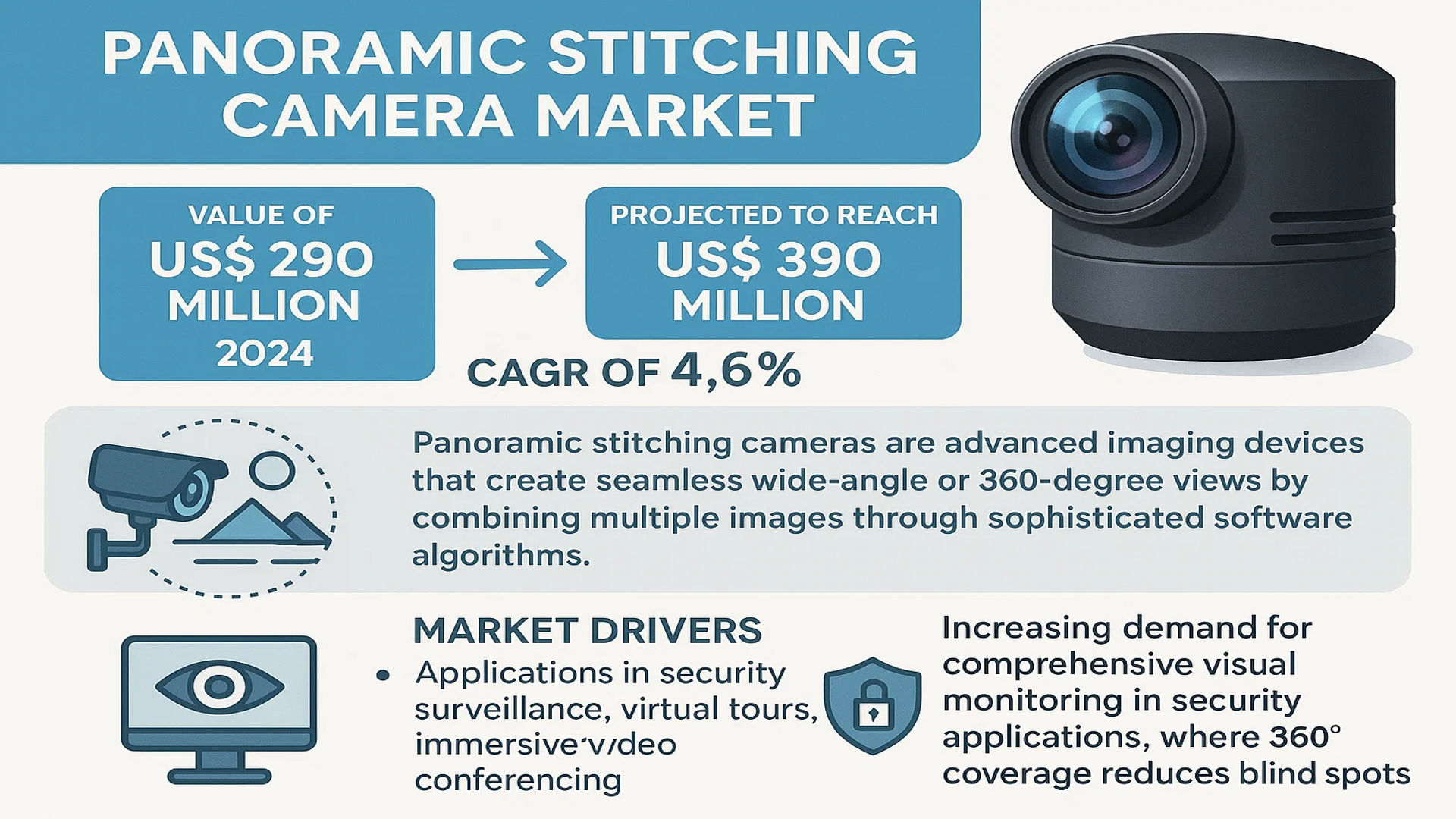
The global Panoramic Stitching Camera Market was valued at 290 million in 2024 and is projected to reach US$ 390 million by 2032, at a CAGR of 4.6% during the forecast period.
Panoramic stitching cameras are advanced imaging devices that create seamless wide-angle or 360-degree views by combining multiple images through sophisticated software algorithms. These systems utilize either multiple camera sensors or ultra-wide-angle lenses (such as fisheye lenses) with real-time image processing to correct distortions, align perspectives, and blend colors for coherent panoramic outputs. The technology finds applications across security surveillance, virtual tours, and immersive video conferencing.
Market growth is driven by increasing demand for comprehensive visual monitoring in security applications, where 360° coverage reduces blind spots. The rising adoption in commercial spaces for virtual reality applications and the education sector for immersive learning experiences further accelerates expansion. Key industry players including Hikvision, Axis Communications, and Zhejiang Dahua Technology are innovating with AI-powered stitching algorithms and 8K resolution capabilities to enhance market competitiveness. North America currently leads adoption due to high security expenditure, while Asia-Pacific shows the fastest growth trajectory with expanding smart city initiatives.
MARKET DYNAMICS
MARKET DRIVERS
Expanding Surveillance and Security Requirements Fueling Market Adoption
The panoramic stitching camera market is experiencing robust growth driven by heightened security needs across commercial and public sectors. Rising concerns over public safety have led to a 13% annual increase in security system installations worldwide. These cameras provide comprehensive 360° coverage with fewer blind spots compared to conventional systems, reducing hardware costs by up to 40% for large-area monitoring. Major transportation hubs in Europe and Asia are transitioning to panoramic solutions, with airports accounting for nearly 28% of professional installations in 2024.
Hybrid Work Models Accelerating Demand for Immersive Conferencing
Corporate adoption of panoramic cameras for video conferencing grew 62% year-over-year as organizations implement hybrid work policies. These devices enable realistic meeting experiences with dynamic participant tracking and 180° field-of-view, compared to traditional webcams’ 78° limitation. The education sector represents another growth vertical, with panoramic cameras being installed in 1 of every 3 new smart classrooms globally. This adoption is supported by a 15% reduction in AV equipment costs when replacing multiple fixed cameras with single panoramic units.
Retail Analytics Creating New Use Cases
Advanced stitching algorithms combined with AI-powered analytics are transforming retail operations. Over 45% of premium retail stores in North America now utilize panoramic cameras for customer traffic analysis, heat mapping, and loss prevention. The technology provides store managers with detailed behavioral insights while reducing surveillance infrastructure costs by approximately 30%. Recent improvements in low-light performance have expanded deployment to 24-hour operations, particularly in convenience stores and hospitality venues.
MARKET CHALLENGES
Latency and Bandwidth Constraints in Real-time Systems
While panoramic cameras offer superior coverage, their high-resolution output creates significant data transmission challenges. Stitched 8K panoramic streams require 4.2x more bandwidth than standard 4K surveillance feeds, creating network bottlenecks. Approximately 37% of early adopters report latency issues exceeding acceptable thresholds for security applications. The computational intensity of real-time stitching also leads to higher power consumption – a critical concern for mobile and battery-operated installations. These technical barriers have slowed adoption in price-sensitive emerging markets.
Other Challenges
Thermal Management Issues
Dense camera arrays in compact housings generate heat loads up to 28W, necessitating active cooling in 68% of professional-grade units. This increases manufacturing costs by 12-15% and reduces product lifespan in high-temperature environments. Thermal-related failures account for nearly 19% of warranty claims in tropical regions.
Interoperability Limitations
Proprietary stitching algorithms create vendor lock-in scenarios, with only 41% of systems supporting ONVIF standards. This fragmentation raises total cost of ownership by requiring specialized software and trained operators for each deployment.
MARKET RESTRAINTS
High Initial Costs Deter SMB Adoption
While panoramic cameras deliver long-term savings, their premium pricing remains prohibitive for smaller enterprises. The average commercial-grade unit costs 3.2x more than comparable fixed cameras, with professional installations requiring 55% higher labor costs. This pricing disparity limits market penetration among SMBs to just 12% of total deployments. Additionally, the specialized nature of panoramic systems necessitates trained technicians, creating service deserts in developing regions where technical expertise is scarce.
Regulatory Uncertainties in Surveillance Applications
Data privacy regulations are creating compliance challenges, particularly in Europe where GDPR requires explicit consent for facial recognition. Approximately 28% of planned panoramic deployments in retail have been delayed due to privacy concerns. Jurisdictional inconsistencies further complicate matters, with municipal bans on certain analytics functions in 14 major US cities. These restrictions force vendors to maintain region-specific product variants, increasing R&D overhead by an estimated 18%.
MARKET OPPORTUNITIES
Edge Computing Integration Opens New Possibilities
Localized processing through edge nodes can address bandwidth and latency concerns while adding analytical capabilities. Hybrid edge-cloud solutions are projected to capture 42% of the professional market by 2026. This architecture reduces cloud dependency and enables real-time decision making for security applications, with processing delays under 120ms. Early implementations in smart cities demonstrate 35% faster incident response times when combining panoramic views with localized object recognition.
Emerging Applications in Autonomous Systems
The robotics and autonomous vehicle sectors present a $290M greenfield opportunity for panoramic vision systems. Current prototypes demonstrate 22% improvement in environmental awareness compared to traditional multi-camera setups. Drone manufacturers are particularly interested, with stitching-enabled payloads reducing weight by 1.8kg while maintaining full spherical coverage. These applications benefit from recent advancements in miniaturization, with new industrial cameras achieving 12MP resolution in sub-50mm form factors.
AI-Enhanced Analytics Driving Premium Solutions
Integration with neural networks enables intelligent scene interpretation beyond basic stitching. Cutting-edge systems now offer occupancy counting with 98% accuracy and behavioral prediction algorithms for retail environments. The analytics software segment is growing at 27% CAGR as enterprises seek deeper operational insights. Recent trials in manufacturing demonstrated 19% productivity gains when combining panoramic monitoring with AI-driven process optimization.
PANORAMIC STITCHING CAMERA MARKET TRENDS
AI-Powered Image Processing Elevates Panoramic Stitching Capabilities
The integration of artificial intelligence (AI) into panoramic stitching cameras has revolutionized imaging accuracy and real-time processing capabilities. Advanced algorithms now enable seamless blending of multiple high-resolution images with minimal distortion, addressing long-standing challenges in color consistency and parallax errors. Recent developments have seen processing speeds improve by approximately 40% compared to traditional methods, while error rates in image alignment have decreased to below 0.5% in premium models. This technological leap is particularly impactful in security applications, where real-time 360° monitoring demands both precision and reliability.
Other Trends
Growing Adoption in Smart City Infrastructure
Urban development initiatives worldwide are driving demand for panoramic stitching cameras in traffic management and public safety systems. The technology’s ability to provide uninterrupted wide-area surveillance with fewer cameras reduces infrastructure costs while improving monitoring efficiency. In transportation hubs, these cameras now account for nearly 35% of newly installed surveillance systems, as they eliminate blind spots common in conventional multi-camera setups. The education sector has also seen rapid adoption, with panoramic cameras being deployed in 25% more lecture halls and campuses globally compared to 2022 levels.
Shift Toward Higher Resolution Formats
Market demand is shifting decisively toward 8K and higher resolution panoramic cameras, particularly in commercial applications where detail capture is critical. While 180° panoramic models currently hold 52% market share, 360° variants are growing at 7.2% annually as VR and immersive media applications expand. Manufacturers are responding with dual-lens systems capable of 12K output, though thermal management and processing power requirements remain technical challenges. In the retail sector, these high-resolution systems have demonstrated 18% improvement in customer behavior analytics accuracy compared to standard HD cameras.
COMPETITIVE LANDSCAPE
Key Industry Players
Technological Innovation and Strategic Partnerships Drive Market Competition
The global panoramic stitching camera market features a moderately fragmented competitive landscape, with established security technology providers dominating revenue share while agile innovators gain traction through specialized solutions. Hikvision and Zhejiang Dahua Technology collectively account for nearly 30% of the global market, leveraging their extensive distribution networks in the security sector where panoramic cameras are increasingly replacing traditional CCTV systems.
While Asian manufacturers lead in production volumes, European players like Axis Communications differentiate through superior image processing algorithms. The company’s latest ARTPEC-8 chipset enables real-time 360° stitching with reduced latency – a critical advantage for transportation surveillance applications. Meanwhile, Hanwha Vision has made significant strides in the retail analytics segment through AI-powered panoramic cameras that track customer behavior patterns.
Mid-tier competitors are adopting varied strategies to carve out market share. TP-LINK has successfully expanded from networking equipment into affordable consumer-grade 180° cameras, while Milesight focuses on ruggedized industrial solutions for challenging environments. The market has also seen increased M&A activity, with security conglomerates acquiring niche software specialists to enhance their stitching capabilities. For example, recent acquisitions in the computer vision space suggest growing integration between panoramic imaging and advanced analytics.
Emerging vendors face distinct challenges in scaling operations and meeting diverse regional certification requirements. However, companies demonstrating innovation in edge computing and low-light performance – such as VIP Vision with its specialized astrophotography cameras – continue to attract investor interest. The competitive intensity is expected to increase as 360° conferencing solutions gain enterprise adoption, creating new opportunities forsoftware-centric players.
List of Key Panoramic Stitching Camera Companies Profiled
- Hikvision (China)
- Zhejiang Dahua Technology (China)
- Axis Communications (Sweden)
- Hanwha Vision (South Korea)
- TP-LINK (China)
- Milesight (China)
- VIP Vision (China)
- GRUNDIG SECURITY (Germany)
- Sunell (China)
Segment Analysis:
By Type
360° Panoramic View Segment Leads Due to Its Superior Coverage and Immersive Experience
The market is segmented based on type into:
- 180° Panoramic View
- Used for wide-angle surveillance with single-lens capture
- 360° Panoramic View
- Offers complete spherical coverage with multi-lens stitching
- Others
- Includes specialized panoramic cameras with custom FOV configurations
By Application
Security Industry Drives Adoption Through Enhanced Surveillance Capabilities
The market is segmented based on application into:
- Security Industry
- Critical for perimeter monitoring and public safety applications
- Video Conferencing
- Enables immersive meeting experiences in corporate environments
- Transportation Industry
- Used in traffic monitoring and vehicle surveillance systems
- Retail Industry
- Supports customer behavior analysis and loss prevention
- Education Industry
- Facilitates remote learning and lecture capture solutions
- Others
- Includes specialized applications in healthcare, manufacturing, etc.
By Technology
Multi-Camera Stitching Technology Dominates for Higher Precision and Resolution
The market is segmented based on technology into:
- Multi-Camera Stitching
- Uses multiple sensors for higher resolution panoramic images
- Single Wide-Angle Lens
- Relies on fisheye lenses for simplified panoramic capture
- Others
- Includes hybrid and emerging panoramic technologies
By End User
Commercial Sector Represents Major Adoption Due to Broad Application Scope
The market is segmented based on end user into:
- Commercial
- Includes office buildings, retail stores, and hospitality venues
- Industrial
- Used in manufacturing plants and warehouse facilities
- Residential
- Growing adoption in smart home security systems
- Government & Public Sector
- Critical for city surveillance and transportation hubs
- Others
- Includes specialized institutional applications
Regional Analysis: Panoramic Stitching Camera Market
Asia-Pacific
The Asia-Pacific region dominates the global panoramic stitching camera market, driven by rapid urbanization, significant investments in smart city projects, and increased adoption of advanced surveillance systems. China leads the regional market due to its expansive manufacturing capabilities and government-led initiatives promoting smart security infrastructure. The country is a major hub for key players like Hikvision and Zhejiang Dahua Technology, which are driving innovation in 180° and 360° panoramic cameras. Meanwhile, India is witnessing steady growth due to rising demand in the retail and transportation sectors, along with increasing security concerns. Southeast Asian nations such as Singapore and Malaysia are also contributing to market expansion through their focus on modernizing public spaces and corporate environments with panoramic imaging solutions. Despite cost sensitivity among some buyers, the region benefits from local manufacturers offering competitively priced products without compromising on technological advancements.
North America
North America holds a substantial share of the panoramic stitching camera market, propelled by the U.S.’s well-established security industry and high consumer demand for advanced video conferencing solutions. The presence of leading technology firms and strong R&D investment fosters continuous improvements in stitching algorithms and image processing. Commercial sectors, particularly retail and education, are increasingly adopting 360° panoramic cameras for enhanced monitoring and virtual collaboration. Additionally, Canada’s emphasis on public safety and infrastructure modernization presents significant opportunities for market growth. The region’s stringent data privacy regulations further drive demand for secure and reliable panoramic surveillance systems, with companies investing in encrypted data transmission and cloud-based storage solutions.
Europe
Europe’s market is characterized by strict compliance requirements and a growing focus on AI-integrated surveillance solutions. Germany and the U.K. are key contributors, leveraging their strong industrial bases to develop high-performance panoramic cameras with real-time analytics capabilities. The implementation of GDPR has pushed manufacturers to prioritize data security, boosting demand for compliant systems in public spaces and corporate offices. Furthermore, the region’s emphasis on smart transportation infrastructure has accelerated the adoption of panoramic stitching cameras in railways and urban transit hubs. European manufacturers like Axis Communications and Hanwha Vision are leading innovations in thermal imaging and low-light performance, catering to diverse security applications.
South America
South America shows modest but steady growth, driven by expanding retail chains and government projects aimed at improving urban security. Brazil remains the largest market, where financial institutions and shopping malls deploy panoramic cameras for theft prevention. However, economic instability and limited technological adaptation in smaller enterprises slow down widespread adoption. Despite these challenges, the region offers potential as awareness about modern surveillance solutions increases, supported by gradual investments in infrastructure and public safety initiatives.
Middle East & Africa
The Middle East is witnessing notable growth due to large-scale smart city projects in the UAE and Saudi Arabia, where panoramic cameras are integral to traffic management and event surveillance. Africa’s market, though still emerging, is driven by increasing security concerns in urban centers and the gradual expansion of retail and logistics networks. Limited local manufacturing capabilities lead to reliance on imports, but the region holds long-term potential as infrastructure development accelerates.
Report Scope
This market research report provides a comprehensive analysis of the Global Panoramic Stitching Camera Market, covering the forecast period 2024–2032. It offers detailed insights into market dynamics, technological advancements, competitive landscape, and key trends shaping the industry.
Key focus areas of the report include:
- Market Size & Forecast: Historical data and future projections for revenue, unit shipments, and market value across major regions and segments. The global market was valued at USD 290 million in 2024 and is projected to reach USD 390 million by 2032, growing at a CAGR of 4.6%.
- Segmentation Analysis: Detailed breakdown by product type (180° Panoramic View, 360° Panoramic View, Others), application (Security, Video Conferencing, Transportation, Retail, Education, Others), and end-user industry to identify high-growth segments.
- Regional Outlook: Insights into market performance across North America, Europe, Asia-Pacific, Latin America, and Middle East & Africa. The U.S. and China are key markets with significant growth potential.
- Competitive Landscape: Profiles of leading market participants including TP-LINK, Milesight, Axis, Hanwha Vision, Hikvision, and Zhejiang Dahua Technology, covering their product portfolios, market share, and strategic initiatives.
- Technology Trends & Innovation: Assessment of emerging technologies like AI-powered image stitching, real-time processing, and integration with IoT ecosystems.
- Market Drivers & Restraints: Analysis of factors such as increasing security concerns, demand for immersive video experiences, and challenges related to high implementation costs.
- Stakeholder Analysis: Strategic insights for camera manufacturers, software developers, system integrators, and investors regarding market opportunities and competitive positioning.
The report employs both primary and secondary research methodologies, including interviews with industry experts and analysis of verified market data, to ensure accuracy and reliability.
FREQUENTLY ASKED QUESTIONS:
What is the current market size of Global Panoramic Stitching Camera Market?
-> Panoramic Stitching Camera Market was valued at 290 million in 2024 and is projected to reach US$ 390 million by 2032, at a CAGR of 4.6% during the forecast period.
Which key companies operate in Global Panoramic Stitching Camera Market?
-> Key players include TP-LINK, Milesight, Axis, Hanwha Vision, Hikvision, Zhejiang Dahua Technology, and Sunell, among others.
What are the key growth drivers?
-> Key growth drivers include increasing security requirements, demand for immersive video conferencing solutions, and smart city initiatives.
Which region dominates the market?
-> Asia-Pacific is the fastest-growing market, driven by technological adoption in China and India, while North America leads in technological innovation.
What are the emerging trends?
-> Emerging trends include AI-powered real-time stitching, integration with 5G networks, and multi-sensor fusion technologies.

Get Sample Report PDF for Exclusive Insights
Report Sample Includes
- Table of Contents
- List of Tables & Figures
- Charts, Research Methodology, and more...
 Download Sample Report PDF





