MARKET INSIGHTS
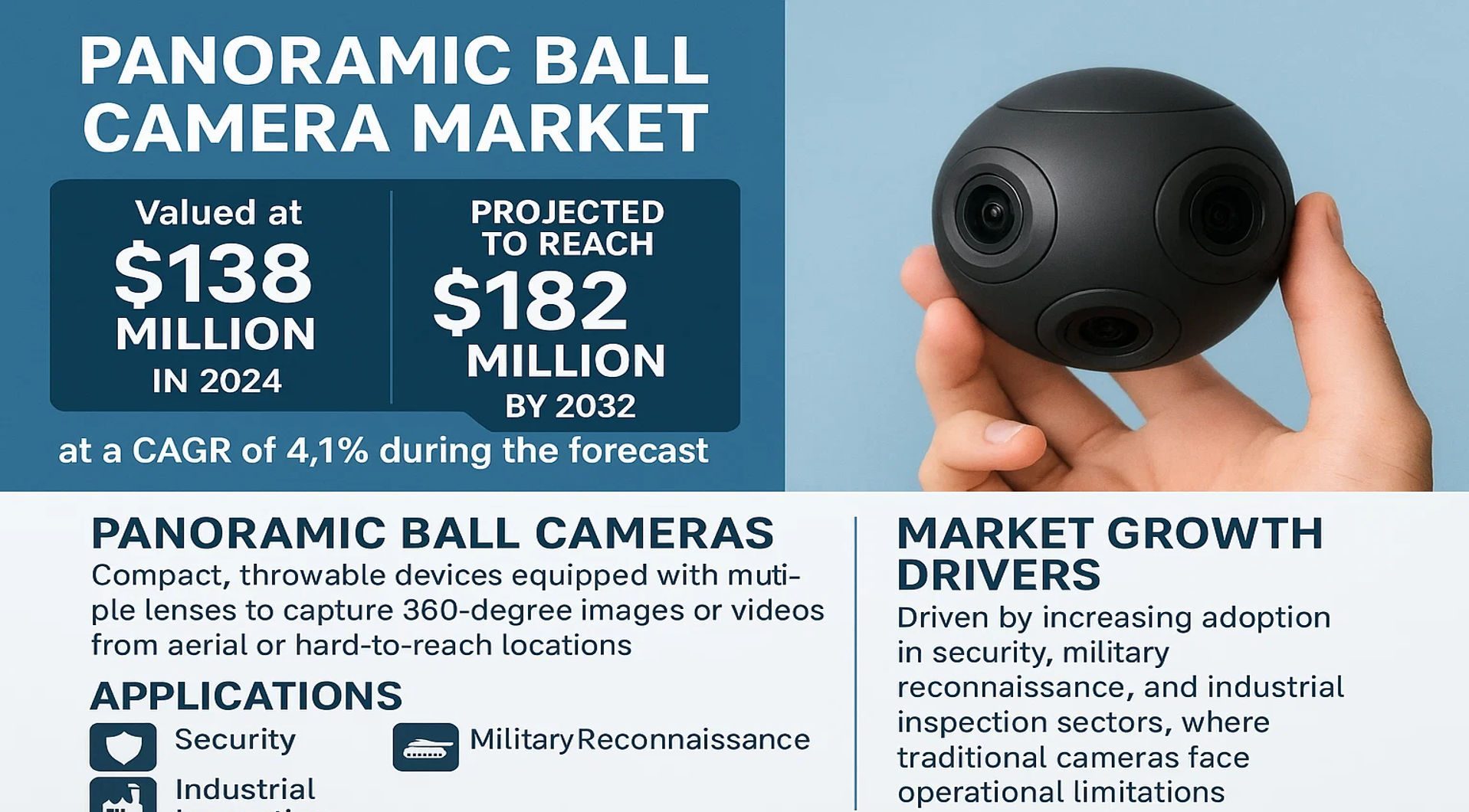
The global Panoramic Ball Camera Market was valued at 138 million in 2024 and is projected to reach US$ 182 million by 2032, at a CAGR of 4.1% during the forecast period.
Panoramic ball cameras are compact, throwable devices equipped with multiple lenses to capture 360-degree images or videos from aerial or hard-to-reach locations. These specialized cameras are designed for applications requiring quick deployment in challenging environments, utilizing advanced stabilization and stitching algorithms to produce seamless panoramic outputs.
Market growth is driven by increasing adoption in security, military reconnaissance, and industrial inspection sectors, where traditional cameras face operational limitations. The U.S. currently dominates the market, while China exhibits strong growth potential. Key players like Axis Communications, Hikvision, and Sony are expanding their product portfolios with AI-powered analytics and ruggedized designs, further propelling market expansion through technological innovation.
MARKET DYNAMICS
MARKET DRIVERS
Growing Demand for Advanced Surveillance Solutions to Drive Market Expansion
The global panoramic ball camera market is witnessing steady growth, projected to reach $182 million by 2032, driven by increasing demand for advanced surveillance solutions. These cameras provide 360-degree coverage, making them ideal for security applications in high-risk areas where traditional cameras fall short. The ability to deploy these cameras in dangerous or inaccessible locations without human intervention significantly reduces operational risks while improving situational awareness. Military and industrial sectors account for over 45% of current adoption rates, with commercial applications rapidly catching up as retailers and smart city projects recognize their value for comprehensive monitoring.
Technological Innovations in Image Processing Enhance Market Potential
Recent advancements in AI-powered image stitching and stabilization algorithms have dramatically improved panoramic ball camera performance. Modern units now feature 8K resolution capabilities with distortion correction, enabling clearer images even when the camera is in motion. The integration of IoT connectivity allows real-time data transmission to command centers, making these devices invaluable for emergency response teams. Manufacturers like Axis Communications and Hikvision have introduced models with enhanced low-light performance, pushing the boundaries of nighttime surveillance effectiveness.
Market growth is further accelerated by the cameras’ dual-use potential in both security and recreational applications. Adventure photographers and documentary filmmakers increasingly adopt these devices for unique aerial perspectives, creating an unusual convergence of professional and consumer markets.
➤ The U.S. remains the largest market, while China shows the fastest growth trajectory, with demand driven by extensive smart city projects and industrial automation initiatives.
MARKET CHALLENGES
Durability Concerns in Extreme Environments Pose Adoption Barriers
While panoramic ball cameras offer unique advantages, their market penetration faces significant hurdles related to durability and reliability. These devices must withstand high-impact landings, extreme temperatures, and harsh weather conditions – factors that currently lead to a 22% higher failure rate compared to fixed surveillance systems. The internal gyroscopic stabilization mechanisms that enable smooth image capture remain particularly vulnerable to shock damage, requiring frequent recalibration or replacement in heavy-use scenarios.
Other Challenges
Limited Battery Performance
The compact form factor restricts battery capacity, with most commercial models offering less than 90 minutes of continuous operation. This limitation significantly reduces effectiveness for prolonged surveillance missions, requiring either frequent retrieval or complex charging solutions that negate the cameras’ throw-and-forget advantage.
Data Transmission Vulnerabilities
Wireless transmission of high-resolution panoramic feeds creates cybersecurity concerns, particularly for military and industrial applications. Encryption standards vary widely across manufacturers, with some budget models offering inadequate protection against interception or jamming attacks.
MARKET RESTRAINTS
High Production Costs Limit Mass Market Adoption
The specialized optics and precision engineering required for panoramic ball cameras maintain premium pricing that restricts broader adoption. Current manufacturing yields hover around 72% for commercial-grade units due to stringent quality requirements for image alignment components. Industrial models command prices nearly 300% higher than equivalent fixed cameras, creating significant budget pressures for security departments weighing cost versus coverage benefits.
Furthermore, market growth faces regulatory constraints in several regions where aerial surveillance capabilities trigger privacy concerns. Some jurisdictions require special permits for deployable cameras that capture imagery beyond property boundaries, adding administrative burdens that slow procurement cycles.
MARKET OPPORTUNITIES
Integration with Autonomous Systems Opens New Application Frontiers
The emerging synergy between panoramic ball cameras and unmanned systems presents transformative opportunities across multiple sectors. Drone manufacturers increasingly incorporate these cameras as modular payloads, creating versatile aerial inspection solutions. This integration potential extends to underwater ROVs for marine exploration and tethered aerostats for persistent perimeter monitoring, potentially expanding the addressable market by 35% within five years.
Advancements in edge computing enable onboard image processing that reduces bandwidth requirements while improving response times. Early implementations in industrial settings demonstrate how real-time anomaly detection algorithms can trigger immediate safety protocols when hazards appear in the panoramic view, potentially preventing costly shutdowns or accidents.
Military modernization programs worldwide prioritize deployable sensor technologies, with several NATO members including panoramic ball cameras in soldier modernization kits. These developments, combined with the booming commercial drone market, position the technology for accelerated adoption curves despite current challenges.
PANORAMIC BALL CAMERA MARKET TRENDS
Integration of AI and Enhanced Durability Drives Market Expansion
The global panoramic ball camera market has witnessed significant growth, fueled by advancements in artificial intelligence (AI) and ruggedized design improvements. Manufacturers are increasingly incorporating AI-enabled features such as real-time object recognition, auto-focus optimization, and automated stitching for seamless panoramic imaging. The surge in demand for high-resolution 360° captures in industries such as security, military, and commercial sectors has pushed companies to innovate with durable materials capable of withstanding harsh environments. For instance, latest models now feature shock-resistant outer shells and are IP67-rated, ensuring reliability in extreme conditions. AI-driven enhancements are also reducing post-processing time, making these cameras indispensable for rapid situational assessments.
Other Trends
Rising Applications in Security and Surveillance
Panoramic ball cameras are gaining traction in security and surveillance due to their ability to capture omnidirectional visuals without blind spots. Law enforcement agencies and private security firms are deploying these cameras in urban surveillance, disaster management, and high-risk operations. The military segment, in particular, has seen an uptick in adoption for reconnaissance missions, where compact, throwable cameras provide real-time intelligence. With the global security industry increasingly prioritizing situational awareness, manufacturers are integrating night vision and thermal imaging capabilities to enhance performance in low-light environments.
Expanding Demand in Commercial and Industrial Sectors
Beyond security, industries are adopting panoramic ball cameras for asset monitoring, inspection of hard-to-reach areas, and immersive marketing content creation. The commercial segment, including real estate and tourism, utilizes these cameras for virtual tours and interactive advertisements. In industrial settings, their ability to capture high-resolution images of pipelines, storage tanks, and other confined spaces reduces manual inspection risks. Furthermore, the integration of cloud-based analytics allows businesses to process captured data efficiently, driving productivity gains. As industries digitalize operations, panoramic ball cameras are becoming a critical tool for remote monitoring and documentation.
COMPETITIVE LANDSCAPE
Key Industry Players
Technological Innovation and Strategic Expansion Define Market Leadership
The global panoramic ball camera market exhibits a competitive yet fragmented landscape, with a mix of established technology giants and specialized innovators driving advancements. Axis Communications, a leader in network camera solutions, dominates the market through its robust R&D investments and strategic partnerships in sectors such as security, industrial monitoring, and commercial imaging. Their recent launch of ruggedized models has further strengthened their market position.
Canon and Nikon, historically known for their imaging expertise, have successfully diversified into panoramic ball cameras by leveraging their optical engineering capabilities. These companies hold significant shares, particularly in North America and Asia-Pacific, where demand for high-resolution, durable devices is rising. Meanwhile, Hikvision and Honeywell are capitalizing on industrial and military applications, offering specialized cameras tailored for extreme environments.
Emerging players like Bounce Imaging and Serveball are disrupting the market with cost-effective, lightweight designs optimized for tactical and consumer use. Their agility in adopting AI-powered stitching technology has allowed them to compete with larger incumbents. The market also sees growing contributions from Peloton Row and Jonas Pfeil, whose niche innovations in 360° capture for sports and adventure applications are gaining traction.
List of Key Panoramic Ball Camera Companies Profiled
- Axis Communications (Sweden)
- Bounce Imaging (U.S.)
- Canon (Japan)
- Hikvision (China)
- Honeywell (U.S.)
- Jonas Pfeil (Germany)
- Nikon (Japan)
- Panone (South Korea)
- Peloton Row (U.S.)
- Serveball (U.K.)
- Sony (Japan)
Segment Analysis:
By Type
Industrial Camera Segment Dominates the Market Due to Its Rugged Design and High-Durability Applications
The market is segmented based on type into:
- Industrial Camera
- Subtypes: Explosion-proof, High-resolution, and others
- Commercial Camera
By Application
Military Segment Leads Due to Increased Surveillance and Reconnaissance Needs
The market is segmented based on application into:
- Commercial
- Military
- Industry
- Other
By End User
Government & Defense Sector Remains Key Adopter for Security and Tactical Operations
The market is segmented based on end user into:
- Government & Defense
- Industrial Enterprises
- Media & Entertainment
- Construction
Regional Analysis: Panoramic Ball Camera Market
Asia-Pacific
The Asia-Pacific region dominates the global panoramic ball camera market, accounting for the largest revenue share due to technological advancements and rapid adoption across industries. China leads this growth, driven by strong government support for smart city initiatives and substantial investments in surveillance infrastructure. Countries like India and Japan are witnessing increasing demand for these cameras in both commercial and military applications. The availability of cost-effective manufacturing and the presence of key players like Hikvision and Sony further strengthen the region’s market position. However, varying regulatory standards and data privacy concerns pose challenges to seamless expansion.
North America
North America is a key player in the panoramic ball camera market, with the United States contributing significantly due to high defense and industrial spending. These cameras are widely used in law enforcement, disaster management, and industrial inspections owing to their durability and 360-degree imaging capabilities. The region benefits from advanced R&D facilities and early adoption of innovative technologies, with companies like Honeywell and Bounce Imaging driving product advancements. Nonetheless, high production costs and strict data compliance regulations, such as GDPR and CCPA, may slightly hinder market penetration in certain sectors.
Europe
Europe exhibits steady growth in the panoramic ball camera market, thanks to stringent security regulations and increasing demand for advanced surveillance solutions. Countries like Germany, the UK, and France prioritize public safety and infrastructure monitoring, leading to higher adoption of these cameras. The presence of manufacturers like Axis Communications and Canon supports market expansion, particularly in commercial and industrial applications. However, slower economic growth in some regions and high competition from local players limit rapid market scaling. Sustainability and energy efficiency are also emerging as crucial factors influencing buyer preferences.
Middle East & Africa
The Middle East & Africa region is witnessing gradual but promising growth in the panoramic ball camera market, primarily fueled by increasing urbanization and infrastructure development. Countries such as UAE and Saudi Arabia invest heavily in smart city projects and security enhancements, creating demand for high-performance surveillance solutions. The military sector also drives adoption for reconnaissance and tactical operations. However, limited technological infrastructure and economic disparities across the region slow down widespread deployment. Long-term growth potential remains high, particularly with rising foreign investments in key industries.
South America
South America represents a developing market for panoramic ball cameras, with Brazil and Argentina showing moderate adoption in security and industrial applications. While economic instability and lower technological penetration restrict faster growth, increasing concerns over public safety and gradual infrastructure improvements present opportunities for expansion. Local manufacturers face competition from global brands, but cost-sensitive markets prefer mid-range solutions. The region’s untapped potential is expected to attract more investments, especially in urban surveillance and industrial automation.
Report Scope
This market research report provides a comprehensive analysis of the global Panoramic Ball Camera market, covering the forecast period 2024–2032. It offers detailed insights into market dynamics, technological advancements, competitive landscape, and key trends shaping the industry.
Key focus areas of the report include:
- Market Size & Forecast: Historical data and future projections for revenue, unit shipments, and market value across major regions and segments. The global market was valued at USD 138 million in 2024 and is projected to reach USD 182 million by 2032, growing at a CAGR of 4.1%.
- Segmentation Analysis: Detailed breakdown by product type (Industrial Camera, Commercial Camera) and application (Commercial, Military, Industry, Others) to identify high-growth segments.
- Regional Outlook: Insights into market performance across North America, Europe, Asia-Pacific, Latin America, and Middle East & Africa, with country-level analysis for key markets including U.S., China, Germany, and Japan.
- Competitive Landscape: Profiles of leading manufacturers including Axis Communications, Canon, Hikvision, Nikon, and Sony, covering their market share, product portfolios, and strategic developments.
- Technology Trends & Innovation: Analysis of advancements in 360° imaging, AI integration, ruggedized designs, and wireless connectivity in panoramic ball cameras.
- Market Drivers & Restraints: Evaluation of factors such as increasing security needs, industrial automation, and technical limitations affecting market growth.
- Stakeholder Analysis: Strategic insights for manufacturers, system integrators, end-users, and investors regarding market opportunities and challenges.
The research methodology combines primary interviews with industry experts and secondary data from verified sources to ensure accuracy and reliability.
FREQUENTLY ASKED QUESTIONS:
What is the current market size of Global Panoramic Ball Camera Market?
->Panoramic Ball Camera Market was valued at 138 million in 2024 and is projected to reach US$ 182 million by 2032, at a CAGR of 4.1% during the forecast period.
Which key companies operate in Global Panoramic Ball Camera Market?
-> Key players include Axis Communications, Bounce Imaging, Canon, Hikvision, Honeywell, Nikon, Sony, and other prominent manufacturers.
What are the key growth drivers?
-> Growth is driven by increasing security needs, industrial automation applications, and demand for innovative imaging solutions in inaccessible locations.
Which region dominates the market?
-> North America currently leads in market share, while Asia-Pacific is expected to show the highest growth rate during the forecast period.
What are the emerging trends?
-> Emerging trends include AI-powered image processing, enhanced durability features, and integration with IoT systems for advanced surveillance applications.

Get Sample Report PDF for Exclusive Insights
Report Sample Includes
- Table of Contents
- List of Tables & Figures
- Charts, Research Methodology, and more...
 Download Sample Report PDF