MARKET INSIGHTS
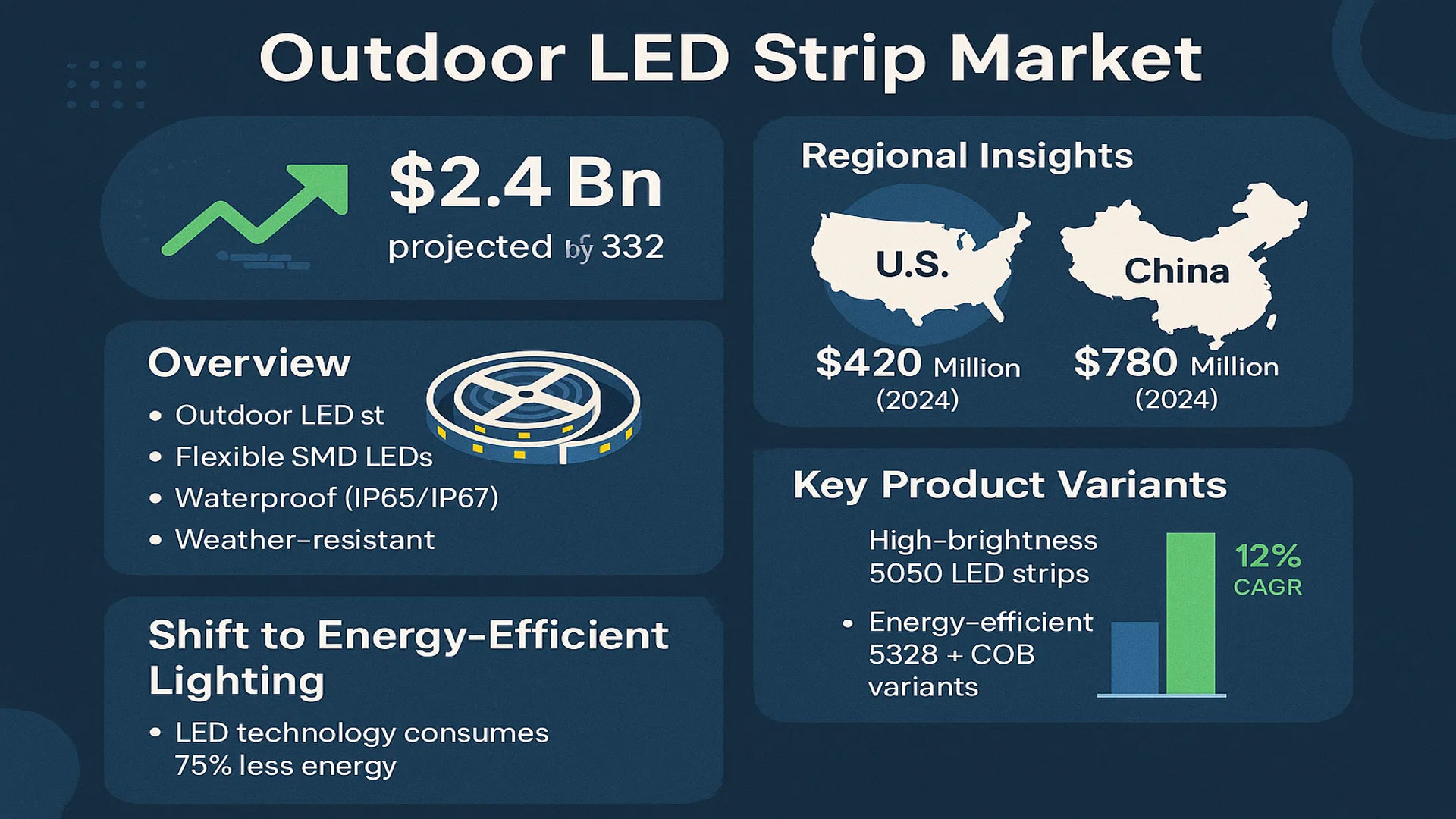
The global Outdoor LED Strip Market size was valued at US$ 2.4 billion in 2024 and is projected to reach US$ 4.6 billion by 2032, at a CAGR of 8.6% during the forecast period 2025-2032. While the U.S. market is estimated at USD 420 million in 2024, China is expected to reach USD 780 million, driven by rapid urbanization and infrastructural development.
Outdoor LED strips are flexible circuit boards populated with surface-mounted light-emitting diodes (SMD LEDs), designed for durability in external environments. These strips offer waterproofing (IP65/IP67 ratings) and weather-resistant features, making them ideal for architectural lighting, signage, and landscape illumination. Key product variants include the high-brightness 5050 LED strips (projected to grow at 12% CAGR) and energy-efficient 3528 strips, along with specialized COB (Chip-on-Board) variants.
Market growth is propelled by the global shift toward energy-efficient lighting solutions, with LED technology consuming 75% less energy than traditional lighting. Government initiatives promoting smart city projects—particularly in Asia-Pacific—are accelerating adoption. However, price volatility of raw materials like gallium nitride poses challenges. Leading manufacturers like Osram and Philips are investing in R&D for advanced thermal management systems, while regional players like Opple and NVC Lighting are expanding distribution networks to capitalize on emerging market demand.
OUTDOOR LED STRIP MARKET DYNAMICS
MARKET DRIVERS
Rising Demand for Energy-Efficient Lighting Solutions to Accelerate Market Growth
The global shift toward energy-efficient lighting solutions is a key driver for the outdoor LED strip market. With increasing awareness of environmental sustainability and stringent government regulations on energy consumption, businesses and homeowners are rapidly adopting LED technology. Outdoor LED strips consume up to 80% less energy than traditional lighting while offering superior brightness and longevity. Their flexibility in design applications, from architectural lighting to landscape illumination, makes them highly versatile. Governments worldwide are incentivizing LED adoption through subsidies and rebate programs, further fueling demand in commercial and residential sectors.
Expanding Smart City Initiatives to Boost Commercial Adoption
Smart city projects across emerging economies are creating substantial opportunities for outdoor LED strips. These projects prioritize intelligent lighting systems that integrate with IoT platforms for energy management and automation. Outdoor LED strips are being widely deployed for street lighting, public space illumination, and architectural highlights due to their durability and low maintenance requirements. Countries like China and India are investing heavily in urban infrastructure modernization, where LED technology plays a pivotal role. The market is expected to benefit from increasing urbanization, with over 60% of the global population projected to live in cities by 2030.
The growing popularity of outdoor entertainment and hospitality venues also contributes to market expansion. Restaurants, hotels, and event spaces use LED strips to create dynamic ambiances, driving aesthetic and functional demand.
MARKET RESTRAINTS
High Initial Costs and Pricing Pressure to Impede Market Penetration
Despite their long-term cost benefits, the higher upfront investment required for quality outdoor LED strips remains a barrier for price-sensitive consumers. Premium products with weather-resistant features and advanced controls can cost significantly more than conventional lighting options. This pricing disparity discourages adoption in developing regions where budget constraints are acute. Additionally, intense competition among manufacturers has led to margin compression, particularly in the mid-range segment, forcing companies to balance quality with affordability.
Other Restraints
Technical Limitations in Harsh Environments
While LED strips are durable, prolonged exposure to extreme weather conditions can degrade performance over time. Moisture ingress and UV radiation remain persistent challenges despite IP-rated products entering the market.
Supply Chain Disruptions
Fluctuations in raw material prices, particularly semiconductors and rare earth metals, impact production stability. Geopolitical tensions and trade restrictions further complicate procurement strategies for manufacturers.
MARKET OPPORTUNITIES
Technological Advancements in IoT Integration to Unlock New Applications
The convergence of LED technology with IoT and smart control systems presents transformative opportunities for the outdoor LED strip market. Wireless dimming, color tuning, and motion-sensitive lighting systems are gaining traction in security and architectural applications. Manufacturers are developing strips with embedded sensors that adjust brightness based on ambient conditions, enhancing energy savings. The global smart lighting market is projected to grow exponentially, with outdoor applications representing a high-growth segment.
Partnerships between lighting companies and tech firms are accelerating innovation. For instance, recent collaborations have yielded solar-powered LED strips with battery backups, ideal for off-grid installations in parks and pathways.
MARKET CHALLENGES
Intense Competition and Commoditization Risks to Challenge Profitability
The outdoor LED strip market faces saturation in basic product categories, leading to pricing wars that squeeze manufacturer margins. Differentiating products through technological innovation while maintaining cost competitiveness remains an ongoing struggle. The influx of low-cost alternatives from emerging markets exacerbates this challenge, sometimes at the expense of quality and safety standards.
Regulatory Compliance
Divergent certification requirements across regions increase compliance costs. Products must meet varying standards for electrical safety, environmental impact, and radio frequency emissions in different jurisdictions.
Consumer Education Gaps
Misconceptions about product lifespan and performance under outdoor conditions persist. Educating buyers on proper installation techniques and maintenance remains critical to ensuring customer satisfaction and brand reputation.
OUTDOOR LED STRIP MARKET TRENDS
Smart Lighting Integration Driving Demand for Outdoor LED Strips
The integration of smart lighting technologies is rapidly transforming the outdoor LED strip market, with demand surging due to advancements in IoT-enabled solutions. Modern outdoor LED strips now feature Wi-Fi or Bluetooth connectivity, allowing users to control brightness, color temperature, and dynamic lighting effects via smartphone apps. The smart lighting sector is projected to grow at a compound annual growth rate (CAGR) of over 20% in the coming years, fueled by increasing consumer preference for energy-efficient and customizable lighting. Additionally, the compatibility of outdoor LED strips with voice assistants like Amazon Alexa and Google Home is further accelerating adoption in both residential and commercial settings.
Other Trends
Sustainability and Energy Efficiency
Environmental concerns and rising energy costs are pushing consumers toward LED-based solutions, which consume up to 80% less energy than traditional incandescent lighting. Governments worldwide are also implementing stricter regulations on lighting efficiency, with many phasing out halogen and fluorescent products in favor of LEDs. This shift is particularly evident in outdoor applications, where long operational hours and harsh weather conditions demand durable, low-maintenance lighting solutions. Manufacturers are capitalizing on this trend by incorporating recyclable materials and reducing the carbon footprint of production processes.
Growing Adoption in Architectural and Landscape Lighting
The architectural sector is emerging as a key growth area for outdoor LED strips, with designers increasingly using them for facade illumination, pathway lighting, and decorative applications. The flexibility and low-profile design of modern LED strips allow for seamless integration into building structures without compromising aesthetics. In commercial real estate, property developers are leveraging these products to enhance curb appeal and夜间visibility. Meanwhile, in residential settings, homeowners are adopting LED strip lighting for garden beds, patios, and outdoor entertainment areas, driven by the availability of waterproof and weather-resistant variants that withstand extreme temperatures and moisture exposure.
COMPETITIVE LANDSCAPE
Key Industry Players
Innovation and Expansion Drive Market Leadership in the Outdoor LED Strip Segment
The global Outdoor LED Strip market exhibits a dynamic and competitive landscape, characterized by the presence of both established multinational corporations and emerging regional players. Osram and Philips continue to dominate the market, leveraging their brand recognition, extensive distribution networks, and technological expertise. Both companies reported strong revenue contributions from their lighting solutions segments in 2023, with outdoor LED strips playing a key role in commercial and architectural lighting applications.
LEDVANCE and Forge Europa have demonstrated significant market traction, particularly in Europe and North America, by focusing on energy-efficient and weather-resistant lighting solutions. Their emphasis on high IP-rated (Ingress Protection) products for harsh outdoor conditions has allowed them to capture a growing segment of the infrastructure and landscape lighting markets.
Meanwhile, Asian manufacturers like NVC Lighting and Opple are rapidly gaining market share through competitive pricing strategies and localized production capabilities. These companies have been particularly successful in price-sensitive emerging markets, though they’re now making inroads into developed markets with improved product quality and reliability.
Technological innovation remains a critical differentiator in this space, with companies investing heavily in R&D to develop advanced features such as:
- Higher lumen output per watt
- Improved color rendering index (CRI) for better light quality
- Smart connectivity and IoT integration
- Enhanced durability for extreme weather conditions
List of Key Outdoor LED Strip Companies Profiled
- Osram (Germany)
- Philips (Netherlands)
- LEDVANCE (Germany)
- Forge Europa (UK)
- Ledridge Lighting (UK)
- Digital Advanced Lighting (U.S.)
- Lighting Ever (China)
- LEDMY (China)
- OML Technology (Taiwan)
- Jiasheng Lighting (China)
- Sidon Lighting (China)
- Optek Electronics (U.S.)
- NVC Lighting (China)
- Opple (China)
- Jesco Lighting (U.S.)
- Ledtronics (U.S.)
- PAK (Taiwan)
- FSL (China)
Segment Analysis:
By Type
5050 LED Strips Lead the Market Due to High Brightness and Durability for Outdoor Applications
The market is segmented based on type into:
- 5050
- Subtypes: RGB, RGBW, single-color
- 3528
- Subtypes: Standard density, high density
- Others
- Subtypes: Flexible COB, addressable strips
By Application
Commercial Use Dominates With Growing Demand for Architectural and Landscape Lighting
The market is segmented based on application into:
- Home Use
- Subtypes: Outdoor décor, patios, gardens
- Commercial Use
- Subtypes: Facade lighting, signage, hospitality venues
By Weather Resistance
Waterproof Variants Account for Majority Share Given Their Essential Protection Against Outdoor Elements
The market is segmented based on weather resistance into:
- Waterproof
- Subtypes: IP65, IP67, IP68
- Water-Resistant
- Standard
By Power Source
Plug-in Powered Strips Remain Prevalent Due to Ease of Installation and Reliability
The market is segmented based on power source into:
- Plug-in
- Battery-powered
- Solar-powered
Regional Analysis: Outdoor LED Strip Market
Asia-Pacific
The Asia-Pacific region dominates the Outdoor LED Strip market, accounting for the largest revenue share due to rapid urbanization, infrastructure development, and strong demand for energy-efficient lighting solutions. China leads the regional market, supported by a robust manufacturing ecosystem and government initiatives promoting LED adoption. Countries like India and Japan are experiencing increased demand for decorative and architectural lighting, particularly in commercial spaces. The region benefits from cost-competitive production and the presence of key manufacturers like OML Technology and Jiasheng Lighting. However, price sensitivity remains a challenge, with consumers often favoring budget-friendly options over advanced features.
North America
North America represents a high-growth market for Outdoor LED Strips, driven by strict energy efficiency regulations and increasing adoption in commercial and residential applications. The U.S. is the largest contributor, with demand fueled by smart home integrations and the popularity of landscape and façade lighting. Key players such as Philips and LEDVANCE emphasize premium, durable products with weather-resistant features. The market also benefits from technological advancements, including Wi-Fi-enabled and RGB strips, catering to customization trends. However, higher upfront costs compared to conventional lighting solutions can be a deterrent for price-sensitive consumers.
Europe
Europe’s Outdoor LED Strip market is characterized by stringent environmental regulations, such as EU Ecodesign directives, which encourage sustainable lighting solutions. Countries like Germany, France, and the U.K. have witnessed strong demand for weatherproof and dimmable LED strips in architectural and hospitality projects. The market is highly competitive, with companies like Osram and Forge Europa focusing on innovative, long-lasting products to meet compliance requirements. While the region shows steady growth, economic volatility and supply chain disruptions pose challenges for manufacturers.
Middle East & Africa
The Middle East & Africa market is in an emerging phase, with growth driven by infrastructure development and tourism projects in countries like the UAE and Saudi Arabia. High temperatures and harsh climatic conditions necessitate high-durability LED strips, creating demand for specialized products. Limited local manufacturing capabilities lead to reliance on imports, particularly from Asia. Despite challenges such as low consumer awareness and budget constraints, the region presents long-term opportunities as urban development accelerates.
South America
South America’s Outdoor LED Strip market is gradually expanding, with Brazil and Argentina showing moderate growth. Commercial applications, such as retail and hospitality lighting, are key demand drivers. Economic instability and fluctuating import costs hinder market growth, but government initiatives promoting energy efficiency offer potential opportunities. The region’s preference for cost-effective products keeps mid-range LED strips in higher demand than premium alternatives.
Report Scope
This market research report provides a comprehensive analysis of the Global Outdoor LED Strip market, covering the forecast period 2024–2032. It offers detailed insights into market dynamics, technological advancements, competitive landscape, and key trends shaping the industry.
Key focus areas of the report include:
- Market Size & Forecast: Historical data and future projections for revenue, unit shipments, and market value across major regions and segments. The market was valued at US$ 2.4 billion in 2024 and is projected to reach US$ 4.6 billion by 2032, growing at a CAGR of 8.6% during the forecast period.
- Segmentation Analysis: Detailed breakdown by product type (5050, 3528, Others), application (Home Use, Commercial Use), and end-user industry to identify high-growth segments and investment opportunities.
- Regional Outlook: Insights into market performance across North America, Europe, Asia-Pacific, Latin America, and the Middle East & Africa. The U.S. market is estimated at USD million in 2024, while China is projected to reach USD million by 2032.
- Competitive Landscape: Profiles of leading market participants, including Forge Europa, LEDVANCE, Osram, Philips, and NVC Lighting, among others. The top five players held approximately % market share in 2024.
- Technology Trends & Innovation: Assessment of emerging technologies, energy efficiency improvements, and smart lighting integration.
- Market Drivers & Restraints: Evaluation of factors driving market growth along with challenges such as supply chain constraints and regulatory issues.
- Stakeholder Analysis: Insights for manufacturers, suppliers, distributors, and investors regarding the evolving ecosystem and strategic opportunities.
Primary and secondary research methods are employed, including interviews with industry experts, data from verified sources, and real-time market intelligence to ensure the accuracy and reliability of the insights presented.
FREQUENTLY ASKED QUESTIONS:
What is the current market size of Global Outdoor LED Strip Market?
-> Outdoor LED Strip Market size was valued at US$ 2.4 billion in 2024 and is projected to reach US$ 4.6 billion by 2032, at a CAGR of 8.6% during the forecast period 2025-2032.
Which key companies operate in Global Outdoor LED Strip Market?
-> Key players include Forge Europa, LEDVANCE, Osram, Philips, NVC Lighting, Opple, and Ledridge Lighting, among others.
What are the key growth drivers?
-> Key growth drivers include increasing demand for energy-efficient lighting, smart city initiatives, and architectural lighting applications.
Which region dominates the market?
-> Asia-Pacific is the fastest-growing region, while North America remains a significant market.
What are the emerging trends?
-> Emerging trends include smart lighting integration, higher IP-rated products for extreme weather conditions, and customizable RGB lighting solutions.

Get Sample Report PDF for Exclusive Insights
Report Sample Includes
- Table of Contents
- List of Tables & Figures
- Charts, Research Methodology, and more...