Key Statistics
Key Takeaways
- Market direction: Optical spacer sales are estimated at USD 326 million in 2025 and USD 489 million in 2034 using the reported 2024 and 2032 global revenue anchors; the endpoint-implied expansion reflects a mixed-material component market.
- Materials: Plastic represents an estimated ~39% of 2025 product value and is modeled to rise ~6.2% annually; stainless steel, brass and other materials serve different thermal, mechanical and cost requirements.
- Demand sectors: Consumer Electronics contributes a modeled ~44% of the 2025 application mix, followed by Automotive at ~25% and Medical Industry at ~20%, with other instruments forming the remainder.
- Regional concentration: Asia-Pacific carries an estimated ~45% of global revenue and North America ~38%, based on the publisher’s relatively high China and United States country indicators in 2024.
- Tolerance discipline: A lens spacer fixes the relative position of optical elements and must satisfy geometry, contact, stray-light and material compatibility requirements within a complete assembly.
Optical Spacer Market Overview
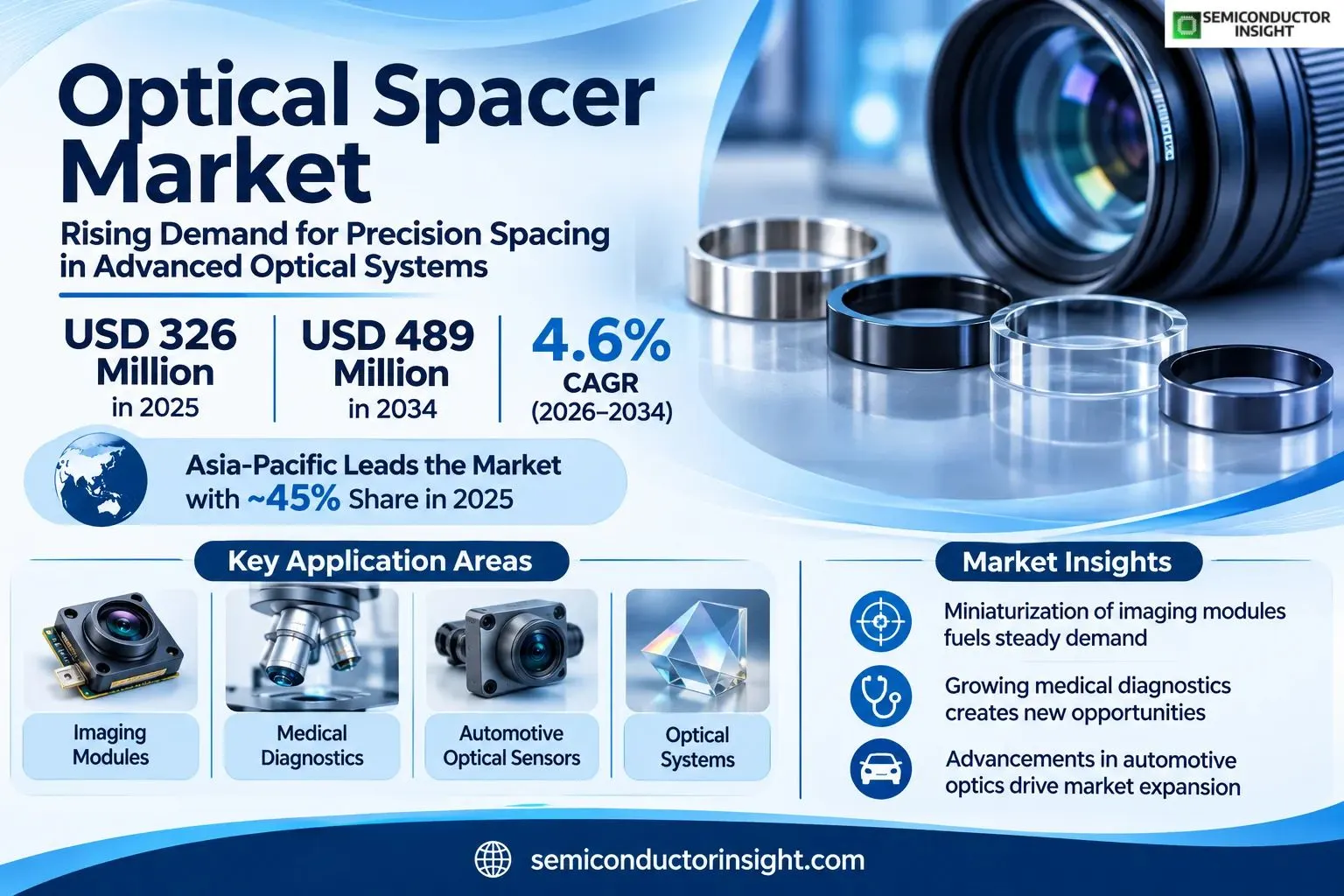
Optical spacer market is estimated at USD 326 million in 2025 and is projected to reach USD 489 million by 2034, representing a derived 4.6% CAGR for 2026–2034. Asia-Pacific has the largest modeled regional position at ~45%. Miniaturization of imaging modules, medical diagnostics and automotive optical sensors creates demand for increasingly precise mechanical spacing and alignment elements.
An optical spacer is a controlled-thickness mechanical or structured-material element used to establish the required separation between optical surfaces or parts of a light-guiding assembly. In a camera objective, a small thickness difference can change focus, tilt and centering; in a packaged sensor, the component may also help create a stable cavity or isolate adjacent materials. Spacer design therefore depends on optical geometry and manufacturing tolerances as much as it does on the underlying plastic, steel or brass substrate.
The revenue boundary includes dedicated optical spacing elements sold into camera, lens, sensing, diagnostic and other optical systems across the publisher’s stated Type and Application groups. Precision metal rings, polymer separation parts and specialized glass or other spacers qualify where they perform a defined optical assembly function. Finished camera modules, optical lenses, protective windows and general-purpose hardware fasteners not specified as optical spacers are excluded. Product materials alone do not determine inclusion; the component must control optically meaningful relative geometry.
Edmund Optics explains that lens positions depend on surface sag and mechanical seating, and that a spacer may be attractive in compact designs even when a retaining ring provides tighter control in some assemblies. This highlights a commercial trade-off between small geometry, manufacturing cost and field stability. Designers may select a precisely machined metal ring for a rugged objective, a molded polymer element for high-volume consumer devices or a structured glass piece for a microscopic optical package.
SCHOTT identifies structured glass wafers as spacer and housing elements in optoelectronic packages including laser diodes and transducers. Its FLEXINITY portfolio offers fine features and dimensional control that become important when customers shrink optical packages. A company supplying high-value structured glass is not necessarily competing directly with manufacturers of low-cost plastic lens rings; the market encompasses several distinct manufacturing routes with different quantities, price levels and qualification practices.
The publisher reports USD 312 million of worldwide value in 2024 and USD 447 million expected in 2032. The implied compound annual expansion is 4.6%, which differs from the stated 5.2% label. The global headline values provide the coherent market series, while country and product estimates are interpreted as contextual indicators unless they can be reconciled with that total. Component demand also depends on optical quality, customization and production yield rather than a simple count of cameras or vehicles manufactured.
Segment Analysis: By Type
The published material classes are Plastic, Stainless Steel, Brass and Other. Their modeled 2025 revenue shares are ~39%, ~30%, ~20% and ~11%, respectively. Polymers lead the material mix by value in this scenario and benefit from designs where molding and mass assembly are economically important. Metal parts remain relevant when mechanical stiffness, threading, thermal expansion behavior or long-life attachment quality takes priority.
| Spacer material | Optical design role and fabrication requirements | Modeled market position |
|---|---|---|
| Plastic | Injection-molded and engineered-polymer spacers can establish axial lens positions in compact consumer devices where weight, repeatable shapes and rapid assembly are important. Optical module designers must assess moisture absorption, creep and thermal expansion before selecting a resin. Molding repeatability can improve part economics when a validated tool produces large volumes, but trimming or distortion may still affect sensitive optical stacks. | Plastic accounts for a modeled ~39% of the 2025 type allocation and is assigned ~6.2% annual growth, reflecting miniaturized electronics and optics manufacturing. The publisher estimates the segment at USD 195 million by 2032. Polymers can support short production cycles, although application-specific tolerances and environmental conditions determine whether they displace machined alternatives. |
| Stainless Steel | Stainless steel spacers provide a relatively stiff mechanical reference for optical housings exposed to vibration, handling and occasional harsh conditions. Precision turning, stamping or laser processing can deliver controlled dimensions, while passivation and surface finish matter where particles or corrosion could damage adjacent optical surfaces. Engineers should verify thermal expansion against the rest of the optical stack to prevent focus drift after assembly. | Stainless Steel represents an estimated ~30% share and ~4.0% modeled growth. It is attractive in precision machinery, automotive imaging and industrial inspection equipment where reliability is valued over minimum mass. Demand is influenced by the complexity of machining, deburring and inspection as well as the amount of metal in each part. |
| Brass | Brass components can be machined efficiently for precision sleeves, spacing rings and some optical instrument fixtures. They provide familiar fabrication behavior and can be selected where conductivity or compatibility with established housings is relevant. Designers must still consider oxidation, mass and changes in geometry across operating temperatures; a traditional material does not remove the need for optical axis alignment and controlled contact pressure. | The Brass group receives a modeled ~20% of 2025 revenue and ~3.2% annual growth, reflecting a stable but less rapidly expanding role. Cost, availability and machinability support continued use in selected instruments and replaceable assemblies. Higher-volume miniaturized devices may favor molded polymers when equivalent positional accuracy can be demonstrated. Each application still needs documented tests of fit and environmental durability. |
| Other | Other materials include glass, specialty ceramics and bespoke engineered substrates that serve optical cavity or package separation needs beyond the three named classes. SCHOTT’s structured glass wafers demonstrate the possible precision of microfabricated through-features. Such products are evaluated with attention to fracture behavior, thermal compatibility, chemical durability and manufacturable panel size, and their use does not imply that all optical glass is counted as spacer revenue. | The residual material class is estimated at ~11% of the 2025 market and modeled at ~2.4% growth. Its share is sensitive to product boundary: specialty glass spacers are included, while protective windows and complete lens assemblies are excluded. Customized projects can carry a high unit price but often require extensive qualification before repeat manufacturing. |
Material engineering and product positioning
The four material groups are not interchangeable in optical design. Plastic can enable cost-efficient miniaturized parts but may require control of molding shrinkage and moisture. Stainless steel gives high stiffness in selected precision mounts, brass offers straightforward machining for established mechanical assemblies, and structured glass supports fine features in specialty optical packages. These differences alter the total manufacturing cost once inspection and reject rates are taken into account.
Material comparisons should be conducted at the level of a finished assembly. A nominally inexpensive spacer that produces tilt or focus loss during thermal cycling may be costly if an optical module must be reworked. Conversely, an unnecessarily precise part can raise machining expenditure without improving imaging performance. Engineering teams therefore specify necessary axial tolerance and surface condition before choosing among the four published material classes.
Annual optical spacer revenue allocations
Illustrative annual spacer-market revenue allocations in USD million are analytical estimates derived from the global endpoint series, 2025 share assumptions and each group’s growth rate. They do not represent disclosed supplier transactions. Subtotals may show small rounding differences. Every series reflects a specified segment-level compound growth assumption over the same forecast period. The model is provided for interpreting the distribution of the global market estimate, not for assigning revenue to an individual company or country.
Region — modeled annual USD million
| Member | 2025 | 2026 | 2027 | 2028 | 2029 | 2030 | 2031 | 2032 | 2033 | 2034 |
|---|---|---|---|---|---|---|---|---|---|---|
| Asia-Pacific | 146.9 | 154.6 | 162.8 | 171.5 | 180.6 | 190.1 | 200.2 | 210.8 | 222.0 | 233.7 |
| North America | 124.0 | 129.1 | 134.4 | 139.9 | 145.6 | 151.6 | 157.8 | 164.3 | 171.0 | 178.0 |
| Europe | 35.9 | 37.2 | 38.6 | 40.0 | 41.5 | 43.0 | 44.6 | 46.3 | 48.0 | 49.8 |
| South America | 9.8 | 10.1 | 10.4 | 10.8 | 11.1 | 11.5 | 11.8 | 12.2 | 12.6 | 13.0 |
| Middle East & Africa | 9.8 | 10.2 | 10.7 | 11.2 | 11.6 | 12.2 | 12.7 | 13.3 | 13.9 | 14.5 |
Type — modeled annual USD million
| Member | 2025 | 2026 | 2027 | 2028 | 2029 | 2030 | 2031 | 2032 | 2033 | 2034 |
|---|---|---|---|---|---|---|---|---|---|---|
| Plastic | 127.3 | 135.2 | 143.5 | 152.4 | 161.9 | 171.9 | 182.6 | 193.9 | 205.9 | 218.7 |
| Stainless Steel | 97.9 | 101.8 | 105.9 | 110.1 | 114.5 | 119.1 | 123.9 | 128.8 | 134.0 | 139.3 |
| Brass | 65.3 | 67.4 | 69.5 | 71.7 | 74.0 | 76.4 | 78.8 | 81.4 | 84.0 | 86.7 |
| Other | 35.9 | 36.7 | 37.6 | 38.5 | 39.4 | 40.4 | 41.3 | 42.3 | 43.3 | 44.3 |
Application — modeled annual USD million
| Member | 2025 | 2026 | 2027 | 2028 | 2029 | 2030 | 2031 | 2032 | 2033 | 2034 |
|---|---|---|---|---|---|---|---|---|---|---|
| Consumer Electronics | 143.6 | 151.2 | 159.2 | 167.7 | 176.5 | 185.9 | 195.7 | 206.1 | 217.0 | 228.6 |
| Medical Industry | 65.3 | 67.9 | 70.6 | 73.4 | 76.4 | 79.4 | 82.6 | 85.9 | 89.3 | 92.9 |
| Automotive | 81.6 | 85.4 | 89.4 | 93.6 | 98.0 | 102.6 | 107.5 | 112.5 | 117.8 | 123.3 |
| Other | 35.9 | 36.7 | 37.6 | 38.5 | 39.4 | 40.3 | 41.3 | 42.2 | 43.2 | 44.2 |
Segment Analysis: By Application
The publisher identifies Consumer Electronics, Medical Industry, Automotive and Other as applications. Modeled 2025 shares are ~44%, ~20%, ~25% and ~11%, respectively. Their purchasing criteria range from compact low-cost camera modules to traceable precision optics in diagnostic systems. A spacer’s required tolerance, material stability and contamination control change substantially depending on the equipment in which it is installed.
| Application | Demand characteristics |
|---|---|
| Consumer Electronics | Consumer Electronics is modeled at ~44% revenue share and ~5.3% annual growth. Smartphone cameras, consumer sensors and compact imaging assemblies need tightly coordinated optical and mechanical dimensions at high production volumes. Plastic and other precisely formed spacers can help manage lens spacing inside constrained housings. Qualification is tied to focus yield, optical axis alignment and the ability to reproduce dimensions across manufacturing lots, rather than simply minimizing individual part cost. |
| Medical Industry | Medical Industry contributes an estimated ~20% share and ~4.0% modeled CAGR. Endoscope optics, diagnostic cameras and laboratory imaging equipment often need compact parts with reliable traceability and material compatibility. Device manufacturers may require specific cleaning, biocompatibility-related or sterilization constraints depending on the location of the optical assembly. Precision spacer selection therefore intersects with validation processes beyond those typical of an ordinary consumer camera module. |
| Automotive | Automotive demand receives ~25% of the allocation and ~4.7% modeled growth. Driver assistance cameras, LiDAR-related optical components and cabin sensors must maintain geometry despite vibration and temperature changes. A stable spacer can protect alignment in a module that is sealed before installation. Engineers evaluate material expansion, dust control and mechanical creep because a tolerance shift after vehicle assembly can be more expensive than the original spacing part. |
| Other | Other applications cover ~11% of modeled sales and ~2.4% annual expansion. Industrial laser instruments, scientific objectives, specialized machine vision and some photonic packages need bespoke lengths or surfaces that do not align with high-volume consumer components. Smaller orders can still be strategically important because they demonstrate material capabilities or establish a qualified supplier for technically demanding assemblies. The revenue boundary remains limited to spacers, not the entire optical instrument. |
Assembly economics depend on production design and maintenance access. A smartphone camera manufacturer may place millions of small spacer units into repeatable automated processes, while a surgical imaging vendor can require detailed lot traceability and stringent cleaning procedures. Automotive systems often emphasize environmental qualification, and research instruments may use bespoke machined parts. These customer requirements explain why the same nominal material can carry very different commercial value across applications, without changing the underlying global market anchors.
Regional Analysis
Asia-Pacific leads the modeled 2025 optical spacer market at ~45%, reflecting dense fabrication of electronic cameras, optical sensors and precision optomechanical components. North America follows at ~38% because medical instrumentation, industrial imaging and specialized photonics require highly specified assemblies. Europe takes ~11%, with South America and Middle East & Africa each at ~3%. These percentages are analytical allocations, not published supplier sales figures.
Which regions most strongly influence optical spacer manufacturing and purchasing?
The geography of component fabrication differs from the geography of final camera or sensor deployment. An optical spacer may be manufactured in a specialized machining workshop, incorporated into an imaging subassembly elsewhere and shipped in a finished device across borders. Consequently the allocation emphasizes optical component supply ecosystems and likely procurement channels, rather than counting every installed camera as an additional spacer sale. Qualification and packaging requirements also differ for medical, automotive and consumer products.
Asia-Pacific is modeled to expand at ~5.3% annually, above the world average, given camera-module assembly density and established high-volume electronic manufacturing. North America is assigned a relatively broad revenue base with ~4.1% growth from engineering-intensive applications. The European ~3.7% trajectory reflects specialized industrial and medical instruments. South America at ~3.2% and Middle East & Africa at ~4.4% remain smaller markets where cross-border component distribution plays an important part.
| Region | Position | Growth outlook | Demand profile | What decides supplier selection |
|---|---|---|---|---|
| Asia-Pacific | Leader (~45%) | ~5.3% CAGR | Camera component fabrication | Yield management and miniaturization |
| North America | Second (~38%) | ~4.1% CAGR | Diagnostic and industrial optics | Assembly qualification and material consistency |
| Europe | Third (~11%) | ~3.7% CAGR | Precision instrumentation | Traceable production processes |
| South America | Fourth (~3%) | ~3.2% CAGR | Imported optical assemblies | Specialty procurement scale |
| Middle East & Africa | Fifth (~3%) | ~4.4% CAGR | Instrumentation and integration | Specialist supply continuity |
Optical Spacer Market Competitive Landscape
The competitive landscape spans precision optomechanical fabrication, optical glass materials and broader optical component supply. The publisher profiles nine organizations, including Newport Industrial Glass, Laurel Industries, SCHOTT, VMG Engineering, Rochester Precision Optics, Buck Scientific, Meller Optics, Seastrom Mfg and Cal-Fasteners. Their roles should not be treated as interchangeable: glass processors, precision optical businesses, machine shops and fastener suppliers can participate in adjacent parts of an optical assembly rather than all manufacturing identical spacers.
SCHOTT describes precision glass substrates and structured optical elements that can perform highly defined package positioning and cavity roles. The firm offers a credible example of a supplier whose differentiated fabrication process may be valuable where traditional turned components are impractical. It does not follow that its entire FLEXINITY or optical glass turnover belongs to optical spacer revenue, and the total market valuation does not aggregate all company product categories.
Meller Optics publishes product information for sapphire optical windows and lens components used under demanding conditions. This evidence establishes technical experience with hard, precision optical materials but does not by itself validate a current optical spacer product line. A competitive review must distinguish relevant engineering capability from verified sales of optical spacers; adjacent suppliers can influence material selection or procurement without necessarily competing as dedicated spacing-element manufacturers.
Rochester Precision Optics and other named optical engineering companies occupy precision assembly and specialist supply positions where mechanical alignment can materially affect system performance. The publisher also lists industrial and fastener-oriented names, so sourcing inquiries should establish actual spacer configurations, production tolerance and destination application before describing them as leading dedicated suppliers. The modeled tiers therefore describe potential market relevance and technical fit rather than an audited company-level revenue ranking.
Customers generally compare delivery reliability, quality documentation, surface finish, material compatibility and unit consistency. A specialist that can support a customized engineering drawing may command a higher per-part price than a general hardware vendor, yet high-volume device assemblers can favor suppliers with automated inspection and stable molding. Competitive advantage depends on total downstream optical yield and the economics of making qualified parts, not brand reputation alone.
Tier structure
| Tier | Companies | Basis of competition |
|---|---|---|
| Technical glass and optical systems | SCHOTT; Rochester Precision Optics; Meller Optics | Precision optical material processing or adjacent instrument-component knowledge; product-specific spacer qualification must be verified. The tier is a qualitative description of capability rather than a measured market-share rank. Customers should review documented positioning-element products, material compatibility, precision and quality controls before designating a supplier as qualified for a regulated, automotive or high-volume optical assembly. |
| Specialist component fabrication | Newport Industrial Glass; VMG Engineering; Laurel Industries | Publisher-profiled companies potentially relevant to custom glass and optomechanical manufacturing. The position acknowledges possible optical fabrication activities but does not assume a company currently markets a particular spacer. Orders for specialized mechanical elements require confirmed dimensions, inspection practice and finishing capability; contracting teams must establish whether each candidate can fabricate the requested geometry and material class economically. |
| Additional profiled industrial suppliers | Buck Scientific; Seastrom Mfg; Cal-Fasteners | Instrument and hardware supply channels listed in publisher scope; not presumed to sell identical optical spacers. These profiles may provide components, procurement relationships or engineering services adjacent to specific instrument designs. Their presence is not evidence of comparable optical spacer revenue. Procurement teams should establish each supplier’s actual product offering, technical capability and evidence of optical tolerance control. |
Key companies profiled
- Newport Industrial Glass
- Laurel Industries
- SCHOTT
- VMG Engineering
- Rochester Precision Optics
- Buck Scientific
- Meller Optics
- Seastrom Mfg
- Cal-Fasteners
Optical Spacer Manufacturing and Capacity Analysis
Production routes include polymer molding, precision metal turning, progressive stamping, structured-glass processing and highly selective inspection. The technically relevant unit is a part that fixes optical separation under prescribed tolerances rather than an arbitrary washer. Process choice depends on production quantity, the optical system’s thermal environment, permitted particulates and whether a component will be bonded, retained or mechanically clamped after final assembly.
Molded polymers can offer cost-effective replication once tooling, resin drying and dimensional shrinkage controls are validated. Injection-molding processes produce large numbers of small parts quickly, but the effective optical tolerance must include wear, tooling temperature and post-molding conditioning. A precision spacer may require camera-module process inspection rather than a conventional dimensional sampling plan because small height or tilt variations can cause a high-value assembled module to fail focus testing.
Metal spacers are often fabricated by precision machining or stamping, followed by deburring, washing and dimensional measurement. Mechanical strength and surface compatibility matter when components contact optical retaining surfaces. Stainless steel and brass are familiar manufacturing materials, yet their thermal expansion, corrosion and potential debris require assessment against the overall housing design. Machined rings are economically attractive when complicated dimensions or moderate volumes make dedicated molding tools uneconomical.
Structured optical glass can create spacer surfaces with high feature density and stable geometry for certain sensor packages. SCHOTT publishes a structured-glass portfolio for optoelectronic applications, highlighting a manufacturing path that does not resemble commodity metal hardware. Technical buyers still need to validate bonding, crack resistance and cleanliness during package sealing. Capacity depends not just on wafer processing throughput but on the proportion of pieces that pass optical and mechanical acceptance criteria.
Optical Spacer Market Dynamics
Miniature imaging modules, diagnostic optical components, precision manufacturing and automotive camera qualification create opportunities for optical spacing elements. The strength of demand is moderated by tolerancing costs, thermal-mechanical drift and the risk of substitution by integrated optical carriers. The impact scores below are analytical allocation assumptions, not measured company financial contributions, and reconcile to the endpoint-based headline growth rate.
MARKET DRIVERS
Drivers Impact Analysis*
| Market Drivers | Impact Rank | CAGR Contribution (%) | 2026–2028 | 2029–2031 | 2032–2034 |
|---|---|---|---|---|---|
| Compact consumer imaging and optomechanical designs | High | +2.40% | High | High | High |
| Automotive camera qualification | Medium-High | +1.90% | High | High | High |
| Precision diagnostics and medical imaging | Medium | +1.50% | Medium | High | High |
| Structured glass and materials engineering | Low-Medium | +1.10% | Medium | High | High |
| Others (instrument upgrades and component services) | Low | +0.90% | Medium | Medium | Low |
Compact cameras need repeatable element separation
As optical modules become thinner, the axial position of each refracting surface can become less forgiving of a spacer’s dimensional variation. A high-volume assembler must control thickness, flatness and contamination to protect final camera yield. This creates business for qualified polymer and metal spacing elements, but also rewards design methods that reduce total part count. Procurement decisions reflect the cost of the resulting aligned module rather than component mass.
Vehicle imaging creates demanding qualification programs
Automotive optical assemblies encounter vibration, temperature cycles and longer service expectations than many consumer devices. A spacing ring may need to retain an intended optical gap across repeated environmental exposures without shedding particles or changing clamping pressure. These requirements support the use of documented material lots, controlled finishes and stable suppliers. The opportunity is component-specific and must not be derived from the total value of automobile electronics.
Diagnostic optics place a premium on reproducible geometry
Optical diagnostics and biomedical instruments depend on precise element registration for reliable illumination, resolution and measurement. Small spacer orders can involve sophisticated material and inspection requirements even if unit volumes are lower than in phones. A designer may prefer a validated specialty part to a cheaper alternative when qualification and downstream instrument downtime are costly. This can sustain supplier margins in selected equipment programs.
Structured material processes broaden possible architectures
Microfabricated glass spacer surfaces can be incorporated into optical packages whose geometry is too small or complex for conventional turned rings. SCHOTT identifies structured glass technology with applications in optoelectronic assemblies, supplying a concrete adjacent manufacturing example. Customers must compare achievable feature tolerances, yield, packaging compatibility and total production expenditure before adopting such a route in a commercially released component.
Instrument maintenance adds a specialized replacement market
Long-lived microscopes, industrial measurement heads and optical laboratories may need replacement spacing parts that duplicate an established design. The order size may be limited, but traceable dimensions and reliable material records provide value beyond simple machining. Technical distributors and experienced workshops can offer custom manufacturing or sourcing services. The resulting spending is a component and service opportunity, not a measure of all imaging equipment in operation.
MARKET RESTRAINTS
Restraints Impact Analysis*
| Market Restraints | Impact Rank | CAGR Contribution (%) | 2026–2028 | 2029–2031 | 2032–2034 |
|---|---|---|---|---|---|
| High dimensional qualification and rework cost | High | -1.30% | High | High | Medium |
| Thermal drift and material incompatibility | Medium-High | -0.90% | High | Medium | Medium |
| Price pressure from large-volume assemblers | Medium | -0.60% | High | High | Medium |
| Others (design integration and supplier switching) | Low | -0.40% | Medium | Low | Low |
Tolerances can overwhelm savings on an inexpensive part
A spacer that costs little to fabricate can generate substantial expense if poor flatness or thickness increases the optical system failure rate. Manufacturers must invest in inspection, cleanliness and process capability, while customers may demand detailed qualification records before approving a source. These fixed costs reduce the appeal of new component programs unless the anticipated lifetime volume supports stable tooling and testing.
Material mismatch causes optical alignment instability
An optical module contains several materials with different thermal expansion, moisture uptake and mechanical stiffness. If the spacing part changes more than adjacent elements, focus or alignment can drift even though every part meets its room-temperature drawing. Engineers must test the complete assembly through temperature and mechanical cycles. Correcting late-stage drift can entail substantial redesign and supplier requalification rather than simply replacing one ring.
Volume purchasers often seek lower unit costs
Consumer electronics assemblers operate under strong cost targets and may favor integrated carriers that eliminate separate spacer purchases. Metal component specialists can struggle to match molding economics at high volumes, while polymer suppliers face pressure to demonstrate adequate stability. Demand forecasts therefore depend on the design architecture adopted in new devices as well as the number of cameras produced. Integration can reduce spacer revenue per finished module.
MARKET OPPORTUNITIES
High-reliability niches create room for specialty suppliers
An optical system used in aerospace testing, precision diagnostics or industrial measurement may have stricter mechanical demands than a typical consumer camera. A supplier that documents material traceability, cleanliness and geometry can participate in development programs that put performance ahead of the cheapest part price. These niches may remain small in volume but can support technically valuable long-term relationships with instrument designers.
Manufacturing analytics can lower delivered optical costs
Automated dimensional inspection and statistical process control help suppliers detect drifting tool or machine performance before a large batch fails assembly. The commercial gain is realized through improved customer yield, reduced rework and faster supplier acceptance. Small optical spacing components offer a useful application because dimensional errors that appear minor in isolation can have a disproportionate effect on complete optical systems.
Advanced optical packages invite alternative separation features
Wafer-level optics and miniaturized sensor housings sometimes require integrated cavities or structures that behave as both support and spacer. Structured glass and carefully engineered polymers may enable new configurations, but feasibility depends on downstream bonding, assembly equipment and material compatibility. The opportunity does not assume one material will replace all conventional rings; different optical architectures will continue to impose different constraints.
Optical Spacer Market Value Chain
The value chain begins with engineering-grade materials and dimensional specifications, proceeds through precision fabrication and metrology, and ends with optical assembly qualification and repair. Unlike a standard fastener, a spacer’s economic role is defined by maintaining the required position between optical elements. Suppliers, integrators and equipment makers therefore share responsibility for performance as the part passes through multiple manufacturing and testing stages.
Engineering specifications. An optical designer must define the intended air gap or element spacing and allocate tolerances among surfaces, housings and retaining components. The spacer material follows from this system-level calculation rather than from a generic hardware catalog. Suppliers receiving clear drawings can select appropriate inspection techniques and identify when geometric constraints are incompatible with economical manufacturing.
Controlled part production. Fabricators select processes according to material form and order volume, combining molding or cutting operations with necessary finishing and cleaning. Parts may be screened using contact or optical measurements to control dimensions. High production rate has limited value if uncontrolled burrs, shrinkage or foreign particles create optical alignment failures at the customer assembly stage.
Integrator qualification. The company building an optical subsystem assesses whether the selected spacer reproduces the intended optical geometry through handling, bonding and environmental testing. A component can satisfy its individual dimensions and still be incompatible with the housing because of differing thermal expansion or retention pressure. Supplier approval is therefore linked to whole-module yield and repeated acceptance tests.
Lifecycle and replacement. After equipment shipment, service providers may need exact replacement spacing parts for an optical instrument. Reliable archives of drawings, material grades and inspection results support repair without disturbing the rest of the optical system. This stage is particularly important for medical and scientific instruments where equipment operating life can greatly exceed a supplier’s initial production order.
Recent Developments Influencing the Optical Spacer Market
- 3 September 2026 SCHOTT lightweight glass wafer announcement
SCHOTT announced REALVIEW 2 lightweight glass wafers targeting optical applications. This adjacent optical-material development underlines the attention paid to precise thin glass handling and surface quality. It does not establish a new optical spacer product or report spacer market sales, but is relevant to optical packaging material engineering. Source - 11 September 2026 Meller sapphire products for high-temperature equipment
Meller Optics described sapphire lenses and windows for high-temperature conditions. The update is evidence of specialty optical-material processing among companies adjacent to the publisher roster, not evidence that the announced windows are optical spacers. Spacer designers can nevertheless consider similar environmental demands when specifying complete instrument assemblies. Source - 15 August 2026 Meller highlights sapphire protection options
Meller published information on sapphire windows used to protect sensitive electro-optical systems. A protective window and a mechanical separation ring are different products; including this event as technical context does not fold window sales into the optical spacer boundary. Hard material processing remains a relevant potential capability. Source - May 2026 ISO optical surface form standard update
ISO published a standard addressing optical element surface form representation and specification. This is relevant to the broader engineering discipline of accurate optical component geometry and inspection. Optical spacer purchasing still requires separate geometry and material tolerances that reflect its function in a complete assembly. Source - 11 March 2026 SCHOTT ultra-large optical MEMS lid technology
SCHOTT introduced ultra-large optical MEMS lids designed for optical circuit switching and sensing applications. The announcement illustrates demanding feature control and optical packaging requirements near spacer applications, though MEMS lids are not identical to the optical spacing components included in the report revenue model. Source
REPORT SCOPE & SEGMENTATION
| Attribute | Details |
|---|---|
| Study Period | 2020–2034 |
| Base Year | 2025 |
| Estimated Year | 2026 |
| Forecast Period | 2026–2034 |
| Historical Period | 2020–2024 |
| Market Size 2025 | USD 326 million |
| Market Size 2026 | USD 341 million |
| Forecast Size 2034 | USD 489 million |
| Growth Rate | 4.6% |
| Largest Market | Asia-Pacific (~45%, 2025) |
| By Type | Plastic · Stainless Steel · Brass · Other |
| By Application | Consumer Electronics · Medical Industry · Automotive · Other |
| By Region | 2025 market proportions and segment growth rates other than the publisher-provided anchors are analyst-modeled assumptions Asia-PacificChina, Japan, South Korea and other Asia-Pacific markets North AmericaUnited States, Canada and Mexico EuropeGermany, France, United Kingdom and other European countries South AmericaBrazil, Chile and Argentina Middle East & AfricaUnited Arab Emirates, Saudi Arabia and South Africa |
| Key Companies Profiled | Newport Industrial Glass, Laurel Industries, SCHOTT, VMG Engineering, Rochester Precision Optics, Buck Scientific, Meller Optics, Seastrom Mfg, Cal-Fasteners |
| Customization Scope | Optional additional analysis includes spacer thickness ranges, lens stack position, metal finishing process, optical package architecture, material grades and supplier qualification practices. |
Frequently Asked Questions
How large is the global optical spacer market?
The estimated 2025 market value is USD 326 million, based on rebasing the publisher’s 2024 and 2032 global monetary endpoints. The forecast for 2034 is USD 489 million and the computed annual growth rate is 4.6%. The scope covers dedicated optomechanical separation parts rather than all optical lenses, covers, electronic sensors or finished imaging modules. Actual contract prices vary according to material, thickness and precision requirements.
Which spacer material has the highest modeled revenue share?
Plastic is assigned an estimated ~39% of 2025 optical spacer sales because molded components can support compact consumer optical assemblies at scale. Stainless steel and brass remain important for geometry or durability requirements that favor machined metal. This is a modeled allocation rather than an audited supplier-level share figure. The material choice depends on thermal expansion, moisture behavior, cleanliness and the positional stability required by the complete device.
Where are optical spacers commonly used?
The published Application segmentation identifies Consumer Electronics, Medical Industry, Automotive and Other. Consumer devices are estimated to represent the largest spending group, but medical and vehicle optics can justify specialized high-reliability materials and tighter inspection regimes. Optical spacers are also relevant to laboratory instrument construction and optical assembly maintenance. Revenue assigned to these groups excludes unrelated electronics and completed optical equipment values.
Which geography represents the largest optical spacer market?
Asia-Pacific is modeled at ~45% of the 2025 optical spacer component market, reflecting concentration in camera and sensor assembly supply chains. North America receives ~38% because of medical instruments, specialist industrial systems and scientific equipment, while other regions have smaller allocations. These are analytical revenue assumptions, not nationally reported statistics. The location of the final camera buyer does not necessarily identify where its spacing component was fabricated.
Why do small optical spacer tolerances matter?
An optical component stack relies on accurate positioning among lens surfaces, apertures, windows or cavities. A minor change in a spacer’s thickness, flatness or tilt can alter focus or alignment even when the piece appears visually correct. Engineers therefore assess material properties, manufacturing consistency and complete assembly performance. For sensitive optical systems, production yield and traceable measurement can matter far more than the quantity of material used.
Can glass be used to manufacture optical spacers?
Yes. Structured glass can provide controlled supports, cavities and package separation features for certain optoelectronic assemblies. SCHOTT documents applications of precision structured glass in specialized device packages. However, glass windows used only for light transmission or environmental protection are outside the spacer revenue boundary unless they also serve the defined positioning role. Customers must consider crack resistance, bonding compatibility, feature dimensions and manufacturing yield.
Which companies are identified in the industry scope?
The publisher lists Newport Industrial Glass, Laurel Industries, SCHOTT, VMG Engineering, Rochester Precision Optics, Buck Scientific, Meller Optics, Seastrom Mfg and Cal-Fasteners. These businesses have different optical and industrial capabilities. Presence on a profiled-company list should not be mistaken for proof that each sells the same specialized spacer product. Purchasers need to verify drawings, tolerance capability and relevant offerings directly before qualifying a supplier.
What holds back broader market expansion?
Precise inspection requirements, material instability and downstream design integration can limit stand-alone spacer demand. A manufacturer may produce inexpensive rings but face costly rejection if small geometry changes lower final camera yield. Polymer parts can distort under thermal or moisture exposure, while metal parts can create cleanliness and mass challenges. Suppliers must demonstrate stable processes and compatibility with the full optical housing, not merely supply low-priced generic washers.
What manufacturing processes are used for optical spacers?
Plastic spacers are often molded, and metal variants can be turned, cut or stamped before deburring and cleaning. Specialized glass structures require precision fabrication and appropriate package bonding. Process choice depends on production volume, dimensional repeatability and the target instrument environment. A complete qualification plan examines both the part’s measurement results and the optical performance of the assembled module under realistic operating conditions.
What period and product categories does this forecast cover?
The report uses 2025 as the base year, 2026 as an estimated year and 2034 as the end of the projection window. It follows the published Type categories Plastic, Stainless Steel, Brass and Other, together with the Application groups Consumer Electronics, Medical Industry, Automotive and Other. Regional allocations are modeled across five world regions. The values represent component revenue rather than installed device counts or the full optoelectronics market.
Research Sources & Evidence Base

Get Sample Report PDF for Exclusive Insights
Report Sample Includes
- Table of Contents
- List of Tables & Figures
- Charts, Research Methodology, and more...
 Download Sample Report PDF