Optical Image Stabilization (OIS) Actuators Market Insights
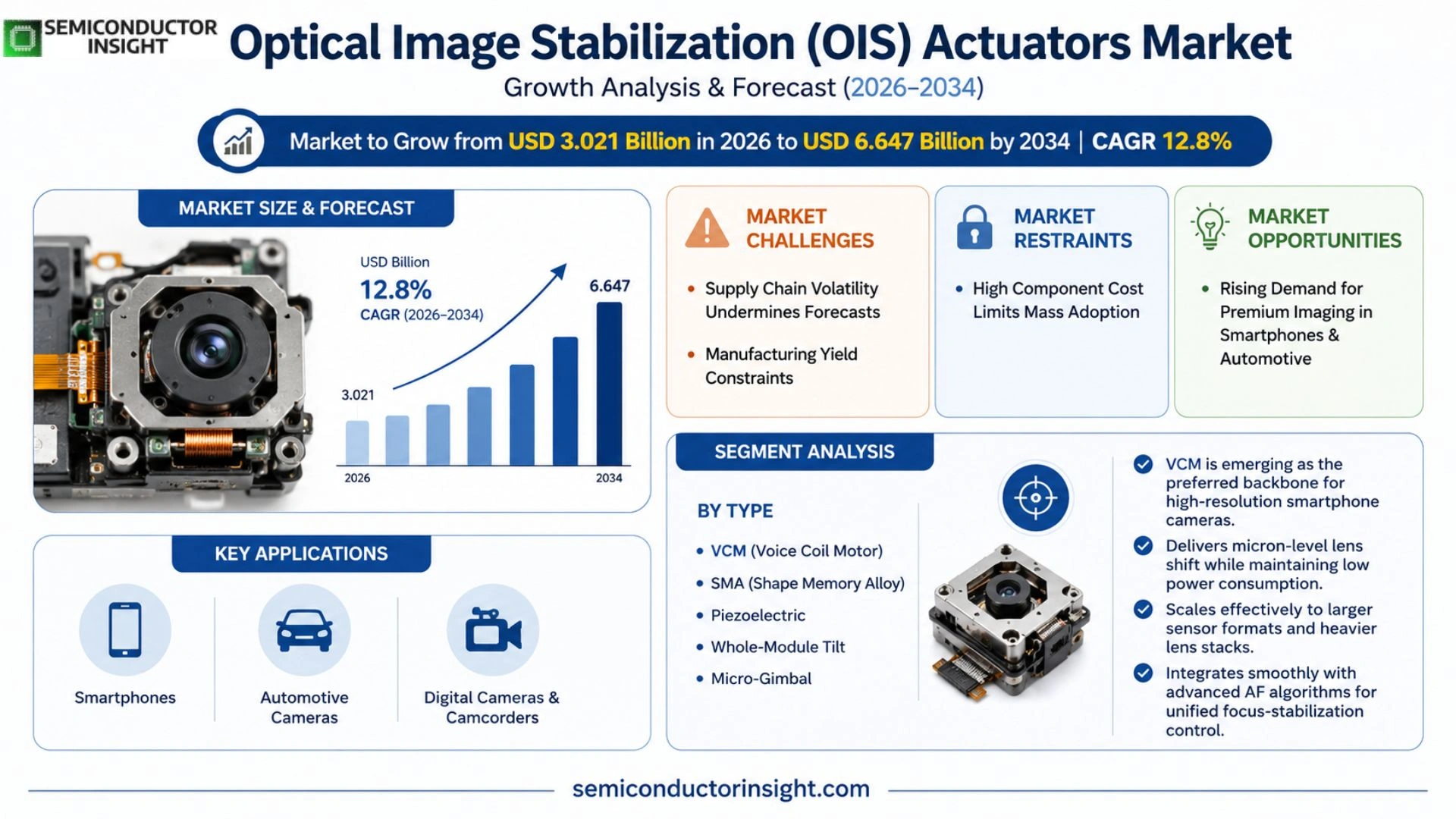
Global Optical Image Stabilization (OIS) Actuators market size was valued at USD 2.889 billion in 2025. The market is set to expand from USD 3.021 billion in 2026 to USD 6.647 billion by 2034, reflecting a 12.8% compound annual growth rate over the period.
Optical image stabilization actuators are core precision‑drive components in smart imaging systems. They counteract hand‑shake disturbances by moving the lens, image sensor or entire camera module at micron‑level precision in real time, thereby improving clarity, stability and usable shutter range across low‑light, telephoto, video, high‑resolution and large‑sensor scenarios. Official product pages reveal multiple technical routes,including VCM, SMA, piezoelectric devices, whole‑module tilt and micro‑gimbal structures,while integration trends shift toward combined AF + OIS designs and module‑actuator lens integration.
The market accelerates because flagship smartphones now target 200 MP imaging, one‑inch main sensors, continuous optical zoom and foldable form factors; each requirement pushes suppliers toward higher torque outputs, larger travel ranges and tighter control loops. At the same time supply remains highly concentrated in East Asia where firms such as AAC Technologies, Nidec and Sunny dominate the value chain; however expanding applications in AR/VR headsets, automotive cameras and medical imaging create new revenue streams beyond traditional handset volumes.
MARKET DRIVERS
Smartphone Camera Innovation Fuels Demand
The relentless race for higher‑resolution sensors and larger apertures has made optical image stabilization indispensable. Manufacturers that incorporate OIS actuators can deliver sharper low‑light photos, a capability that directly translates into premium pricing power for flagship handsets. The competitive pressure to differentiate on image quality therefore acts as a strong catalyst for actuator adoption.
Automotive ADAS Integration Boosts Volume
Advanced driver‑assistance systems (ADAS) increasingly rely on camera‑based perception modules, where motion blur can compromise safety‑critical decisions. Embedding OIS actuators stabilizes the visual feed, enhancing object detection reliability. As OEMs accelerate ADAS roll‑outs across mid‑range models, the cumulative demand for automotive‑grade OIS actuators is set to outpace traditional consumer segments.
➤ Suppliers that secure early design wins in automotive platforms will capture a disproportionate share of the upcoming growth wave.
On the supply side, advances in MEMS fabrication have lowered actuator footprints and improved power efficiency. This enables integration not only in smartphones and cars but also in emerging wearables, expanding the addressable market and reinforcing the upward trajectory of Optical Image Stabilization (OIS) Actuators Market.
MARKET CHALLENGES
Supply Chain Volatility Undermines Forecasts
Global shortages of high‑purity silicon and specialized alloys have lengthened lead times for MEMS components. Fabricators facing material bottlenecks often resort to batching production, which spikes inventory costs and erodes margin expectations for OEMs reliant on just‑in‑time deliveries.
Other Challenges
Manufacturing Yield Constraints
The precision alignment required for sub‑micron actuator movement results in relatively low yields during early production ramps. Yield improvements demand substantial capital investment in clean‑room infrastructure, a hurdle for newer entrants seeking market share.
MARKET RESTRAINTS
High Component Cost Limits Mass Adoption
Even as MEMS processes mature, the bill of materials for a fully integrated OIS solution remains higher than for static lens modules. Cost‑sensitive mid‑tier smartphones often opt for electronic image stabilization (EIS) as a cheaper alternative, curbing the total addressable market for pure‑hardware stabilizers.
The economic calculus tightens further when devices target emerging markets where price elasticity is pronounced. Without a clear pathway to reduce actuator pricing, broader penetration beyond premium segments may stall.
Regulatory scrutiny, particularly in automotive applications, imposes additional compliance testing that lengthens time‑to‑market. The combined effect of price pressure and certification overhead creates a tangible restraint on rapid market expansion.
MARKET OPPORTUNITIES
Emergence of Foldable and Dual‑Camera Modules
Foldable smartphones and dual‑camera arrays demand actuators that can operate under unconventional mechanical stresses while maintaining sub‑pixel accuracy. Designers who engineer OIS solutions compatible with flexible substrates stand to capture a niche yet fast‑growing segment that traditional rigid‑camera manufacturers overlook.
Beyond consumer electronics, the rise of mixed‑reality headsets and drone‑based cinematography opens a new frontier for high‑precision stabilization. These applications value the low‑latency response and compact form factor of MEMS OIS actuators, presenting a lucrative avenue for suppliers willing to tailor performance specifications to immersive‑media requirements.
Optical Image Stabilization (OIS) Actuators Market Trends
Performance Pressures from Next‑Gen Imaging
Smartphone makers and premium camera suppliers are now engineering sensors that exceed 150 MP, incorporate one‑inch class optics, and support continuous optical zoom. Those specifications force OIS components to move heavier lens stacks with micron‑level accuracy while preserving low‑noise operation in dim environments. Vendors that can guarantee repeatable drive torque for larger masses earn a decisive edge, because the perceived image quality of a flagship device hinges on how smoothly the actuator can counteract hand shake during long‑exposure or telephoto shots. The shift from “does it have OIS?” to “how much sensor area can it reliably stabilize?” reshapes procurement strategies, prompting OEMs to source from suppliers with proven high‑load test data and integrated tuning software.
Other Trends
Diverging Technical Architectures
Manufacturers are no longer betting on a single actuator concept. Voice‑coil‑motor (VCM) designs coexist with swing‑arm mechanisms, piezoelectric stacks, whole‑module tilt solutions, and micro‑gimbal assemblies. Companies such as CML and Nidec promote hybrid platforms that blend lens‑shift and sensor‑shift capabilities, while firms like Vista prioritize miniature gimbal geometry to widen compensation angles. The competitive advantage now lies in system‑level integration: algorithms that synchronize autofocus, OIS, and zoom motors, closed‑loop position sensing, and modular calibration kits. Those players that bundle hardware with firmware‑level coordination packages can lock in design win‑rates, because device engineers prefer a single supplier that delivers a turnkey solution rather than stitching together disparate components.
Geographic Concentration and Expanding Application Horizons
Production capacity remains clustered in East Asia, with Korean, Japanese, Chinese, and Taiwanese firms accounting for the bulk of unit output. Meanwhile, demand is diffusing beyond handheld phones. AR/VR headsets, automotive driver‑assist cameras, security surveillance rigs, and medical endoscopes all require the same micrometer‑precise motion control. Suppliers that expose their platforms to these verticals gain a buffer against fluctuations in smartphone shipment volumes. The emerging practice of embedding OIS actuation directly into module‑level designs,often combined with autofocus,creates higher per‑device bill‑of‑materials, turning what used to be a cost‑center into a revenue‑generating feature set. As Optical Image Stabilization (OIS) Actuators Market continues to mature, firms that can marshal cross‑regional supply chains while delivering adaptable, algorithm‑ready modules will capture the most sustainable growth.
COMPETITIVE LANDSCAPE
Key Industry Players
Optical Image Stabilization Actuators: Competitive Dynamics in 2024
The market is anchored by a handful of vertically integrated manufacturers that combine actuator design, sensor‑lens co‑engineering and algorithmic tuning. Nidec’s TiltAC family dominates whole‑module tilt solutions for flagship smartphones, leveraging a mature supply chain in Japan and Taiwan to guarantee millimetre‑level repeatability. LG Innotek has leveraged its semiconductor packaging expertise to deliver integrated AF‑plus‑OIS modules that accommodate one‑inch sensors and 200 MP lenses, a capability that ordinary stabilizers cannot match. Sunny Optical, meanwhile, distinguishes itself through mass‑production capacity for periscope‑type telephoto assemblies, positioning its actuator portfolio as a gateway for OEMs that wish to embed high‑zoom optics without redesigning the camera stack. The strategic thrust of these leaders is shifting from pure vibration mitigation to platform‑level performance, where the number of actuators per device and the ability to manage heavier lens stacks become decisive factors for premium handset makers.
Beyond the top tier, a cluster of specialist firms is carving out relevance through niche technical routes or regional partnerships. CML (China) employs SMA mechanisms to support lens‑shift, sensor‑shift and combined AF‑OIS modules, targeting cost‑sensitive mid‑range devices that still demand respectable low‑light performance. Hozel (Korea) differentiates with three‑axis piezo‑driven motors that enable micro‑gimbal stabilization for AR/VR headsets and robotic vision. Vista (Japan) focuses on micro‑gimbal stabilization (MGS) that mimics miniature gimbals, allowing continuous optical zoom without sacrificing speed. AAC Technologies stresses vertical integration from MEMS sensor to drive electronics, while Haesung and MinebeaMitsumi invest heavily in closed‑loop Hall sensor feedback to tighten positioning error margins. These players illustrate a competitive shift toward system‑level delivery, whereby algorithmic coordination and manufacturing consistency often outweigh a single actuator patent.
List of Key Optical Image Stabilization Actuators Companies Profiled
- Nidec Corporation
- LG Innotek
- Sunny Optical Technology (Group) Co., Ltd.
- CML Group
- Hozel Co., Ltd.
- Vista Inc.
- AAC Technologies Holdings Inc.
- Haesung Precision Co., Ltd.
- MinebeaMitsumi Inc.
- JY SOLUTEC
- EM‑Tech Co., Ltd.
- Bluecom Co., Ltd.
- iMOSS Co., Ltd.
- TDK Corporation
- Hosiden Corporation
Segment Analysis:
| Segment Category | Sub-Segments | Key Insights |
| By Type |
|
VCM is emerging as the preferred backbone for high‑resolution smartphone cameras.
|
| By Application |
|
Smartphone Main Camera continues to dominate usage scenarios.
|
| By End User |
|
Smartphone OEMs set the strategic direction for actuator evolution.
|
| By Integration Mode |
|
Integrated AF + OIS Modules are gaining traction as the preferred delivery format.
|
| By Technical Route |
|
Micro‑Gimbal Structures represent the forward‑looking architecture for complex multi‑axis stabilization.
|
Regional Analysis: Optical Image Stabilization (OIS) Actuators Market
North America
Silicon Valley and the Boston corridor host a concentration of MEMS startups that pilot advanced magnetic‑suspension concepts, shortening the time from prototype to market‑ready OIS actuator. Partnerships with tier‑one OEMs accelerate technology validation.
Redundant silicon wafer suppliers and localized assembly lines mitigate disruptions, allowing manufacturers to honor tight smartphone launch schedules even when global logistics face strain.
Accelerated certification pathways for electronic components, combined with clear electromagnetic‑compatibility guidelines, enable quicker time‑to‑market for new actuator architectures.
Late‑stage funding rounds for actuator firms have risen, reflecting confidence that higher‑resolution imaging will remain a differentiation lever for premium devices across sectors.
Europe
European camera‑module assemblers benefit from a heritage of precision engineering, where incremental improvements in OIS actuator damping translate directly into competitive advantage for mobile and automotive players. Regulatory harmonization across the EU streamlines cross‑border component certification, while sustainability mandates push suppliers toward recyclable materials and energy‑efficient manufacturing processes. German and French R&D centers are experimenting with hybrid actuation that blends piezoelectric and electromagnetic forces, a direction that could reshape performance expectations for low‑light shooting.
Asia‑Pacific
Asia‑Pacific hosts the majority of smartphone assembly capacity, compelling local OIS actuator producers to prioritize cost efficiency without sacrificing the stabilization depth required for high‑resolution sensors. Aggressive price competition forces manufacturers to adopt tiered product lines, reserving premium multi‑axis designs for flagship models while offering simplified single‑axis units for mid‑range devices. At the same time, emerging markets such as India and Indonesia are witnessing a surge in demand for compact imaging solutions in wearables, opening a niche for ultra‑small actuators that balance performance with ultra‑low power consumption.
South America
In South America, the adoption curve for advanced imaging hardware is shaped by a blend of mobile penetration and rising interest in drone‑based surveying. Local OEMs, often subsidiaries of global brands, import OIS modules but are beginning to assemble final devices domestically to avoid tariffs. This shift encourages regional suppliers to develop actuation platforms that meet both the durability required for outdoor use and the sensitivity demanded by professional‑grade imaging.
Middle East & Africa
The Middle East & Africa region sees OIS actuator relevance driven by surveillance, security, and oil‑field inspection applications. Companies in the UAE and South Africa are integrating ruggedized actuators into thermal‑imaging cameras, where stabilization reduces motion blur during long‑duration monitoring. Although volume remains modest compared with consumer markets, the higher unit value of industrial‑grade devices makes this a profitable segment for niche manufacturers.
Report Scope
This market research report provides a comprehensive analysis of the Optical Image Stabilization (OIS) Actuators Market , covering the forecast period 2026–2034. It offers detailed insights into market dynamics, technological advancements, competitive landscape, and key trends shaping the industry.
Key focus areas of the report include:
- Market Overview: The report begins with an overview outlining its current market scenario, key growth indicators, and industry transformation drivers. It discusses macroeconomic factors, demand–supply balance, regulatory landscape, and the strategic role of semiconductors in powering advancements across industries such as automotive, telecommunications, consumer electronics, and industrial automation.
- Market Size & Forecast: Historical data and future projections for revenue, unit shipments, and market value across major regions and segments.
- Segmentation Analysis: Detailed breakdown by product type, technology, application, and end-user industry to identify high-growth segments and investment opportunities.
- Regional Insights: Insights into market performance across North America, Europe, Asia-Pacific, Latin America, and the Middle East & Africa, including country-level analysis where relevant.
- Competitive Landscape: Profiles of leading market participants, including their product offerings, R&D focus, manufacturing capacity, pricing strategies, and recent developments such as mergers, acquisitions, and partnerships.
- Technology Trends & Innovation: Assessment of emerging technologies, integration of AI/IoT, semiconductor design trends, fabrication techniques, and evolving industry standards.
- Market Drivers & Restraints: Evaluation of factors driving market growth along with challenges, supply chain constraints, regulatory issues, and market-entry barriers.
- Stakeholder Insights: Insights for component suppliers, OEMs, system integrators, investors, and policymakers regarding the evolving ecosystem and strategic opportunities.
Primary and secondary research methods are employed, including interviews with industry experts, data from verified sources, and real-time market intelligence to ensure the accuracy and reliability of the insights presented.
FREQUENTLY ASKED QUESTIONS:
What is the current market size of Optical Image Stabilization (OIS) Actuators Market?
-> Optical Image Stabilization (OIS) Actuators market is set to expand from USD 3.021 billion in 2026 to USD 6.647 billion by 2034, reflecting a 12.8%
Which key companies operate in Optical Image Stabilization (OIS) Actuators Market?
-> Key players include AAC Technologies Holdings Inc., Goertek Inc., Shenzhen Goodix Technology Co., Ltd., Shanghai Awinic Technology Co., Ltd., TDK Corporation, Nidec Corporation, LG Innotek, Sunny Optical, NAMUGA, and CML (using SMA technology).
What are the key growth drivers?
-> Key growth drivers include rising demand for ultra‑high‑resolution smartphone cameras (200 MP and one‑inch sensors), periscope telephoto modules, foldable devices, AR/VR applications, and continuous optical‑zoom capabilities that require advanced OIS actuation.
Which region dominates the market?
-> Asia dominates the market, driven by concentrated manufacturing bases and major OEMs in South Korea, Japan, China, and Taiwan.
What are the emerging trends?
-> Emerging trends include integration of autofocus (AF) and OIS in single actuators, diversification of technical routes such as VCM, SMA, piezo, whole‑module tilt and micro‑gimbal stabilization, and expansion of OIS applications into AR/VR, automotive, security and medical imaging.

Get Sample Report PDF for Exclusive Insights
Report Sample Includes
- Table of Contents
- List of Tables & Figures
- Charts, Research Methodology, and more...
 Download Sample Report PDF